

14 min 30 sec
Available in: English
Selling with Noble Purpose: How to Drive Revenue and Do Work That Makes You Proud
Shows salespeople and sales leaders how anchoring every pitch in the good a product does for customers sharpens thinking, builds trust and grows revenue, and how stories, shared data and small habits keep that purpose alive.
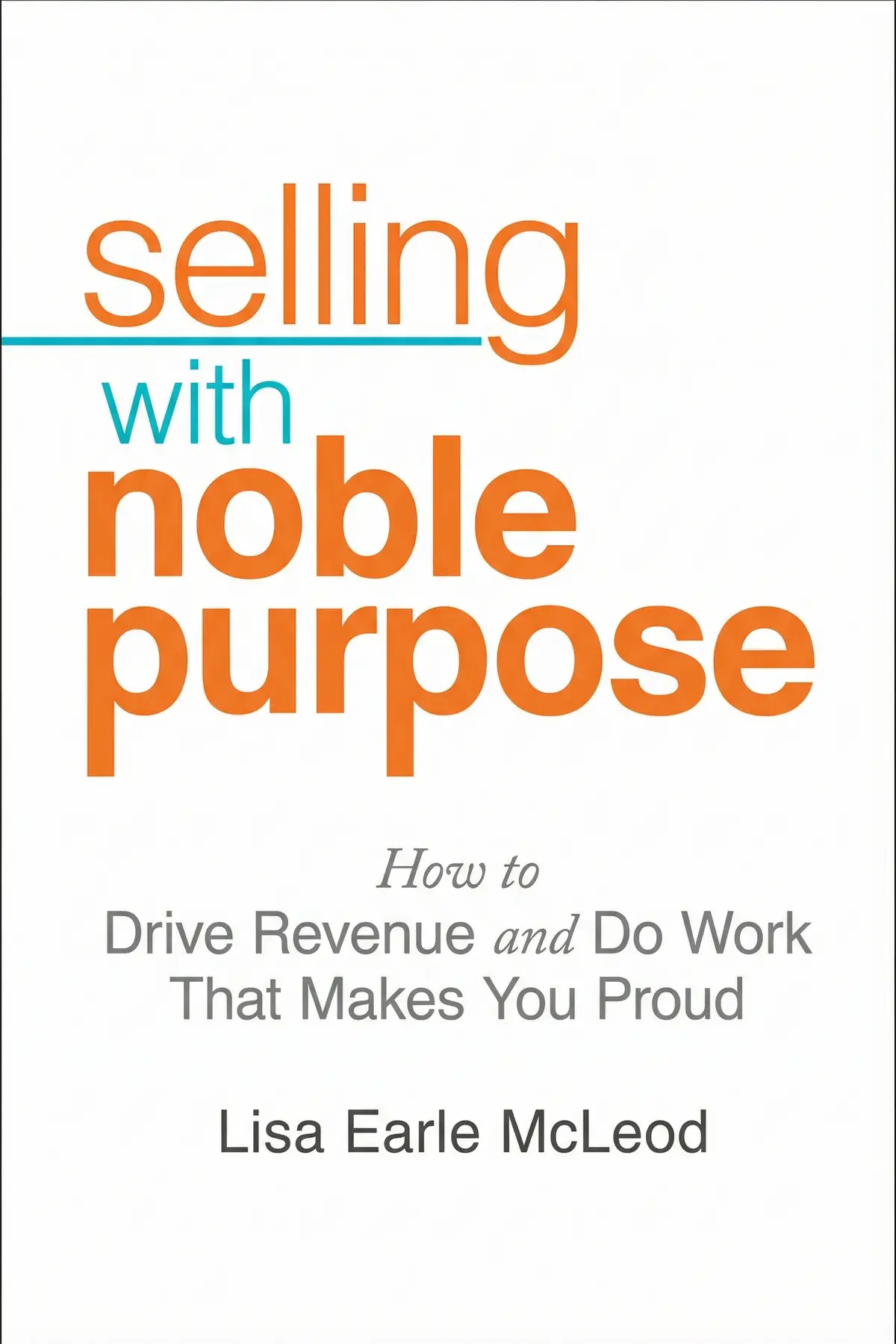
Table of Content
1. Introduction
1 min 02 sec
If you sell for a living, you have probably felt the push to close a deal the customer did not need, and the hollow feeling that came after. In Selling with Noble Purpose, former Procter & Gamble sales leader Lisa Earle McLeod argues that the pressure is the problem. She points to research suggesting that salespeople who care about helping customers sell more than those who are chasing quotas.
Her claim is that purpose pays. When sellers know how their product makes a customer’s life or business better, they think more clearly, earn more trust and bring in more revenue. Fear and quotas do the opposite. The evidence runs from a decision at Southwest Airlines worth a billion dollars to a rep asleep in his car in falling snow, waiting for a 3 a.m. phone call. Along the way you get a better answer to the question of what you do, a way to build stories that sell, and small daily habits that keep a whole team facing the customer.
2. Describe your work in a way that energizes you
1 min 38 sec
A dull answer at a party can reveal more about your job than any performance review. One simple question changes how people talk, how they feel and even which part of the brain does the work.
3. Putting customers first protects your profits
1 min 46 sec
Consultants told one airline it could likely earn $350 million a year, and its marketing expert said no. A struggling consumer giant faced a similar choice. Both decisions show what happens when purpose meets a spreadsheet.
4. Let real belief do the convincing for you
1 min 44 sec
Buyers often turn down a pitch that sounded perfect, and they rarely know why. A study of how people decide whom to trust suggests the deciding signals have little to do with the script.
5. Lead without fear and keep your reps honest
1 min 39 sec
A saleswoman’s presentation went well, and her boss yelled at her anyway. What she did before the next client visit shows exactly what a frightening boss teaches the people who report to him.
6. Turn your best customer moments into stories that sell
1 min 48 sec
A train equipment maker with low morale found its turnaround in a snowy parking lot and a frozen rail yard. Neither moment came from a marketing department, yet both changed how staff and buyers saw the company.
7. Give reps the coaching no manager has time for
2 min 03 sec
Most companies pour money into managers to train their sales teams. The numbers on how often a manager actually hears a new rep’s calls suggest the real teacher is sitting somewhere else.
8. Fill slow moments with one-minute acts of service
1 min 36 sec
On a campus tour, a stranger offered McLeod and her daughter a hand. His job title surprised her, and the rule behind his offer shows how a busy organization keeps its purpose in sight.
9. Conclusion
1 min 14 sec
McLeod reverses a cynical picture of selling. The pushy, quota-driven floor treats the customer as a target and the rep as someone to be driven by fear. Her evidence suggests that model fails even on its own terms. It makes reps think less clearly, signal doubt, stage performances for their managers and miss what clients need. Purpose works the other way at every scale, from a single brain lighting up to a billion dollars of new revenue at Southwest.
The practical starting point is small. Keep your answer ready to the question of when your work last helped someone, and let it shape how you talk about your job. Prepare for every call by learning what the customer is trying to achieve, then put that into the shared system so the next colleague starts ahead. If you lead a team, coach before and after calls, and trade the shouting for questions about the customer. When a new fee or a hard push looks tempting, ask whether it leaves the customer better off.
The rep asleep in his car in the snow was not chasing a quota. He was waiting to help a customer, and his company made that night the story every new hire hears.
About this book
What is this book about?
Many sales floors run on pressure. Reps are told to maximize their own numbers and push hard, whether or not the customer needs what they sell. Lisa Earle McLeod, a former sales leader at Procter & Gamble, argues that this culture, however common, is not the best route to strong sales and revenue. Salespeople who believe their product genuinely helps people sell more than those chasing targets. McLeod calls this selling with a noble purpose. She shows how purpose engages the thinking part of the brain, how Procter & Gamble and Southwest Airlines turned it into profit, and why buyers read a seller's doubt through body language and tone. She also shows how a frightening manager can turn honest reps into actors. The second half is a toolkit for keeping purpose alive day to day. It covers company stories that lift morale and win clients, and customer databases that record goals as well as orders. It also covers a shared library of won deals and one-minute acts of service for the quiet hours. Readers get a better answer to the question of what they do for a living, and a practical way to sell more while feeling proud of it.
Book Information
Who it's for
Salespeople tired of quotas
Salespeople tired of pushing quotas who want to feel proud of what they sell.
Managers wanting customer-focused reps
Sales managers who want reps focused on customers instead of on pleasing the boss.
Founders setting up sales
Founders building a sales culture, a useful customer database or a shared library of winning deals.
About the Author
Lisa Earle McLeod
Lisa Earle McLeod was a sales leader at Procter & Gamble before she founded her own firm, McLeod & More, Inc., in 2001. She built the Noble Purpose methodology after research suggested that salespeople motivated by purpose outsell colleagues focused on targets and quotas. She has written five books, worked as a newspaper columnist and given keynote talks in 25 countries.
Ratings & Reviews
Ratings at a glance

What people think
Listeners find the central message of the book to be motivating, even if some feel the prose is occasionally redundant or too general for certain professional positions. Furthermore, the "Noble Sales Purpose" model is praised for its ability to guide teams away from a fixation on immediate gains toward the real-world influence their efforts have on customers. The text is also noted for offering actionable strategies for execution, while one listener highlights that the author’s narration makes for an excellent audiobook experience. In addition, the shared perspectives assist sales professionals in discovering significant purpose in their everyday work, which results in better client connections and improved unity within the company.
Top reviews
Look
Finally got around to reading this, and it’s a refreshing departure from the usual high-pressure sales manuals. McLeod argues that profit is a result of your work rather than the sole purpose, which is a massive paradigm shift for most organizations. Truth is, we often get so bogged down in quarterly numbers and daily reports that we forget the human being on the other side of the transaction. The 'Noble Sales Purpose' framework provides a clear path to bridge that gap. My only real gripe is that it feels a bit stretched in the middle chapters, but the core message is too important to ignore. If you want to stop feeling like a number, start here.
Show moreSuthinee
As someone who spends hours in the car, I opted for the audiobook and it was a fantastic decision. The author narrates it herself and her passion for the subject really shines through in her voice. It’s not just another dry business book; it’s a call to find meaning in what we do every day. I loved the distinction between mission, vision, and purpose. It helped me realize that our deepest desire is to know that our work actually matters to someone else. This is definitely going on my 'must-read' list for every new hire on our sales team.
Show moreYindee
Wow, this really hit home for me as a sales leader who has struggled with the disconnect between board room demands and customer reality. We often tell our reps to care about the client, yet every internal meeting is focused exclusively on when we can collect the revenue. McLeod exposes this hypocrisy and shows how a Noble Sales Purpose can actually drive higher profits by aligning the team’s emotional needs with the client’s success. It’s insightful, empowering, and remarkably human. This book should be read alongside The Challenger Sale to give your technical skills a much-needed heart transplant.
Show morePriya
After hearing so much buzz about NSP, I had to see if it lived up to the hype. It does. In my experience, top-performing salespeople are always driven by something deeper than a commission check, but leadership rarely gives them the language to express it. This book provides that vocabulary. It taps into the core emotional needs of connection and meaning that we all share. The writing is accessible and far from the 'holier-than-thou' tone I was worried about based on the title. It is a genuine look at how being helpful is the most profitable strategy you can have.
Show moreJib
The core concept here is game-changing, especially if you’ve spent years feeling burned out by the typical 'crush your quota' culture. Look, customers can immediately sense when they are just a line item in your bonus calculation, and that realization kills trust instantly. By focusing on the actual impact your product has on a client’s life, you build a much more sustainable and rewarding career. I found the three specific questions for identifying your NSP to be incredibly practical and immediately applicable to my team's weekly meetings. It’s a solid read, though it does get a little repetitive toward the end.
Show moreSara
Picked this up on a recommendation, and I'm glad I did because it changed how I approach my prospecting calls. The chapter on the internal conversation becoming the external conversation was a huge 'aha' moment for me. When you emphasize short-term gains, your customers feel like targets, not partners. I appreciated the practical steps for implementation, even if the audience felt a bit too broad at times. Whether you are a solo salesperson or a CEO, there is a lot of value in asking what you love about your job on your best day. It's a great way to find that 'special sauce' again.
Show moreThongchai
Ever wonder why some sales teams seem to have an endless engine while others burn out in six months? The difference is purpose, and this book breaks down exactly how to build that into your organizational DNA. I liked the focus on how we make a difference in the life of the customer as the primary driver. It’s a solid 4-star read because the message is vital, even if it feels a little repetitive in the final third. I’ve already started changing the way I ask questions in my client meetings based on the 'Noble Purpose' framework and the results are already showing.
Show moreOksana
While the philosophy is sound, I found the execution to be a bit repetitive for such a short page count. Frankly, the first few chapters cover the most ground, while the latter half feels like it's trying to fill space with add-ons. I totally believe in the purpose-driven concept, but the author spends a lot of time defending the idea instead of diving deeper into varied case studies. It’s a good reminder to focus on customer needs rather than just internal revenue goals, but I think you could get the gist of it in half the time. Worth a skim for the framework.
Show moreAnna
Not gonna lie, the title almost turned me off because it sounds a bit preachy at first glance. However, Lisa Earle McLeod quickly dispels that notion by emphasizing mutual benefit over moralizing. It’s an interesting companion piece to other sales books because it provides the 'why' behind the 'how.' My main frustration was how broad the application felt; she tries to speak to everyone from the C-suite to the lone wolf salesperson simultaneously. This occasionally dilutes the impact of the specific implementation steps. Still, if you’re feeling like your work lacks meaning, this book might help you find your footing again.
Show moreLillian
To be fair, I think I'm in the minority here, but this felt a bit like corporate fluff to me. I was expecting more technical strategies, but instead, it’s very heavy on the 'feel-good' philosophy of sales. While I agree that having a purpose is important, the writing is quite broad and feels much longer than it actually is. If you’re looking for something with the grit of SNAP Selling, this might feel a little soft. It’s not that the advice is bad—helping people is obviously good—it’s just that it could have been a long blog post instead of a full book.
Show moreQuestions about this book
What is the main idea of Selling with Noble Purpose?
Lisa Earle McLeod argues that salespeople sell more when they understand and believe in how their product improves customers’ lives. Purpose engages the thinking part of the brain, makes enthusiasm genuine instead of acted, and keeps attention on what the customer needs. She contrasts this with pressure-driven sales cultures, where fear and quotas push reps to sell volume and lose the customer’s trust.
Does selling with purpose actually increase revenue?
McLeod gives several examples. Procter & Gamble returned to profit by 2001 after Jim Stengel required every product to show a measurable way of improving lives. Southwest Airlines refused bag fees worth an estimated $350 million a year, ran a Bags fly free campaign and, in her account, gained $1 billion in revenue. Citrix grew from zero to $500 million in five years using shared case studies of won deals.
What does the book say about fear-based sales management?
McLeod argues that fear shifts a rep’s focus from the customer to the boss. She describes an intimidating manager at Procter & Gamble who yelled at her after a good client meeting. Before his next visit, she asked clients to pretend they would order more and agree a smaller real contract later. Frightened reps push volume, clients sense it, and accounts drift to competitors.
How can I apply Selling with Noble Purpose at work?
Start by describing, out loud, a time your work made a difference to someone. Before calls, learn the customer’s goals and challenges and record them in your CRM. Write up one successful sale a month in a shared library, collect stories of moments when your product saved a customer, and use quiet periods for one-minute acts like checking in with a client.
Readers also enjoyed





AUDIO SUMMARY AVAILABLE
Listen to Selling with Noble Purpose in 15 minutes
Get the key ideas from Selling with Noble Purpose by Lisa Earle McLeod, plus 5,000+ more nonfiction titles.
- 5,000+ titles
- Listen as much as you want
- 7-day free trial
- Cancel anytime









