
A Little History of Philosophy
Nigel Warburton
 English
 ไทย
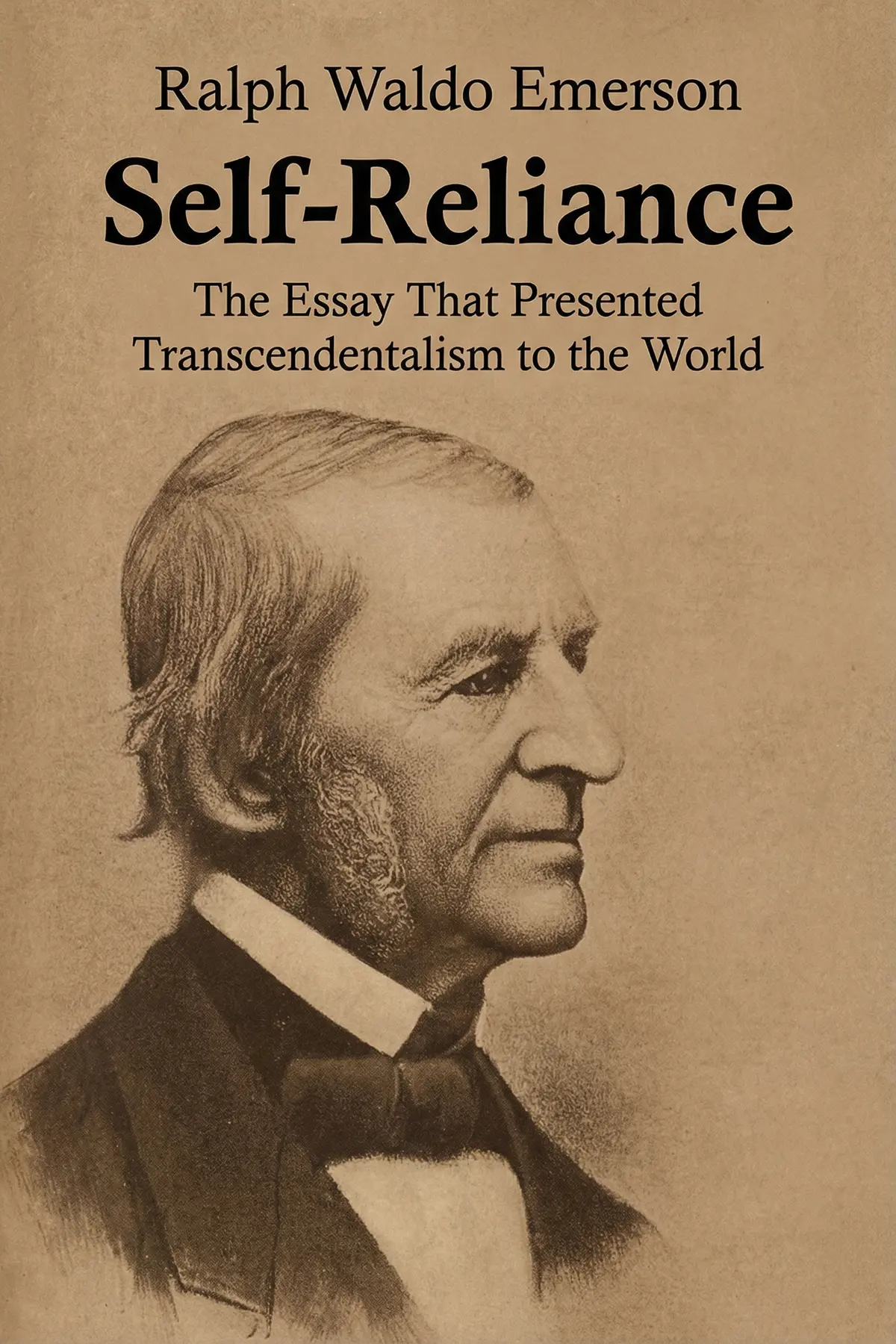
Emerson's essay shows why trusting your own judgment matters more than fitting in. It covers how to face disapproval, change your mind openly, and stop expecting travel, money or crowds to fix you.
1 min 07 sec
If you run every idea past other people before you dare to believe it, Ralph Waldo Emerson has a diagnosis: you are giving away the one thing that makes you original. In Self-Reliance, first published in Boston in 1841, he defines genius as believing your own thought, trusting that what feels true in your private heart holds for everyone. Ignore that voice, he warns, and a stranger will one day say exactly what you thought, and you will have to take your own idea back from someone else, with shame.
The essay’s argument is that honest perception in the present is the only source of original work and lasting peace. Four forces pull us away from it: the wish to fit in, loyalty to our past words, respect for borrowed authority, and the hope that travel, money or a crowd will rescue us. Emerson answers each one, with a famous line on consistency, a hard test for what we owe our families, and a reason no trip abroad cures an unhappy mind.
1 min 41 sec
A colleague says your idea out loud and gets the credit. Emerson thought that small sting reveals what genius really is, and why most of us waste the version of it we already carry.
1 min 39 sec
Babies and hungry boys have something most adults lose along the way. Emerson describes the bargain we strike to get our bread, and the small daily signs that show what it is costing.
1 min 48 sec
Emerson wrote the line about consistency that people still quote at each other. Its real target is a fear most professionals carry every day: being caught saying something different from last year.
1 min 56 sec
Standing before a palace or a famous painting, most people feel small. Emerson turns that feeling upside down with an old fable about a drunkard who wakes up in a duke’s bed.
1 min 47 sec
A few flowers outside a window gave Emerson his clearest picture of strength. Their lesson is aimed at anyone who keeps replaying old mistakes or waiting for some better future self to arrive.
1 min 53 sec
Family, friends, clients and good causes all want a piece of you at once. Emerson offers a demanding test for telling real duty from polite performance, and dares his critics to try it.
1 min 55 sec
The dream of escaping your sadness in a beautiful foreign city is old. Emerson explains why it fails, and why better tools, more property and bigger crowds of supporters fail in the same way.
1 min 10 sec
Self-Reliance is, finally, an essay about where authority lives. Emerson takes it away from churches, parties, famous names, past promises and bank accounts, and places it in one person’s honest perception in the present moment. That is a demanding standard, and readers have seen its risks: Herman Melville’s Captain Ahab in Moby-Dick has been read as self-reliance pushed until it sees only itself. Emerson’s own safeguards are the higher self he asks us to trust and the duties he keeps even as he renews them.
What the essay supports is small and daily. Say the idea you were about to swallow, before a stranger says it for you. Let a changed opinion stand, trusting the long zigzag to straighten out. Swap one polite falsehood at home for a kind truth. And before handing your hopes to a trip, a purchase or a crowd, remember the drunkard in the duke’s bed, who was a prince all along.
Near the very end comes a sentence worth carrying out the door: “Nothing can bring you peace but yourself.”
Many capable people keep their best ideas to themselves, wait for permission, and measure their lives by what others expect. Ralph Waldo Emerson wrote Self-Reliance, first published in his Essays of 1841, to argue against exactly that habit. It is widely seen as his defining statement on individualism and his call to trust oneself. Emerson defines genius as believing your own thought. He then takes on the forces that push it aside: a society that rewards conformity, the fear of contradicting what we said yesterday, reverence for famous names and institutions, and the hope that travel, property or a crowd of supporters will do our work for us. Along the way he offers memorable images: a baby that conforms to nobody, a ship whose zigzag course straightens from far away, roses that never compare themselves with earlier roses. The reader gets a clear map of Emerson's argument, the safeguards he built into it, and practical ways to test it at work and at home.
Professionals who keep their best ideas to themselves until someone else says them first.
Career switchers and young people torn between family expectations and their own judgment.
Readers curious about the essay behind the famous line on foolish consistency.
Ralph Waldo Emerson was born in Boston in 1803 and died in 1882. He studied at Harvard and the Cambridge Divinity School and became a Unitarian minister in 1826, then left Unitarianism by 1832 to work as a poet, writer and lecturer. His 1836 essay Nature set out the philosophy of Transcendentalism, and his 1837 speech The American Scholar followed. Self-Reliance appeared in his first collection, Essays: First Series, in 1841. He was a close friend and mentor to Henry David Thoreau.
Listeners find these essays deeply stimulating, with one listener highlighting how the content encourages life reflection, and they value the traditional prose and informative quality. Regarded as a famous masterpiece, listeners believe it is well worth the price. However, perspectives on readability are divided; while some find the experience delightful, others describe it as a painful slow read. Furthermore, the small font size is a common point of criticism.
Wow. Emerson’s prose hits like a lightning bolt to the soul even two centuries later. I found myself highlighting nearly every other sentence because his words carry such an intense, jazzy tempo. This isn't just a dry historical text; it's a vibrant manifesto for anyone tired of the suffocating pressure to conform. He encourages us to trust that inner intuition rather than looking toward weary traditions or the hollow opinions of the masses. While his stream-of-consciousness style can be a bit disorganized, that raw energy is exactly what makes it feel so authentic. It forces you to stop and reflect on your own life choices instead of just passively consuming information. You don't read Emerson to agree with him on every point of theology or logic. You read him to wake up. It is a dense, beautiful, and absolutely essential piece of American thinking that I plan to revisit whenever I feel lost in the noise.
Show morePicked this up during a period of professional transition and found it incredibly life-affirming. There is something deeply romantic and esoteric about the way Emerson describes our connection to the universe. He doesn't bother with boring, theoretical arguments; instead, he just riffs on the glory of the individual spirit. Not gonna lie, some of the passages on 'non-conformity' felt like they were written specifically for my current situation. The book challenges you to abandon the safety of the herd and stand on your own two feet, which is terrifying but necessary. Even the parts that seemed a bit rambling or disorganized eventually contributed to this overwhelming sense of intellectual freedom. It's a classic for a reason, and the educational value alone makes it worth the price of admission. If you feel like society is trying to mold you into a dull copy of everyone else, read this immediately. It is a fiery, mystical call to action.
Show moreAs someone who has always felt a bit like an outsider, Emerson’s 'Self-Reliance' felt like a warm embrace from a kindred spirit. He captures that independent American soul perfectly, urging us to find the glimmers of genius within our own minds. I love that he doesn't try to make everything make perfect communicative sense; instead, he pushes the reader to derive their own meanings. The way he describes our connection to nature and the 'unseen' reality beneath the mundane is just breathtakingly beautiful. His vocabulary is even more extensive than Shakespeare’s, yet he uses it to create a jazzy, energetic tempo that never feels stuffy. Frankly, I think everyone should read this at least once, preferably when they are young and still deciding who they want to be. It’s a manifesto for the soul that celebrates the courage it takes to be truly yourself in a world of copies. I will definitely keep this on my shelf forever.
Show moreEver wonder why every American literature course eventually leads back to this specific essay? After finally finishing it, I understand the hype, though it wasn't exactly an easy beach read. Emerson’s vocabulary is staggering, and his sentences often feel like they are barely on speaking terms with one another. To be fair, the readability is a bit of a mixed bag because his thoughts jump from nature to the 'Oversoul' without much warning. It’s a slow, deliberate experience that demands your full attention, or you’ll find yourself lost in his mystical rhetoric. The edition I purchased was a great price, but the print size was frustratingly small, which made the dense paragraphs even harder to navigate. Still, the core message about self-reliance and the 'hobgoblin of small minds' is incredibly empowering. It is a thought-provoking classic that provides a necessary bridge between Eastern philosophy and Western individualism.
Show moreFinally got around to reading this classic, and while the wisdom is undeniable, the physical copy I bought had microscopic print that made my eyes ache. Aside from the publishing quality, the content itself is a fascinating glimpse into the mind of a true Transcendentalist. Emerson writes with a rhythmic, almost trancelike flow that reminds me of Nietzsche or Spinoza at times. He has this way of giving names to unnamable qualities of life, making the mundane feel sacred and the complex feel simple. Look, I didn't agree with his dismissive take on science and empiricism, but I loved his celebration of mental fortitude. His critique of how society 'improves' only to make the individual weaker is particularly astute in our modern digital age. It’s a painful slow read in some sections, but the moments of clarity are absolutely dazzling. Every page offers a new insight that makes you question why we value consistency over growth.
Show moreAfter hearing so much about Transcendentalism, I expected a dry academic lecture, but instead found a mystical stream of consciousness that was surprisingly engaging. Emerson has a very specific, hardy way of writing that feels like he’s shouting wisdom at you from across a canyon. While I found his rejection of prayer and traditional scripture to be a bit extreme, his observations on human nature are quite profound. The truth is, his style is all about the gut and the heart, rarely pausing for anything as cold as a logical proof. This can make the essay feel a bit disorganized, but it also makes it feel more alive and human. The book is a great value and a classic piece of literature that really makes you reflect on your relationship with society. Just be prepared for some dense language and a few sections that seem to ramble on without a clear destination. It’s a journey worth taking for the intellectual stimulation alone.
Show moreThe essence of Emerson is found in his refusal to be consistent or logical in the way we expect from modern thinkers. He famously calls a foolish consistency the 'hobgoblin of small minds,' and he certainly lives by that rule in these pages. I appreciated his celebration of solitude and his embrace of a connection to history that doesn't rely on blind imitation. At times, the writing feels like he’s just carried away by his own momentum, which makes for a delightful and energetic reading experience. However, I can see why some people find it a painful slow read because he never quite gets to a straightforward point. He expects you to work for the meaning, which is a refreshing change from most self-help books today. The print size in my edition was small, but the substance of the essays was more than enough to keep me interested. It’s a classic that manages to be both frustrating and deeply rewarding at the same time.
Show moreFrankly, this is the kind of book you have to read slowly with a highlighter in hand to truly appreciate the depth. Emerson’s 'Self-Reliance' is a powerful reminder that our own intuition is often more reliable than the consensus of the crowd. I loved his lyrical might and the way he describes the 'Oversoul' as a unifying force, even if the concept is a bit nebulous. Some of the language is definitely dated, and his aversion to facts and science can be a bit off-putting to a modern reader. Still, the educational value is high, and it provides a great foundation for understanding the American spirit of individualism. It’s a thought-provoking collection that challenges you to be an active participant in the world rather than a passive observer. While it isn't always a compelling page-turner, the nuggets of sage wisdom are worth the effort. It is a solid 4-star classic that everyone should have in their library for moments of reflection.
Show moreTo be fair, I appreciate the historical weight of this text, but the sheer arrogance of Emerson’s philosophy is often hard to swallow. He speaks with such total confidence about subjective experiences that it almost feels like he's trying to replace traditional religion with his own ego. The truth is, his dismissive attitude toward history and established values seems to overlook the basic flaws in human nature. He claims that listening to one's gut is the path to divinity, but that feels like a recipe for total chaos and selfishness. I struggled with the way he treats logic as if it’s a burden rather than a tool for clarity. While the writing is undeniably poetic and contains some beautiful gems about solitude, the underlying message feels a bit too much like a convenient excuse for self-importance. It is worth reading for the perspective, but I would suggest approaching these claims with a heavy dose of skepticism.
Show moreLook, I wanted to love this because the quotes about non-conformity are so iconic, but the delivery left me feeling more confused than inspired. Emerson’s writing style is a chaotic stream of consciousness that often lacks any discernible organization or logical structure. He seems to value intuition over reason to such an extent that the essay becomes a series of high-energy rants rather than a cohesive argument. Personally, I found his constant borrowing from Eastern religions while simultaneously attacking traditional values to be a bit contradictory. The book is definitely thought-provoking, and I can see why it’s considered an American classic, but it felt like a chore to finish. It’s essentially a very long lecture on why you should only listen to yourself, which sounds great until you realize he’s also a bit of a hypocrite. If you enjoy mystical, flowery language, you might love this, but if you prefer clear and grounded philosophy, you'll probably be frustrated.
Show moreEmerson argues that genius means believing your own thought and trusting that what is true for you privately will prove true for others. He sees society as rewarding conformity, and he urges readers to resist it, along with the fear of contradicting their past words, reverence for borrowed authority, and the hope that travel, property or crowds can supply what only honest self-trust provides.
Emerson says people cling to their past statements because others use those statements to predict them. He calls that kind of consistency the hobgoblin of little minds and urges saying what you think today, even if it contradicts yesterday. He compares a life to a ship sailing a zigzag of tacks: seen from far enough away, honest actions line up into one clear direction.
Not quite. Emerson wants an end to false hospitality and false affection, and he drafts a declaration to his family that he now belongs to the truth. But he says he will still care for his parents, support his family and stay faithful to his wife, in his own way. The commentator Edward Emerson also stressed that the self to rely on is a higher self, man’s share of divinity.
The essay suggests a few habits. Write down and voice an idea before you dismiss it. Let a new opinion replace an old one without apology. Notice the forced smile or polite nod you give in dull company and drop it. Replace one comforting falsehood with a kind truth. And before a big purchase or trip, ask what you hope it will change in you, since Emerson says your sadness travels with you.
It suits anyone who defers to others too quickly: professionals who hold back ideas, young people weighing family expectations against their own judgment, and career switchers who need courage to take a different path. It also suits readers who want the original source of famous lines on consistency and self-trust, along with the safeguards Emerson built in against taking them too far.
Nigel Warburton

John Rawls


Richard Wiseman





William B. Irvine
AUDIO SUMMARY AVAILABLE
Get the key ideas from Self-Reliance by Ralph Waldo Emerson, plus 5,000+ more nonfiction titles.









