

59 Seconds: Change Your Life in Under a Minute
Richard Wiseman
 English
Shows how to turn curiosity into a practical skill for connecting with people, including those you disagree with, through four practices: detach, intend, value and embrace. It also covers knowing when to hold back.
1 min 05 sec
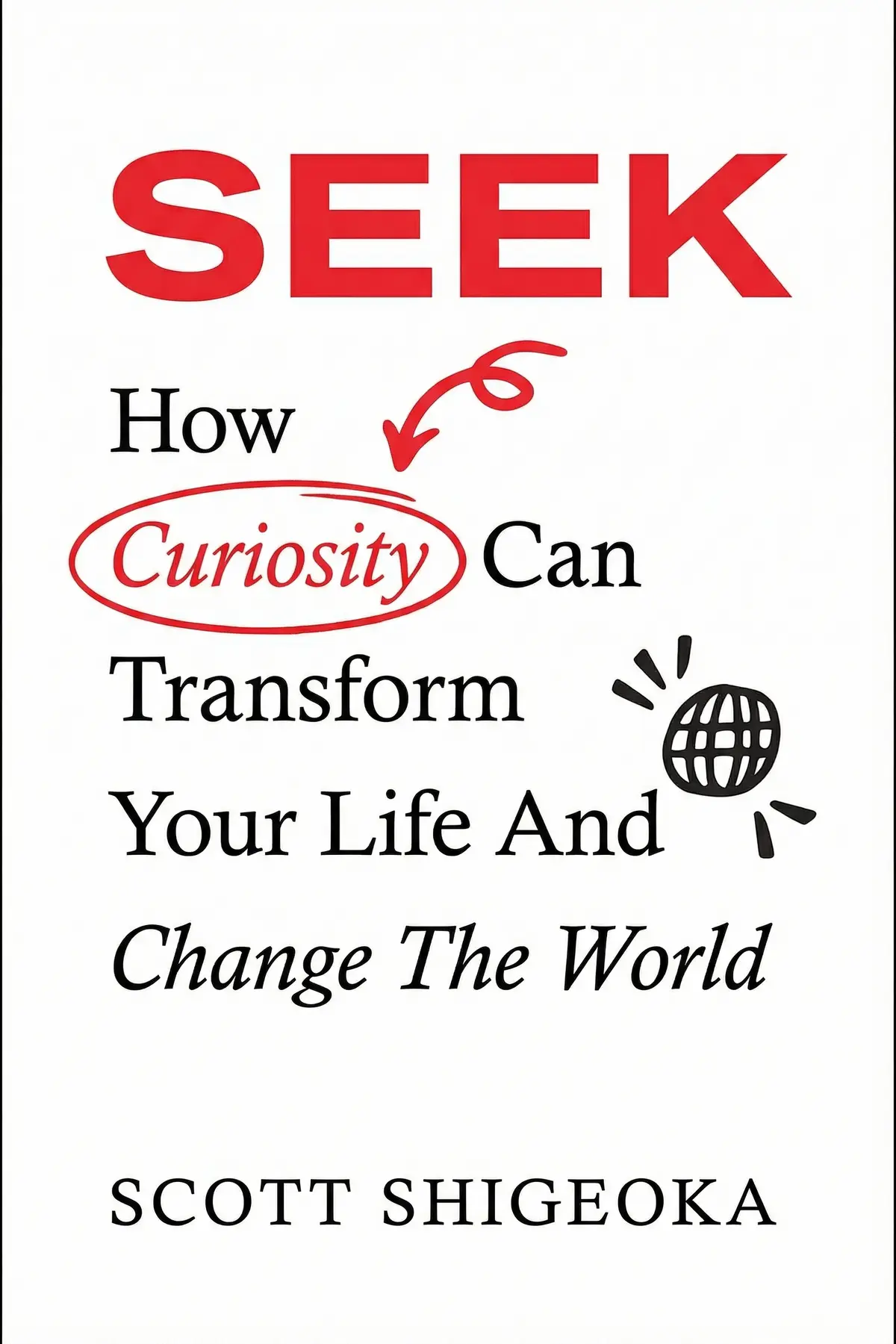
If talking with people who see the world differently tends to end in a long argument or a polite retreat, Scott Shigeoka has been there. In Seek, the curiosity expert describes how he used to fall into exactly those two habits, until a year of living out of his car pointed him somewhere new. He had left a comfortable life behind, felt unsure at first, and came back with a fresh sense of purpose and one central finding: curiosity, practiced deliberately, can change how you relate to almost anyone.
His argument is that curiosity is a skill of connection as much as a hunger for facts, and that it can be trained through four practices he groups under the word DIVE: detach, intend, value and embrace. Around that method he maps where curiosity can point, what tends to block it, and when it is wiser to hold back. What you get is a way to turn a tense exchange into an honest one, plus three checks that keep that openness safe for both sides.
1 min 58 sec
Most of us think we are curious, yet we tend to aim our questions in only one direction. Shigeoka maps three, and the one you neglect may be the one you need most right now.
1 min 47 sec
When a friend shares bad news, most of us reach for details and stop there. Shigeoka found that one more step changes the whole conversation, and he names the four things that usually stop us from taking it.
1 min 49 sec
The beliefs that help you make sense of people can also shrink what you are able to see in them. Shigeoka’s first practice asks you to loosen them, without asking you to give up who you are.
1 min 41 sec
Feeling curious and acting curious are surprisingly far apart. Shigeoka’s second practice closes that distance with purpose and preparation, and his own year on the road is the most extreme version of it.
1 min 36 sec
Curiosity comes easily with friends. With the relative whose views you cannot stand, it disappears. Shigeoka’s third practice targets exactly that person, and it also turns back toward the one asking the questions.
1 min 41 sec
Losses and sudden changes can close us off or open us up. Shigeoka’s final practice describes the difference, and why facing a difficulty is a very different thing from being swallowed by it.
1 min 51 sec
A well-meant question at the wrong moment can leave someone feeling cornered. Shigeoka offers three checks to run before going deep, and a reason to believe that careful curiosity spreads.
1 min 22 sec
Shigeoka’s year in a car began as a way out and ended as a method. What he brought home was a way of meeting people that does not depend on agreeing with them. In his telling, curiosity is no fixed trait that some people happen to have. It is a set of habits anyone can practice: clearing away assumptions, choosing to look, granting dignity and staying open when life hurts, all within limits that keep everyone safe.
The larger claim is that this matters beyond any single conversation. Each person who practices deep curiosity makes it a little easier for the people around them to do the same, and Shigeoka believes that spread can help build fairer, more connected communities.
The method is small enough to start tomorrow. The next time you feel certain about someone, name whether an assumption, a bias or plain certainty is speaking. When someone shares a problem, follow the facts with a question about how it felt. And before you go further, check that you are the right person, at the right time, and that you know when to ease off.
The debates and retreats that once filled Shigeoka’s conversations had one thing in common: both ended the conversation. Curiosity is how you keep it going.
Many of us struggle to connect with people who see the world differently. Conversations turn into arguments, or we pull away. Scott Shigeoka knew both habits well, until he left a comfortable life and spent 12 months living out of his car. He came back convinced that curiosity, practiced on purpose, can change how we relate to almost anyone. Seek treats curiosity as more than a hunger for facts. Shigeoka describes three directions it can point: inward toward yourself, outward toward other people and the world, and beyond toward the largest questions of life and death. He names what gets in the way, from fear and trauma to lack of time and distance, and offers a four-part method he calls DIVE: detach from your assumptions, biases and certainty, intend to be curious on purpose, value the dignity of every person including yourself, and embrace life's difficult moments. Readers get a usable practice for difficult conversations, along with three questions to ask before going deep, so that curiosity stays respectful and safe for everyone involved.
People whose talks with relatives or coworkers of opposite views end in arguments or silence.
Managers and team leads who want their questions to build trust instead of tension.
Anyone working through a hard season who wants to understand themselves and others more honestly.
Scott Shigeoka is a curiosity expert and speaker who turns research into practical strategies for well-being and connected relationships. He is known for this work at the Greater Good Science Center at UC Berkeley and for his courses at the University of Texas at Austin. He has shared his ideas with public officials, health care professionals, artists, activists, educators, community leaders and businesses. Originally from Hawaii, he now lives in California.
Listeners find the work deeply moving and motivational, highlighting fascinating research that broadens their perspective on curiosity. The prose is relatable, and listeners enjoy the influential stories and actionable advice provided. They admire the restorative nature of the book, observing its potential to alleviate anxiety, while one listener points out its ability to enhance professional life.
This book feels like a warm invitation to reclaim a part of ourselves we often lose after childhood. Scott Shigeoka doesn't just talk about being inquisitive; he provides a profound roadmap for using curiosity as a healing tool against anxiety and disconnection. The way he weaves together research with powerful narratives, especially the 'Cup of Tea' analogy, really resonated with my personal journey. I found the DIVE framework—Detach, Intend, Value, Embrace—to be incredibly practical for my daily life. While some might find the tone a bit optimistic, I think his down-to-earth writing style makes the deeper philosophical musings very accessible. It’s the kind of book you’ll want to gift to anyone struggling to find common ground in this polarized world. Truly an inspiring read that changed how I view my interactions with strangers.
Show moreAfter hearing the author speak on a podcast, I knew I needed to dive into the full text of Seek. It is a rare thing to find a book that manages to be both intellectually stimulating and deeply emotional. Shigeoka’s exploration of 'deep curiosity' helped me realize how much I’ve been living on autopilot, making snap judgments about everyone I meet. The stories are the real highlight here; they aren't just filler but essential illustrations of how we can transform relationships. Personally, the 'Value' step in his framework—recognizing we won't always agree and that's okay—helped me navigate some difficult family dynamics during the holidays. This is a keeper that I plan on revisiting whenever I feel myself becoming closed-off or cynical.
Show moreFinally got around to reading SEEK and it's easily one of the most profound books on human connection I've read this year. The way Scott Shigeoka connects the act of wondering with the act of healing is just brilliant. I’ve always been a curious person, but this book showed me the difference between being 'nosy' and being 'deeply curious.' The research is compelling and well-integrated, providing a sturdy backbone for the more emotional narratives. I especially loved the focus on how curiosity can improve our lives at work; it's already helped me approach difficult conversations with my team from a place of understanding rather than defense. This is a smart, enlightening, and necessary book for our current times. I’ll definitely be gifting copies to my colleagues.
Show morePicked this up on a whim after seeing Shigeoka's DIVE framework mentioned in an education newsletter. As a teacher, the concept of 'detaching' from assumptions before entering the classroom is a game changer for the new school year. The writing is engaging and the stories, like the one about the nuns, provide a great backdrop for his theories. I will say, at times it felt a bit repetitive, as if the core message could have been a long-form essay rather than a full book. However, the practical tips for fostering deep curiosity are solid. It’s not just about asking questions; it’s about the intention behind them. This is a great resource for anyone in a leadership or mentorship role who wants to improve how they connect with others.
Show moreShigeoka’s writing style is incredibly down-to-earth, which makes the heavier research sections much easier to digest. I listened to the Spotify audiobook narrated by the author, and while his voice is very specific and expressive, it really helped the 'storytelling' aspect of the book shine. I particularly enjoyed the sections on how curiosity can mitigate loneliness and fear. My only gripe is that the DIVE acronym felt a bit forced at times, like he was trying too hard to make it 'stick' for a corporate audience. Still, the message is vital. In an era where we are all so disconnected, learning to 'sit with' discomfort and ask better questions is a skill we all need to practice. It’s a solid 4-star read for me.
Show moreTruth is, I thought I was already a pretty curious person until I encountered the ABCS analogy in these pages. This book pushes you to go beyond the 'what' and 'how' and really get into the 'why' of the people around us. Shigeoka writes with a lot of heart, and his vulnerability makes the advice feel earned rather than preached. I did feel like the 'corporate speaker' vibe peeked through a little too often, with glossy formatting and easy-to-digest bullet points that felt a bit like a workshop. However, the core message about the courage to be curious is so important that I can overlook the slightly 'glossy' delivery. It’s a great tool for anyone looking to break out of their bubble and actually connect with the world.
Show moreNot what I expected, but not necessarily in a bad way—just a bit repetitive in the middle sections. I’ve been looking for ways to handle work-related stress, and the ABCS analogies here offered some decent perspective on managing anxiety through curiosity. To be fair, if you’ve read a lot of self-help, many of these concepts will feel like common sense repackaged with a new acronym. The DIVE method is easy to remember, but I found myself skimming through the parts that felt like a corporate speaker’s script. Shigeoka is clearly talented and his heart is in the right place, but I wish he had gone deeper into the psychology rather than staying on the surface. It’s a decent 'mid-tier' self-help book that serves as a good reminder to stay open-minded.
Show moreLook, the narration on the audiobook is certainly a choice—Scott has a very distinct voice that might not be for everyone, but it does make the experience feel personal. The content itself is a bit of a mixed bag. On one hand, the stories about human interaction are genuinely moving and provide a nice break from the 'how-to' sections. On the other hand, the informational parts feel a bit surface-level for someone who already practices mindfulness. I found myself forgetting the specifics of the 'Intend' and 'Value' steps almost as soon as the chapter ended. It’s a pleasant read and definitely has some 'aha' moments, but it didn't spark as much deep thought as I had hoped for given the title. Good, but not groundbreaking.
Show moreWhy do so many modern self-help books feel like an extended pitch deck for a corporate keynote circuit? Frankly, I had high hopes for this one, but it ended up being a standard business-professional guide masquerading as deep philosophy. The author’s attempt to bridge political divides by attending a Trump rally felt incredibly naive to me. He seems shocked that people with different views can still be 'nice,' which feels like a very surface-level realization for a grown man. Also, citing 'The Body Keeps the Score' so early on made me question the scientific rigor of the rest of the text. There are some okay tips scattered throughout, but the solution to systemic oppression isn't just asking 'curious questions' over coffee. It’s a pass for me.
Show moreThe chapter on political polarization was where the author lost me completely. In my experience, suggesting that we can solve deep-seated human rights issues by simply being 'more curious' about people who hold hateful views is a major disservice to marginalized communities. It feels like a very rose-colored glasses approach to the world. Beyond the political stuff, the book felt quite generic. One minute he’s talking about mindfulness and the next he’s giving advice that feels like it belongs in a LinkedIn thought-leader post. I struggled to keep track of the primary theme because it kept veering into different self-help tropes. If you're brand new to the genre, you might find something here, but seasoned readers will likely find it lacking in substance.
Show moreShigeoka argues that curiosity is a skill of connection that can be practiced, not just a hunger for facts. After spending 12 months living out of his car, he concluded that deep curiosity could change his relationships, especially with people who held different views. He teaches it through a four-part method called DIVE: detach, intend, value and embrace.
DIVE stands for detach, intend, value and embrace. Detach means loosening your assumptions, biases and certainty. Intend means choosing curiosity on purpose and preparing your mindset and setting. Value means recognizing the dignity of every person, yourself included. Embrace means facing life’s difficult moments and learning from them. Shigeoka presents these as ongoing practices that reinforce each other.
Inward curiosity looks at yourself: your thoughts, emotions, needs and dreams. Outward curiosity looks at other people and the world, from other cultures to a friend’s experiences. Beyond curiosity reaches toward the largest questions, about life, death and what lies between. Shigeoka illustrates the force behind them with the Polynesians’ ocean voyages and with how children learn language.
When you feel sure about someone, name whether an assumption, a bias or certainty is driving that feeling. When someone shares a problem, follow your factual questions with one about how it felt. Before going deep, check whether you are the right person, whether it is the right time and whether you know when to slow down or stop.
Yes. Shigeoka warns that deep curiosity without awareness of limits and boundaries can leave people panicked, overwhelmed or unsafe. That is why he asks you to consider your role, the timing and the signs that it is time to pause. Sometimes, he says, living curiously means pulling back and respecting your own comfort and other people’s.
Richard Wiseman





William B. Irvine


Andrew D. Thompson


Deepak Chopra
AUDIO SUMMARY AVAILABLE
Get the key ideas from Seek by Scott Shigeoka, plus 5,000+ more nonfiction titles.









