

14 min 08 sec
Available in: English
Say What They Can’t Unhear: The 9 Principles of Lasting Change
Shows why sound arguments for change get rejected and how to frame any proposal so it fits the beliefs, identity and desires people already hold, from small first steps to agreements they won't regret.
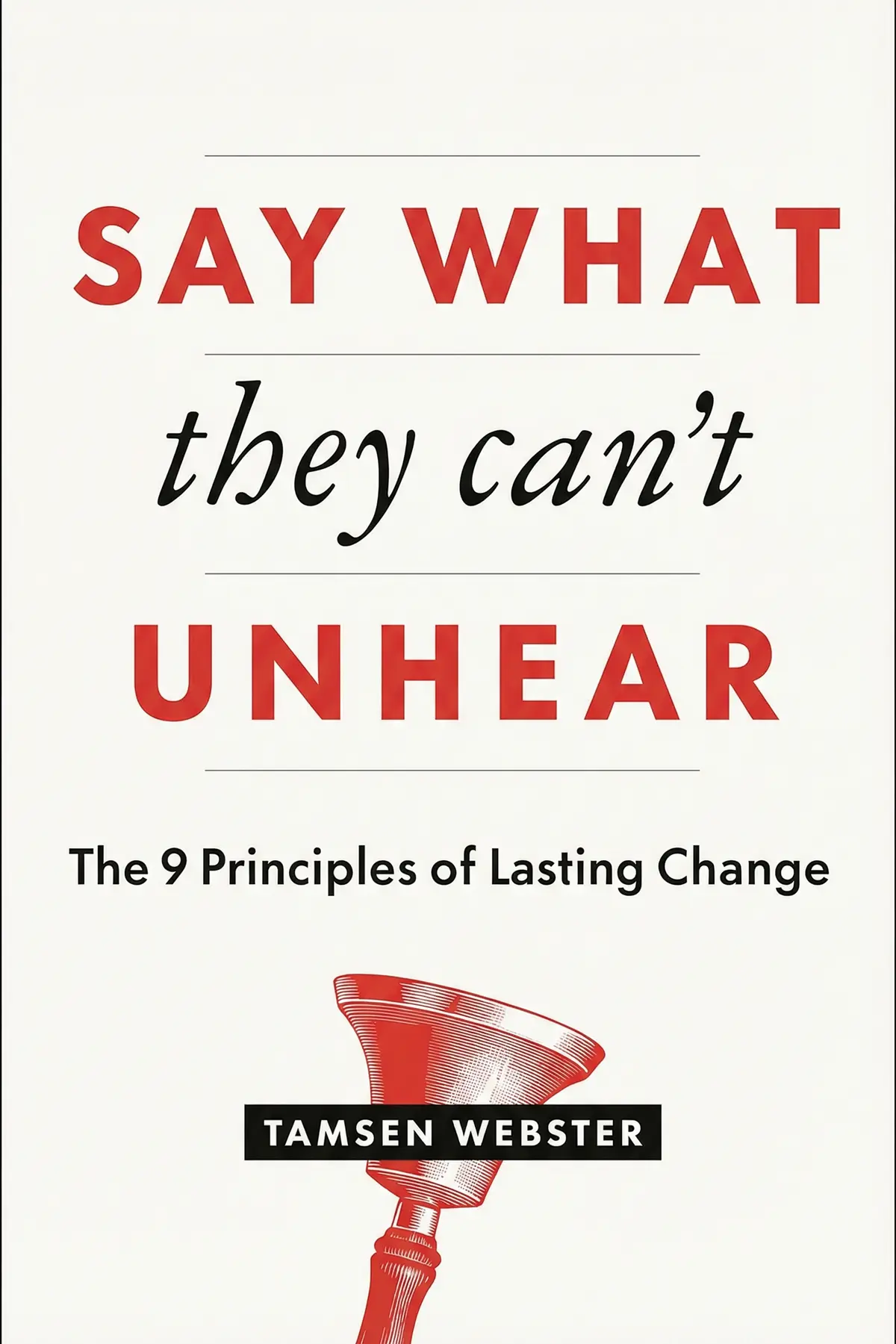
Table of Content
1. Introduction
1 min 09 sec
If your case for a change is strong and people still won’t move, the argument is probably not the problem. In Say What They Can’t Unhear, Tamsen Webster, who has spent more than two decades helping leaders win support for change, explains that people cling to familiar patterns, even harmful ones, because those patterns feel safe. A new idea therefore arrives as a threat before it arrives as an improvement, and resistance follows.
Webster sets out nine principles of lasting change, and they add up to a single claim: people accept change when it looks like the next chapter of a story they already believe, and they fight it when it feels like an attack on who they are. Her evidence ranges from a nineteenth-century maternity ward to a startup selling robots to farmers. What it gives you is a way to find the belief beneath someone’s resistance, and a set of small moves for framing a proposal so that a boss, a client, a community or your own stubborn habits can accept it.
2. Win support for change without blaming anyone
1 min 40 sec
Two medical pioneers pushed for the same simple hygiene habit in the nineteenth century. One watched his colleagues reject it and patients die again; the other got doctors to adopt it. The difference had nothing to do with evidence.
3. Find the hidden story behind every decision
1 min 47 sec
A trip to a furniture store and a pitch for a climate technology reveal the same hidden force behind decisions. Miss it, and even a flawless argument can fall apart in front of the wrong audience.
4. Offer advice that respects how people see themselves
1 min 42 sec
A major company’s sales method won clients brilliantly and then started driving them away. The method never changed, and that turned out to be the whole problem. Its mistake is easy to repeat with any colleague.
5. Use a stronger belief to soften a stubborn one
2 min 00 sec
A shouting match over school funding calmed down after one teacher spoke, and a group of climate skeptics softened their view. Both turned on the same move, which works only if you stop arguing with the belief in front of you.
6. Make the change small enough not to hurt
1 min 32 sec
Quitting a favorite sweet drink overnight feels like discipline, yet it usually ends back at the start. The reason goes beyond willpower to what the drink stands for, and the fix is surprisingly modest.
7. Stop wanting the change more than they do
1 min 35 sec
A farm-robot startup built impressive technology that farmers ignored. Its engineers had solved the wrong problem, and its story shows when extra effort to persuade someone does more harm than good.
8. Build agreements people will never regret
1 min 36 sec
Some purchases leave you doubting yourself a day later, while others never trouble you even when they disappoint. The gap between them suggests how to make a yes stick long after the meeting ends.
9. Conclusion
1 min 07 sec
Webster’s nine principles describe one habit of mind. People can follow complicated reasoning, but they act on simple motives: keep doing what feels rewarding, and avoid what doesn’t. A change that fights those motives looks like a threat, however good the evidence. A change that grows out of them looks like the obvious next move. Semmelweis had the facts and lost; Nightingale had the frame and won.
You cannot control how someone feels about a change. You can control how you introduce it. Before the next proposal you make, at work or at home, name the belief the other person holds most firmly and describe your idea as a way to honor it. Shrink the first request until it costs them little, and collect small agreements before asking for the big one. If they still don’t want it, step back for now.
The most lasting changes are the ones people would have chosen anyway, once someone showed them how the new path fits the story they already live by. Say what fits that story, and it becomes very hard to unhear.
About this book
What is this book about?
Plenty of good ideas die in meetings even when the logic is sound, because the people hearing them feel threatened. Tamsen Webster argues that this resistance is built into how minds work. Familiar patterns feel safe, even when they cause harm, so any proposal to do things differently sets off a defense before it gets a fair hearing. Her answer is a set of nine principles of lasting change. Each one describes how people actually decide: through inner stories, through deep principles they treat like laws of nature, and above all through their sense of identity. She shows why direct attacks on deep beliefs fail, why painful all-or-nothing plans collapse, and why no one can be pushed into wanting something. Her cases include Ignaz Semmelweis and Florence Nightingale promoting handwashing, a Fortune 500 sales team that alienated its own clients and a farm-robot startup that offered far too much. Readers learn to find the belief behind someone's resistance, link a change to values the person already holds, ask for small painless steps and build agreement through a series of little yeses, at work, in a community or in their own habits.
Book Information
Who it's for
Managers facing team resistance
Managers and team leads whose sensible changes keep meeting resistance from their people.
Pitching clients and investors
Founders, consultants and salespeople pitching to clients or investors who don't share their assumptions.
Bridging divides, changing habits
Community organizers facing divided rooms, and anyone trying to change a personal habit without relapsing.
About the Author
Tamsen Webster
For over two decades, Tamsen Webster has worked with leaders on the messages they use to build backing for change. Her clients and collaborators have included Harvard Medical School, TEDxCambridge, Johnson & Johnson and impact-driven start-ups. Her first book, Find Your Red Thread, became a bestseller after its 2021 release. She says much of what she knows about people, messages and change took root during her years as a Weight Watchers leader.
Ratings & Reviews
Ratings at a glance
What people think
Listeners find the book highly successful at conveying core concepts for driving transformation, with one review characterizing it as a perceptive manual on the psychology of influence. Furthermore, the material is praised for its accessibility, cited as essential reading for executive leaders and for its effectiveness in developing content for lasting change. Listeners also value the foundational ideas, with one review noting they are backed by solid science, and the book's communicative style, with one listener noting it's not typical business talk. Listeners describe the guide as both entertaining and straightforward to grasp.
Top reviews
Tanyaporn
Wow. This book completely flipped the script on how I approach team meetings. I used to think that providing enough data would naturally lead people to the right conclusion, but Webster proves why that often backfires. Her breakdown of the '9 Principles' isn't just theory; it feels like a tactical manual for navigating human resistance. I specifically loved the distinction between 'you’re right' and 'that’s right,' as it perfectly captures why some of my past initiatives failed to gain real traction. The writing is incredibly tight and avoids the usual fluff you find in business books. It’s dense with insight but remains surprisingly easy to digest. If you are struggling with change management or just want your ideas to actually stick, this is essential reading. It’s rare to find a book that feels this immediately applicable to my daily work life.
Show moreKanokwan
Finally got around to reading this and Chapter 4 on identity was a total lightbulb moment for me. We often try to persuade people by challenging their views, but Webster explains why that just causes them to shut down. To be fair, I’ve been guilty of trying to 'fix' my team's mindset instead of aligning with their existing sense of self. The book teaches you how to frame a message so it becomes part of the listener’s own internal narrative. This isn't about manipulation; it's about deep alignment. The prose is sharp, conversational, and completely devoid of typical corporate jargon. I finished it in two sittings because the flow is so natural. It’s the kind of book you buy copies of for your entire management team. Every principle feels like a missing piece of a puzzle I’ve been trying to solve for years.
Show moreYok
As someone who deals with corporate resistance daily, the concept of 'reactance' was exactly the label I needed for my professional frustrations. Webster has a gift for taking complex psychological triggers and making them accessible for the average manager. The book is structured around nine principles that help you guide others toward change without making them feel pushed. Personally, I found the section on storytelling particularly insightful because it moves away from the 'salesy' approach and toward true connection. The writing is punchy. The advice is practical. The examples are relatable. I’ve already started shifting the way I phrase my project proposals based on the 'can't unhear' framework. It’s one of those rare business books that actually delivers on the promise of its title. You really can’t unhear these principles once you’ve read them.
Show moreKiattisak
Ever wonder why your best ideas get shot down even when they make perfect sense? This book provides the answer. Tamsen Webster explains that it’s not about the strength of your argument, but how that argument interacts with the listener’s identity. The way she explains the psychology of decision-making is brilliant. I’ve read a lot of books on persuasion, but this one feels different because it isn't about winning an argument. It’s about making the change so irresistible and logical that the other person adopts it as their own idea. The chapters are short and impactful. I found myself highlighting nearly every other page. This isn't just for business people; it’s for anyone who needs to communicate an idea that matters. It’s a masterclass in empathy-driven communication that will change the way you speak to everyone.
Show moreSupranee
Gotta say, I was skeptical about another business book on 'change,' but this one is a refreshing departure from the norm. It avoids the typical rah-rah motivation and gets straight into the mechanics of how the brain accepts or rejects new information. The nine principles are a fantastic framework for anyone who needs to lead a team through a pivot. I especially liked the focus on the audience's 'internal story.' The book is incredibly readable and lacks the dry, stuffy tone of most leadership guides. It feels like having a conversation with a very smart, very direct mentor. I’ve already recommended it to several coworkers who are struggling with project buy-in. It’s an essential tool for creating messages that don't just get heard, but actually get acted upon. Tamsen Webster has really delivered something special here.
Show moreChanon
Not what I expected, but exactly what I needed. I thought this would be a sequel to her first book about building a 'Red Thread,' but it’s really a deep dive into the psychology of why people resist new ideas. The focus on 'lasting change' is so relevant in today’s volatile work environment. Each principle is illustrated with clear examples that make the complex science feel intuitive. I particularly enjoyed the section on how to avoid triggering a defensive response in your audience. The book is short, but don't let that fool you; it’s packed with more actionable advice than books twice its length. It’s the kind of resource you keep on your desk and reference before every big presentation or difficult conversation. Webster has a unique ability to make you see your own communication flaws with a sense of humor and a clear path toward improvement.
Show moreAiden
After hearing Tamsen speak at a marketing event, I expected a deep dive into simple messaging, but this is actually a sophisticated masterclass in human behavior. It focuses heavily on change management, which was a welcome surprise given my current role. The principles are logically organized and backed by solid psychological research without feeling like a dry academic paper. Frankly, I recognized myself in many of the 'what not to do' scenarios she described. My only minor gripe is that while she emphasizes understanding the audience's values, I wanted more specific exercises on how to uncover those hidden beliefs when they aren't obvious. Still, the concept of identity as the ultimate influencer is a game-changer. It’s a quick, punchy read that I’ll likely revisit several times this year. Definitely worth the shelf space for any leader.
Show moreHugo
Picked this up after a colleague recommended it for our leadership book club. Not gonna lie, I usually find books on 'lasting change' to be a bit repetitive, but this one stands out due to its focus on the audience's internal story. The 9 principles provide a very clear roadmap for communication. I particularly appreciated the focus on how people need to feel smart, capable, and good during a transition. One small critique is that the book is so streamlined that I sometimes felt I was missing the 'how-to' on the discovery phase of the process. It tells you what to say, but finding the raw materials for that message requires a bit more legwork than the book covers. However, the delivery and the science behind the messaging are top-notch. It’s an insightful guide for anyone tasked with moving a group of people toward a new goal.
Show moreSawit
The core concepts laid out in these pages are undeniably powerful, yet I found the pacing a bit relentless at times. Tamsen Webster is a masterful communicator, but her style here is so 'tight' that I felt I lacked the mental breathing room to fully process one principle before moving to the next. Truth is, some sections felt slightly redundant as if the same point was being hammered home through different lenses. While I appreciate the lack of fluff, a few more long-form case studies would have helped ground the abstract psychology for me. It is a solid resource for persuasion, but it didn't quite resonate with me as much as her earlier work. If you prefer a very fast-paced, high-information-density style, you will love it. For me, it was a bit of a whirlwind that left me wishing for a more leisurely exploration of the 'why' behind the change.
Show moreHassan
Look, I appreciate the science-backed approach and the author clearly knows her stuff, but I struggled to stay engaged. The book felt more like a collection of high-level observations than a practical toolkit I could use on Monday morning. To be fair, the writing is professional and the principles are logical, but it felt a bit too abstract for my needs. I was looking for more step-by-step templates for message creation, and this focused much more on the broad psychology of change management. It might be a great fit for senior executives who deal in high-level strategy, but for a frontline manager, it felt a bit removed from the daily grind. I didn't find the 'nine principles' as revolutionary as the marketing suggested. It’s an okay read, but it didn't quite hit the mark for me personally.
Show moreQuestions about this book
What is Say What They Can't Unhear about?
Tamsen Webster explains why sound arguments for change often fail and how to make them land. People hold on to familiar patterns because they feel safe, so new ideas trigger resistance. Across nine principles of lasting change, she shows that people accept a change when it fits their inner stories, core principles, identity and existing desires, and resist it when it feels forced, painful or like an attack on who they are.
What are the nine principles of lasting change?
Webster’s principles say that change is a reaction as well as an action, that every decision has a story, and that principles set patterns. Identity influences decisions most strongly, deeply held beliefs shift the least, and lasting change is undermined by pain. When two truths fight, only one wins. Nobody can be made to want a change more than they already do. Finally, there is no believer’s remorse.
How do you apply Webster's principles at work?
Start by finding what the other person already believes about how success happens, then describe your change as a way to get more of it. Avoid wording that blames their past decisions. Ask for the smallest painless first step, the way someone might cut from three sugary drinks a day to two. Strip out features or options they don’t care about, and gather small agreements before you present the full plan.
Why do people resist change even when it helps them?
Webster points to reactance: when people feel pushed, or suspect a change serves someone else, they defend their freedom to choose. Ignaz Semmelweis cut deaths on a maternity ward in 1847 with handwashing, yet doctors who felt blamed abandoned the practice and deaths rose again. Florence Nightingale later won doctors over to the same habit by tying it to their existing belief in bad air.
Who should read Say What They Can't Unhear?
It suits leaders introducing new processes, founders and salespeople pitching to investors or clients, consultants giving advice, community organizers facing divided meetings, and anyone who keeps slipping back on personal changes. Webster’s cases come from a hospital ward, a Fortune 500 sales team, a school funding debate and a farm-robot startup, so the principles apply at work, in communities and in private life.
Readers also enjoyed









AUDIO SUMMARY AVAILABLE
Listen to Say What They Can’t Unhear in 15 minutes
Get the key ideas from Say What They Can’t Unhear by Tamsen Webster, plus 5,000+ more nonfiction titles.
- 5,000+ titles
- Listen as much as you want
- 7-day free trial
- Cancel anytime









