

15 min 10 sec
Available in: English
 ไทย
EnglishไทยSam Walton: Made in America: Made In America
By Sam Walton, John Huey
Shows how Sam Walton grew a single small-town variety store into a retail empire by copying rivals' best ideas, serving customers first, using competition as fuel and finally treating staff as partners.
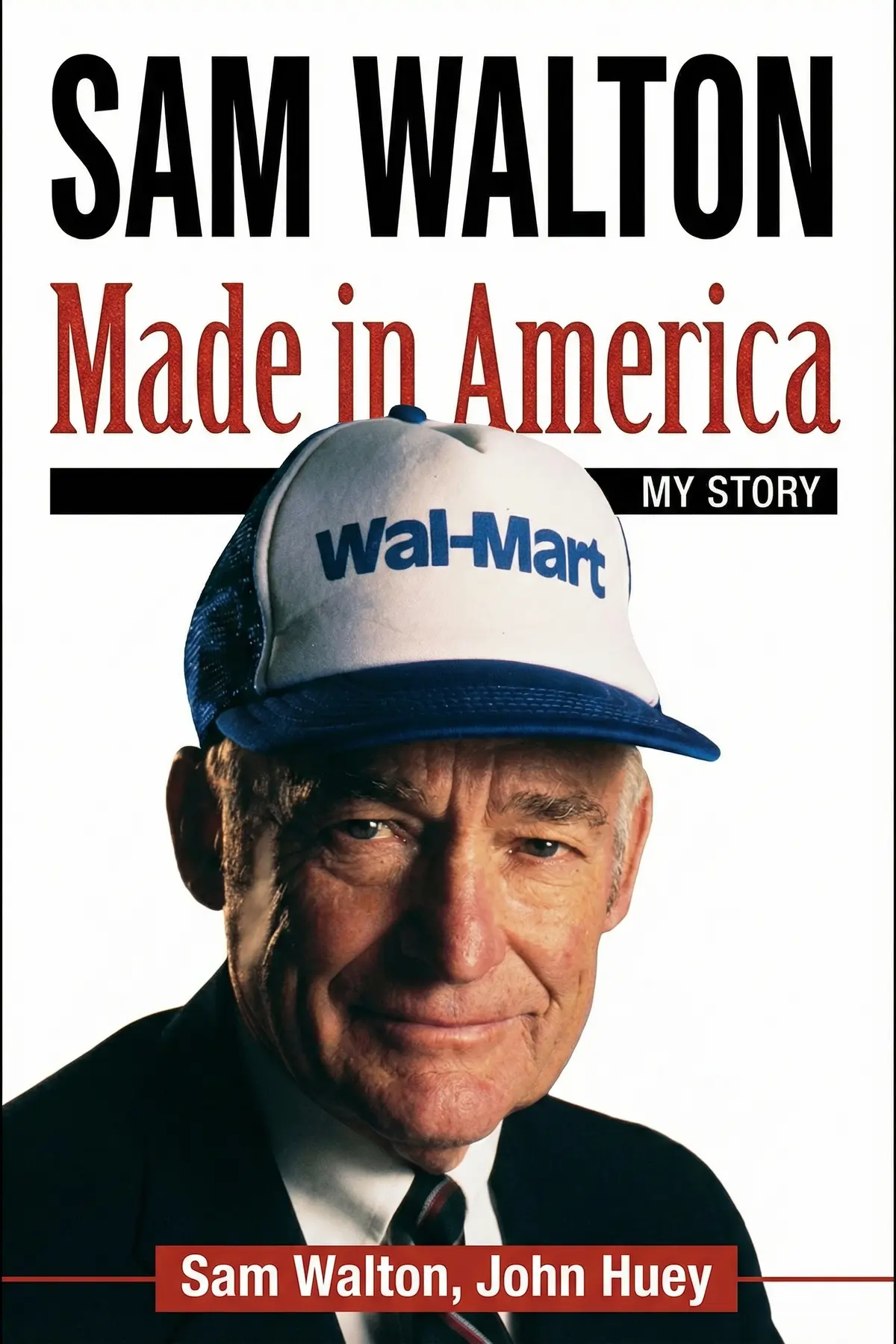
Table of Content
1. Introduction
1 min 02 sec
If you run a small business, or hope to, the giants can look untouchable, built on money and luck you will never have. The founder of Walmart says otherwise. In Sam Walton: Made in America, written with journalist John Huey, Walton describes building a retail empire from a single variety store, partly by copying good ideas he spotted in other people’s shops. By his death in 1992 he ranked among the richest people in the world, yet many of his methods were small and borrowed: two checkout counters at the front, cheap metal shelves, a morning cheer.
The thread through his story is a habit of looking outward. Walton kept studying customers, rivals and eventually his own staff, and he changed his stores whenever he saw something better. Follow that habit through his life and you get a working playbook for competing with larger players, along with an honest record of the mistakes that nearly cost him everything.
2. Treat your first small jobs as business training
1 min 48 sec
A father too proud to borrow and a mother who turned cows into cash gave a Depression-era boy two very different lessons about money. One of them he copied, and one he made sure to avoid.
3. Borrow the best idea in every rival's store
1 min 58 sec
Walton was never shy about where his best ideas came from. A shop in Minnesota, a competitor’s shelving and a supplier’s morning ritual all ended up inside Walmart, and one of them reached the president.
4. Put the shopper first, even when it costs a sale
1 min 47 sec
Farm families spent their Saturdays driving from shop to shop, and Walton saw an opening nobody else was using. His answer made customers loyal and made him enemies, and he defends it to the end.
5. A bigger rival can make you sharper
2 min 03 sec
Walmart had a tenth as many stores as Kmart when they went head to head. A manager’s wild order of detergent and a price war over toothpaste showed Walton why a giant next door can be good news.
6. Back a new staff title with real money
1 min 40 sec
In 1955 Walton made a store manager cancel raises that had lifted his clerks from 50 to 75 cents an hour. Then a shop sign in England changed how he saw the people working for him, and he backed the change with cash.
7. Admit the big mistake fast, then celebrate the wins
1 min 58 sec
An early retirement split Walmart into rival camps and sent its share price into free fall. Eight years later, the same founder was dancing on Wall Street in a Hawaiian outfit, and both moments taught him something.
8. Measure what your business gives back to its community
1 min 48 sec
Critics called Walton uncharitable, and he thought they were missing two things. One was a long list of scholarships. The other was a sum he worked out himself, running into billions of dollars.
9. Conclusion
1 min 06 sec
Walton’s life reads less as a story of genius than of attention. The boy who delivered milk for his mother became one of the world’s richest men by looking hard at whatever was in front of him: farm families wandering between shops on Saturday, two checkout counters in Minnesota, a supplier’s morning cheer, a sign on an English store. He was slow to learn in places, underpaying clerks for years and handing over his company too early, and each time he recovered by admitting it and acting fast.
His example points to things you can begin this week. Walk into a competitor’s business with a notebook, write down what they do better and work out how you could do it more cheaply. Find the moment your customers lose time or patience, and fix it even if a sale goes elsewhere. If you lead people, give them a real share of the gains before you give them a new title.
Then, when the target you swore was impossible is finally hit, keep your side of the bet, even if it means a hula skirt on Wall Street.
About this book
What is this book about?
Big competitors can look untouchable to anyone running a small business, as if their success came from money and luck nobody else will ever have. Sam Walton, who was among the richest people in the world when he died in 1992, tells a different story. With journalist John Huey, he describes how a boy who delivered milk during the Great Depression built Walmart, one borrowed idea at a time. Walton's methods were mostly simple and open to anyone. He moved the checkout counters to the front of the store after seeing that layout in Minnesota. He swapped wooden shelves for cheaper metal ones. He stayed open longer than the shops farm families used, and he fought Kmart with a wall of discounted Tide and six-cent toothpaste. He is also frank about his failures: clerks he underpaid for years and an early retirement that nearly destroyed the company. Readers get a practical playbook for competing against larger players, a model for sharing success with employees, and an honest record of how one founder recovered from his worst mistake.
Book Information
Who it's for
Small business owners
Small business owners facing a much bigger competitor and looking for practical ways to fight back.
Founders and managers
Founders and managers who want a working model for copying good ideas and sharing profits with staff.
Interested in retail history
Readers curious how one Depression-era boy from Oklahoma built a retail empire, mistakes included.
About the Author
Sam Walton
Sam Walton, born in Kingfisher, Oklahoma, in 1918, opened the first Walmart in Rogers, Arkansas, in 1962 and started Sam's Club in 1983. Walmart grew into the largest company in the world by revenue, and Walton was once the wealthiest American. He died in 1992. His co-author, John Huey, is an American journalist who edited Fortune, ran the Atlanta bureau of The Wall Street Journal and later led Time Inc. as editor-in-chief.
Ratings & Reviews
Ratings at a glance
What people think
Listeners find this book to be a mandatory resource for business majors, filled with gems of wisdom and personal stories of diligence. Moreover, they view it as one of the top selections on genuine entrepreneurship, with one listener observing how Sam Walton built a powerful company from the ground up. Additionally, the text is easy to follow and offers great value, with one listener highlighting its detailed approach to business practices.
Top reviews
Cooper
Sam Walton's life story is a masterclass in American grit and retail innovation. He wasn't just lucky; he was obsessed with the details of his business, often visiting competitors to measure their aisles. This book captures that relentless drive perfectly, showing how he moved from a single variety store to a global empire. I appreciated his "buy low, sell high" philosophy and the emphasis on trying new things until they stick. Even if you aren't into business, his sheer energy is enough to keep you turning pages. It feels like a genuine piece of history told by the man who lived it. It’s an essential read for anyone who wants to understand the engine of American capitalism.
Show moreMingkwan
Finally got around to reading this classic and it’s arguably the best blueprint for building a business from nothing. Walton’s focus on the customer and his willingness to experiment is something every startup founder should study. He wasn't afraid to get his hands dirty or look silly, even if it meant doing a hula on Wall Street to boost morale. The book is packed with pearls of wisdom that apply to more than just retail stores. It’s an easy, engaging read that avoids the boring jargon found in most business biographies. I highly recommend the audio version if you want to really feel his personality. He was a true original in every sense of the word.
Show moreSuthinee
As someone who appreciates a good success story, I found the early chapters about his first retail failures quite grounding. It’s easy to look at a billionaire and assume it was all easy, but Walton worked himself to the bone. He mentions how he’d spend his vacations looking at other people's stores instead of relaxing on a beach. That kind of singular focus is rare and honestly a bit terrifying to contemplate for a normal person. The book does a great job of explaining the Wal-Mart way and how he motivated people to work for a common goal. It’s a foundational text for anyone who wants to understand the modern economy. Hard work pays off, and this book proves it.
Show morePatchara
The chapter on learning from the competition is worth the price of the book alone. Walton was a sponge, constantly soaking up ideas from everyone around him, from his own employees to his biggest rivals. This humility in the face of learning is likely why he was able to crush so many other established retailers. He didn’t just follow the rules; he reinvented them to suit his vision of low prices for the common person. The book is incredibly well-structured and moves at a fast pace, reflecting the man’s own high-energy lifestyle. It's a must-read for anyone who wants to see how real wealth is created through hard work. It truly is an American business classic.
Show moreThanit
Not what I expected from a corporate biography, as it reads more like a conversation on a porch than a board meeting. Sam Walton’s voice is so distinct and full of life that you can almost hear him talking to you directly. He doesn't sugarcoat the difficulties of the retail world or the friction he sometimes had with his own family. I was particularly struck by his commitment to his core values even as the company grew to an unimaginable size. It’s a testament to what one person can achieve with enough persistence and a clear goal. This is easily one of the most practical and honest business books I’ve ever come across. I'll be keeping this on my shelf for a long time.
Show moreRania
Ever wonder how a single discount store in Arkansas became a global titan? Walton explains the mechanics of his success through a series of ten rules that still feel relevant for entrepreneurs today. He emphasizes the importance of action over over-planning, which is a refreshing take in a world full of corporate red tape. I particularly enjoyed the sections where he admits to his mistakes, like losing his first lease or failing at early store concepts. The writing style is folksy and accessible, making a potentially dry business history feel like a series of interesting anecdotes. My only complaint is that some sections feel a bit repetitive regarding his small-town values. It’s a great study of a very focused mind.
Show moreThanakorn
Picked this up after my manager recommended it and I have to say, the guy's energy was contagious. Even though I’m not a huge fan of the modern Walmart experience, hearing about the early days was surprisingly inspiring. Walton had this personality of a promoter that really shines through the prose, making the growth of the company seem inevitable. He managed to weave in comments from his family and associates, which adds a lot of necessary perspective to his own narrative. It’s a great read for anyone looking to understand the nitty-gritty of retail management. Just be prepared for a lot of talk about logistics and stacking it high. You’ll definitely learn something about persistence.
Show moreStella
To be fair, there is a massive disconnect between the associate culture Sam describes and the reality of shopping there today. He paints a picture of a friendly, small-town atmosphere where everyone is a partner, but that hasn't been my experience in a decade. Despite that, the historical value of this autobiography is undeniable for anyone studying business. He was a pioneer in using technology to track inventory and was always one step ahead of the curve. It’s a fascinating look at how one man’s vision can change the entire landscape of global commerce. I think Sam would be disappointed with how heartless the monster he created has become over the years. Still, his personal journey is undeniably impressive.
Show moreSven
Look, I wanted to like this more, but the constant mentions of panties and the weirdly defensive tone about his father-in-law's loan felt off. It’s an informative book, but Walton comes across as a very strange individual who was perhaps too obsessed with his work. He claims to be a simple man, yet he’s flying his own plane around the country to scout store locations. There’s a lot of good ol' boy posturing that feels a bit forced when you consider the billions he was raking in. Still, the business advice is solid if you can get past the odd personal quirks. It’s a decent read for the history, but take his humility with a grain of salt. It’s complicated.
Show moreSomboon
Let’s be real: this book is basically a billionaire’s manifesto on how to exploit labor while acting like a country bumpkin. Sam spent his whole career fighting unions and paying the lowest wages possible, yet he wants us to see him as a simple guy who loves quail hunting. The part about his father seizing farms during the Depression was incredibly chilling and tone-deaf to include. He constantly mentions how he started with nothing, conveniently glossing over the massive loan from his father-in-law. It's a fascinating look into a corporatist mind, but not in a way that makes him likable. I left this book feeling more cynical about the American dream than when I started. It's a weirdly defensive autobiography.
Show moreQuestions about this book
What is the main idea of Sam Walton: Made in America?
Sam Walton describes how he grew a single variety store into Walmart by constantly looking outward. He copied good ideas from other stores, put customers first even when it cost him a sale, used big competitors like Kmart as motivation, and eventually treated employees as partners with a share in the profits. He is also candid about mistakes, including an early retirement that nearly ruined the company.
How did Sam Walton compete with Kmart?
When Walmart had about 150 stores against Kmart’s roughly 1,500, one manager built a huge Tide detergent display from 3,500 cases, which drew crowds. In Little Rock in 1977, Walton matched or beat every Kmart price until toothpaste sold for six cents, and Kmart backed off. Walton credits the competition with pushing Walmart to try bolder promotions and keep prices low.
Why did Walmart call its employees associates?
On a 1971 trip to England, Walton saw a store sign for Lewis Company, J. M. Lewis Partnership listing its workers as associates. He liked the idea of a partnership instead of simple management. Back home he renamed employees associates and, knowing the word alone meant little, introduced profit sharing through stock options or cash bonuses so staff benefited from Walmart’s success.
What was the Saturday Massacre at Walmart?
In 1974 Walton retired early and made Ron Mayer chief executive, which split the company into rival camps. In 1976 Walton asked for his job back. Mayer and dozens of loyal senior managers left, and the share price fell sharply. Walton quickly filled the posts and brought in his friend David Glass, under whom sales recovered almost immediately.
How can I apply Sam Walton's lessons to my own business?
Walton’s closing advice is to study competitors thoroughly and keep accurate notes on their practices; he even had staff check rivals’ trash for prices. Beyond that, his story suggests copying what works and doing it more cheaply, removing the frustrations customers face, sharing profits with staff, admitting big mistakes quickly and celebrating milestones in memorable ways.
Readers also enjoyed

A Promised Land
Barack Obama


A River in Darkness: One Man’s Escape from North Korea
Masaji Ishikawa

A Spy Among Friends: Philby and the Great Betrayal
Ben Macintyre


A Year in the Life of William Shakespeare: 1599
James Shapiro



AUDIO SUMMARY AVAILABLE
Listen to Sam Walton: Made in America in 15 minutes
Get the key ideas from Sam Walton: Made in America by Sam Walton, plus 5,000+ more nonfiction titles.
- 5,000+ titles
- Listen as much as you want
- 7-day free trial
- Cancel anytime









