

A History of Iran: Empire of the Mind
Michael Axworthy
 English
 ไทย
The story of Apollo 8, the first crewed flight around the moon, and how a lagging, divided United States prepared it in four months through bold planning, precise execution, close teamwork and unseen support.
54 sec
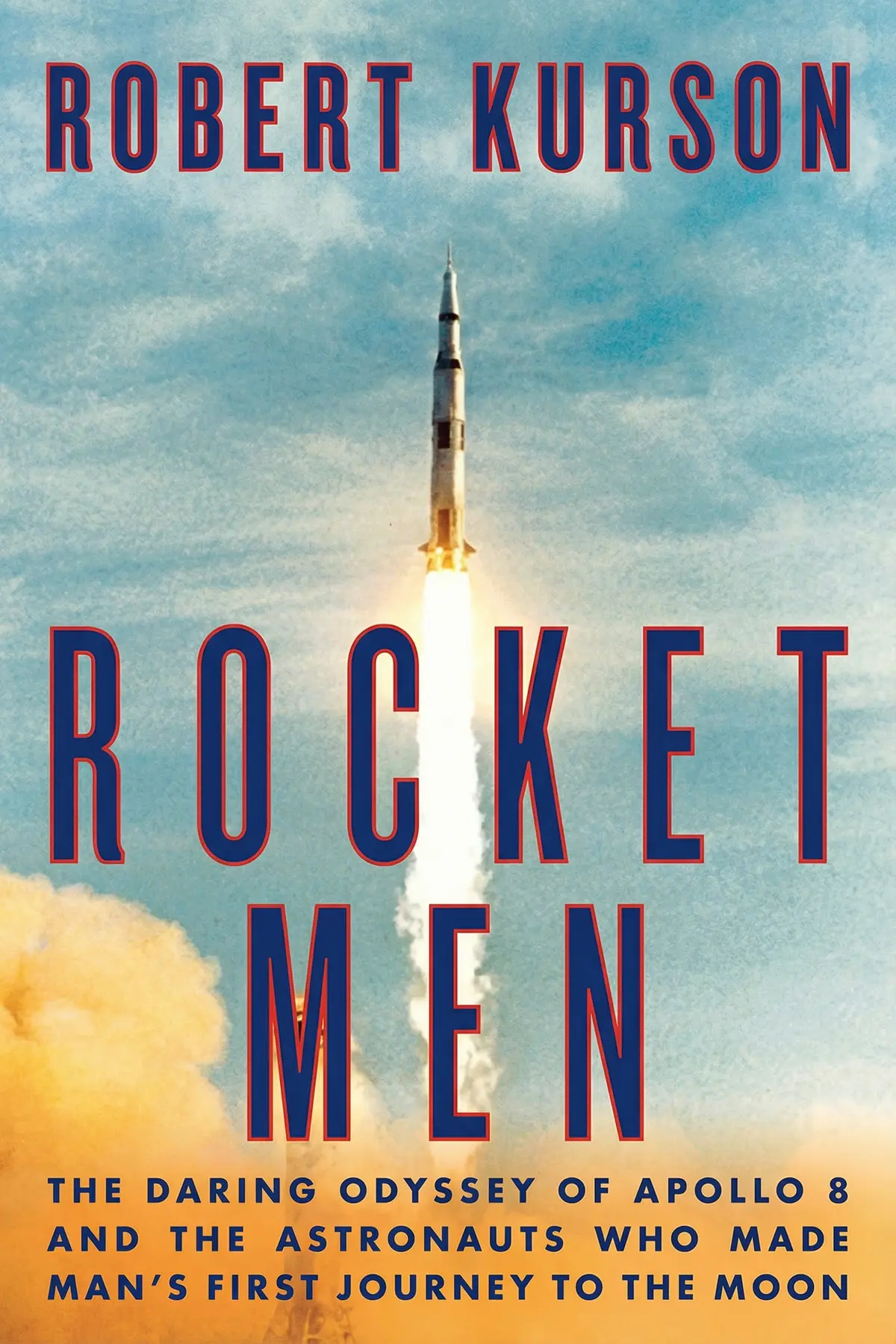
Most people know about the first moon landing and almost nothing about the risky flight that made it possible. In Rocket Men, journalist Robert Kurson tells that story: Apollo 8, the first crewed mission to circle the moon and return, prepared by a lagging and divided United States in about four months. Kurson shows that the gamble worked because of exact calculation, a crew that pulled together and thousands of people the world never saw.
And a flight launched to beat the Soviet Union ended by showing humanity its own small, shared planet. Along the way you will hear why 69 miles above the moon was the target, what a coded message about custard told one astronaut, and how two wives in pearls posed for photographers while their husbands tried to leave lunar orbit. It is a lesson in how bold bets are really won.
1 min 34 sec
In 1957, the same year Sputnik reached orbit, an American rocket barely cleared its launch pad before exploding, and by 1961 a Soviet cosmonaut had circled the Earth. The way the United States answered that humiliation set the terms for everything Apollo 8 would later attempt.
1 min 31 sec
War protests, assassinations and riots in 130 cities made 1968 a year of fracture. Kurson explains what a single spaceflight could and could not offer a country pulling itself apart.
1 min 30 sec
A secret intelligence report, a fatal fire and a rocket that shook itself to pieces all landed on NASA at once. One engineer’s answer turned panic into a four-month plan.
1 min 25 sec
Apollo 8 was never going to land, yet its orbit was planned to the mile as if it would. A dart, a peach and the number 69 explain why that mattered.
1 min 38 sec
One astronaut wanted adventure, one loved geology and one wanted to beat the Soviets. A grumpy crew on the previous flight shows why that mix of motives turned out to be an advantage.
1 min 35 sec
Behind the moon, the crew fired an engine with no radio contact at all. And on the way home, one astronaut watched what looked like his heat shield breaking apart.
1 min 31 sec
A message about custard, a magazine photo shoot in pearls and a speech on a Navy ship reveal who else carried Apollo 8 to the moon, and who ended up with the credit.
1 min 28 sec
The mission was meant to win a Cold War contest. Its most lasting results were a hurried snapshot from a small window and a Christmas broadcast watched around the world.
1 min 09 sec
Rocket Men is finally a portrait of how audacious things get done. The United States began the space race behind and kept slipping: an exploding rocket, Gagarin’s orbit, a fatal fire, a shuddering Saturn V. Its response was to move faster, cut the goal to a piece that could be done perfectly, rehearse it as if it were the real landing and give it to three men who trusted each other. Around them stood thousands of others, including a wife who kept the custard in the oven so her husband could look at the moon.
The story supports a few habits. When you are behind, pick one bold target and shrink it to what your team can carry out without error. Rehearse under real conditions, and agree beforehand on the signal that means success. Choose teammates for how deeply they care, and thank the people nobody photographs.
Then keep Earthrise in mind. Three men flew to win a race and brought home a picture of one small, shared world. A hard project can end by changing how you see the place you started from.
In 1968 the United States was losing the space race and coming apart at home. The Soviets had launched Sputnik, sent Yuri Gagarin into orbit and were reported to be close to flying cosmonauts around the moon. NASA was still recovering from the Apollo 1 fire and a failed Saturn V test, while war, riots and assassinations divided the country. Robert Kurson tells how NASA answered with a gamble: Apollo 8, a crewed mission to orbit the moon and come home, prepared in about four months. He follows the engineer who shrank the goal, the three astronauts and their very different motives, the engine burn performed out of radio contact behind the moon, and the wives who hid their fear while the press watched. The result is a close account of how an audacious plan actually succeeds, and of what it left behind: the Earthrise photograph and a Christmas broadcast that turned a Cold War contest into a reminder of what all people share.
Space and history fans who know the moon landing but not the flight that paved the way.
Team leads and project managers facing a hard deadline after painful setbacks.
Readers curious about 1968 and how the Cold War shaped America's push to the moon.
Robert Kurson, born in 1963 and based in Chicago, trained at Harvard Law School and practiced real estate law before turning to writing. He started at the Chicago Sun-Times, moved to Chicago magazine and then to Esquire, where he became a contributing editor and won a National Magazine Award. His work has also appeared in Rolling Stone and The New York Times Magazine. His other books include Shadow Divers, about two Americans who found a sunken German U-boat, and Crashing Through, about a man who gains sight after a lifetime of blindness.

Listeners find this narrative to be a gripping experience that flows like a novel, providing a superb chronicle of the Apollo 8 journey and exceptional insights into its preparation. The prose is expertly written, and listeners value the deep historical context, particularly regarding the year 1968. They describe it as an absorbing adventure that embodies human bravery and spirit, while maintaining a perfect harmony between the mission’s technical details and its personal elements.
1968 was a year of absolute chaos, and Kurson manages to capture that tension perfectly within the framework of a space mission. Most people focus on the Apollo 11 moon landing, but this book argues convincingly that Apollo 8 was the more daring feat. I was moved by the juxtaposition of the Vietnam War and civil rights protests against the quiet, terrifying solitude of three men orbiting the moon. The writing is so cinematic that I often forgot I was reading nonfiction. While the technical bits are present, they never bog down the emotional core of the story. It’s a testament to the human spirit during a time when everything seemed to be falling apart. Truly a must-read for history buffs.
Show moreWhy did it take me so long to read this? I’ve always been fascinated by NASA, yet I knew surprisingly little about the specific risks involved in the Christmas 1968 mission. Kurson doesn't just focus on the men in the capsule; he gives significant space to their wives—Susan Borman, Marilyn Lovell, and Valerie Anders. Seeing the mission through their eyes added a layer of anxiety and groundedness that many space books lack. The reality of their domestic lives, lived under the shadow of potential tragedy, was heartbreaking. To be fair, some of the political context felt a little repetitive if you're already familiar with the 60s. However, the description of the 'Earthrise' photo alone makes the whole book worth it.
Show moreHonestly, this is one of the few books that actually made me hold my breath during chapters where I already knew the outcome. Kurson has a gift for building suspense out of historical facts that should be common knowledge. I was particularly struck by the 'Genesis' reading on Christmas Eve and how that moment impacted a fractured world. The book does a great job illustrating how thin the margin for error was for these men. If one engine didn't fire at the exact right second, they were lost in space forever. It’s a terrifying thought that keeps you turning pages late into the night. It isn't just a book about NASA; it’s a book about what it means to be brave when the world is watching.
Show morePicked this up on a whim and was completely blown away by the depth of the personal interviews. It's rare to get this level of candid detail from Borman and Lovell so many years after the fact. The stories about the physical toll of spaceflight—including the less glamorous parts like space sickness—made the astronauts feel like real people rather than untouchable icons. I loved how the book highlighted the precariousness of the technology they were using. They were essentially flying a giant tin can powered by computers less sophisticated than a modern calculator. It’s a gripping reminder of what can be achieved through sheer collective will. Highly recommended for anyone who loves a good underdog story.
Show moreAs someone who usually finds military or space history a bit dry, I was surprised by how much I loved this. It reads exactly like a thriller novel, with short, punchy chapters that keep the momentum moving forward. The way Kurson ties the mission to the assassinations of MLK and RFK creates a powerful emotional arc. It gives the Apollo 8 journey a sense of purpose that goes beyond just beating the Russians. Truth is, I teared up a little during the final chapters when the 'Earthrise' photo is described. It was a moment of unity in a year defined by division. This is easily one of the best nonfiction books I've picked up in years.
Show moreNot what I expected at all, but in the best way possible. I thought this would be a dry recitation of dates and flight paths, but instead, it’s a deeply moving portrait of three families. The courage of the wives, waiting by their 'squawk boxes' for any news of their husbands' survival, was just as compelling as the flight itself. Kurson's writing is elegant and descriptive, painting a picture of the lunar surface that feels hauntingly beautiful. It’s a great balance of science, politics, and heart. Even if you aren't 'into' space, you should read this for the historical perspective on 1968. It is a brilliant reminder that even in our darkest times, we are capable of reaching for the stars.
Show moreAfter hearing so much praise for the audiobook, I finally dove into Ray Porter's narration, and wow, he really brings these astronauts to life. I’ll be the first to admit that rocket science isn't usually my thing, but the way Kurson explains the 'Trans-Lunar Injection' made sense even to a layman like me. The pacing is relentless, feeling more like a high-stakes thriller than a history text. My only minor gripe is that the author’s tone can lean a bit heavily into hero worship at times. Still, the level of research is undeniable, especially the interviews with Borman, Lovell, and Anders. This is exactly the kind of inspiring story we need right now.
Show moreThe chapter on the decision to change the mission from an Earth orbit to a Lunar orbit was fascinating. It shows the sheer guts of the NASA leadership, specifically Chris Kraft and Bob Gilruth, who pushed for this when the Soviets were gaining ground. I've read several books on the space race, but none have captured the bureaucratic gamble quite like this one. Kurson balances the math with the humanity of the astronauts perfectly. My only complaint is that the epilogue felt a bit rushed compared to the meticulous detail of the launch prep. Nevertheless, the storytelling is top-tier. It makes a complicated piece of history accessible to anyone with an interest in adventure.
Show moreEver wonder what it actually felt like to be inside the Command Module during the first lunar orbit? This book is probably the closest most of us will ever get to that experience. The technical descriptions are vivid without being confusing, and the human drama is front and center. I particularly appreciated the focus on the families back in Houston, as their perspective is often sidelined in these types of accounts. Frankly, the book is quite long and the middle section regarding the training can drag a little bit if you aren't a hardcore space nerd. But once they launch, the tension never lets up until they splash down in the Pacific.
Show moreWhile I appreciate the amount of research that went into this, the narrative voice felt a bit too 'rah-rah' for my personal taste. Don't get me wrong, the Apollo 8 mission was an incredible achievement of engineering and bravery, but the prose sometimes veers into melodrama. I found myself skimming some of the more flowery descriptions of the American spirit to get back to the actual mission specs. It’s a solid history, but I think I prefer nonfiction that maintains a more objective, clinical distance from its subjects. If you want a story that reads like a Tom Clancy novel, you'll love it. For me, it was just okay.
Show moreIt tells the story of Apollo 8, the first crewed mission to orbit the moon and return. Kurson shows how a United States falling behind the Soviets, and divided by war and assassinations in 1968, prepared the flight in about four months. He follows the planning, the three astronauts, the risky maneuvers and the families and staff who supported them, ending with the Earthrise photograph and the Christmas broadcast.
Apollo 8 was planned as if it were a landing mission, so its calculations, training and mission rules laid the groundwork for later flights. Its orbit 69 miles above the surface tested the exact height a landing craft would need. The crew became the first people to see the far side of the moon, photographed it up close and scouted possible landing sites.
Earthrise is the picture Bill Anders took when Earth suddenly appeared in his window while Apollo 8 orbited the moon. He grabbed a camera and shot as fast as possible. Kurson presents it as one of the mission’s two lasting gifts, alongside the Christmas broadcast, because it showed Earth as small and fragile and made people feel what all humans share across borders.
The story suggests shrinking a bold goal to what can be done perfectly, as engineer George Low did, and rehearsing it under real conditions. It shows the value of a crew whose motives differ but whose commitment matches, and of deciding in advance what success looks like. It also highlights the families and staff behind the famous names, whom Borman thanked on the USS Yorktown.
Michael Axworthy

Tom Standage

Ishmael Beah




William J. Bernstein

Ben Macintyre


AUDIO SUMMARY AVAILABLE
Get the key ideas from Rocket Men by Robert Kurson, plus 5,000+ more nonfiction titles.









