

12 min 04 sec
Available in: English
Robert’s Rules of Order
A practical guide to running meetings that reach decisions. It covers equal rights for every member, majority rule, and motions, the tool that gets each idea introduced, debated and settled before the meeting ends.
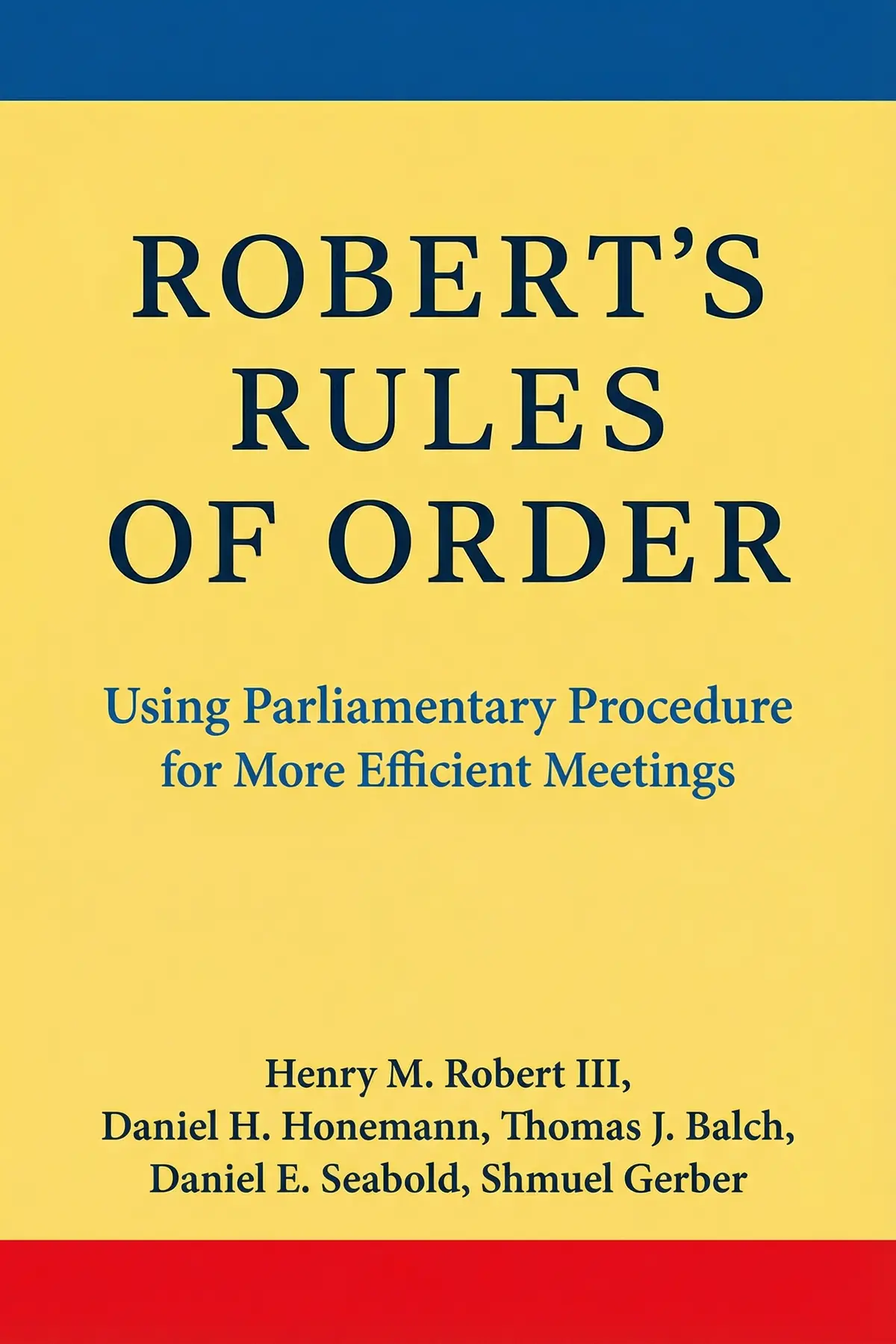
Table of Content
1. Introduction
1 min 01 sec
If your meetings run long, decide nothing and leave people angry or confused, the fix may be older than any productivity app. Robert’s Rules of Order, now kept up to date by Henry M. Robert III, Daniel H. Honemann, Thomas J. Balch, Daniel E. Seabold and Shmuel Gerber, starts from one plain idea: a group works best when everyone agrees on the rules before the talking begins. The first version appeared in 1876, written by Henry M. Robert, an Army engineer who had been asked to chair a meeting that collapsed into chaos. His guidelines remain the leading authority on meeting procedure for local governments and membership groups across the United States.
The core idea is simple. Give every member equal rights, let the majority decide, take one subject at a time as a motion, and settle every motion before anyone goes home. Learn a few of these moves and you can run a meeting that reaches decisions.
2. Give every member an equal voice and vote
1 min 39 sec
Some meetings belong to whoever talks loudest, and others to whoever holds rank. Two old principles, turned into a few firm habits, change who gets heard without asking anyone to be braver than they are.
3. Put the foundations in place before you meet
1 min 39 sec
A group can know every rule and still end up arguing about whether the rules apply at all. A few decisions made before the first meeting stop that argument from ever starting.
4. Turn any idea into business with a motion
1 min 37 sec
A Motown love song hides a small piece of meeting procedure. That procedure decides which ideas get the group’s time and which disappear in seconds, and it filters out one familiar kind of time waster.
5. Know which kind of motion you are making
1 min 44 sec
Some motions propose new business, others change the business already on the floor, and some affect only the meeting itself. Knowing the difference tells you which tool to use when a discussion stalls.
6. Keep a dragging debate moving without silencing anyone
1 min 39 sec
Cutting a long discussion short can feel like steamrolling the people who still want to speak. The manual sets a higher bar for ending debate, and it offers gentler options than shutting the conversation down.
7. Revisit a vote fairly and still end on time
1 min 41 sec
Every group sometimes regrets a decision. But a process that lets anyone reopen any result never finishes anything. Two carefully limited motions, and one rule about ending, make it possible to have both.
8. Conclusion
1 min 04 sec
Robert’s Rules can look like a thick book of procedure, but its purpose is human. An Army officer who had watched a meeting collapse wanted a way for people who disagree to decide things together without anyone being shouted down. Nearly a century and a half later, the answer still rests on a few commitments. Every member has equal rights and the majority decides. The group takes one subject at a time, and nothing is left without a fate.
You do not need to memorize every motion to use that. Ask your group to write its parliamentary authority, its quorum and its officers into the bylaws. In your next meeting, ask each speaker to say first whether they are for or against, and hold everyone to one turn before anyone takes a second. When a debate starts to loop, propose a time limit or a committee instead of another hour of talk.
The real test of a fair meeting is not whether your side wins. It is whether the people who lost the vote walk out knowing they were heard, and knowing exactly what was decided.
About this book
What is this book about?
Most people know the feeling of leaving a meeting that ran long, decided nothing and left tempers short. Robert's Rules of Order offers an answer first written in 1876 by Henry M. Robert, an Army engineering officer who had been asked to lead a meeting that fell apart. Today his guidelines are the leading authority on meeting procedure for local governments, organizations and membership groups across the United States. The manual rests on two principles: every member has equal rights to attend, raise subjects, speak and vote, and the majority decides. From those principles it builds a working structure. The group adopts the rules in its bylaws, sets a quorum and appoints a chair and a secretary. Ideas then enter the meeting as motions, need a second, are debated in fair turns and are finally voted on. Readers learn the three families of motions and the tools for limiting debate, postponing, referring to a committee, reconsidering a vote and rescinding an earlier decision. They also learn why every motion has to be settled before adjournment. The result is a meeting where the losing side still feels heard and everyone knows what was decided.
Book Information
Who it's for
Leaders of stalled meetings
Board members, club officers and committee chairs whose meetings drag on without decisions.
Leads wanting balanced discussion
Team leads who want quiet colleagues heard and dominant voices kept in check.
New to formal motions
Volunteers and new members of local governments or associations who need to learn how formal motions work.
About the Author
Henry M. Robert III
Henry M. Robert III, grandson of the manual's original author, worked with his mother, Sarah Corbin Robert, and lawyer William J. Evans on the complete revision published in 1970 as Robert's Rules of Order Newly Revised. Daniel H. Honemann, a Baltimore attorney, joined the work in 1990. Thomas J. Balch co-authored later editions and the shorter In Brief guide. Daniel E. Seabold, a Hofstra University mathematician, and Shmuel Gerber, a professional parliamentarian, helped write the 11th and 12th editions.
Ratings & Reviews
Ratings at a glance
What people think
Listeners find this title to be an excellent resource that is simple to navigate and comprehend, offering a concise set of standard regulations alongside an extensive look at procedural guidelines. They value its utility during intricate gatherings, with one listener highlighting how it fosters healthy debate. The guide earns praise for its straightforward prose and affordable cost, serving as a worthwhile inclusion in any personal collection.
Top reviews
Brooklyn
This book is an absolute lifesaver for anyone thrust into a leadership position without years of training in parliamentary procedure. I was pleasantly surprised to see the little logo that looks suspiciously like something from a Tolkien novel on the cover, which made me smile before I even opened it. Truth is, the full manual is way too dense for a beginner to digest in a weekend, so this abbreviated version is perfect. It gives you the most essential twenty percent of the rules that you actually need to survive a standard meeting without causing a riot. While it’s definitely not a page-turner, the clarity of the writing and the specific examples of what to say during motions make it indispensable. I keep it in my bag for every board meeting just in case things get heated.
Show moreTantipat
Not what I expected at all, but in a weirdly positive way that makes me feel much more confident in my role as secretary. I’ve heard people describe Robert's Rules as a sort of "Dungeons and Dragons" for keeping meetings under control, and after reading this, I totally see why. It provides a rigid framework that, while boring to some, actually encourages healthy debate by giving everyone a fair chance to speak. The sample dialogue sections are probably the most useful part of the entire book because they tell you exactly what words to use. Frankly, if you are involved in any kind of organized group, you need to have this on your shelf for the price alone. It turns chaos into order almost instantly.
Show morePot
Frankly, I think every citizen should have a copy of this in their personal library to understand how democratic organizations are supposed to function. The authors have done a remarkable job of taking an encyclopedic set of rules and turning them into a succinct, easy-to-understand guide for the rest of us. It promotes a level of accountability and transparency that is often missing from modern discussions and debates. I particularly liked the instructions for participants; it’s not just for the person running the show, but for everyone in the room. The price is right, the writing is sharp, and the information is timeless. It’s a must-have for anyone who cares about running meetings smoothly and fairly without unnecessary drama.
Show moreSamuel
After hearing about Robert's Rules for years, I finally bought this "In Brief" version to see what the fuss was all about. It’s a brilliant little manual that manages to be comprehensive without being overwhelming, which is a difficult balance to strike with such technical material. The structure is logical, moving from basic motions to more complex voting procedures in a way that builds your confidence as you go. It really helps to clarify those confusing moments in meetings where everyone is talking at once and nothing is getting decided. Not gonna lie, I even found some of the old-fashioned examples quite charming in their own way. It’s an essential purchase for any professional who wants to master the art of orderly meetings.
Show moreAlejandra
Ever wonder how to keep a room full of opinionated people from shouting over each other for three hours straight? I bought this because I needed a crash course before chairing a debate, and I honestly don’t think I could have managed without it. It’s significantly more accessible than the unabridged version, though it does occasionally remind you that it shouldn’t be used as the ultimate authority for complex legal disputes. The tables and charts are incredibly helpful for a quick reference when you’re in the middle of a vote and someone calls for a point of order. To be fair, the content is still pretty dry, but the authors did their best to make it digestible. It’s a solid investment for any professional's library.
Show moreNarut
As someone who recently joined a nonprofit board, I felt completely lost during my first few meetings until I sat down with this guide. It distills the complex, old-fashioned rules into something that feels manageable for a modern business environment or a small community committee. The way it breaks down the roles of various officers ensures that everyone knows exactly what they are responsible for during the session. Gotta say, the layout is excellent, with clear headings and a succinct style that gets straight to the point without unnecessary fluff. It’s not exactly recreational reading, but it’s a vital tool for ensuring fairness and accountability in any formal gathering. My meetings have become much more productive since I started implementing these basic procedures.
Show moreTee
Finally got around to studying this after years of winging it in committee meetings, and I regret waiting so long to get a copy. This book is equal parts fascinating and mind-numbingly tedious, but it is undeniably effective at providing a structure for fair play. It focuses on the common rules that cover 80% of situations, which is exactly what most of us need without the headache of the master text. The writing is surprisingly clear, and the authors do a great job of explaining the "why" behind certain procedures. Personally, I found the section on bylaws and minutes to be the most practical part for my current needs. It’s a handy reference that I’ll definitely be keeping within arm's reach from now on.
Show moreLeo
Picked this up after attending a chaotic conference where nobody seemed to know the proper way to introduce a motion or take a vote. While the book is certainly much easier to navigate than the standard 600-page tome, it still feels a bit like reading a technical manual for a toaster. I found the sample scenarios about tennis clubs and social organizations a bit dated, yet they do help illustrate how the rules apply in real-world settings. It serves its purpose as a basic introduction, but I often found myself wishing I had just bit the bullet and bought the full version for more detail. It’s okay for a quick refresh, but it left me wanting a little more depth on specific parliamentary maneuvers.
Show moreJib
Look, nobody is picking this up for the scintillating prose or a gripping narrative arc, but it gets the job done. It is a very dry read that can be a struggle to get through if you aren't actively applying it to a meeting you have coming up. While it’s a lot shorter than the full version, it still feels like a chore to navigate through the various layers of parliamentary procedure. I appreciate the charts and the "what to say" examples, but the tone is just so clinical that it’s hard to stay focused for long periods. It’s a good source book to have on hand for quick questions, but don't expect to actually enjoy the process of reading it. It's a tool, nothing more.
Show moreConnor
The chapter on motions was helpful, but I found the constant disclaimers about this not being the "official" authority to be incredibly frustrating. Why would I spend time reading an abbreviated version if I still have to go buy the full-length book to be certain of the rules? It feels like a "cheat sheet" that was expanded into a small book just to make a few extra dollars from people who are afraid of the primary text. In my experience, if you're in a situation where you need Robert's Rules, you probably need the whole thing to avoid being corrected by a "rules lawyer." It’s easy enough to read, sure, but it feels incomplete and left me searching for answers that weren't there. It’s just too basic for any serious board work.
Show moreQuestions about this book
What is the main idea of Robert's Rules of Order?
The manual argues that meetings work when a group agrees on one set of rules in advance. Every member has equal rights to attend, raise subjects, speak and vote, and the majority decides. Ideas arrive one at a time as motions, are debated in fair turns and are settled by a vote or a ruling from the chair before the meeting ends.
How does a motion work in Robert's Rules of Order?
When nothing else is under discussion, a member recognized by the chair proposes that the group take an action. Usually a second member has to back the proposal, and without that support it dies and the group goes on to other business. Once seconded, the chair runs the debate. Each speaker gets one turn before anyone speaks twice and opens by stating whether they are for or against.
What are the types of motions in Robert's Rules?
There are three broad families. Main motions bring new business, such as a donation to a charity. Secondary motions are subsidiary, privileged or incidental. They amend, postpone or refer a motion, deal with recesses and adjournment, or handle objections, appeals of the chair’s rulings and suspending the rules. Renewal motions bring a matter back before the group.
How do you stop a debate that goes on too long?
A member can move to limit debate by capping the number of speakers or the time allowed, or move to close debate entirely. Both need a two-thirds vote. Gentler options include postponing the motion to a set time, referring it to a committee for expert review, or tabling it, which in the manual means putting it aside indefinitely.
Can a group change a decision it already voted on?
Yes, in two ways. Within the same meeting, a member who voted with the majority can move to reconsider, and if a majority agrees, the vote is taken again. To change a decision from an earlier meeting, members move to rescind. That needs a simple majority with advance notice, or two-thirds without notice.
Readers also enjoyed


A Year with Peter Drucker: 52 Weeks of Coaching for Leadership Effectiveness
Joseph A. Maciariello



Acting with Power: Why We Are More Powerful Than We Believe
Deborah Gruenfeld

All In: How Great Leaders Build Unstoppable Teams
Mike Michalowicz



7 Powers: The Foundations of Business Strategy
Hamilton Helmer
AUDIO SUMMARY AVAILABLE
Listen to Robert’s Rules of Order in 15 minutes
Get the key ideas from Robert’s Rules of Order by Henry M. Robert III, plus 5,000+ more nonfiction titles.
- 5,000+ titles
- Listen as much as you want
- 7-day free trial
- Cancel anytime









