
13 min 49 sec
Available in: English
Rewired: The McKinsey Guide to Outcompeting in the Age of Digital and AI
Shows why so many companies' digital and AI efforts barely touch profits, and how leaders can rewire goals, talent, teams, technology, data and adoption so that thousands of teams keep improving the business with technology.
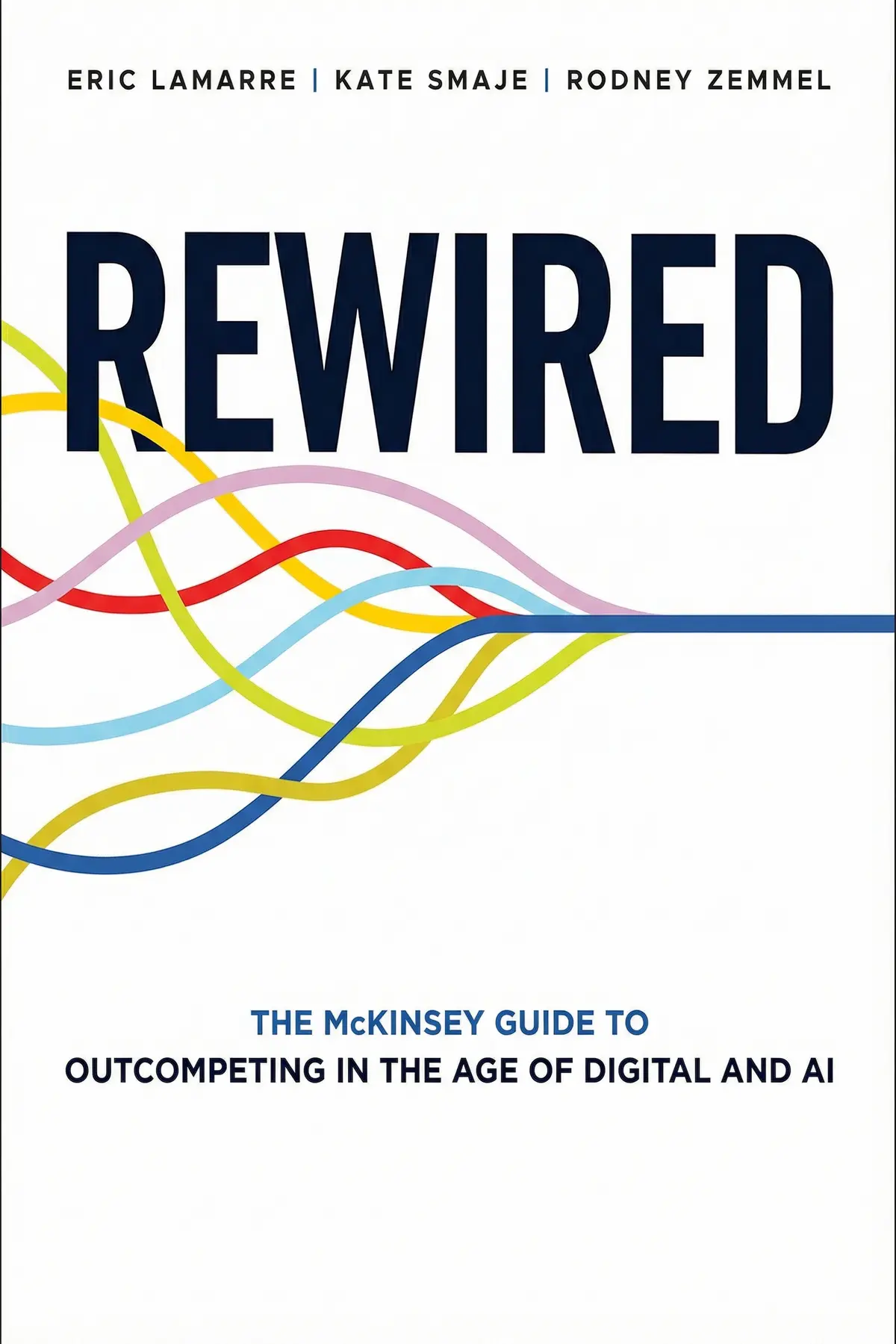
Table of Content
1. Introduction
1 min 06 sec
Many companies have bought digital tools and launched AI pilots, yet see little of it in their results. In Rewired, McKinsey senior partners Eric Lamarre, Kate Smaje and Rodney Zemmel open with an unnamed chief executive who complained that digital was visible all over his company apart from its profits. Drawing on the firm’s analysis of 200 large digital and AI transformations, the authors argue that the fix is rarely another technology purchase.
Lasting results come when leaders rewire the business itself: its goals, its people, the way teams are organized, its technology, its data and the way new tools reach daily work. Done well, that rewiring lets hundreds or thousands of teams keep using technology to serve customers better, bring down unit costs and create new value.
What follows is their playbook in six moves, from a target the whole company can aim at to getting people to actually use what gets built, with the questions a leader should be able to answer at each step.
2. Turn a vague digital ambition into a target
1 min 49 sec
Most digital visions sound inspiring and give nobody anything to do on Monday morning. One small rewrite, longer and far less elegant, changes who can act on it and who is held to it.
3. Choose a first move big enough to matter
1 min 53 sec
Start too small and nothing important shifts. Start too big and the company buckles under the weight. The authors offer a way to find the slice that is just right, and a construction firm shows the payoff.
4. Build a talent bench that grows its own experts
1 min 59 sec
A brilliant developer who never wants to manage anyone is a puzzle for most promotion systems. How a company answers that puzzle decides whether its digital skills deepen or drain away.
5. Set up teams and technology that ship fast
1 min 54 sec
The authors want large companies to become fast and flexible, so that their whole organization, not just IT, can innovate digitally at speed. The authors trace that delay to two design choices, and one of them explains why so many AI projects never leave the lab.
6. Make data as easy to use as tap water
2 min 06 sec
Collecting every data point feels like progress, yet it rarely sets a company apart. An insurer, a household water pipe and a bank with a thousand data experts show what does.
7. Get people to actually use new tools
1 min 53 sec
Plenty of digital projects work perfectly in testing and then fade once they meet real staff. A mining company spent eight months avoiding that fate, and its approach can be copied far outside mining.
8. Conclusion
1 min 09 sec
In the authors’ view, digital value sits in the wiring of the company: a target the leaders own together, people with room to grow, teams and systems that release changes fast, data anyone can draw on, and rollouts planned around the humans who must change. Leave one of those out and the unnamed chief executive’s complaint returns, with digital showing up everywhere except the profit line.
The authors also refuse the comfort of a finish line. Because technology keeps moving, they treat this rewiring as work executives will carry on for their entire careers.
The place to begin is modest. Rewrite your digital goal until it carries a number and a date, the way GreenTech’s did. Pick one domain where customers or staff feel real pain, and name the indicator that would prove it solved. Then, before anything is built, decide who will train the people who must use it.
At Freeport-McMoRan, engineers and frontline crews spent eight months shaping one AI system together. That kind of shared effort, repeated across hundreds or thousands of teams, is the picture of a rewired company.
About this book
What is this book about?
Most large companies have started some kind of digital or AI program. Far fewer can point to results. Eric Lamarre, Kate Smaje and Rodney Zemmel, senior leaders at McKinsey, argue that the missing piece is rarely the technology. It is the organization around it. Drawing on McKinsey's analysis of 200 large digital and AI transformations, Rewired lays out the playbook the firm says it has used with clients over six years. It covers six connected capabilities: a roadmap the top team owns, a talent bench where digital experts can grow, an operating model built for speed, a distributed technology environment, data that is easy to use everywhere, and the work of getting people to adopt new tools and scaling them across the enterprise. Case studies such as Freeport-McMoRan and DBS show the ideas in practice. Readers get a practical way to set a digital goal with a number and a date, choose where to start, organize people and data, and plan rollouts around the humans who must change. The authors also insist the work never really ends, because technology keeps moving.
Book Information
Who it's for
Executives awaiting digital results
Executives whose digital and AI programs look busy but barely show up in results.
Leaders planning the organization
Transformation, product and data leaders planning how to organize teams, technology and data.
Managers leading digital work
Managers who lead digital specialists or must roll out new tools to frontline staff.
About the Author
Eric Lamarre
Eric Lamarre is a senior partner in McKinsey's Boston office who has led McKinsey Digital in North America and helped shape how the firm serves clients through digital and AI transformations. Kate Smaje is a senior partner who holds McKinsey's global leadership role for technology and AI. Rodney Zemmel, a former molecular biologist, has been a global co-leader of McKinsey Digital and works with clients on digital transformations, AI and building digital businesses.
Ratings & Reviews
Ratings at a glance
What people think
Listeners view this work as an outstanding manual for digital transformation, providing actionable tips and an all-encompassing method for executing digital plans within a company. They value how easy it is to digest and believe it is essential reading for corporate executives.
Top reviews
Kavya
Finally, a transformation guide that doesn't just speak in high-level riddles or buzzwords! This book is essentially the McKinsey playbook made public. The sections on building proprietary digital solutions and fostering high-quality talent are standout chapters. I loved the story about Zoe, the developer who wants to remain a master coder rather than a manager. It’s a refreshing take on how to value technical expertise. Look, digital transformation is incredibly hard work, and this book doesn't sugarcoat the effort required. It’s packed with checklists and team-staffing models that you can actually use in a Monday morning meeting. For any leader in a traditional organization, this is an essential read.
Show moreAria
Ever wonder why 70% of digital transformations fail? This book provides the most comprehensive answer I’ve seen yet. It’s not about the technology itself, but the six enterprise capabilities you have to 'hardwire' into your culture. The writing is incredibly sharp and clear, which is what you’d expect from this trio of authors. I found the case studies—especially the ones involving LEGO and DBS—to be highly motivating examples of what’s possible. They don't just tell you to be 'data-centric'; they explain how to build the data products that drive actual decision-making. It’s a heavy, technical book in some parts, but it is well worth the time for any serious practitioner.
Show moreChamp
The structure here is what sets it apart from the sea of AI hype books currently flooding the market. Instead of just talking about what AI might do in the future, it focuses on the unsexy, foundational work required to use it today. Managing data is treated as a core business capability rather than a technical chore. Personally, I found the section on 'domain-based' transformation to be a game-changer for my own strategy. By identifying specific areas of activity that are ripe for change, you can avoid the 'boil the ocean' trap that kills most projects. It’s a masterclass in organizational design. If you want to outcompete your peers, you need to read this.
Show moreArjun
Digital transformation is a messy, painful, and often confusing process, but this book offers a decent flashlight for the tunnel. I’ve been through several of these 're-orgs' and this is the first time I’ve seen the 'McKinsey way' laid out so clearly. The emphasis on user adoption is particularly important. Most companies build the tech but forget that people actually have to use it. The authors argue that talent is the heart of transformation, and I couldn't agree more. It’s a bit dry and academic in spots, but the sheer volume of practical tools makes it a mandatory reference for our leadership team.
Show moreOn
Picked this up thinking it would be another generic consultant pitch, but it's actually quite practical. The authors provide a roadmap that feels road-tested rather than purely theoretical. I especially appreciated the focus on 'pods' and how to structure cross-functional teams for actual delivery. To be fair, some of the advice on leadership alignment feels like corporate boilerplate we’ve all heard before. However, the technical architecture diagrams and workplans add a layer of detail that most business books lack. It’s a solid manual for anyone trying to navigate the messy reality of legacy systems. Not a perfect cure-all, but a very useful flashlight for the tunnel of digital change.
Show moreGung
As someone who has navigated three different 'agile' migrations, the chapter on scaling delivery hit close to home. Rewired does an excellent job of distilling a decade of working models into a very accessible summary. The book is organized into 35 terse chapters, making it easy to jump to the specific problem you’re facing at the moment. I did find the focus a bit narrow at times. It treats transformation as an internal project you can control through sheer force of will. In reality, the external market and vendor ecosystems are much more chaotic than this book suggests. Still, as an internal guide for optimizing your own capabilities, it’s one of the better options on my shelf.
Show moreUbolwan
McKinsey really knows how to package their wisdom into something digestible and authoritative. After hearing so much hype about AI lately, I needed something that felt grounded in operational reality. This book delivers that. It covers everything from talent paths to cloud infrastructure without getting lost in the clouds themselves. One minor gripe is that the case studies feel a bit sanitized for a corporate audience. I would have loved to hear more about the failures or the 'ugly' parts of the process. Regardless, the checklists and best practices provide a sense of confidence that is often missing during a chaotic pivot. It’s a road-tested manual for the modern era.
Show moreOtt
It’s a bit of a mixed bag, to be fair. On one hand, you get these incredibly clear guidelines on how to structure a digital department from the ground up. On the other hand, there’s an underlying irony that you probably need to hire the authors' firm to actually execute any of it. The frameworks for defining an AI strategy are well thought out and reflect real-world experience. However, the book falters when it comes to the 'how' of implementation in a messy, non-corporate environment. It may look sensible on paper, but the authors don't know your specific business constraints. It’s a good reference for the 'what,' but the 'how' is still up to you.
Show moreMontri
Not what I expected from such a big-name release, though it certainly has its moments. The book offers a very clear roadmap for internal change, which is helpful for legacy firms. However, it feels like it’s answering the questions of yesterday. We are moving into an era of networked coordination, yet this book treats transformation as a purely internal matter. To be fair, the sections on data-centricity are sharp. But they ignore the reality that most firms rely on complex ecosystems of partners who won't just integrate with you. It’s useful for optimizing what you control, but it lacks a vision for how firms relate to the world outside them. A bit incomplete.
Show moreTanawan
The truth is, if you’ve spent more than six months working in a modern tech stack, this will feel like a collection of common sense. It is far too basic for practitioners. Where it does go into the weeds, such as specific 'pod' compositions, it becomes overly prescriptive and rigid. Frankly, the whole thing reads more like an expensive infomercial for McKinsey’s consulting services than a standalone guide. The authors are clearly brilliant, but they assume every business fits into a neat, sterile box they've designed in a vacuum. If you already understand agile software development, you can safely skip this. It's really for executives who still think 'digital' is just a website.
Show moreQuestions about this book
What is the main idea of Rewired?
Lamarre, Smaje and Zemmel argue that digital and AI pay off only when leaders rewire the business itself, not when they add another tool. Drawing on McKinsey’s analysis of 200 large transformations, they describe six capabilities to build: a shared roadmap, a strong talent bench, a fast operating model, a distributed technology environment, data that is easy to use everywhere, and the work of adoption and scaling. Together these let many teams keep improving the business with technology.
How do you write a good digital transformation vision according to Rewired?
The top team should agree on a vision that is bold but achievable and concrete enough to act on. The book’s illustration contrasts a vague goal, becoming a digital leader in sustainable technologies, with a precise one: raise sustainable energy output 30 percent in five years with digital tools while cutting operating costs 15 percent. The CEO must champion it, and the resulting roadmap is treated as a contract for the C-suite.
Why do AI projects fail to scale, according to the authors?
The authors argue that most machine learning failures come from weak practices for turning models into working products, which is why they stress MLOps. More broadly, tools fail when people do not adopt them. Freeport-McMoRan avoided this by having technology experts and frontline workers collaborate for eight months, and the book recommends role-based training, engaged leaders and a dedicated team to manage the rollout.
What does Rewired say about digital talent?
The authors want companies to offer career paths that let experts, such as a developer who wants to master coding rather than manage, advance in their field. They recommend multi-year learning paths matched to skills and levels, reskilling through bootcamps for people from nontechnical backgrounds, and a digital on-ramp that brings employees from many specialties up to speed on the company’s tools and methods.
Who should read Rewired?
It is written for leaders ready to do the hands-on work of changing how their company operates: executives running digital or AI programs, heads of technology and data, and managers responsible for specialist teams or for rolling out new systems. It suits readers who want a structured playbook with case studies such as DBS and Freeport-McMoRan, and who accept that the work is ongoing.
Readers also enjoyed









AUDIO SUMMARY AVAILABLE
Listen to Rewired in 15 minutes
Get the key ideas from Rewired by Eric Lamarre, plus 5,000+ more nonfiction titles.
- 5,000+ titles
- Listen as much as you want
- 7-day free trial
- Cancel anytime









