

59 Seconds: Change Your Life in Under a Minute
Richard Wiseman
 English
Shows how to stop circling problems and switch to solutions within a minute, using one simple question, small first steps, a daily goal plan and a 100-second mental workout built for high-pressure performance.
1 min 05 sec
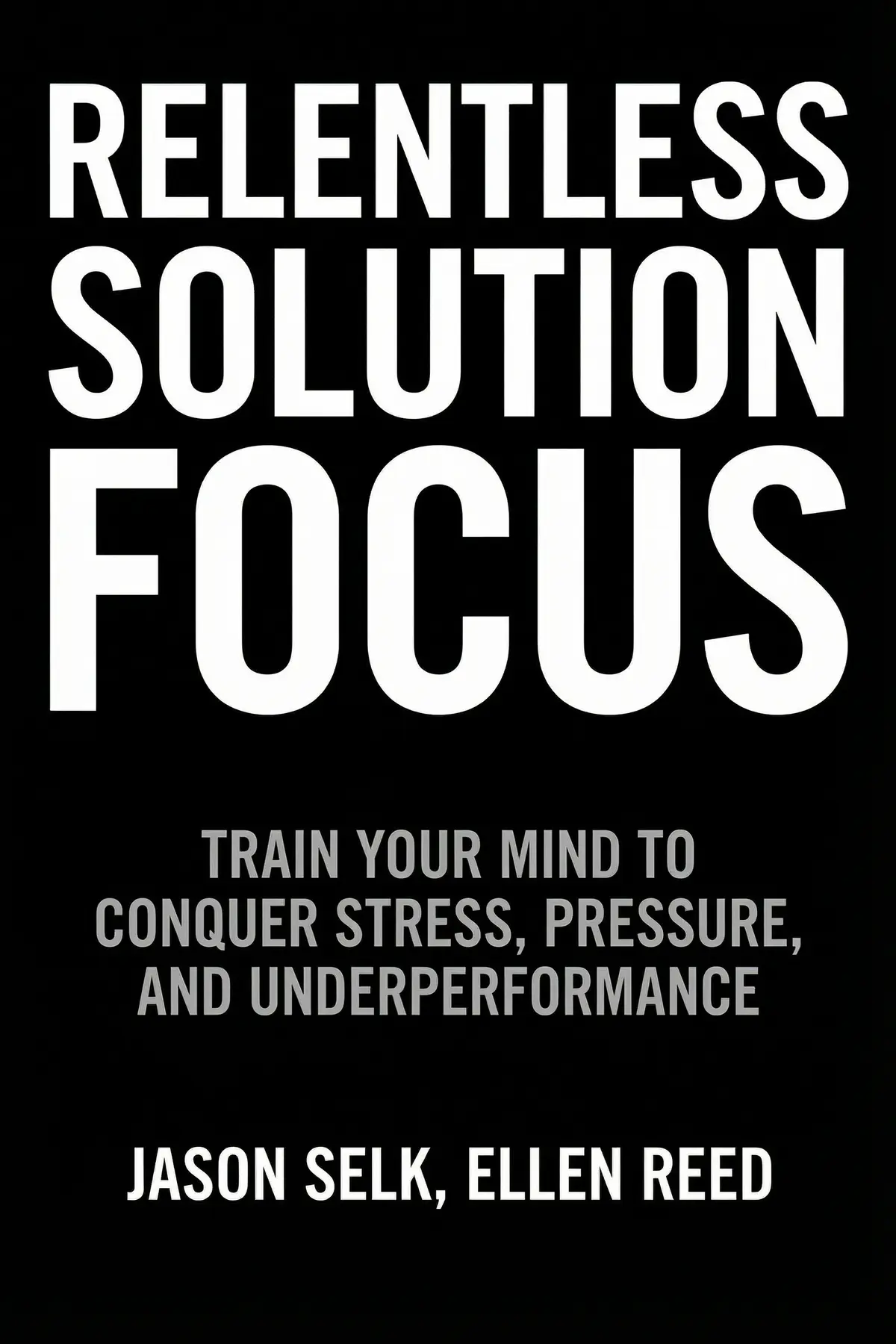
When a deadline slips or a client complains, most minds lock onto what went wrong and keep circling, and that circling raises stress while making the next decision worse. In Relentless Solution Focus, performance coach Jason Selk and experimental psychologist Ellen Reed argue that this default can be retrained. They call it problem-centric thought and treat it as a mental weakness, one that toughness can reverse.
Their alternative is a mindset that keeps steering attention to the next useful action, fast and over and over. The throughline is simple: mental toughness is a trainable habit of switching from problem to solution within a minute, then building that switch into daily goals and practice. The stories include a financial advisor facing nearly 400 nervous clients, a man who taught himself to be a morning person, a room of baseball stars taking notes and a mind workout that fits into 100 seconds. Each one doubles as a tool to try this week.
1 min 36 sec
A client kept checking a coworker’s numbers several times a day, though he was winning the comparison all along. His story shows why studying a problem harder can be the very thing that keeps it alive.
1 min 37 sec
A brown lawn and a neighbor with perfect grass set off a familiar spiral of irritation. The way out took one question, a strict time limit and several tries before an answer finally worked.
1 min 32 sec
A client’s plan to fix the balance between his work and his family hit a wall at six in the morning. What he did next decided whether the plan died or paid off twice over.
1 min 32 sec
A falling market left one financial advisor with nearly 400 anxious clients to call and no obvious way to reach them all. The way through started with a number far smaller than 400.
1 min 39 sec
Most goals fade because nothing connects them to an ordinary weekday. The authors offer a short equation that ties a ten-year picture of your life to a single thing you do every day.
1 min 37 sec
Some of the best baseball players in the world surprised a little-known speaker in 2006 by doing something many top performers would skip. Their habit pairs with another that perfectionists almost never practice.
1 min 35 sec
Athletes use it before high-stakes competition, and it takes under two minutes. The routine leans on a habit Jack Nicklaus said he followed before every single shot, even in practice.
1 min 11 sec
What Selk and Reed describe works like a reflex, and reflexes can be trained. Minds will always spot problems first; that is how they are wired. Toughness, in their telling, is about what happens in the next minute: whether a worry gets sixty seconds or a whole evening, whether a failed fix ends the effort or prompts another question. Albert did not need a friendlier colleague, and James did not need fewer clients. Each needed a smaller, sharper next move.
So start by catching yourself. When stress, anger or guilt shows up, treat it as the signal, give the problem its minute, and ask for one action that would make things a little better, asking again if the first answer fails. Each evening, open a Success Log and write what went well, even something as small as arriving three minutes early, along with one improvement for tomorrow; some days, grade yourself out of ten on your goals instead. Run the 100-second workout each morning.
Problems will keep arriving. The habit worth building is the one that turns each of them, within a minute, into the next thing to do.
Most people believe that solving a problem starts with understanding it thoroughly. Jason Selk and Ellen Reed call that belief a myth. The brain naturally fixes on what is wrong, and the longer it dwells there, the larger the problem grows, the more stress builds and the worse our decisions get. They call this problem-centric thought and treat it as a sign of mental weakness that training can reverse. Their answer is Relentless Solution Focus. Give a problem no more than about a minute, then ask what single action would improve things, and keep asking until something works. Drawing on Selk's work as a coach to athletes, executives and financial advisors, the book shows the method through clients who reclaimed family time, broke an obsession with a coworker and reached hundreds of worried clients in a falling market. Readers also get a planning equation that links a long-term vision to one daily activity, a two-part habit for beating perfectionism, a daily Success Log and the Mental Workout, a five-step routine of breathing, a personal mantra and visualization that takes 100 seconds.
Professionals whose worries about work follow them home and crowd out clear decisions.
Managers, advisors and salespeople facing overwhelming workloads or high-pressure moments.
Perfectionists who notice only their mistakes and want a daily routine to rebuild confidence.
Jason Selk is a high performance coach who directed sport psychology for the St. Louis Cardinals from 2006 to 2011, years in which the team won two World Series. He owns Enhanced Performance Inc. and has coached CEOs, senior executives, professional athletes, Olympians, entrepreneurs and financial advisors. Ellen Reed holds a doctorate in experimental psychology from St. Louis University, where she specialized in memory and cognition, and has a background in professional dance. Together they founded Level Up, which brings techniques from their private coaching to people who could not otherwise reach it.
Listeners find the book's advice functional and beneficial, with one listener mentioning that it provides specific tools for focusing on solutions. Furthermore, the work offers an impressive path for development, and one listener notes its ability to lower stress. Listeners also value the straightforward nature of the content.
Finally got around to reading Selk’s work, and the simplicity of the RSF framework is its greatest strength. While some might find the concept of switching from problem-centric thinking to solution-focus obvious, the 60-second rule provides a tangible way to actually execute it. I noticed a significant drop in my daily stress levels once I started asking myself what one small thing I could do to improve a situation. To be fair, the stories about professional athletes can feel a bit distant for those of us in the corporate world, but the underlying psychology is sound. It’s an action-oriented guide that cuts through the noise of traditional self-help fluff. This isn't just theory; it’s a functional toolkit for anyone prone to overthinking or mental paralysis.
Show moreWow. This book completely reframed how I approach my morning routine and my interactions with colleagues. The idea that we can only hold one thought at a time—and that we should choose a solution-oriented one—is a total game-changer. I appreciate the emphasis on 'done-well' rather than perfection, which has helped me overcome a lot of learned helplessness in my career. Frankly, the 3-minute mental workout is the most efficient habit I’ve ever implemented. It’s rare to find a productivity book that actually reduces stress rather than adding more tasks to your plate. Highly recommended for anyone who feels like they’re running in place despite working harder than everyone else around them.
Show moreAfter hearing so much buzz about 'Relentless Solution Focus,' I decided to give it a shot, and I wasn't disappointed. The authors provide a clear action plan to combat the biological tendency toward negativity. It’s fascinating to realize how much time we spend in PCT without even noticing the toll it takes on our productivity. The shift to RSF isn't about ignoring problems, but about refusing to let them occupy your mental space for more than a minute. In my experience, this is the most direct way to build mental toughness. The workbook-style organization makes it easy to follow along and actually apply the lessons. It’s a life-altering read if you’re willing to do the work.
Show moreWe should teach this in high schools to give kids a head start on mental health. The core message is simple: what we focus on expands. If you focus on the trash, your life feels like trash. If you focus on the solution, you find a way forward. I love the 'no whining' rule and the insistence that results only change when behaviors change. This isn't just some airy-fairy positive thinking book; it's a gritty, disciplined approach to managing your own mind. Short, impactful, and incredibly easy to implement if you have the discipline. Best investment I've made in myself lately.
Show moreIn a world where we are constantly bombarded with bad news, this book is a breath of fresh air. It teaches you how to take back control of your internal narrative by focusing on small, actionable wins. Personally, I found the section on 'mental head trash' to be incredibly relatable and the stats about how many negative thoughts we have per hour were eye-opening. It provides a structured path to move from being a victim of your circumstances to being an architect of your success. Even if you only take away the 60-second rule, it’s worth the price of admission. It has helped me significantly lower my stress and boost my daily output.
Show moreAs someone who struggles with 'head trash' and constant worry, this book offered a much-needed mental reset. Dr. Selk and Ellen Reed argue that our brains are naturally wired for PCT (Problem-Centric Thought), which makes the deliberate practice of RSF essential. The 'One Thing to Do' exercises are brilliant because they prevent you from feeling overwhelmed by the scale of a problem. Truth is, there’s a fair bit of repetition throughout the chapters, and the authors certainly love their acronyms. However, the core message about replacing negative thoughts within a minute is powerful enough to overlook the occasional boastful anecdote about the St. Louis Cardinals. It’s a solid manual for building mental toughness without needing a PhD in psychology.
Show moreEver wonder why some people stay calm under pressure while everyone else is panicking? This book breaks down that exact mental shift into a repeatable process that anyone can learn. I loved the focus on small improvements, even just an inch of progress, because it makes daunting projects feel manageable again. Look, the writing style is a bit aggressive and the repetition is definitely there, but that’s probably the point if they're trying to reprogram your brain. I did find some of the templates on the website more useful than the chapters explaining them. It's a practical guide that emphasizes doing over knowing, which is exactly what I needed to break my habit of over-analyzing problems.
Show morePicking this up was a great decision for my professional development this year. The distinction between Jungian and Freudian approaches to thought was a highlight for me, as it explains why suppression doesn't work. We need thought replacement, and the 'one thing' activity is the perfect tool for that. To be fair, the book can feel a bit like a collection of blog posts stitched together, and the authors’ enthusiasm can border on hyperbole. But the results speak for themselves. Since implementing the 60-second rule, my team has noticed a major shift in how we handle setbacks. It’s about creating a culture where 'I don't know' is replaced by active problem-solving.
Show moreThe concept presented here is undeniably valuable, but I can’t help feeling this could have been a long-form article rather than a full-length book. I found myself skimming through the later sections because the authors kept hammering the same points over and over again. It feels a bit like an old-school infomercial where they spend more time selling you on the benefits than refining the actual methodology. Not gonna lie, the constant use of buzzwords and acronyms made my head spin after a while. If you can get past the repetitive nature and the focus on elite, wealthy clients, there are some decent nuggets of wisdom regarding the Theory of Dominant Thought. Just be prepared for a lot of filler between the actual exercises.
Show moreThis book felt like being shouted at by a motivational speaker for 200 pages. While the core idea of focusing on solutions is fine, the delivery is incredibly rigid and, quite frankly, a bit arrogant. Dr. Selk seems very impressed with his own success with the Cardinals, and the stories about millionaires didn't resonate with me at all. I also take issue with the suggestion that we should just 'choke out' negative emotions within sixty seconds. It feels dismissive of actual human experiences and leans too far into toxic positivity for my taste. If you've read anything about growth mindsets before, you’ve already encountered these ideas under different, less annoying names. It’s a lot of ego wrapped in a very thin methodology.
Show moreJason Selk and Ellen Reed argue that the mind naturally fixes on problems, a habit they call problem-centric thought, and that dwelling on problems makes them grow, raises stress and worsens decisions. Their alternative, Relentless Solution Focus, trains you to spot that loop, switch to solutions quickly and keep looking for one improving action until something works. They present it as a learnable form of mental toughness.
The authors suggest giving a problem no more than 60 seconds of attention, just enough to notice that a negative cycle has started. Then you ask what single thing you could do to make the situation better. In their account, switching fast limits the effect of cortisol on judgment. If the first answer fails, ask again, as one author did four times before deciding to ask his neighbor about his brown lawn.
The Mental Workout is a five-step routine that takes 100 seconds. You take a centering breath, in for six seconds, hold for two and out for seven. You say a short identity statement twice, then spend about a minute visualizing: half on your life three to ten years ahead, half on winning the next 24 hours. You repeat the statement and end with another centering breath.
Start with the smallest useful step. A financial advisor in the book facing nearly 400 worried clients set a target of three calls a day and decided on the one message clients most needed, which let his two assistants help; he reached everyone in three weeks. Pair that with one daily activity tied to each yearly goal, and a Success Log noting what went well and what to improve tomorrow.
Not according to the authors. Optimism is part of it, but the method centers on action: noticing a problem, limiting how long you dwell on it and finding a concrete step that improves the situation. When a problem cannot be solved, they still expect you to improve at least one thing instead of waiting to see what happens, a stance they call an attack mentality.
Richard Wiseman





William B. Irvine


Andrew D. Thompson


Deepak Chopra
AUDIO SUMMARY AVAILABLE
Get the key ideas from Relentless Solution Focus by Jason Selk, plus 5,000+ more nonfiction titles.









