

13 min 07 sec
Available in: English
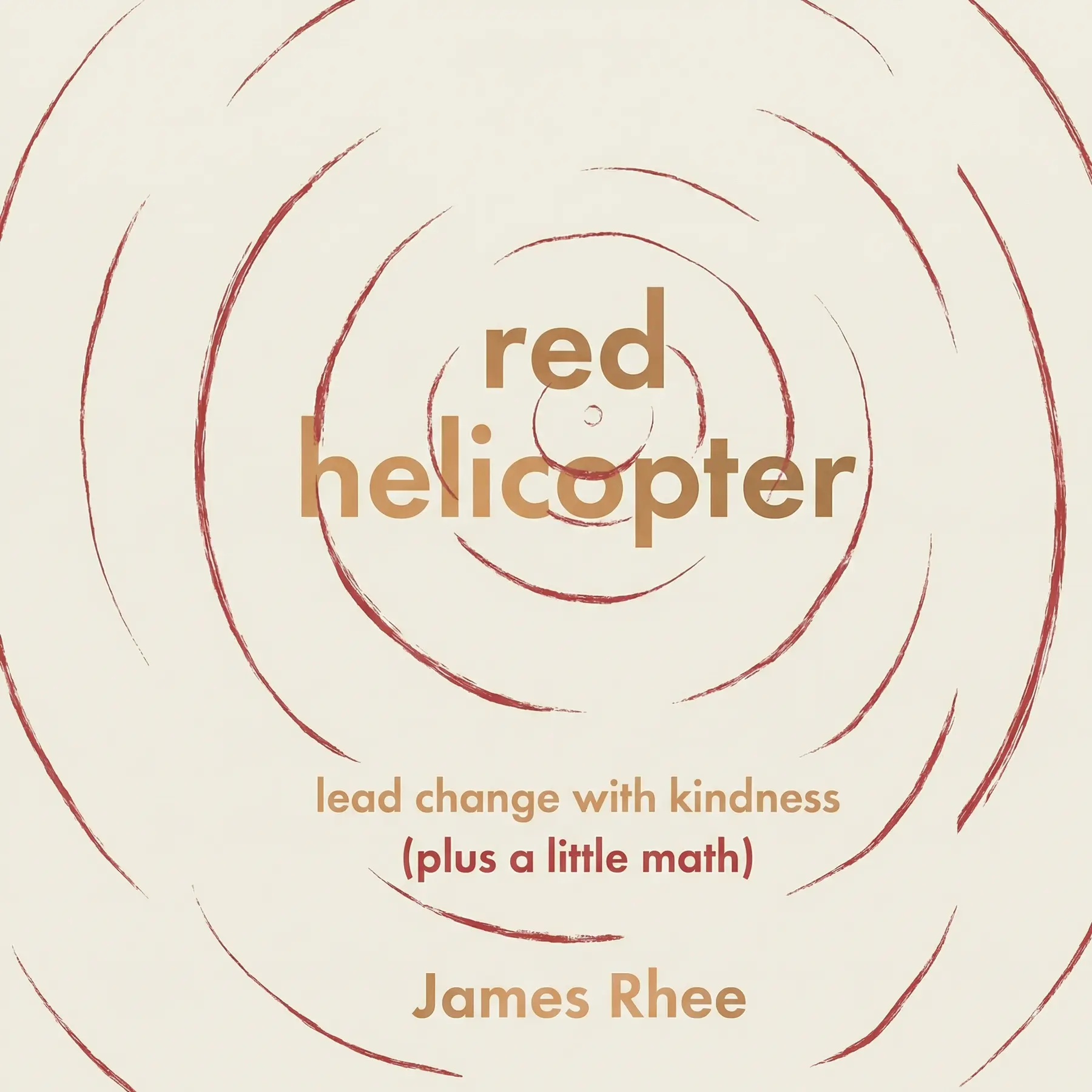
Red helicopter: Lead Change with Kindness (Plus a Little Math)
By James Rhee
Shows how James Rhee rescued a twice-bankrupt retailer by finding and measuring the goodwill inside it. It also teaches the basic accounting and finance you need to treat kindness as an asset at work and at home.

Table of Content
1. Introduction
1 min 07 sec
If you lead people, you have probably been told that kindness is a nice extra and the numbers are what count. James Rhee spent seven years showing that kindness belongs inside the numbers. In Red helicopter, the former teacher and private equity investor tells how he took over Ashley Stewart, a fashion retailer that had already gone bankrupt twice, and steered it away from liquidation by finding and measuring the goodwill inside it. According to his publisher, that bet multiplied the company’s fortunes several times over.
The book is a parable built on his own story, and its throughline is simple: kindness is a real asset, and a little basic math lets anyone see it, grow it and lead with it. Along the way, Rhee teaches the accounting and finance most schools skip, through a toy helicopter, a balance sheet for your own life and stores full of loyal customers. The reward is a way to make the case for decency in the language your boss, your board or your bank already speaks.
2. See kindness as an asset you can count
1 min 47 sec
A twice-bankrupt retailer, abandoned by the money world, was handed to a man who had never run a company. Everyone expected a sale of the pieces. He went looking for something no financial report had ever recorded.
3. Turn your first lesson in kindness into a compass
1 min 44 sec
A kindergartner shares his lunch and gets a toy red helicopter in return. Years later, at a critical point in his career, that small exchange came back to him and led him to reassess his values and priorities.
4. Draw up an honest balance sheet for your life
1 min 56 sec
Most people pick a career direction without knowing how the systems around them actually work. Rhee borrows a tool from accounting and points it at your own life, where the most revealing column is rarely the one you expect.
5. Sell safety and friendship before you sell product
1 min 47 sec
The clothes on the racks were never the whole story at Ashley Stewart. What customers and staff valued most did not appear in any sales report, and finding it changed how the company was run.
6. Start with small acts and let goodwill compound
1 min 48 sec
A single act of care can seem too small to matter inside a struggling company. Rhee describes a pattern that repeats naturally when built soundly, creating social bonds that financial capital cannot easily copy.
7. Build a life that can land anywhere
1 min 48 sec
A helicopter will never beat a jet for speed or height. Rhee argues that is exactly why it makes the better model for a career, a company and a life, though some readers remain unconvinced.
8. Conclusion
1 min 10 sec
What Red helicopter finally offers is a translation. Rhee takes the things most of us file under soft, like trust, friendship and a shared lunch, and shows them standing on the same balance sheet as cash and debt. At Ashley Stewart, a twice-bankrupt company the money world had written off, that translation made the difference between liquidation and seven years of rebuilding alongside the people who already loved the brand.
The practice starts close to home. Draw up your honest balance sheet, and look hardest at the liabilities you have stopped noticing. Find out what your customers or colleagues really come to you for, and let the people who create that value see the numbers. Then choose one small act of care you can repeat, and keep track of what it builds over several months.
None of this asks you to stop counting. It asks you to count more of what is real. Rhee’s helicopter will never be the fastest thing in the sky, but it can land where others cannot, and lift off again carrying more than it brought.
About this book
What is this book about?
Most leaders are taught that kindness is pleasant but optional, and that the real work happens in the spreadsheet. James Rhee argues that this split is false. When he took over Ashley Stewart, a twice-bankrupt fashion retailer whose staff and customers were mostly Black women, he had no CEO experience and few people expected him to succeed. His bet was that the company's hidden goodwill could be found, measured and put to work. Red helicopter tells that seven-year turnaround as a parable. It is shaped by the values of Rhee's dying immigrant parents and named for a toy he received in kindergarten for sharing his lunch. Woven into the story are introductory lessons in accounting, finance, behavioral science and corporate law, subjects Rhee says schools leave out. Readers learn to build an honest balance sheet for their own lives, to see what customers and colleagues really value, and to lead change through small acts that compound into goodwill. The aim is a lasting balance of life, money and joy, and the freedom to change direction when the ground shifts.
Book Information
Who it's for
Struggling to quantify trust
Team leads and managers who sense that trust drives results but struggle to make that case with numbers.
Facing turnaround or crisis
Founders and operators facing a turnaround or a crisis who want a human approach backed by basic finance.
Never learned accounting
Parents and young professionals who never learned accounting and want to apply it to their own lives.
About the Author
James Rhee
James Rhee is an investor, executive, teacher and writer from the United States. He started out teaching high school, then graduated from Harvard Law School and edited for the Harvard Law Review. After helping manage private equity at Boston firms, he became chairman and CEO of the fashion retailer Ashley Stewart and brought it back from bankruptcy. He founded FirePine Group, a family-office investment platform. At Howard University he holds the John H. Johnson Chair of Entrepreneurship, and he teaches at MIT Sloan School of Management as well.
Ratings & Reviews
Ratings at a glance
What people think
Listeners find this leadership book to be both absorbing and profoundly personal, with one review emphasizing its human-centered approach to uplifting communities. The narrative also garners acclaim; one listener remarks on how it captures the essence of storytelling from the heart. Additionally, listeners value the book’s professional focus, with one review describing its unique blend of life and business.
Top reviews
Akosua
Wow. This isn't just another corporate manual about maximizing efficiency at any cost. James Rhee shares a deeply personal narrative that bridges his Korean-American upbringing with the high-stakes world of private equity. The way he describes saving Ashley Stewart through a combination of 'kindness and math' felt revolutionary. It’s rare to find a business book that makes you actually feel something, let alone move you to tears. He argues that empathy isn't a weakness but a strategic asset for any leader. While the lemonade stand analogies are very simple, they effectively dismantle complex financial concepts for the average reader. I also loved the illustrations by Heyon Cho, which added a soulful layer to the text. It's a compelling reminder that our professional lives don't have to be divorced from our humanity. Highly recommended for anyone tired of the typical cutthroat leadership advice.
Show moreNadia
As a second-generation immigrant, Rhee’s reflections on his parents and his upbringing hit incredibly close to home. This isn't just a business book; it's a bridge between cultures. He shows how the values of his Korean heritage—loyalty, respect, and communal care—actually became his greatest competitive advantages in the boardroom. The way he treated the employees at Ashley Stewart as human beings first and 'assets' second should be a case study in every MBA program. My only minor gripe is that the middle sections repeat some of the same themes of vulnerability a few too many times. Regardless, the emotional resonance of his storytelling is unmatched in this genre. It’s a beautiful reminder that we don't have to leave our souls at the door when we clock in. This book is a narrative that beats with a genuine pulse.
Show morePakpoom
Finally got around to reading this for my professional development group. It’s an interesting hybrid of memoir and leadership guide that focuses on how societal flourishing is possible through communal care. Rhee focuses on the idea that financial literacy combined with compassion can transform a community, and he uses his experience at Ashley Stewart to prove it. I loved the emphasis on resilience and gratitude. The truth is, most business books are dry and repetitive, but this one has a real heart. I did feel that the connection between the red helicopter story and his corporate strategies was a bit tenuous at certain points. Sometimes the bridge between a childhood toy and a multimillion-dollar turnaround felt a little forced for the sake of the metaphor. But the overall message of aligning your values with your work is something every modern leader needs to hear.
Show morePan
Not what I expected from a guy who worked in private equity! I was prepared for a cold, numbers-driven analysis of a retail turnaround. Instead, I found a book that left me feeling inspired and, surprisingly, a little teary-eyed. Rhee’s writing style is accessible and warm. He talks about 'humanizing the corporate world' in a way that feels achievable rather than just using empty corporate buzzwords. His relationship with his mom and the origins of the red helicopter are the soul of the book. It’s a testament to the fact that leading with kindness isn't a soft option—it’s actually a courageous one. I’ve already recommended this to several colleagues who are feeling burnt out. It’s a refreshing antidote to the 'hustle culture' that dominates the business section these days. Pure heart-led storytelling.
Show moreSin
The core philosophy here—marrying your personal values with your business mind—is something I’ve been trying to articulate for years. Rhee does it brilliantly. He challenges the standard metrics of success, like status and power, and asks us to look at what truly matters for long-term fulfillment. The 'kindness plus math' framework is such a simple but potent way to view leadership. It reminds us that while the numbers have to work, they only work because of the people behind them. I particularly liked the sections on transparent communication and the power of being vulnerable. Got to say, the illustrations really make the book feel like a special object, not just another Kindle download. It’s a profound look at how we can redefine our industries by simply being more human. A must-read for anyone in a leadership position looking for meaning.
Show moreLook
James Rhee offers a refreshing, if occasionally idealistic, blueprint for leadership in a world that often prizes profit over people. The story of the red helicopter toy serves as a poignant anchor for his philosophy on radical generosity. I found the section on his time at the plus-sized retailer Ashley Stewart to be the highlight, showing how vulnerability can build trust in a fractured company culture. Frankly, some of the broader societal examples, like Maria’s grocery store, felt a bit like a stretch for larger industries. It’s hard to imagine every sector responding so warmly to this 'human-centered' approach. However, his focus on financial literacy as a tool for empowerment is spot on. It’s a solid hybrid of corporate strategy and personal memoir. If you're looking for a guidebook on how to lead with a heart without losing your mind over the balance sheet, this is a great start.
Show moreSirirat
Ever wonder if kindness is actually enough to survive the corporate grind? Rhee definitely thinks so, and he makes a compelling case through his turnaround of Ashley Stewart. The book is beautifully written, and the anecdotes about his mother and childhood are touching. His success is undeniable, though I do wonder how much of that was due to his specific high-level connections rather than just the 'kindness' he preaches. At times, the narrative veers into a utopian territory, but the core message remains powerful. Competition is still a necessity for growth, even if you’re a 'nice' leader, and Rhee acknowledges that balance in his own way. It’s an inspiring read that definitely prompts you to rethink your own leadership style and how you define success beyond simple metrics of power.
Show moreMind
Picked this up because I saw his TED talk and wanted more depth. It didn't disappoint. Rhee masterfully weaves his immigrant experience with a very practical 'operating system' for both life and business. The central metaphor of the red helicopter—a gift of gratitude—really sticks with you long after you close the cover. I appreciated the honesty about his own struggles and the vulnerability required to lead a bankrupt company back to health. To be fair, the 'math' part of his 'kindness and math' formula could have been explored a bit more deeply for those of us wanting technical insights. It leans heavily on the emotional side of the equation. Still, the message about being your true self at work is incredibly powerful. It's a quick read but one that prompts a lot of genuine self-reflection.
Show moreBee
To be fair, I wanted to like this more than I did because the premise is so vital for our current culture. Rhee is clearly a brilliant man with a massive heart, but the book feels a bit too altruistic for the day-to-day grind of the real world. The idea that a ripple effect of kindness can solve systemic economic challenges is a beautiful sentiment, but it almost falls flat when you consider how cutthroat global markets actually operate. I struggled with the simplified lemonade stand analogies; they felt a bit reductive for a complex financial turnaround. While his personal story is moving, the advice can be frustratingly vague for a manager looking for hard, concrete steps. If you want a feel-good story about a business turnaround, this is great, but it might not be the universal 'operating system' that every industry can replicate.
Show moreSombat
Red Helicopter is a unique read that manages to be both geeky and deeply emotional, but it didn't quite hit the mark for me. James Rhee takes us through the high-stakes world of retail bankruptcy but keeps the focus almost entirely on the 'soft' side of things. His storytelling is top-notch, yet I found the 'math' part of his 'kindness plus math' formula to be a bit thin on actual details. Some might find the tone a bit too idealistic for a business book, especially when he discusses the ripple effects of small acts like they're a universal law. Personally, I think the Maria grocery store example was a bit too sanitized to be truly replicable in a global corporate environment. It’s an inspiring memoir for sure, but as a leadership manual, it lacks the practical grit I was hoping for when I picked it up.
Show moreQuestions about this book
What is Red helicopter by James Rhee about?
It is a parable built on Rhee’s own story of leading Ashley Stewart, a fashion retailer that had gone bankrupt twice, away from liquidation. Rhee, who had never been a CEO, bet that the company’s intangible goodwill could be identified, measured and used. The book argues that kindness is a real business asset and pairs that idea with simple lessons in accounting, finance and behavioral science, aiming for a lasting balance of life, money and joy.
What is the little math in Red helicopter?
The little math refers to the basic accounting, finance, behavioral science, economics and corporate law that Rhee weaves into his story, subjects he says schools rarely teach before people start working. It stays introductory and often uses lemonade stand examples. Its most personal form is asking readers to build an honest balance sheet for their own lives, listing assets and liabilities to reveal the hidden obstacles that hold them back.
How did James Rhee turn around Ashley Stewart?
Rhee was meant to help for about six months but stayed seven years as owner, chairman and CEO. He built on friendship and shared values with a workforce of mostly Black women, listened to employees at every level and taught store staff business basics. One reader notes the company focused on stores that gave customers safety and friendship. According to the publisher, building on goodwill multiplied the company’s fortunes several times over.
How can I apply Red helicopter at work?
Start by naming what people truly trust about your team and how you would measure whether that trust grows. Ask what customers or colleagues really come to you for beyond your product, and share the relevant numbers with the people who create that value. Then repeat one small act of care each week. Rhee argues that such acts scale and that goodwill builds a reserve you can draw on in a crisis.
How does Red helicopter compare to Daring Greatly?
Library Journal compared Rhee’s book to Brene Brown’s Daring Greatly and Simon Sinek’s Leaders Eat Last. Like those books, it puts human connection at the center of leadership. Its distinctive angle is the pairing of kindness with simple accounting and finance, and its grounding in one concrete business turnaround, which also gives readers a look at how private equity and big law operate.
Readers also enjoyed


A Year with Peter Drucker: 52 Weeks of Coaching for Leadership Effectiveness
Joseph A. Maciariello



Acting with Power: Why We Are More Powerful Than We Believe
Deborah Gruenfeld

All In: How Great Leaders Build Unstoppable Teams
Mike Michalowicz



7 Powers: The Foundations of Business Strategy
Hamilton Helmer
AUDIO SUMMARY AVAILABLE
Listen to Red helicopter in 15 minutes
Get the key ideas from Red helicopter by James Rhee, plus 5,000+ more nonfiction titles.
- 5,000+ titles
- Listen as much as you want
- 7-day free trial
- Cancel anytime









