

13 min 18 sec
Available in: English
Red Flags, Green Flags: Modern Psychology for Everyday Drama
By Ali Fenwick
Gives you two simple tests for any relationship: five signs that a partner, friend or employer is good for you, and a three-step way to respond calmly when warning signs appear.
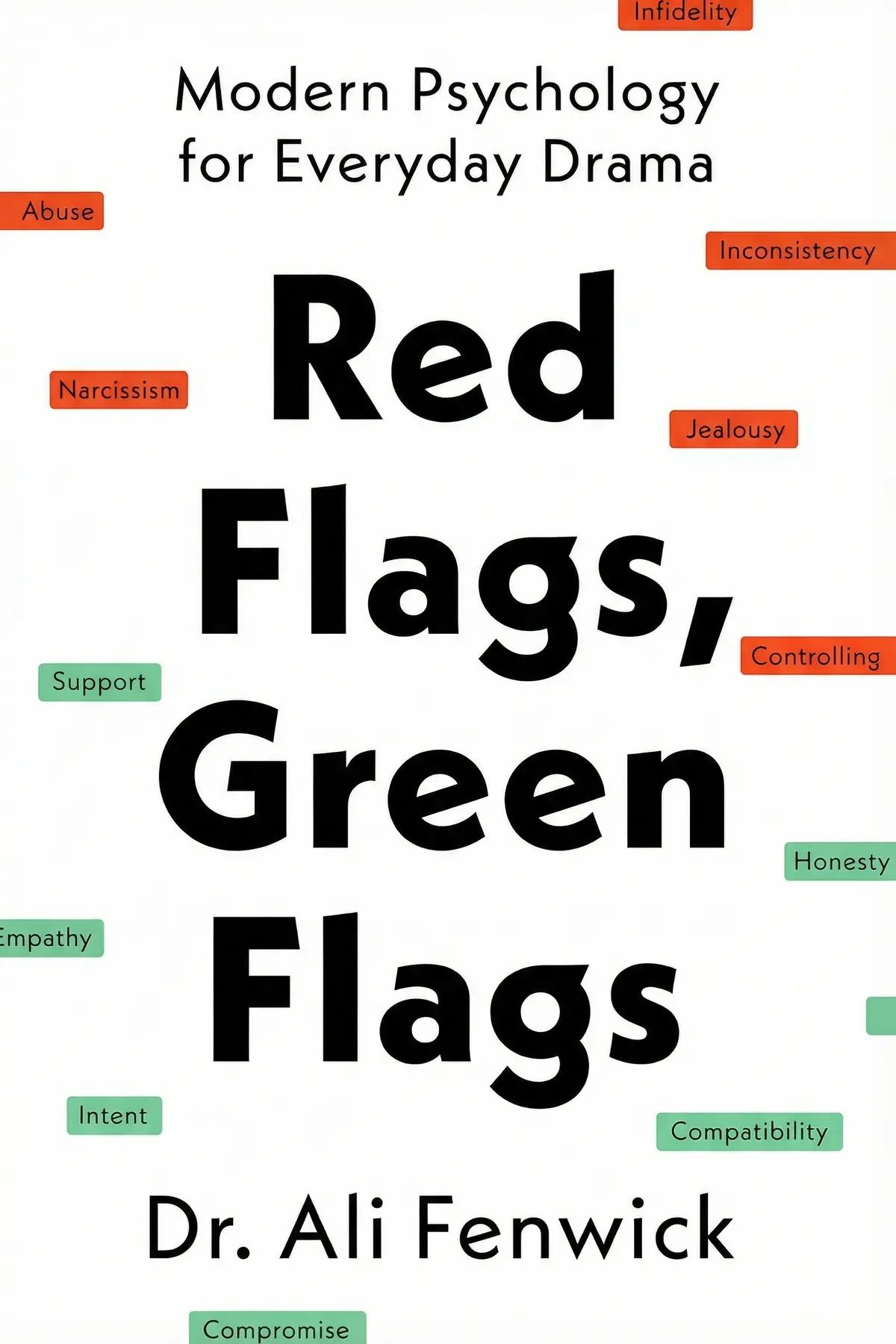
Table of Content
1. Introduction
1 min 02 sec
From birth we learn how relationships work from the people around us, and while that lesson serves some people well, others keep falling back on the same losing strategies, good or bad. In Red Flags, Green Flags, behavioral psychologist and psychotherapist Ali Fenwick offers a simpler guide: two short acronyms, one for what healthy connection looks like and one for what to do when something feels wrong.
GREEN names five signs that a partner, friend or employer is worth investing in. RED gives a three-step response to warning signs: reflect, engage, decide. Fenwick’s case is that relationships come without a manual, but you can write a working one by learning the signs of health, slowing down when something hurts, and making deliberate choices about who stays in your life.
That applies to a new romance, an old friendship and the boss who keeps pushing for replies on evenings and weekends. By the end you will have a test for any relationship and a calm script for the moment it starts to go wrong.
2. Five signs a relationship deserves your effort
1 min 57 sec
Many people stay too long in bonds that drain them because nobody ever showed them the alternative. Fenwick turns a single color into a checklist you can run on anyone, from a new date to a longtime manager.
3. Turn an uneasy moment into a calm decision
1 min 51 sec
A declaration of love after only a handful of dates. A boss who wants weekend replies while you are burning out. The urge is to react at once, and Fenwick explains why that urge often points you the wrong way.
4. Set deal breakers that fit your own life
1 min 45 sec
A friend who talks over you, a partner who has emotionally checked out: one person shrugs, another packs a bag. Fenwick explains why nobody else can tell you where your line sits, and how to find it.
5. Keep hold of your reality under manipulation
1 min 31 sec
Some partners do not just cross your boundaries. They make you doubt your own memory of what happened. Fenwick offers two simple defenses that cost nothing and work while you plan what comes next.
6. Spot the workplace lines that ask too much
2 min 04 sec
We are all family here. No raise this year, but how about a promotion? These phrases sound generous. Fenwick explains what they are really asking of you, and the one request that tests whether a promise is real.
7. Break the pattern of choosing the same red flags
1 min 50 sec
Some people leave one bad relationship and walk straight into its twin. Fenwick traces the pattern back to a set of uncomfortable questions most of us never ask ourselves, or the people we love.
8. Conclusion
1 min 18 sec
Fenwick’s two acronyms add up to a kind of traffic system for the people in your life. Green tells you when to keep going: someone genuine, respectful and empathetic, who lifts you and cares for the bond as you do. Red tells you to stop, not to run but to reflect, speak and only then decide. The book’s deeper message is that the missing manual is something you write yourself, through practice and honest conversation, and that the person you most need to read clearly is often you.
The steps it supports are small. When a reply or a request stings, give yourself the right to pause before answering, and work out whether the feeling belongs to now or to the past. When a manager offers a promotion instead of a raise, or keeps promising one, ask for a date and the targets that would earn it. And soon, ask someone you love what their red and green flags are, then listen openly.
Some relationships will pass that test and grow. Some will not, and leaving them will hurt. Either way, you will be choosing with your eyes open, at home, among friends and at work.
About this book
What is this book about?
Most of us learn how relationships work from the people who raised us, then carry that lesson into dating, friendships and jobs, sometimes repeating the same losing pattern for years. Even people with a good start can end up in a toxic office or friend group and feel stuck. Behavioral psychologist and psychotherapist Ali Fenwick offers a plain, portable guide built on two acronyms. GREEN describes what healthy connection looks like: genuine, respectful, empathetic, elevating and nurturing. RED describes what to do when something feels wrong: reflect on where the reaction comes from, engage the other person honestly, and decide what to do if nothing changes. Fenwick applies these tests to romance, friendship, family and work. He covers how to set your own deal breakers, how to protect your memory and sanity from gaslighting, which friendly-sounding phrases at work are really requests for more of your time, and why some people keep choosing partners with the same red flags. Readers get a vocabulary for judging any relationship and a calm script for the moment one starts to go wrong.
Book Information
Who it's for
Stuck in relationship patterns
People who keep ending up in the same draining relationships and want to understand why.
Professionals questioning their workplace
Professionals unsure whether a demanding boss or workplace culture is normal or toxic.
Hoping to raise issues
Anyone who wants a calm, simple way to raise a problem with a partner, friend or relative.
About the Author
Ali Fenwick
Ali Fenwick is a behavioral psychologist and psychotherapist who holds a full professorship in organizational behavior and innovation, and he teaches at Hult International Business School, where he also runs a research lab on transforming behaviors. He has coached and taught executives in many countries for two decades. He founded the Dr. Fenwick Lab for Human Behavior and Technology, which aims to keep humans, not algorithms, at the center of change, and he reaches millions on social media as modern.day.psychologist.
Ratings & Reviews
Ratings at a glance

What people think
Listeners find that while viewpoints differ regarding the level of detail and the author's casual vocabulary, many value the broad examination of social interactions involving family, the workplace, and romance. Listeners appreciate the functional lists of "red" and "green" flags, which aid in detecting both negative tendencies and constructive behaviors in oneself and others. They also note the effectiveness of the integrated communication aids and decision-making exercises, with one listener describing the book as a "clear and concrete" handbook for handling today's social complications. Furthermore, its methodical layout and research-based evidence provide a reachable guide for people aiming to define stronger personal boundaries.
Top reviews
Taweesak
Finally, a psychology book that doesn't just focus on toxic boyfriends. This guide covers the whole spectrum, from overbearing parents to those passive-aggressive colleagues we all deal with. I especially appreciated the sections on family dynamics because those red flags are often the hardest to spot when you've lived with them your whole life. The "time to leave" versus "willingness to stay" prompts were eye-opening. Look, it’s not perfect, and the slang can be a bit much at times, but the practical value is definitely there. It’s rare to find a book that helps you identify your own toxic traits as much as it helps you judge others.
Show moreSuwit
Wow, the 'stay or go' checklists in the final sections are absolute game-changers. I’ve been struggling with a friendship that felt increasingly one-sided, and seeing those behaviors laid out so clearly helped me make a decision I’ve been putting off for months. The book is very visual and structured, which I love. It’s not just theory; it’s a practical manual for life. I think the author’s background in research shows through in the way he categorizes patterns. If you’re tired of being gaslit or ghosted and want to understand the "why" behind it, pick this up. It’s an essential guide for the modern era.
Show morePrayoon
Dr. Fenwick brings his Instagram energy to the page in a way that’s mostly successful. Truth is, I followed him for his reels, so I wasn't sure if a full-length book would work. I was pleasantly surprised by how he categorizes modern social problems. The breakdown of online dating behavior—like ghosting and gaslighting—gave me some much-needed perspective on why people act so weird on apps. The scientific backing adds a layer of credibility that sets it apart from your average TikTok life coach. It’s a fast, punchy read that provides actual tools for communication instead of just vague platitudes.
Show moreZanya
After seeing the reels online, I was curious if the book would have more meat on its bones. It definitely does, though it retains that accessible, conversational feel. What I found most valuable were the concrete tools for setting boundaries. It’s one thing to know someone is "red flag status," but it’s another to know exactly what to say to them. The scientific research sprinkled throughout gives it a more professional feel than a standard self-help book. My only real gripe is that some of the sections felt a bit rushed. I would have loved more depth on the workplace dynamics, but overall, it's a helpful resource for navigating modern social chaos.
Show moreLaor
Identifying my own red flags was a gut punch I didn't see coming. Most books like this just tell you how everyone else is the problem, but Ali Fenwick forces you to look in the mirror. He explains that we can't change others, only how we respond and how we show up in relationships. That perspective shift alone made the book worth it for me. The "Best Version of Yourself" concluding chapter was incredibly motivating. Yes, some of the wording is a bit "cringe" and the formatting is simple, but the message of self-accountability is powerful. It's a quick read that actually makes you think about your own habits.
Show moreJonathan
Most people pick this up for the dating advice, but the sections on workplace dynamics were where I found the most value. In my experience, professional boundaries are the hardest to maintain, and this book provides actual scripts for dealing with toxic colleagues. It’s written in a very punchy, direct style that mirrors the author's online presence. Some might find it a bit too simplistic, but I think that’s the point. It’s meant to be a field guide, not a textbook. It helped me recognize several green flags in my current partner that I was taking for granted, which was a nice bonus. Truly a useful read.
Show moreTaw
Is this book ground-breaking? No, probably not if you've already done a lot of therapy or read plenty of self-help. However, for those just starting to look at their relationship patterns, it’s a solid enough primer. I found the checklists of green flags particularly helpful because we often spend so much time looking for the bad that we forget what the good looks like. The tone is very "social media," which makes it an easy read, but sometimes it lacks the psychological depth I was hoping for. It’s more of a "manual for drama" than a deep dive into human behavior. It's okay, just don't expect a masterclass in clinical psychology.
Show moreSomrutai
The structure of this guide is actually its strongest point. It’s divided into clear sections—family, work, friends, and dating—making it very easy to jump to what you need. I personally found the workplace chapters to be the most insightful. Dealing with an intrusive boss is a nightmare, and Fenwick offers some very practical "green flag" behaviors to look for in a healthy environment. Some of the language is a bit too "modern" for my taste, but the core message is solid. It’s a decent toolkit for anyone feeling overwhelmed by the drama in their life and needing a clear way to categorize social behaviors.
Show moreTern
Not gonna lie, I expected a lot more from a behavioral scientist. While the premise of "Red Flags, Green Flags" is great, the execution felt repetitive and a bit trite. Each chapter follows the same rigid structure which started to feel like a chore by the halfway mark. I kept waiting for more detailed psychological explanations, but instead, I got more lists and slang. It feels like a collection of Instagram captions expanded into a book. To be fair, if you are struggling with a very specific toxic relationship, the communication tools might give you a place to start. For me, it just didn't offer anything new or particularly insightful.
Show morePete
Ditched this after the first few chapters. Frankly, the writing style is just messy and feels like it desperately needed a heavy-handed editor. I can handle a casual tone, but seeing "bae" and "peeps" in a psychology-based book is a major turn-off for me. It felt like an adult trying way too hard to be relatable to Gen Z, and it just came across as cringe. Beyond the tone issues, the actual content felt extremely surface-level. If you’ve spent five minutes on social media, you already know most of these "red flags." It might be a decent starting point for someone who has zero boundaries, but for everyone else, it’s mostly common sense wrapped in poor sentence structure.
Show moreQuestions about this book
What is the main idea of Red Flags, Green Flags?
Ali Fenwick argues that relationships come without a manual, but you can build one. He uses GREEN to describe healthy connection (genuine, respectful, empathetic, elevating, nurturing) and RED to describe how to respond to warning signs (reflect, engage, decide). Applied to romance, friendship, family and work, the two tests help you see what is good for you and act calmly when something is not.
What does the RED method mean in Red Flags, Green Flags?
RED is a three-step response to warning signs. Reflect first, to work out whether a strong reaction comes from the present situation or an old, unresolved hurt. Engage next, by raising the issue honestly and watching whether the other person responds with respect and empathy. Decide last: if the harmful behavior continues after you have spoken up and set limits, you are allowed to walk away.
What are workplace red flags according to Ali Fenwick?
Fenwick warns about phrases like everyone here is a family when you are asked to work weekends, or a promotion offered in place of a raise. Being told you must all be friends blurs work and personal life and can lead to burnout. Colleagues covering for each other and repeated promises that never arrive are also red flags. He suggests asking for a timeline and clear targets for any promised reward.
How does Red Flags, Green Flags suggest dealing with gaslighting?
If your memory of events is regularly questioned, Fenwick advises writing down what happened and what was said, so you have a record to check against. He also encourages you to rely on any relatives or friends who are able to back you up. Keeping your ties to other people and staying sure of your own values, he argues, guards your mental health while you work out how to leave.
Who should read Red Flags, Green Flags?
It suits people who keep repeating the same painful relationship patterns, workers unsure whether their workplace is healthy, and anyone who wants simple language for talking about boundaries with a partner, friend or relative. Its tools are easy to remember and use, such as pausing before reacting, writing down your deal breakers, and asking loved ones about their red and green flags.
Readers also enjoyed






AUDIO SUMMARY AVAILABLE
Listen to Red Flags, Green Flags in 15 minutes
Get the key ideas from Red Flags, Green Flags by Ali Fenwick, plus 5,000+ more nonfiction titles.
- 5,000+ titles
- Listen as much as you want
- 7-day free trial
- Cancel anytime









