

13 min 25 sec
Available in: English
Provoke: How Leaders Shape the Future by Overcoming Fatal Human Flaws
Shows leaders how to catch the moment a possible trend becomes a certain one, and how to act on it with small, testable moves that shape the market without risking the whole business.
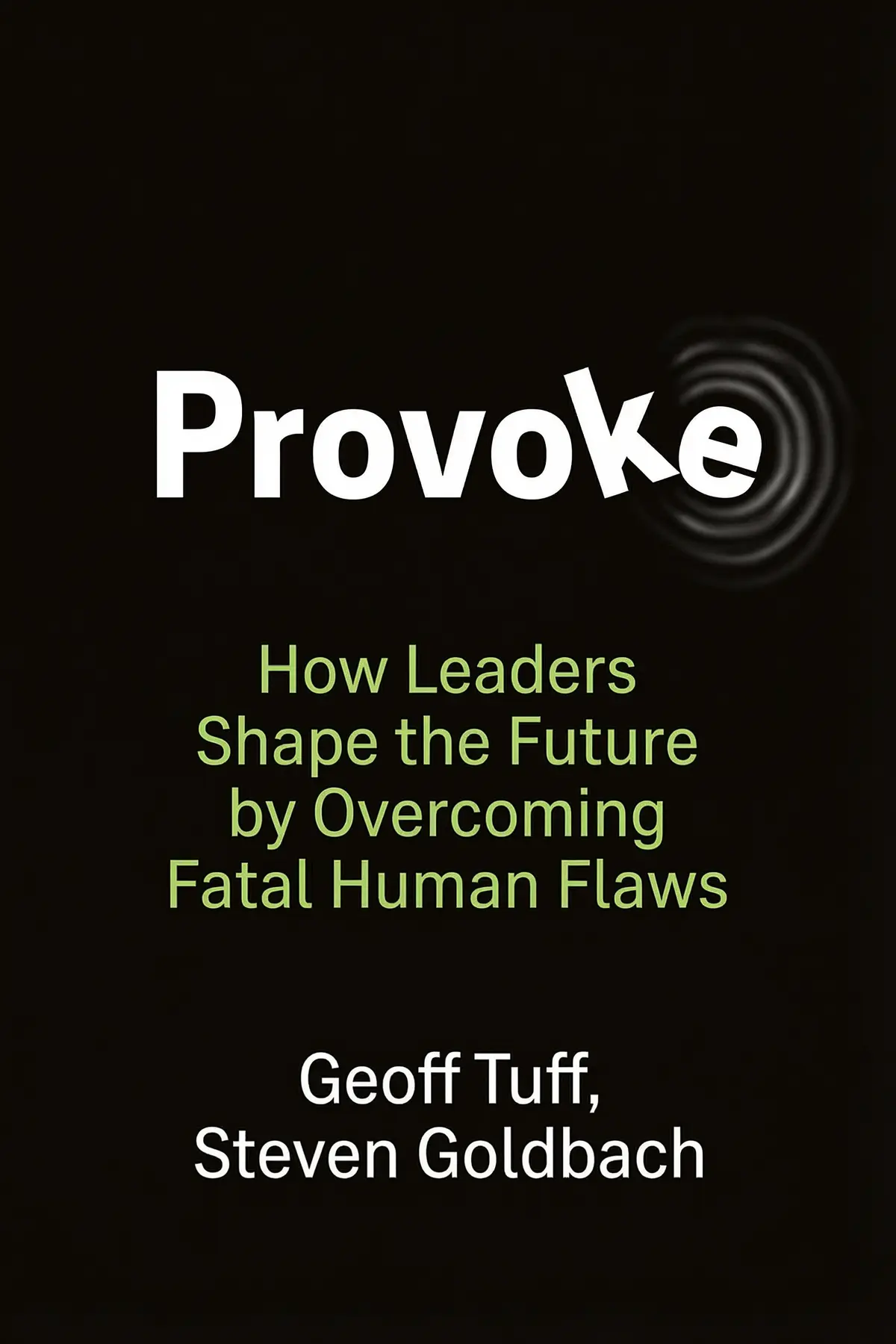
Table of Content
1. Introduction
1 min 00 sec
Most large companies miss big change, and the reason is rarely that the signs are hidden: the signs simply look too small to matter. In Provoke, Deloitte strategists Geoff Tuff and Steven Goldbach describe a cable media executive who learned that 1.75 percent of his customers were watching clips on sites like YouTube, and ended the meeting. Waiting to be a fast follower, the authors argue, already means waiting too long.
Their case is that you can shape the future without betting the company. Read faint signals early. Test the moment when a possibility hardens into a certainty. Then make small, measurable moves that teach you fast, and when a shift turns against you, adapt honestly instead of hoping. The stories of Warby Parker, the founder of General Motors and Intel give the method its weight. By the end, you will have a way to act before anyone hands you a map, and to tell which bets deserve the next step.
2. Small numbers can hide your biggest threat
1 min 50 sec
An executive heard that a tiny share of his customers had changed their habits, and he closed the meeting. His reasoning sounded sensible at the time. The pattern behind it repeats in almost every large company.
3. Spot when a possibility turns into a certainty
2 min 01 sec
Act too early and you look reckless. Act too late and rivals own the market. Between those two mistakes sits a narrow window, and three simple tests can tell you whether you are standing in it.
4. Map several futures before you pick a bet
1 min 44 sec
Nobody can predict the future, so planning for one version of it is a gamble. An energy company thinking about 2035 shows a sturdier habit, one that turns vague worries into numbers you can check.
5. Start with a move small enough to learn from
2 min 03 sec
Betting everything on the future you want feels decisive and often ends badly. An online glasses seller kept growing by doing something less dramatic, and one experiment happened in a founder’s own home.
6. Turn a trend you dislike into your advantage
1 min 46 sec
A man who hated cars so much that he banned his daughter from riding in them ended up founding General Motors, built from the biggest operating car companies in the US. His reasoning offers a model for facing change you resent.
7. Admit the old business is ending, then rebuild
1 min 52 sec
Two Intel leaders asked each other one imaginary question, and the honest answer cost the company dearly in the short run. Without it, Intel might now be a cautionary tale in business textbooks.
8. Conclusion
1 min 09 sec
Provoke adds up to a different idea of what leadership is for. The cable executive made an understandable mistake: he waited for certainty, and certainty only arrives after the opening has closed. Tuff and Goldbach ask leaders to live in the gray zone instead, where a likely trend is still turning into a definite one, and to keep moving there in small, measured steps. Durant shows that you can steer a change you dislike. Grove and Moore show that you can survive one that beats you, as long as you say so out loud in time.
The authors’ plainest advice is to do something, because action almost always teaches more than standing still. In practice, that means keeping a few scenarios alive with one indicator each, running any promising possibility through the tests of desire, feasibility and legality, and making your first move the smallest one that still gives a clear answer. When a small group of customers starts behaving oddly, treat it as a test to run, not a number to round down.
The first movers never had a map either. What they had was the habit of testing, learning and testing again.
About this book
What is this book about?
Executives often debate whether to be first movers or fast followers. Geoff Tuff and Steven Goldbach argue that the debate itself is a trap. Waiting for the pioneers to prove themselves means you have already held back for too long. The leaders who shape a market act without a map, and they do it in a way that does not put everything at risk. The authors explain why large companies miss trends that later look obvious. Leaders judge new behavior through their own experience, analyze signals until the moment has passed, and respond with too little, too late. Against that pattern they set a method they call provocative strategy: imagine several futures and track them, test whether a possibility is desirable, feasible and legal, and make minimally viable moves that give fast feedback. The stories range from a cable executive who dismissed early YouTube viewers to Warby Parker, General Motors founder Billy Durant and Intel's exit from memory chips. Readers get a way to time their bets, steer a change they never wanted, and admit defeat early enough to rebuild.
Book Information
Who it's for
Leaders sensing market shifts
Executives and senior managers who sense their market shifting but cannot tell how fast.
Founders weighing new trends
Founders deciding when to commit to a new trend without risking the whole company.
Strategy and innovation staff
Strategy and innovation teams who need a practical way to track scenarios and run small tests.
About the Author
Geoff Tuff
Geoff Tuff is a principal at Deloitte with more than 30 years of advising large companies on strategy, growth, innovation and new business models. He previously led the innovation firm Doblin and was a senior partner at Monitor Group. Steven Goldbach has served as Deloitte's US Chief Strategy Officer and led its US Sustainability practice, helping executives make hard strategy choices when the future is unclear. He was also a partner at Monitor Group. Together they wrote Detonate and Provoke, both nominated for Thinkers50 awards, and they host The Provocateurs, a monthly leadership podcast based on Provoke.
Ratings & Reviews
Ratings at a glance

What people think
Listeners consider this book an essential manual for leaders dealing with volatility, specifically pointing out the strategic transition from asking "if" to choosing "when." They value the hands-on "five models of provocation" and the way real-life case studies show how to spark organizational transformation. While some have mixed feelings about the depth of the prose, with one listener suggesting the central theme could be more streamlined, most believe the insights are vital for correcting the human tendencies that result in paralysis. Additionally, they highlight that the framework is particularly suited for those in fast-moving fields and note its effectiveness at converting ambiguity into a powerful strategic asset. Furthermore, listeners admire the authors' focus on taking the initiative, with one listener remarking that the "master provocateurs" examples serve as both a source of inspiration and a practical toolkit.
Top reviews
Thitima
Wow. This is exactly the kind of strategic foresight I’ve been looking for to help my team handle the chaos of the current market. Tuff and Goldbach have crafted a brilliant framework that turns the scary concept of ambiguity into a massive strategic advantage. I particularly loved the 'Activate' phase, which highlights how to use ecosystems and network effects to tip the scales in your favor. It’s rare to find a business book that manages to be both inspirational and instructional without feeling like it's preaching from an ivory tower. The profiles of 'master provocateurs' at the end provided the perfect finishing touch. If you're tired of playing it safe and want to start shaping your own future, buy this book immediately.
Show moreBrahim
Finally got around to reading this, and the timing couldn't have been better as my company faces some major technological disruptions. The shift from asking 'if' something will happen to deciding 'when' you will act is a simple concept that has profound implications for how we allocate resources. Tuff and Goldbach don't just tell you to be bold; they provide a modular blueprint—Envision, Position, Drive, Adapt, Activate—to actually make it happen. I found the 'Drive' model particularly empowering, especially the parts about influencing the market to create a more advantageous outcome for your own goals. It’s a masterclass in strategic foresight that every CEO should have on their desk. This is a must-read for the modern era.
Show moreSupaporn
After hearing so much buzz about Tuff and Goldbach’s previous work, I dove into Provoke expecting a standard corporate strategy manual. What I found was a compelling argument for switching your mindset from 'if' a change will happen to exactly 'when' it will hit. The 'Position' model really resonated with me because it forces you to stop waiting for certainty, which is a trap most of us fall into. Frankly, the real-world case studies like Warby Parker help ground the theoretical frameworks in something tangible. It’s a solid follow-up to Detonate, though it does get a bit repetitive in the middle sections. If you can push through the occasional dense paragraph, the blueprint for navigating ambiguity is incredibly valuable for anyone in a leadership role today.
Show moreSupatra
Picked this up on a whim and was pleasantly surprised by how much it challenged my own hesitation in decision-making. The authors make a strong case for why 'Action is nearly always superior to inaction' because of the immediate feedback loops it creates. I’ve been stuck in the 'Envision' phase for too long at my startup, and the 'Adapt' model gave me the nudge I needed to stop over-analyzing and start moving. My only real gripe is that some of the stories felt a little too 'clean,' as if the messy reality of these business pivots was polished away for the sake of the framework. Still, it’s a great guide for anyone trying to navigate a rapidly shifting industry where the old rules no longer apply.
Show moreElan
The core message here—that action is superior to inaction—is undeniably powerful, but the delivery felt like it could have been condensed significantly. While I appreciate the 'five models of provocation,' I found myself nodding along to points that felt a bit like they were being stretched to fill pages. To be fair, the examples involving Tencent and WeChat are fascinating and offer great insight into how global players 'Drive' change rather than reacting to it. Is it a good book? Yes. Could it have been a punchy 20-minute TED Talk? Absolutely. It’s worth a skim if you’re looking to overcome those 'fatal human flaws' that lead to corporate paralysis, but don't expect a quick read.
Show moreRatchanee
Ever wonder why 89% of Fortune 500 companies from the 1950s are gone? This book attempts to answer that by looking at how leaders fail to adapt to the shifting 'if to when' timeline. I liked the focus on behavioral flaws—the things that keep us from making bold moves when the signs are all there. However, the writing style oscillates between being very engaging and incredibly dry, making it hard to maintain momentum through the entire text. The five models are a helpful way to categorize strategy, but they often overlap so much that the distinctions feel a bit forced. It’s a decent resource for a weekend read, especially if you’re interested in the 'Position' and 'Drive' aspects of market leadership.
Show moreLucas
Not what I expected, but still worth the time for the 'Activate' and 'Position' chapters alone. Tuff and Goldbach are clearly experts in their field, and their background at Deloitte shines through in the structured, methodical approach they take to strategy. My issue is that the book feels a bit too focused on large-scale corporate entities, making some of the advice feel less applicable to smaller organizations. Personally, I found the breakdown of how to work with outside parties versus doing things in-house to be the most practical part of the text. It’s a three-star read for me because while the theory is sound, the execution felt a bit more academic than I prefer for my business books.
Show moreSomporn
The chapter on the 'Envision' model was the highlight for me, specifically the focus on creating a 'focal question' to guide your diversity of outcomes. It’s a useful tool for getting a team on the same page when the future feels like an 'abyss of the unknown.' That said, I found the section on 'Activate' to be a bit repetitive of things I’d already read in the authors' previous book, Detonate. Not gonna lie, I was expecting a bit more growth in their philosophy between the two publications. It serves as a good refresher for strategy consultants, but if you're looking for radical new ideas, you might find this a bit too familiar. A solid, safe three stars for a well-written, if slightly redundant, guide.
Show moreIsaiah
Honestly, this felt like a lot of corporate jargon wrapped around a few simple observations that most experienced managers already understand. The authors spend an exhausting amount of time trying to rename basic business agility as 'provocation' without offering much that feels truly revolutionary. I found the section on 'Envisioning' particularly frustrating because it relies so heavily on the idea that we can predict leading indicators that are often invisible until after the fact. Look, maybe if you’ve never read a strategy book before, this will feel fresh, but for the rest of us, it’s a bit of a slog through Deloitte-branded terminology. It tries too hard to be 'Provocative' while staying safely within the bounds of standard consulting logic.
Show moreCarter
As someone who has worked in strategy for fifteen years, I struggled to find the 'breakthrough' insights promised by the title. The five models of provocation felt like a rebranding of existing concepts like scenario planning and agile implementation, just with fancier names. While the WeChat and Warby Parker examples are interesting, they've been covered extensively in countless other business articles and podcasts over the last decade. Gotta say, I was hoping for more 'overcoming fatal human flaws' and less 'here is a five-step framework for your next meeting.' The book is beautifully produced and well-marketed, but the actual substance felt a bit thin for the price point. It's okay, but far from essential.
Show moreQuestions about this book
What is the main idea of Provoke by Geoff Tuff and Steven Goldbach?
The authors argue that waiting to be a fast follower means waiting too long. Leaders should instead act during phase change, the gray zone where a possible trend is becoming a certain one. They do this through provocative strategy: imagining several futures, tracking indicators, making small moves that give fast feedback, steering trends they cannot stop and adapting when a shift goes against them.
What is phase change in Provoke?
Every trend has an if stage, when something is possible but not in motion, and a when stage, when it has become inevitable. Phase change is the gray area between them. The authors suggest testing a possibility against three conditions: customers must want it, as with Airbnb, it must be technically feasible, as with Uber, and it must be legal or able to become legal.
What is a minimally viable move?
It is an action that causes little disruption but gives a lot of feedback. The authors pair it with two more steps: frame the action so success can be measured quickly, then test it. Warby Parker used this cycle repeatedly, from mailing five frames to try at home for free to a founder hosting clients at home before the company opened physical stores.
How can I apply Provoke at work?
Write one open focal question about your field, build a few scenarios from real forces and pick an indicator for each. Check any promising trend for desire, feasibility and legality. Make your first step small and measurable. And when the old business is fading, borrow Andy Grove’s question to Gordon Moore: if you were new here today, what would you do?
Readers also enjoyed


A Year with Peter Drucker: 52 Weeks of Coaching for Leadership Effectiveness
Joseph A. Maciariello



Acting with Power: Why We Are More Powerful Than We Believe
Deborah Gruenfeld

All In: How Great Leaders Build Unstoppable Teams
Mike Michalowicz



7 Powers: The Foundations of Business Strategy
Hamilton Helmer
AUDIO SUMMARY AVAILABLE
Listen to Provoke in 15 minutes
Get the key ideas from Provoke by Geoff Tuff, plus 5,000+ more nonfiction titles.
- 5,000+ titles
- Listen as much as you want
- 7-day free trial
- Cancel anytime









