

13 min 54 sec
Available in: English
Procrastination: Why You Do It, What to Do About It Now
Shows why people put off important tasks by tracing delay to fear, self-criticism and avoided feelings. It offers small, kind steps for changing the habit and for supporting a procrastinator you live or work with.
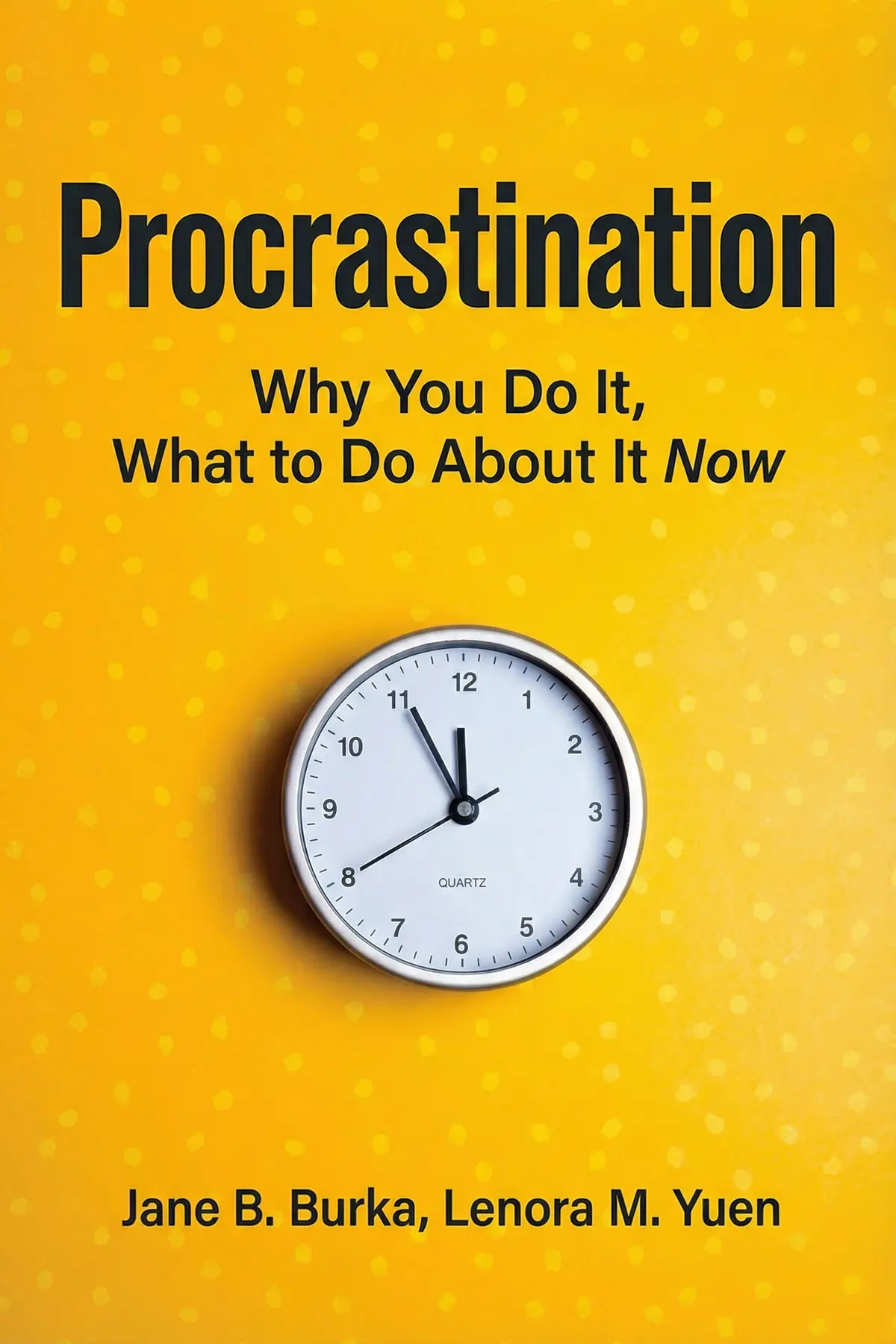
Table of Content
1. Introduction
1 min 07 sec
You keep putting off the report, the phone call or the appointment, and then you call yourself lazy. Psychologists Jane B. Burka and Lenora M. Yuen offer a different diagnosis. In Procrastination, they argue that delay is mostly a way of avoiding feelings such as fear and doubt, and that harsh self-criticism keeps the habit going instead of curing it.
The authors draw on workshops they led at the University of California, Berkeley, and with business and public groups. They treat procrastination as a habit with emotional roots, one that says nothing about your intelligence. Every idea ahead builds the same case: delay shields you from an uncomfortable feeling for a moment, so the way out means facing that feeling with kindness and moving in very small steps.
Along the way you will see why success can frighten people as much as failure does, and why your sense of time may differ from a colleague’s. You will also hear what to say, and what to avoid saying, to a procrastinator you live or work with.
2. Separate the delay from your intelligence
1 min 30 sec
Rushed, late work can leave you doubting your own ability. Burka and Yuen see a very different cause behind it, and that cause explains why no single switch can end the habit.
3. Talk back to the voice demanding perfection
1 min 48 sec
The thoughts that keep a task untouched often sound like hard facts about what will happen if you get it wrong. The authors suggest testing those thoughts, and few of them hold up.
4. Count the attempt as a win
1 min 40 sec
A procrastinator can finish a strong piece of work and still feel like a failure. The authors explain why, and why a good result can set off the very delay it should cure.
5. See how avoiding hard talks keeps you stuck
1 min 31 sec
A difficult conversation with a family member can sit untouched for months. Burka and Yuen trace that kind of delay to upbringing and relationships, and they count what it quietly costs.
6. See the gap between clock time and felt time
1 min 38 sec
Two people can look at the same deadline and experience very different amounts of time before it arrives. That mismatch explains many workplace clashes, and it shifts as you grow older.
7. Shrink the goal and catch the urge early
1 min 48 sec
Long-standing habits resist big resolutions. The authors describe a slower route, one that begins with your sleep and your moods and ends with victories so small you may barely notice them.
8. Help a procrastinator without nagging them
1 min 34 sec
Living or working with someone who always delays wears down patience fast. The natural responses tend to backfire, and the authors explain what to try instead, and when to stop trying.
9. Conclusion
1 min 18 sec
Burka and Yuen recast delay as a form of self-protection. Each postponed task buys a few hours away from fear, doubt or the spotlight. Later the bill arrives as rushed work, strained relationships and a growing sense of not being good enough. Seen this way, more self-criticism cannot be the answer, since it only feeds the cycle. What works is honesty about the feeling and patience with yourself while you change.
That points to a few things worth doing this week. Catch the moment the familiar dread arrives and ask whether the thought behind it is a fact or an assumption. Choose one small task, do it at the hour you feel strongest, and celebrate finishing it, just as you would celebrate arriving somewhere early. If someone you love or manage keeps delaying, swap the reminders for a clear request and a real conversation about what feels hard.
None of this happens overnight, and the authors never pretend it does. Small, steady effort is the whole method. Somewhere on your list is a task you have been avoiding while you listened. Opening it now, even for a few minutes, counts as the first win.
About this book
What is this book about?
Almost everyone delays now and then. For some people, though, procrastination becomes a pattern that damages their work, their self-esteem and their relationships. Psychologists Jane B. Burka and Lenora M. Yuen argue that the habit is widely misunderstood. They stress that it is not a sign of low intelligence. In their account, it is a way of avoiding uncomfortable feelings such as fear and doubt, and harsh self-criticism and perfectionist thinking keep it going. Drawing on their workshops and counseling work, the authors look at what sits behind delay: unrealistic assumptions about failure, a surprising fear of success, family history and relationships, and the gap between clock time and a person's inner sense of time. They also point to conditions such as ADHD, depression, stress and poor sleep that can make it worse. The way forward they describe is gradual. Notice when the urge to delay arrives, treat yourself with patience, set small goals and reward each one. A final section helps partners, colleagues and managers support a procrastinator without nagging, and shows how to recognize a relationship that is not getting better.
Book Information
Who it's for
Last-minute students and professionals
Students and professionals who keep finishing important work at the last minute and then blame themselves for it.
Frozen by perfectionism
Perfectionists who freeze before tasks because anything less than flawless feels like failure.
Around a chronic procrastinator
Partners, colleagues and managers who live or work with a chronic procrastinator.
About the Author
Jane B. Burka
Jane B. Burka and Lenora M. Yuen are psychologists who have spent years working with people who put things off. Together they have led seminars and workshops at the University of California, Berkeley, and taught corporate and public audiences across the country. Yuen practices as a psychologist in California. Their book draws directly on that workshop and counseling experience.
Ratings & Reviews
Ratings at a glance

What people think
Listeners find the writing style accessible and value the quality research presented. Furthermore, the guide suggests methods for conquering procrastination, and one listener observes that it is particularly useful for managing ADHD and related issues.
Top reviews
Camila
Finally got around to reading this, and frankly, I wish I hadn't put it off. The authors clearly understand the neurodiversity aspect of procrastination, making it particularly helpful for those of us dealing with ADHD or executive dysfunction. While some might find the academic research a bit dry, the breakdown of the 'Cycle of Procrastination' was incredibly eye-opening for my daily routine. It doesn’t just tell you to 'just do it,' which is the most useless advice ever. Instead, Burka and Yuen offer concrete strategies to dismantle the fear of failure that keeps us paralyzed. The writing is accessible, though the second half feels slightly less revolutionary than the deep psychological dive in the first. If you want more than just 'time management tips' from a random blog, this is the definitive resource. It really helped me reframe my relationship with the clock.
Show moreJiraporn
As someone who has struggled with deadlines for decades, this was a revelation for my mental health. Most books on this topic treat you like you’re just lazy, but Burka and Yuen actually treat you like a human being with complex emotions. The way they slice up the wounded psyche into bullet points made me realize that my anxiety was the driver, not my lack of willpower. It’s a shattering look at why we avoid the things that matter most. Not gonna lie, I teared up a bit reading the case studies because they sounded exactly like my own internal monologue. The 'Unschedule' technique is a total game-changer for anyone who feels overwhelmed by a standard to-do list. This is easily the most empathetic and deeply researched book on the subject I have ever encountered.
Show moreJonathan
To be fair, I didn't think a book could actually change my workflow, but this one proved me wrong. It provides a comprehensive psychological report on why we sabotage ourselves through delay. The authors don't just give you a planner; they give you a mirror to see your fears and anxieties clearly. I found the sections on how procrastination manifests in different cultures and family dynamics to be particularly enlightened. It’s an easy read despite the depth of the research, and it offers real strategies that go beyond 'just stop procrastinating.' I’ve already started implementing the small-step approach and it has significantly reduced my daily stress levels. This is a must-read for anyone who feels like they are constantly racing against the clock.
Show moreNannapat
Finally, a book that understands procrastination is an emotional regulation problem, not a time management one. I’ve read plenty of productivity books, but this is the only one that actually stuck. The authors admit their own struggles with the topic, which makes the advice feel much more authentic and less like a lecture. The chapter on the 'Cycle of Procrastination' should be required reading for every college student and professional. It’s a life-sapping habit, and this book gives you the tools to finally break free from the 'tomorrow' trap. Truth is, the second half is a bit more standard, but the psychological foundation laid in the first half makes those tips much more effective. I feel much more equipped to handle my tasks without the crushing weight of guilt.
Show morePot
The first half of this book felt like a personal attack in the best way possible. By analyzing the childhood roots and parental expectations that lead to adult stalling, the authors helped me see my habits as a defense mechanism rather than a character flaw. Personally, I found the section on fear of success just as compelling as the fear of failure chapters. The research is robust and well-presented, avoiding the typical fluff found in modern self-help. However, I’ll admit the second half, which focuses on practical steps, felt a bit more generic compared to the brilliant psychological insights. Some of the tips felt like they were written for a pre-internet era, yet the core principles still hold up remarkably well today. It's a dense read that requires focus, but the payout is worth the effort if you're serious about changing.
Show moreKwan
Burka and Yuen dive deep into the 'why' before getting to the 'how,' and that makes all the difference. It’s easy to find tips on the internet, but understanding the psychological report on your own behavior is much harder. This book provides a dynamic look at the roots of delay, from perfectionism to the fear of being controlled by others. I appreciated that they didn't offer 'quick fixes' because we all know those never stick in the long run. The strategies for managing ADHD were particularly grounded in reality and didn't feel like they were just glossing over the struggle. Some parts are a bit academic, but the writing style is generally easy to digest if you take it in small chunks. It’s a solid 4-star resource for anyone tired of the endless 'I'll do it tomorrow' cycle.
Show moreManop
Ever wonder why you're cleaning the fridge instead of finishing that report? This book explains that behavior through a lens of psychological protection, and it is fascinating. I specifically loved the 'Unschedule' method because it forces you to acknowledge how much time you actually spend on 'must-do' activities. It makes you realize that your window for work is smaller than you think, which strangely reduces the pressure. To be fair, the book is a bit dated in its mentions of technology, but the human brain hasn't changed that much since it was written. My only minor complaint is that the first half is much stronger than the second. The 'what to do about it' section feels a bit like a list of things you might find on a productivity blog. Still, the insight into the procrastinator's mindset is invaluable for self-awareness.
Show moreKan
Truth be told, I have mixed feelings about how this material is structured. While the exploration of the 'procrastinator's cycle' is fascinating and deeply relatable, the book is quite long-winded and starts to feel repetitive after a few chapters. I felt like the authors spent too much time blaming our parents and not enough time on the actual mechanics of finishing a task. Some of the advice, like the 'Unschedule' idea, is genuinely clever and has helped me visualize my free time better. But then you hit sections that feel like common-sense-isms that could be summarized in a short article. To be fair, the research is clearly there, and it’s more rigorous than most 'hacks' you find online. I just think a tighter edit would have made the message much more impactful for someone who is already struggling with focus.
Show moreSaowalak
Look, the advice here is solid, but the tone can be a bit patronizing at times. I felt like the authors were constantly patting me on the head while telling me why I’m failing at life. That being said, the research into the 'Cycle of Procrastination' is actually quite brilliant and helped me identify my own triggers. The book is divided into two parts, and while Part 1 is a bit heavy on the 'it's your parents' fault' narrative, it does offer a unique perspective. The second part has some decent strategies for time management, though they aren't all revolutionary. It’s a bit of a slog to get through because of the repetitive sentence structures and long-winded explanations. If you can get past the slightly pious tone, there is a lot of good meat in here to chew on.
Show moreWacharapol
Not what I expected based on the hype surrounding this title. Frankly, it was really, really boring and felt like an extra source of nagging from a high school counselor. The authors use a lot of clichéd phrases and 'common sense' wisdom that I’ve heard a thousand times before in therapy and school. For instance, telling me that a journey begins with a single step isn't exactly groundbreaking psychology. Much of the book is composed of long-winded anecdotes that didn't apply to my situation at all. I found the tone to be quite condescending, as if the authors are talking down to a child rather than an adult looking for professional help. If you want something engaging, I’d suggest checking out online comics or shorter articles instead of slogging through this. It’s an anachronism in the age of modern productivity research.
Show moreQuestions about this book
What is the main idea of Procrastination by Burka and Yuen?
Psychologists Jane B. Burka and Lenora M. Yuen argue that procrastination is a habit rooted in emotion, not a sign of low intelligence. People delay to avoid feelings such as fear, doubt and vulnerability, and harsh self-criticism keeps the cycle going. Because the causes are complex, the habit cannot be switched off at once, but it can be reduced over time through self-awareness, kindness toward yourself and small, rewarded steps.
Why do people procrastinate, according to the book?
The authors point to several sources. Unrealistic thoughts, such as believing everything must be flawless or disaster will follow, drive delay. So can fear of success, which brings the spotlight and fresh worries about failing. Upbringing and relationships play a part, as do differences in how people sense time. Procrastination can also flare up with ADHD, depression or low self-esteem, as well as with stress and poor sleep.
How can I stop procrastinating, based on this book?
Start by noticing when the familiar thoughts and feelings appear, and ask how, when and on what you delay. Therapy and mindfulness can help with that awareness and show your most productive hours. Set clear goals and a plan you can follow, start small, and reward each small win. Treat effort as a success in itself, and be patient with setbacks, since the authors stress that every bad stretch is temporary.
How can I help someone who procrastinates?
Burka and Yuen warn that nagging and doing the task for the person often make things worse. Instead, work together on the problem, communicate clearly, reward positive steps, listen to how the person feels and tell them what you appreciate about them. The procrastinator must also be willing to change. If there is no buy-in and the relationship keeps hurting your well-being, the authors suggest it may be time to reconsider it.
Readers also enjoyed





A Guide to the Good Life: The Ancient Art of Stoic Joy
William B. Irvine


A High-Performing Mind: Strengthen Your Mind and Live Your Best Life
Andrew D. Thompson


Abundance: The Inner Path to Wealth
Deepak Chopra
AUDIO SUMMARY AVAILABLE
Listen to Procrastination in 15 minutes
Get the key ideas from Procrastination by Jane B. Burka, plus 5,000+ more nonfiction titles.
- 5,000+ titles
- Listen as much as you want
- 7-day free trial
- Cancel anytime









