


12 min 51 sec
Available in: English
Predictable Revenue: Turn Your Business Into a Sales Machine with the $100 Million Best Practices of Salesforce.com
Shows how to turn erratic sales into a revenue number you can forecast by sorting leads by type, splitting the sales team into specialized roles and selling around the client's success.
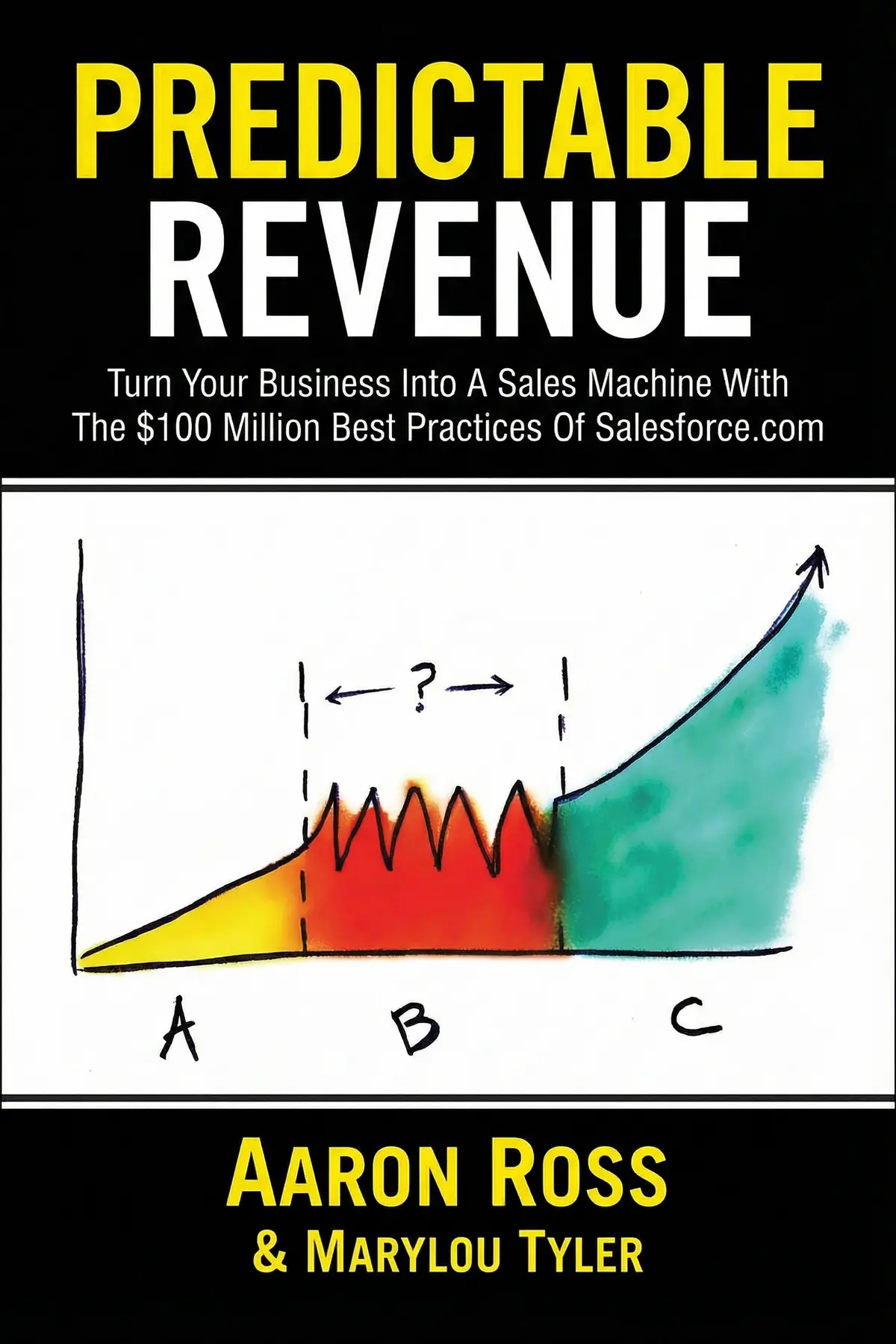
Table of Content
1. Introduction
59 sec
If your sales swing from a record month to an empty one, you cannot plan the next year, let alone the next five. In Predictable Revenue, Aaron Ross and Marylou Tyler argue that adding salespeople rarely cures this. What cures it is a steady flow of new leads, handled by people who each do one part of the sale well.
The authors draw on practices from Salesforce.com and define predictable revenue as sales that keep growing and that you can reasonably count on in advance. A number like that lets a company plan years ahead, and it makes a founder far more believable in front of investors. Their case is that this steadiness is built piece by piece: through the kinds of leads you chase, the way you split the sales work and how you treat the buyer from the first call. Along the way you get a vocabulary for your pipeline, a team design that works even with two people, and a three-hour sales conversation you can run next week.
2. Stop hiring your way toward more revenue
1 min 38 sec
When a quarter disappoints, the instinct is to add salespeople. The authors argue that this reflex belongs to an older era of selling, and that the internet has changed what actually brings customers in.
3. Sort your leads into seeds, nets and spears
1 min 47 sec
A thirty-second television spot can bring in thousands of names, yet those names may be worth less than a handful found another way. Knowing which kind of lead you hold changes how you spend money and patience.
4. Make the best prospects come to you
2 min 04 sec
Trade shows have a poor name in sales, and free trials once scared software firms. Both can feed a steady stream of buyers who arrive already interested, if they are run with a plan.
5. Give every stage of the sale its own specialist
1 min 44 sec
A salesperson who prospects, closes and soothes unhappy customers in the same day does each job at half speed. The authors propose a split that even a two-person team can use.
6. Prospect by email before you pick up the phone
1 min 47 sec
Cold calling has a reputation for rejection and wasted hours. The authors rebuild it from the ground up, starting long before anyone dials and setting a surprising limit on how many replies you should want.
7. Sell the customer's success instead of the close
1 min 48 sec
Pressure to close deals often makes salespeople worse at closing them. A written plan for the client and a conversation in three timed stages offer a calmer route to a yes that lasts.
8. Conclusion
1 min 04 sec
What Ross and Tyler describe is a way to make sales boring in the best sense: a number you can forecast. The old picture of a lone closer pushing buyers until they give in is replaced by a chain. Seeds, nets and spears feed it. Specialists move each lead along. A success plan and a patient conversation in three stages turn interest into a customer who stays. When any link is missing, revenue goes back to swinging from month to month.
You can start with what you already have. Label where your recent customers came from, and notice which of the three lead types you have been ignoring. If you are building a team, hire a closer first and someone to feed that closer second. Before your next important prospect meeting, write down what that client’s business will look like once your product is working for them, then bring the decision makers into the room to build that picture with you.
A forecast you can trust starts with knowing, every Monday, where next month’s customers will come from.
About this book
What is this book about?
Most companies that want more revenue do the obvious thing and hire more salespeople. Aaron Ross and Marylou Tyler argue that this outdated reflex rarely works. What makes revenue steady enough to plan years ahead, and believable enough to show investors, is a constant supply of new leads moving through a well-designed sales process. Drawing on practices from Salesforce.com, the authors start with what a lead is and sort leads into three types: seeds, nets and spears. They show how to attract inbound prospects through referrals, free trials and well-prepared conferences. They explain why a sales team should be divided into four specialized functions, even when the team is only two people. And they describe Cold Calling 2.0, an approach to outbound prospecting that begins with an ideal customer profile and opens with email. The book ends on how deals should be sold: around a written success plan for the client and a three-stage conversation lasting three hours and fifteen minutes. Readers get a vocabulary for their pipeline, a hiring order and a sales process they can try straight away.
Book Information
Who it's for
Founders with uneven sales
Founders whose sales swing from strong months to empty ones and who need numbers they can plan around.
Managers splitting sales roles
Sales managers deciding how to split prospecting, closing and account care across a team.
B2B sellers rethinking cold-calling
Business-to-business sellers tired of pushy cold calling who want a calmer outbound method.
About the Author
Aaron Ross
Aaron Ross is the author of Predictable Revenue and, with Jason Lemkin, From Impossible To Inevitable. He also wrote Predictable Income, a practical system for building several income streams. Marylou Tyler founded Strategic Pipeline, a consulting group that helps Fortune 1000 companies improve outbound sales. She wrote Predictable Prospecting, on growing a business-to-business pipeline, published by McGraw-Hill, and in 2016 was nominated to the Sales Lead Management list of 20 women to watch.
Ratings & Reviews
Ratings at a glance
What people think
Listeners find the book highly readable and value it as a great source of best practices, with one listener noting it offers a thorough method for finding new prospects. Moreover, the text is full of useful ideas; one listener describes it as an efficient crash course in the sales industry. Additionally, listeners praise the writing style, with one noting it’s a non-jargon-filled writer.
Top reviews
Anawin
Wow, this is an absolute masterclass in outbound strategy that cuts through the typical fluff found in sales literature. Aaron Ross and Marylou Tyler have created a guide that is remarkably easy to read and highly actionable. I loved the lack of jargon; they explain complex organizational structures in a way that actually makes sense. The concept of 'Predictable Revenue' isn't just a catchy title—it is a legitimate goal achieved through the rigorous separation of roles. After implementing just a few of the prospecting tips, we saw a noticeable shift in our lead quality. Personally, I think this book is a competitive advantage for anyone willing to actually follow the steps. It is the OG for a reason. Even with the older references, the logic is flawless. This is one of those rare business books I will actually keep on my shelf for reference.
Show moreBua
Ever wonder why Salesforce scaled so aggressively during its early years? This book pulls back the curtain on the exact outbound engine they used. Predictable Revenue is a dense, experience-based manual that is filled with actionable points for C-level executives and managers alike. I was expecting a lot of fluff, but what I got was a strategic roadmap. The authors do a great job of explaining why your current sales team might be failing—usually because they are spread too thin. Gotta say, the tips on how to structure a 'cold' email to get a referral are worth the price of the book alone. It’s an excellent foundation for any startup founder. It may be the 'OG' book, but the wisdom here is timeless. Highly recommended for anyone who needs to build a sales machine from scratch.
Show moreErn
Picked this up on a recommendation and was pleasantly surprised by how readable it was despite being a business manual. The authors speak from a place of deep experience, not just theory. They understand the real-world friction between marketing and sales. I found the section on 'mistakes for C-level people' to be particularly stinging but necessary. The truth is, most sales problems are actually management problems. By implementing the specialized roles suggested here, you remove the 'prospecting' burden from your top closers. This allows them to do what they do best: close. It’s a brilliant, non-jargon-filled look at how to grow a business sustainably. I don't give five stars often, but for the impact this had on our internal processes, it’s well-deserved. Truly a best-kept secret for those who haven't read it yet.
Show moreMikael
Finally got around to reading the 'Sales Bible' of Silicon Valley and I can see why it is held in such high regard. The primary insight—separating your market response reps from your outbound prospectors—is something many startups still get wrong. Ross provides a very detailed method for discovering new prospects without relying on soul-crushing cold calls. I found the section on 'Blackberry-sized emails' quite funny, though it shows the book's age. The truth is, the framework works if you have the right price point. You can't just throw people at a problem without a system, and this book provides that structure perfectly. It is a quick, efficient crash course for anyone entering the SaaS space. Just be prepared for some management 'mumbo jumbo' toward the final chapters that doesn't quite match the technical quality of the beginning.
Show moreTak
Not what I expected from a business book, but in a good way. Instead of the typical '10 secrets of closing' nonsense, this is a functional blueprint for building a department. The breakdown of how Salesforce built their outbound machine is fascinating. I especially liked the emphasis on not making your closers do their own prospecting. It seems obvious now, but the book explains the 'why' behind it through experimental data. Look, some of the tactics for emailing feel a bit gimmicky by today's standards, like asking for a referral to the right person. Still, the underlying strategy of specialization is sound. It’s an excellent source of best practices for anyone trying to move away from 'lumpy' revenue toward something more consistent. It’s a solid 4-star read that every founder should skim at least once.
Show moreDivya
As someone who has struggled with lead generation for years, the distinction between seeds, nets, and spears was eye-opening. The authors understand that you can't just tell a salesperson to 'go sell more' without giving them a funnel. This book provides a clear, proven tactic for creating that funnel. I appreciated the specific examples and the illustrations that help visualize the sales process. My only gripe is that it feels slightly repetitive in the middle sections. You could probably get 80% of the value by reading the first half and the conclusion. However, the advice on avoiding unsolicited phone calls is still very relevant in 2024. Most people just don't pick up the phone anymore, so the email-first approach is vital. It’s a practical, no-nonsense guide for scaling a sales team.
Show moreFelix
Look, the advice here is solid but it comes with a specific context that many readers might overlook. This sales process is specifically tailored for products with a certain lifetime value. If your LTV is too low, the cost of an SDR team will eat your margins alive. That being said, for the mid-market and enterprise space, this is pure gold. The writing style is conversational and fast-paced. I finished it in two sittings. I particularly liked the focus on the Market Response Rep role. Most companies lump inbound and outbound together, which is a huge mistake. By separating them, you ensure that no lead falls through the cracks. It’s an efficient crash course in modern sales architecture. It has a few flaws and a bit of survivorship bias, but the core principles are undeniably effective.
Show morePatchara
The core takeaway is simple: specialize or die. If you have your best salespeople spent half their day hunting for phone numbers, you are losing money. Predictable Revenue teaches you how to stop that leak. While I agree with other reviewers that it can be a bit 'self-promotional' for Ross's consulting business, the actual advice is top-tier. The breakdown of lead types—seeds, nets, and spears—is a framework I use every day now. It helps in defining which marketing activities are actually driving revenue. The book is a bit of a relic in terms of the tech it mentions, but the psychology of the sales process remains the same. It’s a motivating read that gives you a concrete plan. If you're tired of 'unpredictable' months, just buy the book and follow the Salesforce model.
Show moreScarlett
If you are looking for a silver bullet to solve your revenue problems, this isn't it, but there is some decent theory here. The authors break down lead generation into three categories: seeds, nets, and spears. While the 'spears' or outbound prospecting section is the most famous part, it feels a bit dated in the era of modern spam filters. I appreciate the focus on specialization within the sales team, separating the SDRs from the AEs. To be fair, this was probably revolutionary when it first came out, but now it's just standard industry practice. The writing is clear and avoids heavy jargon, which I liked. However, I can't help but feel like I was being sold a consulting package for half the book. It’s a good historical reference for how Salesforce scaled, but don't expect it to change your life today.
Show moreNathan
Why did I spend six hours listening to what is essentially a long-form advertisement for sales consulting? This book could have easily been condensed into a three-page PDF or a quick blog post without losing any of the meat. The core message is simply to split your sales team into those who find leads and those who close deals. Frankly, the rest of the content feels like filler designed to drive traffic to the author's website. There are constant mentions of outdated technology like Blackberries that make the advice feel a bit dusty. If you are selling a product with a low lifetime value, this process will absolutely bankrupt you. It only works for a specific mid-market niche. I found the tone a bit obnoxious and self-congratulatory throughout the chapters.
Show moreQuestions about this book
What is the main idea of Predictable Revenue?
Aaron Ross and Marylou Tyler argue that steady, forecastable sales come from a constant flow of new leads handled by a specialized team, and that simply hiring more salespeople is an outdated fix. Drawing on practices from Salesforce.com, they explain the types of leads, how to attract them, how to divide sales roles and how to sell around the client’s success.
What are seeds, nets and spears in Predictable Revenue?
They are the book’s three types of leads. Seeds grow from brand reputation through searches, public relations, social media and content, and convert well over time. Nets come from broad marketing such as email campaigns and TV ads, bringing volume but converting less often. Spears come from targeted outbound work, where dedicated people pursue specific companies matching a defined profile.
What is Cold Calling 2.0?
It is the authors’ approach to outbound prospecting. You first define an ideal customer profile, then find or build a database of matching prospects. Instead of phoning first, you send regular small batches of emails that read like personal notes from one salesperson, keeping replies to a manageable five to ten a day, and follow up by phone with those who respond.
How should a small company structure its sales team according to the book?
The authors say even very small teams should specialize. The first sales hire should be someone who can close deals, and the second should focus entirely on generating leads for that person. In larger teams, sales splits into four functions: inbound lead qualification, outbound prospecting, closing deals by account executives, and account management for existing customers.
What does the sales method that takes three hours and 15 minutes involve?
It is a three-stage sales conversation. A 15-minute light conversation checks whether a deeper talk is worthwhile. A one-hour qualification and discovery call with the people responsible for new deals tests the fit. Finally, a two-hour group working session with all key decision makers builds a shared vision of how the product will make the client successful.
Featured in
Readers also enjoyed


7 Powers: The Foundations of Business Strategy
Hamilton Helmer





Alibaba: The House That Jack Ma Built
Duncan Clark


AUDIO SUMMARY AVAILABLE
Listen to Predictable Revenue in 15 minutes
Get the key ideas from Predictable Revenue by Aaron Ross, plus 5,000+ more nonfiction titles.
- 5,000+ titles
- Listen as much as you want
- 7-day free trial
- Cancel anytime









