
12 min 44 sec
Available in: English
Power Questions: Build Relationships, Win New Business, and Influence Others
Shows how a few well-timed questions can win clients, test plans, help people make their own decisions and get a stalled meeting moving. Each question is drawn from real encounters with executives, donors and teams.
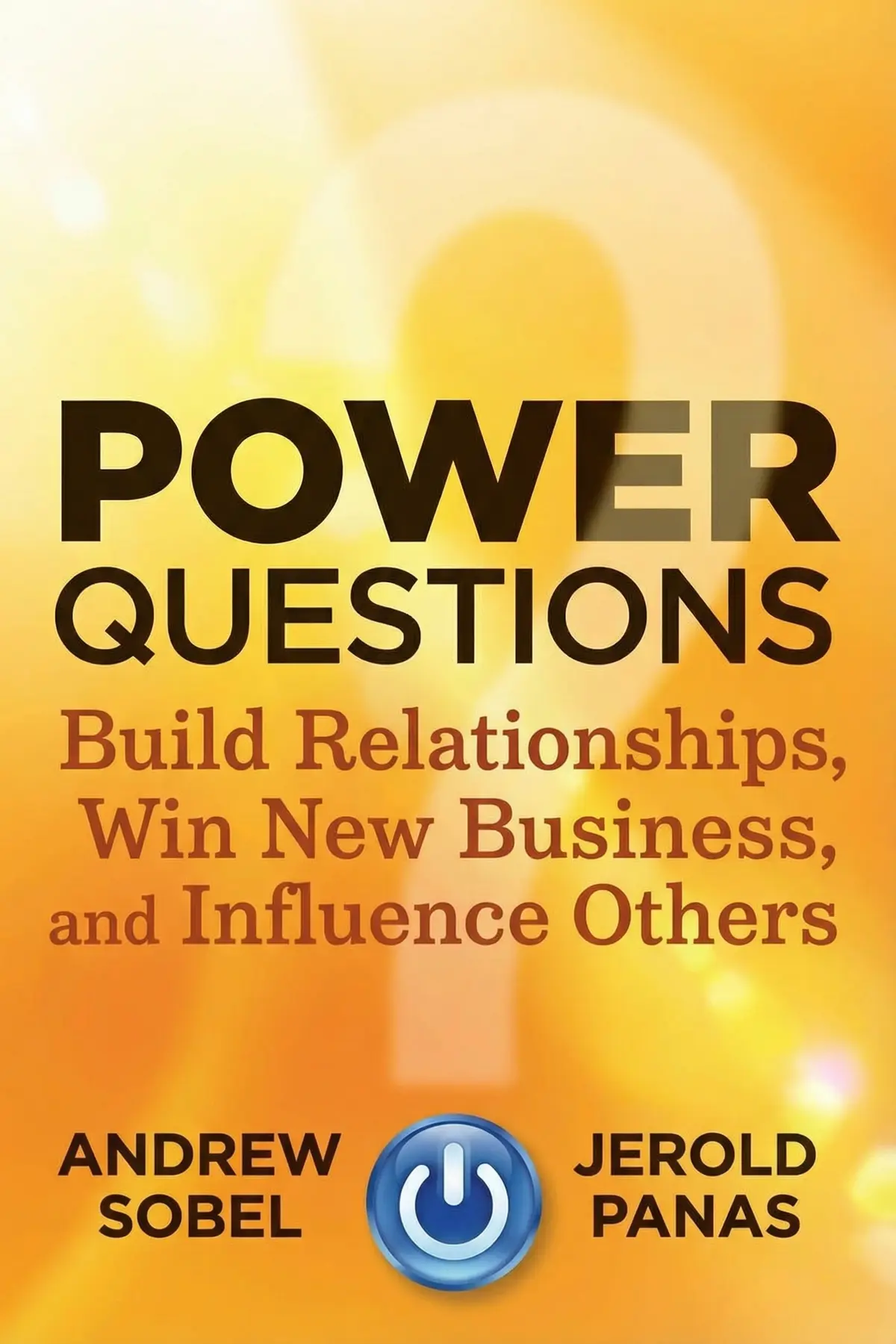
Table of Content
1. Introduction
1 min 08 sec
Most professionals walk into a client meeting ready to talk, and that readiness is often what loses the room. In Power Questions, adviser Andrew Sobel and fundraiser Jerold Panas argue that a well-chosen question does more for a relationship than the best presentation. Their book is built from short real encounters, and the pattern keeps repeating: the person who stops explaining and asks something open learns what the other side wants, and earns their trust along the way.
The authors note that big shifts have often started with a question. Einstein wondered whether he could ride along on a beam of light. Peter Drucker asked executives what business they were really in. Sobel and Panas bring that same tool down to lunches, sales pitches, donor visits and planning meetings. Their claim is that influence comes less from what you say than from what you ask, and when you ask it. Across a dozen stories, you will collect a few exact questions to carry into your next pitch, your next hard decision or your next stalled meeting.
2. Answer the pitch request with a better question
1 min 49 sec
A client invites you to introduce your firm, and it feels like the perfect opening. Two partners got that same invitation. One overwhelmed the client with detail, while the other opened up a genuine conversation with a single question.
3. Get people to tell you what they truly value
1 min 51 sec
A fundraiser asked a wealthy donor for a large gift and watched the meeting go wrong. What saved it was an admission most people avoid, followed by a question that revealed where the donor’s heart really was.
4. Test any plan with two blunt questions
1 min 54 sec
A celebrated inventor spent ten years on a machine the market shrugged at, and a hospital CEO nearly charged into an acquisition. Each case points to a question that could save years of effort.
5. Help people decide without giving advice
1 min 44 sec
When someone brings you a hard choice, telling them what you would do feels generous. A minister weighing his career and a CEO stuck in the wrong parts of her job show what works better.
6. Name your purpose to transform your daily work
1 min 41 sec
A group of tired bankers and a young man headed for medical school both found their direction through one uncomfortable exercise. Peter Drucker left five questions that do the same job for anyone.
7. Turn a drifting meeting into firm decisions
1 min 27 sec
Everyone has sat through a planning session full of slides that settles nothing. In one such meeting, a participant asked five plain words, and the whole room had to face what it had and had not done.
8. Conclusion
1 min 10 sec
What Sobel and Panas offer, in the end, is a different place to look for influence. The partner who stopped pitching, the fundraiser who started over with Allan Favort and the bankers who remembered why they worked all gained ground by giving someone else room to speak. In the authors’ account, a question does several jobs at once. It shows you what a client needs. It tests a plan against reality and against mission. It lets people reach decisions they own, and it pulls a wandering group back to its purpose.
You can begin small. Keep one return question ready for the moment someone asks you to describe yourself, and let them tell you what they want to know. Before your next big commitment, ask whose problem it solves and how it fits the mission you claim. When a meeting circles, ask what has been decided.
Einstein’s question was about light, and Drucker’s was about business. Yours might be about a client lunch on a Tuesday. The scale changes, but the move stays the same, and the room tends to open up for whoever asks the best question.
About this book
What is this book about?
Most professionals prepare for meetings by preparing what to say. Andrew Sobel and Jerold Panas argue that this habit often costs them the relationship, because every minute spent explaining yourself is a minute you are not learning what the other person cares about. Their book is built from short real encounters. A partner buries a telecom client in slides. A fundraiser asks a donor for money for the wrong cause. A bank vice president spends a client lunch talking about herself. Each story is set against a better moment, when someone asked an open question and the conversation changed: Rich DeVos telling how Amway began, a CEO rethinking an acquisition, a minister finding his own answer, bankers remembering why they chose their work. Readers come away with a set of specific questions and a sense of when to use them: in pitches and client meetings, when testing a plan against real needs and mission, when coaching someone through a hard choice, when looking at their own life, and when a meeting circles without deciding anything.
Book Information
Who it's for
Ready to pitch clients
Consultants, bankers and salespeople who walk into client meetings ready to pitch.
Managers and coaches
Managers and coaches who want people to reach their own decisions instead of waiting for advice.
Stuck in indecisive meetings
Fundraisers, founders and anyone stuck in meetings that end without a decision.
About the Author
Andrew Sobel
Andrew Sobel helps companies and individuals grow revenue by winning new clients and deepening existing relationships, and he helps professionals move from hired expert to trusted adviser to senior executives. His books on trusted business relationships have been translated into 21 languages. Jerold Panas is an executive partner at Jerold Panas, Linzy and Partners, a firm specializing in campaign services and financial resource development. He co-founded the Institute for Charitable Giving, which he chairs, and lectures on the field.
Ratings & Reviews
Ratings at a glance
What people think
Listeners find this title very easy to follow and value the deep questions that encourage better analytical thought. Furthermore, the content acts as a functional tool that aids listeners in achieving goals professionally and personally while strengthening connections and enhancing conversational abilities. Listeners also enjoy the engaging narratives included, with one listener highlighting the way it offers specific contexts for applying the questions alongside detailed justifications.
Top reviews
Preeda
The chapter on Socratic questioning really changed how I approach my leadership role within my department. Instead of just barking orders, I’m learning to ask questions that foster engagement and drive collaborative decision-making. Not gonna lie, I was skeptical about the 'power' of these questions at first, thinking they might come off as manipulative or overly 'salesy.' However, the authors emphasize building deeper connections and aligning with organizational values rather than just getting what you want. The writing style is very accessible, though I did find some of the historical references a bit shallow. Overall, it’s a valuable tool for personal growth and self-discovery that I’ll likely keep on my desk for reference.
Show moreJames
Wow, I didn't realize how much I was dominating my professional interactions until I read these pages. It’s a wake-up call for anyone who thinks they have all the answers. The authors show how asking reflective questions can lead to personal transformation and better alignment with your core values. Gotta say, the way they structure the stories makes the advice feel very actionable. Instead of just telling you what to do, they provide scenarios that show the 'before and after' of a conversation. Some of the 'power questions' are admittedly simple, but their impact on building relationships is undeniable. It’s a compelling read that I’ve already recommended to several friends in management positions.
Show moreLuke
Picked this up because I wanted to stop talking and start listening during client meetings. The authors argue that the right inquiry can turn a stale presentation into a genuine dialogue, and truth is, they’re right. While some of the scenarios felt a bit like they were designed for high-powered CEOs only, the underlying logic is solid. I appreciated how they showed the transition from 'Yes or No' dead-ends into deep reflection. To be fair, a few of the questions are painfully obvious if you've been in sales for more than a year. However, the sheer volume of examples makes it a practical resource for anyone struggling to build rapport. It's an easy read that focuses more on application than theory.
Show moreSam
After hearing several colleagues recommend this, I finally dove into Sobel and Panas’s world of inquiry. The book is neatly divided into four sections, ranging from professional interactions to personal reflection. To be fair, the real-life scenarios illustrate the concepts much better than a simple list would have. I particularly liked the section on enhancing leadership, as it provides a clear roadmap for using strategic questions to inspire change. Some critics might say the stories are drivel, but I found them to be a practical way to see the questions in action. It’s a quick read that emphasizes how a single well-placed inquiry can transform a relationship. It's definitely improved my communication skills over the last month.
Show moreKofi
Direct and easy to digest, this guide functions more like a toolkit than a deep philosophical text. Personally, I think it’s perfect for those in sales or proposal development who need to move beyond 'pitching' and start 'consulting.' The authors provide several examples of how to redirect a conversation that has gone off track, which is a lifesaver in high-stakes meetings. My only gripe is that some of the questions feel a little too personal for a standard office environment—you really have to read the room. Truth be told, it’s not a 'question dictionary' that covers every possible scenario, but it certainly helps you develop a more inquisitive mindset. A solid 4-star resource for career development.
Show moreSomchai
Honestly, the best part of this entire read is the list of questions compiled at the very end. While the stories throughout the book provide context, they can sometimes feel a bit repetitive or overly focused on the authors’ own 'hero' figures. That said, the core message about the power of well-crafted questions is vital for anyone looking to win new business or influence others. I found myself highlighting several pages where they explain how to unlock new insights during a consultation. Some of the commentary is a bit thin, but the book succeeds as a practical resource. It encourages critical thinking about how we communicate. If you can get past the occasional 'brown-nosing' tone, there’s a lot of value to be found here.
Show moreLaddawan
Finally got around to finishing this, and I find myself reaching for it before every big networking event. What makes this book stand out is how it frames questions as a strategic tool for leadership and influence. I’d say the authors do a great job of showing how to turn an ordinary interaction into a meaningful exchange. While I agree with other reviewers that some examples feel a bit 'multilevel marketing' in their delivery, the intent is clearly about fostering deeper connections. The four-section structure makes it easy to navigate to the specific type of advice you need. It’s a practical guide that promotes a more open-minded approach to both work and life. Well worth the time for the communication tips alone.
Show moreHemp
Ever wonder why some conversations just fall flat even when you’re trying your hardest to be engaging? This book tries to solve that by providing a 'question dictionary' of sorts, wrapped in various anecdotes. Frankly, it feels a lot like those online recipe blogs where you have to scroll through a life story just to find out how many eggs to use. The stories are hit or miss—some are compelling, while others feel a bit like filler or 'brown-nosing' success stories. That said, the list at the back is incredibly useful for a quick pre-meeting refresh. It’s not a masterpiece, but for a junior professional in marketing or sales, it offers a decent foundation for improving communication skills.
Show moreNongnuch
As someone who has worked in sales for a decade, many of these 'power questions' felt like stuff I learned in week one. It’s a bit frustrating to wade through paragraphs of personal reflections just to get to a single sentence of advice. The truth is, the book could have easily been a long-form blog post. I expected more useful, high-level information rather than basic stories about meeting famous people. However, I can see why it’s popular; it’s an easy read and the scenarios for question use are explained clearly. It’s a decent starting point for someone who is naturally shy or lacks experience in professional networking, but it didn't quite live up to my high expectations.
Show moreWilliam
Not what I expected from a book with such a bold title. In my experience, most of these 'Power Questions' are things people with basic social awareness already do. The authors spend a lot of time congratulating themselves on their interactions with various 'pompous' success stories, which got old fairly quickly. Look, I wanted a deep dive into the psychology of inquiry, but instead, I got a collection of anecdotes that felt a bit vapid. There are some okay insights regarding how to get people to open up about their egos, but the substance is paltry for the price. If you’re brand new to the professional world, you might find some value here, but seasoned veterans will probably find it unhelpful.
Show moreQuestions about this book
What is the main idea of the book Power Questions, written by Andrew Sobel with Jerold Panas?
The authors argue that well-timed questions build trust and influence more reliably than polished answers. Through a dozen real encounters, from a failed telecom pitch to a donor meeting rescued by a fresh start, they show how open questions reveal what people need and value, test plans against real demand and mission, help others make their own decisions and turn aimless meetings into decisive ones.
What should you say when a client asks you to tell them about your company?
In one of the book’s stories, a junior partner answered that request with a long presentation and learned nothing about the client. His senior partner, given the same invitation, asked what the client would like to know about the firm. That reply turned the meeting into a dialogue in which the client named the topics that mattered, so the partner could focus only on those.
How can questions help someone make a decision?
Sobel describes advising Tom Sewell, a minister facing a major career decision. Instead of giving advice, he asked what Sewell felt was the right decision for himself, and Sewell reasoned his way to a choice that fit his values. In a similar way, asking divisional CEO Claire which parts of her job she wanted more and less of led to a restructuring of her role around mentoring and new market strategies.
What question fixes a meeting that goes nowhere?
The book describes a planning meeting lost in PowerPoint slides and vague agenda items. One participant asked what the group had decided that day. The room realized nothing had been settled, refocused, and left with firm conclusions and concrete next steps. In the story, one participant’s plain question is enough to refocus the meeting and move the group toward clear decisions.
Who should read Power Questions?
It suits professionals whose work depends on relationships: consultants, bankers, salespeople, fundraisers and leaders. Anyone who tends to over-explain in client meetings, rushes to give advice, or sits through meetings that decide nothing will find specific questions to try. Its reflective exercises, such as Drucker’s five questions and writing your own obituary, also help readers weighing a career change.
Readers also enjoyed






AUDIO SUMMARY AVAILABLE
Listen to Power Questions in 15 minutes
Get the key ideas from Power Questions by Andrew Sobel, plus 5,000+ more nonfiction titles.
- 5,000+ titles
- Listen as much as you want
- 7-day free trial
- Cancel anytime









