

14 min 19 sec
Available in: English
Positive Intelligence: Why Only 20% of Teams and Individuals Achieve Their True Potential and how You Can Achieve Yours
Shows how to spot the mental habits that turn stress into self-sabotage, weaken them by naming them, and train a calmer, wiser mode of thinking with short daily exercises, alone or with a team.
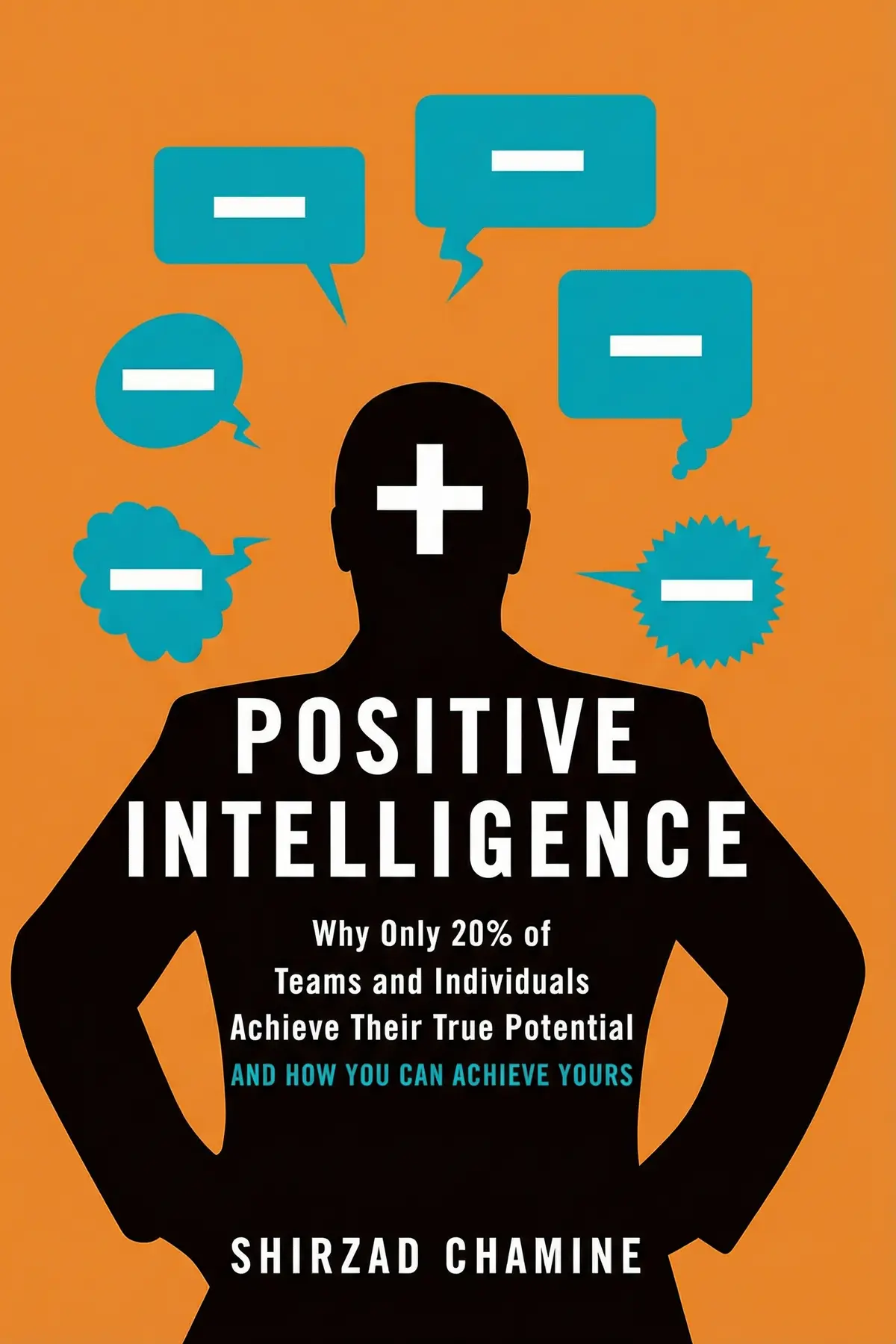
Table of Content
1. Introduction
1 min 06 sec
If your harshest critic is the voice in your own head, Shirzad Chamine has a way to measure how often it wins. In Positive Intelligence, the executive coach defines a score he calls PQ: the share of time your mind works as your ally instead of your enemy. Most of the battles that drain you, he argues, happen inside your head, and that means they can be trained.
The case runs like this. Old survival habits, which Chamine calls Saboteurs, keep you anxious and stuck. A wiser part of the mind, the Sage, can take over once you name the first and exercise the second. Along the way you meet an entrepreneur who turned down 125 million dollars, a brain researcher whose stroke left her strangely calm, a CEO who rediscovered a turkey sandwich, and a couple who rebuilt a 21-year marriage. Each one brings a tool you can try within the hour, from labeling your inner critic to ten-second exercises done while brushing your teeth.
2. Winning more will not calm your anxious mind
1 min 41 sec
An entrepreneur knew exactly how much money would make him happy, then refused more than twelve times that amount. His choice reveals where dissatisfaction really comes from, and why the next promotion rarely fixes it.
3. Name your Saboteurs to loosen their grip
1 min 44 sec
Ten familiar mental habits take turns running your day, from the perfectionist to the people-pleaser. The cheapest way to weaken them sounds almost too simple, and it borrows a villain from the movies.
4. A calmer way to meet good and bad news
1 min 39 sec
A farmer loses his best horse, gains several more, and watches his son get hurt, yet his reaction never changes. His stubborn calm describes a part of your mind most people rarely let speak.
5. Solve hard problems with five Sage powers
1 min 43 sec
Most people jump from a problem straight to judging solutions, and wonder why they keep picking the same ones. Chamine lays out five steps in a deliberate order, and the order itself does much of the work.
6. Build mental muscle in ten-second reps
1 min 50 sec
A brain researcher lost the use of half her brain and felt more peaceful than ever. You do not need her ordeal to reach that state, only a short daily workout hidden inside your morning routine.
7. Raise the PQ of your whole team
1 min 36 sec
A CEO who wept over his falling stock found a turning point in a sandwich. What his team discovered next shows why a group’s mindset is something different from the sum of its people.
8. Repair a relationship by listening without blame
1 min 48 sec
A successful executive and the wife who gave up her career had stopped understanding each other after two decades. One simple listening rule changed what each of them could see, and what they did next.
9. Conclusion
1 min 12 sec
Chamine’s argument sounds modest and reaches far. Much of what wears you down is the commentary your own mind adds to events, and that commentary comes from reflexes built for a world of predators and hunger. Peter turned down 125 million dollars because a voice moved his finish line. Jill Taylor lost the use of her brain’s left side and found peace. The difference in both cases was which part of the mind held the wheel.
That turns PQ into a skill you can train. Begin with the Saboteur you recognize most easily and give it a slightly ridiculous name, so its next speech sounds like a character talking. Fold ten-second reps into the day, at the sink, in the shower, at lunch, working toward a hundred of them. And when a real problem arrives, be kind to yourself first, explore it, list ideas without judging them, then pick the path you would be glad of looking back from the end of your life.
The farmer never knew whether the next event would be good or bad. He simply refused to let fear decide for him, and that refusal can be practiced, one breath at a time.
About this book
What is this book about?
Most people know the feeling of being their own worst enemy: worrying a good plan to death, bristling at feedback, or reaching a goal only to feel it was not enough. Shirzad Chamine, a longtime coach of CEOs and executive teams, argues that these fights happen mostly inside the head, which means they can be trained. His measure is PQ, the share of time your mind works as an ally rather than an enemy. Low PQ comes from ten Saboteurs, survival reflexes such as the Judge, the Pleaser and the Controller that once kept us safe and now feed anxiety. High PQ comes from the Sage, a calmer part of the mind with five powers: empathy, exploring, innovating, choosing a path that fits your values, and acting. The book gives readers a practical method. Name each Saboteur to loosen its grip, then build mental muscle with ten-second sensory exercises folded into everyday routines. Stories of a CEO hit by the 2008 recession and a strained 21-year marriage show how the same tools work for teams and relationships.
Book Information
Who it's for
Self-critical professionals
Professionals whose inner critic turns every achievement into the next demand.
Managers and team leads
Managers and team leads trying to lift a group's mood and focus during a hard stretch.
Under stress at home
People handling stress or tension at home who want short, daily practices instead of theory.
About the Author
Shirzad Chamine
Shirzad Chamine is Chairman Emeritus and former CEO of the largest coach-training organization in the world, and earlier ran an enterprise software company. He has coached hundreds of CEOs and their executive teams and trained coaches and managers at many Fortune 500 firms. He holds a Stanford MBA, a psychology degree and a master's in electrical engineering, did doctoral studies in neuroscience, and lectures on Positive Intelligence at Stanford. This is his first book.
Ratings & Reviews
Ratings at a glance
What people think
Listeners find this book accessible and clear, viewing it as a necessary read for all. They praise the pragmatic strategy, with one listener remarking that it can be put to use in daily life right away. The text delivers deep perspectives on behavior and growth, enabling people to hit their milestones and better themselves. Listeners prize its transformative nature, as one noted it helped them pause and evaluate their past. It efficiently aids in stilling the mind and minimizing tension.
Top reviews
Wanphen
This book completely shifted my perspective on why I self-sabotage so frequently. I have always been my own harshest critic, but seeing that inner voice labeled as a 'Judge' helped me distance myself from those toxic thoughts. The concept of the 'Sage'—the part of us that handles challenges with empathy and curiosity—is a game-changer for anyone struggling with chronic stress. I particularly identified with the 'Hyper-Achiever' and 'Pleaser' saboteurs, which have dominated my career for years. The writing is accessible, and the advice is immediately applicable to daily life. I’ve noticed a significant drop in my anxiety since I started practicing the PQ reps, which are essentially micro-meditations you can do anywhere. It is rare to find a personal development book that is this practical. This is a must-read for anyone who feels stuck in their own head.
Show moreDek
As someone who has spent years in the corporate world, I’ve read my fair share of leadership books, but this one stands out for its clarity and ROI. Chamine distills complicated interpersonal dynamics into a framework that actually makes sense for teams. We often talk about 'soft skills,' but this book treats mental fitness as a hard metric that impacts the bottom line. The idea that we have 'mental muscles' that need regular exercise is a brilliant metaphor. I’ve started implementing the 10-second PQ reps before big meetings, and the difference in my focus is palpable. It helps me move from a place of judgment to a place of curiosity. The book is well-organized and provides a clear roadmap for personal growth. I’ve recommended it to several colleagues who are now seeing similar improvements in their stress levels and performance.
Show moreDaranee
After hearing about Positive Intelligence on a podcast, I started practicing the techniques to manage my chronic stress and I am genuinely impressed. The author’s personal story about his own 'Judge' was moving and made the concepts feel very relatable. I’ve been doing the PQ exercises for three weeks now, and I can actually feel my brain shifting gears when I get triggered. I’m sleeping better and my blood pressure has actually gone down according to my last checkup. The 'Restless' and 'Victim' saboteurs were my biggest hurdles, but the book gave me the tools to catch them before they spiraled. It’s a very empowering read. It teaches you that you have a choice in how you respond to life’s challenges. I wish I had discovered this framework ten years ago; it would have saved me so much unnecessary heartache.
Show moreAnchalee
Finally got around to reading this and it’s arguably the most practical guide to mental fitness I’ve ever encountered. The concept of 'Positive Intelligence' as a quotient (PQ) that you can actually improve is brilliant. I loved the breakdown of the Sage powers versus the Saboteurs’ survivor brain. It explained so much about why I react the way I do under pressure. The 'Hyper-Rational' description was a mirror of my own worst habits, especially in how I distance myself from emotions. Chamine’s writing is clear and the exercises are short enough that even the busiest person can’t make excuses. It’s about building new neural pathways through consistent, tiny actions. This book doesn't just tell you to 'be positive'; it shows you exactly how to do the work. I’m already seeing a difference in my relationships and my overall sense of peace.
Show morePooja
Picked this up on a recommendation from my manager and found the 'PQ reps' surprisingly easy to integrate into a busy workday. The premise is simple: our minds are often our own worst enemies, and we need to train our mental muscles to shift from negative to positive responses. I love how the book breaks down the 10 Saboteurs, like the 'Controller' and the 'Avoider,' which makes it easier to spot them in real-time. My only gripe is that the terminology gets a bit jargon-y at times, and some of the stories feel a little too perfect. However, the core exercises are undeniably effective for grounding yourself during high-pressure situations. It’s a great tool for leadership development. I’ve already started using the assessment with my team to improve our communication and reduce friction. Definitely worth a read for the actionable strategies.
Show moreElias
Ever wonder if complex psychological issues can really be boiled down to ten little 'saboteurs'? While the framing is definitely simplistic, the effectiveness of the 'Yes, and...' exercise and the focus on the 'Sage' powers cannot be ignored. The book helps you realize that your inner chatter isn't actually 'you,' which provides a much-needed sense of relief. I found the 'Stickler' description particularly illuminating for my own habits. Even if the 'neuroscience' claims are a bit overblown, the mindfulness techniques are solid and rooted in established psychological principles. It’s an easy read, though it does get repetitive toward the middle chapters. I appreciated the concrete steps for quieting the mind. It’s not a magic cure, but it is a very useful manual for anyone looking to improve their mental well-being and productivity.
Show morePita
Wow, the descriptions of the 'Avoider' and 'Hyper-Vigilant' types were so spot-on it felt like the author was reading my mind. I’ve always known I had these tendencies, but giving them a name took away their power over me. The book is a bit repetitive, and the 'New-Agey' lingo might turn some people off, but the results are hard to argue with. It’s essentially a modernized, more structured version of mindfulness meditation tailored for the business world. I appreciated the focus on the 'Sage' powers—Empathize, Explore, Innovate, Navigate, and Activate. These provide a great framework for problem-solving without the usual emotional baggage. While I wish there were more rigorous citations for the data mentioned, the practical impact on my daily happiness has been undeniable. It’s a solid resource for anyone looking to tame their inner critic.
Show moreYaowares
In my experience, most self-help books are 90% fluff, but this one actually gives you a workout plan for your brain. The truth is, the concepts aren't entirely new—it's mostly rebranding the inner critic and mindfulness—but the way it's packaged makes it much easier to execute. The assessment on the website is a great starting point to identify your primary saboteurs. I was surprised to find 'The Controller' at the top of my list, but once I saw it, I couldn't unsee it. The book is written in a very encouraging tone and is easy to digest. My only complaint is that it can feel a bit like an advertisement for the author's more expensive coaching pods. Regardless, the book itself contains enough information to start making changes on your own. It’s a practical guide for anyone wanting to quiet their mind.
Show moreOrawan
Before buying into the hype, I decided to look deeper into the author's scientific claims, and what I found was frankly disappointing. To be fair, Shirzad Chamine presents some interesting ideas about mental fitness, but the "neuroscience" branding feels like a total stretch. He is marketed as a neuroscientist, yet his background is actually in Electrical Engineering and Business, with only a brief stint in a PhD program he never completed. The book repeatedly cites groundbreaking research that simply doesn't exist in peer-reviewed journals. While I appreciated the descriptions of the 'Judge' and 'Saboteur' archetypes, it’s hard to trust a system built on such a shaky foundation of academic forgery. The prose is repetitive, and the constant upselling of his program left a bad taste in my mouth. If you can ignore the fake credentials, there might be some value here, but stay skeptical.
Show moreGai
Look, the content in this book isn't necessarily harmful, but I cannot stand the intellectual dishonesty presented by the author. He claims his program is based on research with 500,000 participants, yet this data is nowhere to be found in any scientific database. Even more egregious is the way he misrepresents actual studies. For instance, he references Robert Zajonc’s work on facial muscles to claim that 'fake positivity' causes coronary heart disease, which is a total fabrication of the original study’s conclusion. The book is filled with these kinds of pseudoscientific leaps. He tries to dress up basic meditation as 'PQ Brain' technology to sell a coaching program. If you want real mindfulness, read Eckhart Tolle or Jon Kabat-Zinn instead. Don’t waste your money on a businessman pretending to be a neuroscientist through a veil of small forgeries and made-up jargon. It’s irresponsible.
Show moreQuestions about this book
What is the main idea of Positive Intelligence by Shirzad Chamine?
Chamine argues that most stress and self-sabotage happen inside your mind. He measures this with PQ, the share of time your mind works for you instead of against you. Low PQ comes from ten Saboteurs, survival habits like the Judge and the Controller. High PQ comes from the Sage, a calmer mode with five powers. You raise PQ by naming the Saboteurs and exercising the Sage.
What are the ten Saboteurs in Positive Intelligence?
The Judge leads them, criticizing you for never doing enough. The others are the Stickler, who demands perfection; the Pleaser; the Hyper-achiever; the Victim; the Hyper-rational, who dismisses feelings; the Restless, chasing excitement; the Hyper-vigilant, always expecting trouble; the Controller, who micromanages; and the Avoider, who dodges conflict. Chamine says everyone deals with a mix of them daily.
What are PQ reps and how do you do them?
A PQ rep is at least ten seconds, about three breaths, of full attention on your body and senses. Chamine recommends 100 reps a day for 21 days, folded into routines: feeling the brush while cleaning your teeth, listening to shower water, tasting each spice in a meal, or watching a friend’s expressions closely. When a Saboteur intrudes, use it as a cue for another rep.
Can Positive Intelligence help teams and relationships?
Yes, Chamine applies it to both. A team’s PQ is not the average of its members, so he advises building individual PQ first and then the group’s, with clear shared values. A CEO named Frank used this after the 2008 recession, and his stock recovered within 18 months. A couple, Patrick and Susan, eased marital tension by repeating each other’s worries back without blame.
What are the five Sage powers?
Empathy comes first, starting with kindness toward yourself. Exploring means studying a situation with curiosity before acting. Innovating means generating ideas without judging them yet. The fourth power compares the options and picks one that fits your values, tested by imagining yourself looking back at the end of your life. Activation means acting on that choice with focus while ignoring the Saboteurs’ doubts.
Readers also enjoyed




A Guide to the Good Life: The Ancient Art of Stoic Joy
William B. Irvine


A High-Performing Mind: Strengthen Your Mind and Live Your Best Life
Andrew D. Thompson


Abundance: The Inner Path to Wealth
Deepak Chopra

AUDIO SUMMARY AVAILABLE
Listen to Positive Intelligence in 15 minutes
Get the key ideas from Positive Intelligence by Shirzad Chamine, plus 5,000+ more nonfiction titles.
- 5,000+ titles
- Listen as much as you want
- 7-day free trial
- Cancel anytime









