

A History of Iran: Empire of the Mind
Michael Axworthy
 English
Shows how an English aristocrat who spied for Moscow turned a parlor game into a world sport, and how China later used it to win respect abroad and reopen contact with America.
1 min 02 sec
Most of us treat sport as a break from politics. Nicholas Griffin’s Ping-Pong Diplomacy shows the opposite: barely fifty years ago the United States and China had no contact whatsoever, and the first crack in that wall opened at a table tennis championship in Japan.
Griffin, a novelist and journalist, traces the story back to one unlikely man. Ivor Montagu was an English aristocrat, a committed communist and secretly a Soviet spy, and he turned a game for after dinner into a global sport. His hope was that ping-pong would help the West see communist states in a kinder light.
The throughline is easy to state. Because Montagu built ping-pong into an open, international sport, China could use it first as propaganda and then as a back door to Washington. Follow it, and you will see how a staged handshake on a bus led to a presidential visit, and why small public gestures sometimes achieve what formal diplomacy cannot.
1 min 40 sec
He grew up playing in the prime minister’s garden, yet the boy who would shape a global sport had no talent for the games his family adored, and a political taste that horrified them.
1 min 53 sec
A trademark dispute with a famous toy company threatened to keep the game in the hands of people who could afford the right equipment. One teenager’s response decided who would get to play.
1 min 47 sec
Stalin’s own viewing box, a broken code and a letter to the founder of the Chinese Red Army all appear in the life of the man who ran world table tennis.
1 min 48 sec
In London, an entire restaurant stood up and walked out when one athlete arrived. Within a year, crowds that had booed his team were clapping, and an isolated government far away was studying why.
1 min 50 sec
While hunger spread across the country, one group of young athletes ate well every day. Their leaders expected something in return, and the price of failure sat on every plate.
1 min 40 sec
A long-haired American teenager climbed onto the wrong bus, or so one side claims. The gift he received, and the cameras waiting for him afterward, tell a more deliberate story.
1 min 54 sec
Banquets under hostile banners, a reporter paying for film he had never seen, and a secret flight over the Himalayas: the road from a sports trip to a presidential meeting took some strange turns.
1 min 06 sec
Ping-Pong Diplomacy ends where Montagu’s hopes began. He wanted his game in palaces and embassies as well as sports halls, and the proof came from the country he had worked hardest to welcome. Beijing poured money and attention into a sport, used it to cheer its people through hunger, and then used it to start a conversation it could not risk starting any other way. A silk print, a T-shirt and a few photographs did not make the deal. They made it safe to begin.
The story holds something for ordinary life too. When two sides are stuck, look for a low-stakes setting where people can meet without either appearing to give ground first. Watch for the courtesy that changes a room, the way Ogimura’s refusal to raise his flag did in London. And notice who built the neutral spaces you rely on, because rules written by one stubborn enthusiast can outlast him by decades.
Montagu wrote the rules so that anyone could play. Half a century later, a Chinese champion sat smiling in a United Nations seat his game had helped win.
For decades the United States and China had no contact at all. When the silence finally broke in 1971, it happened at a table tennis championship in Japan, through a teenage American player and a Chinese world champion. Nicholas Griffin sets out to explain how a game once played after dinner in English country houses ended up opening the way to a presidential summit. His story begins with Ivor Montagu, a wealthy British aristocrat who loved ping-pong and communism in equal measure, and who secretly passed information to the Soviet Union. Montagu wrote the sport's rules, kept it open to everyone and built its international federation, hoping the game would help the West see communist states more kindly. Griffin then follows Japan's use of the sport to repair its postwar image, China's heavy investment in its players during years of famine, and the staged encounter on a bus that led to Kissinger's secret flight and Nixon's visit to Beijing. Readers get a compact, character-driven account of how symbolic gestures, carried by people without official rank, can move great powers that cannot afford to be seen moving first.
History readers who want the human story behind the reopening of relations between China and the United States.
Sports fans curious about how a game shaped world politics.
Professionals who handle tense relationships and want to see how symbolic gestures can open stalled talks.
Nicholas Griffin is a London-born novelist and journalist whose articles have appeared in The Times, the Financial Times and Foreign Policy. He has written seven books, among them four novels and The Year of Dangerous Days, a history of Miami in 1980, and his work has also reached film, television and magazines. That mix of reporting and storytelling shapes his account of how a game changed world politics.
Listeners find the writing both captivating and expertly composed, characterizing the book as a gripping segment of world history. They value the depth of information, with one listener noting it provides a nice compact synopsis of 20th-century history. The narrative earns praise for its insights into the impact on world diplomacy.
What an absolutely wild ride through a chapter of history I thought I already knew. Most people know the basic story of Nixon going to China, but Griffin digs into the 'why' and 'how' in a way that feels fresh and vital. The connection between the British aristocracy and Mao’s regime through the medium of table tennis is just stranger than fiction. Truth is, the book reads more like a thriller than a standard history tome. I was gripped by the descriptions of the Chinese team’s training and the political pressure they faced during the Great Leap Forward. It’s a masterful blend of sports reporting and high-level political analysis. If you want to understand how the modern world was shaped by a 'faintly ridiculous' sport, you need to pick this up.
Show moreThe drama in these pages is incredible. Nicholas Griffin writes with a novelist’s flair, turning a series of diplomatic meetings and sports matches into a high-stakes chess game. The way he juxtaposes the humble origins of 'whiff-whaff' with the massive egos of Nixon and Mao is brilliant. I loved the characterization of the players—they weren't just athletes, they were diplomats in tracksuits. This book provides such a nice compact synopsis of the 20th century's shifting alliances. It’s rare to find a non-fiction book that is this informative while remaining so genuinely entertaining. Every chapter revealed something new about the hidden mechanics of the Cold War. Truly a great read for anyone interested in how cultural exchange can thaw even the iciest political relations.
Show moreEver wonder how a simple game could prevent a war? Griffin’s book answered that and more. It’s a fascinating story that hasn't been told with this much detail before. I was particularly struck by how the Chinese team was used to distract the public from the Great Leap Forward. It’s a sobering reminder of how sports can be used for propaganda. Despite the heavy subject matter, the prose is light and engaging. The book is a perfect first read for the year if you want something that makes you think. It connects the dots between a British aristocrat, an American hippie, and the most powerful leaders in the world. I highly recommend it to anyone who enjoys history that reads like a thriller. It's a fantastic look at global impact.
Show moreFinally got around to reading this, and it’s a total trip. Griffin manages to make the world of international table tennis feel as high-stakes as a Bond movie. The cast of characters is just bizarre—you've got hippie athletes, Soviet spies, and calculating politicians like Nixon all orbiting this small celluloid ball. It’s a great example of how small, seemingly insignificant cultural exchanges can lead to massive diplomatic realignments. I particularly liked the focus on Montagu’s role as a bridge between East and West. While some of the middle chapters drag a bit when discussing the minutiae of tournament rules, the overall impact on world diplomacy is presented brilliantly. It’s a nice, digestible way to understand the Sino-American rapprochement without picking up a thousand-page textbook.
Show moreAs someone who grew up playing basement ping-pong, I had no idea my hobby had such a radical pedigree. Griffin’s exploration of the game’s origins as a deliberate Communist plot is eye-opening. The way Ivor Montagu manipulated the international federation to favor Eastern Bloc interests is a narrative thread I never expected. The book does a fine job of showing how the Chinese team became a symbol of national pride, even as the country suffered through immense internal turmoil. The writing is sharp and usually moves at a good clip, though it occasionally gets lost in the weeds of minor tournaments. Still, it’s a fascinating chapter of world history that deserves more attention. It makes you realize that nothing in international relations is ever truly accidental.
Show moreAfter hearing about 'Ping-Pong Diplomacy' for years, I finally understand the full scope of what happened. This isn't just about a few matches; it’s about the entire Sino-Soviet split and the desperate need for China to reconnect with the world. Griffin does an able job of framing the matches within the context of the Cultural Revolution, showing how dangerous the game became for the Chinese players. Personally, I found the biography of Ivor Montagu to be the most compelling part. He was such an eccentric figure, moving between British high society and Soviet intelligence circles. The book is well-written and offers a deep dive into a niche but pivotal moment. It’s a bit dense in the middle, but the payoff at the end makes the journey worth it.
Show moreWho knew that a game once called 'whiff-whaff' could actually change the course of global history? This book provides a compact synopsis of how a simple pastime was weaponized by Ivor Montagu to spread Communist ideals. It’s a fascinating premise, but the execution is hit or miss. At times, the narrative flows with a novelist’s flair, especially during the 1971 tournament. Other sections feel like they’re bogged down in overly minute biographical details that don't always pay off. To be fair, the section on the Cultural Revolution’s impact on the Chinese team was harrowing and well-researched. I just wish the pacing was more consistent throughout. It’s a solid read if you’re a history buff, but casual readers might find themselves skimming the more academic chapters.
Show moreIs it a sports book or a political biography? Griffin tries to do both, and while he’s mostly successful, the tone can be quite jarring. One minute you're reading about the physics of a backspin and the next you're deep in the weeds of Soviet espionage tactics. Look, the research is impeccable, and I learned a lot about the isolation of 1960s China that I didn’t know before. However, the author’s voice is a bit dry for my tastes. He focuses heavily on the chronology of events rather than the emotional stakes of the players. It’s an informative read for research purposes, but it didn't exactly set my world on fire. It's an important story, just told in a somewhat clinical fashion that kept me at arm's length.
Show moreMaybe my expectations were just too high for this one. I came for a sports story and left feeling like I’d sat through a particularly dusty lecture on 20th-century geopolitics. Griffin clearly knows his stuff, but the writing is so detached that it’s hard to stay engaged. Frankly, he seems to almost look down on the sport of ping-pong itself, treating it more like a weird historical fluke than a game with its own soul. The book ends with a weirdly dismissive note about how soccer and basketball are the 'real' sports, which felt like a slap in the face to anyone who actually likes table tennis. It’s an okay historical chronology, but it lacks the human warmth needed to make the players feel like more than just pawns in a Cold War game.
Show moreI really wanted to love this, but the author's attitude kept getting in the way. There is a palpable sense of disdain for the sport of ping-pong throughout the text. Griffin seems more interested in the spycraft and the political maneuvering than in the actual athletes who risked everything to play. To me, the players felt like afterthoughts in their own story. The book concludes with a redundant comparison to basketball, essentially calling table tennis irrelevant in the modern era. Not gonna lie, I found it frustrating. The historical facts are there, but the spirit of the game is entirely missing. It’s a dry, academic exercise that lacks the passion I was hoping for.
Show moreGriffin tells how table tennis helped reconnect the United States and China after decades without contact. He starts with Ivor Montagu, an English aristocrat, communist and Soviet spy who wrote the sport’s rules and built its international federation. China later invested heavily in the game, and in 1971 a meeting between an American player and a Chinese champion in Japan led to a team visit, Kissinger’s secret trip and Nixon’s visit to Beijing.
Montagu came from one of England’s richest families and loved two things: ping-pong and socialism. As a teenager he chaired the national association and wrote the official rules, then founded the International Table Tennis Federation. He also passed information to the Soviet Union, including news that British scientists had broken a Soviet code. He used the federation to welcome Soviet and Chinese teams, hoping the sport would improve how the West saw communist states.
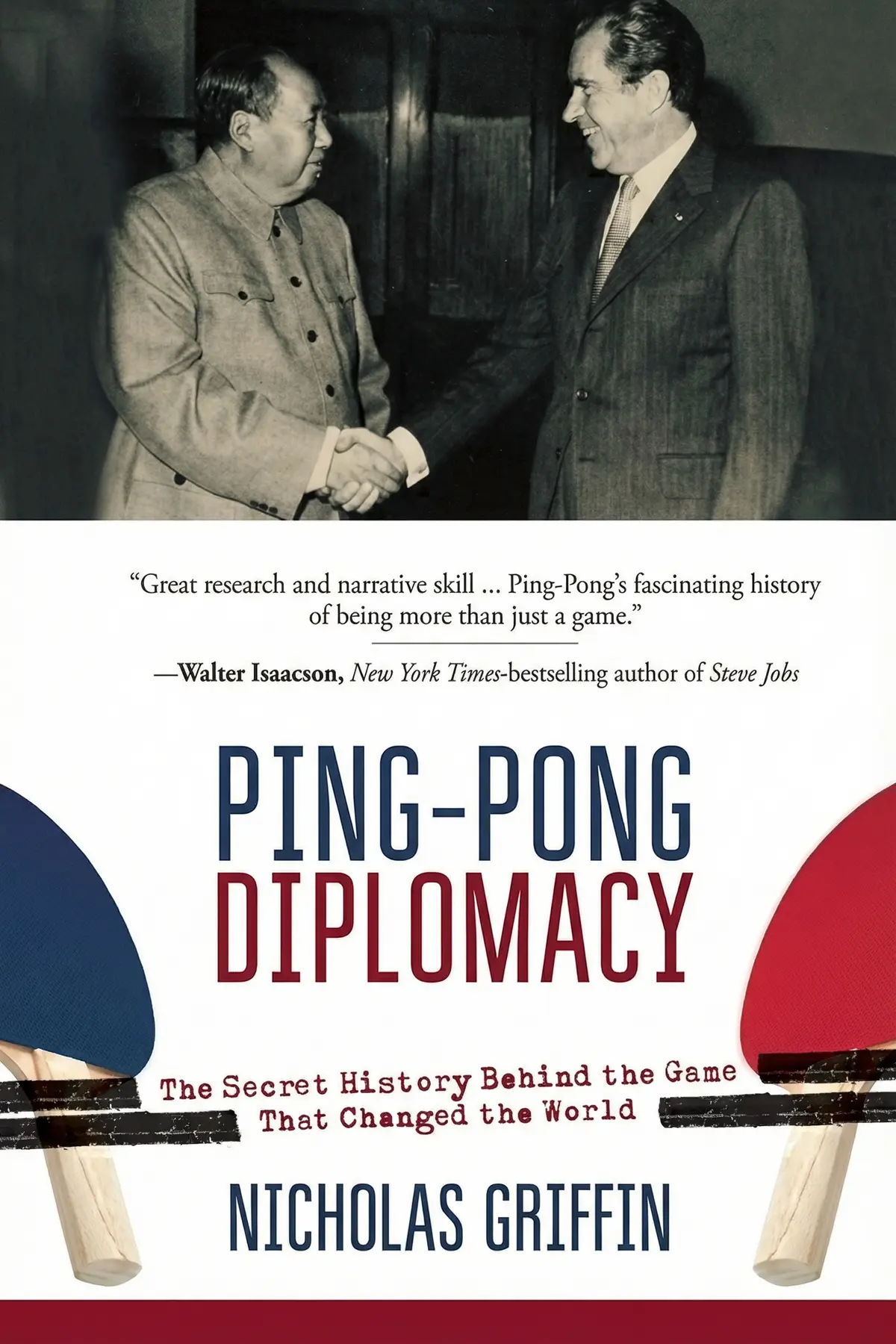
On April 5, 1971, American player Glenn Cowan boarded the Chinese team bus at the world championships in Nagoya, Japan. The Chinese champion Zhuang Zedong shook his hand and presented him with a silk screen print showing the Huangshan Mountains. Griffin argues the moment was likely planned: players could not normally carry such gifts, Cowan later said he was invited, and photographers were waiting when the bus returned. The photos spread worldwide and led to an invitation to China.
The American team’s visit to China drew huge press coverage, and a Gallup poll showed that most Americans, for the first time, supported China joining the United Nations. That summer Henry Kissinger flew secretly to Beijing for talks with Zhou Enlai, and Nixon then announced a visit to China. Later, the Chinese team toured the United States, and Zhuang Zedong was filmed in China’s new permanent seat on the Security Council.
The book shows how small public gestures can shift attitudes, as when Japan’s Ichiro Ogimura declined to raise his flag after winning in London. It also shows how low-stakes meetings between people without official rank let two sides test a relationship without losing face. And it illustrates how an open institution, like Montagu’s federation, can become a doorway for those shut out elsewhere.
Michael Axworthy

Tom Standage

Ishmael Beah




William J. Bernstein

Ben Macintyre


AUDIO SUMMARY AVAILABLE
Get the key ideas from Ping-Pong Diplomacy by Nicholas Griffin, plus 5,000+ more nonfiction titles.









