

59 Seconds: Change Your Life in Under a Minute
Richard Wiseman
 English
Shows why high-stakes moments so often bring out your worst thinking. It also gives simple ways to stay clear and creative in exams, interviews, negotiations and speeches, from changing one word to standing differently.
55 sec
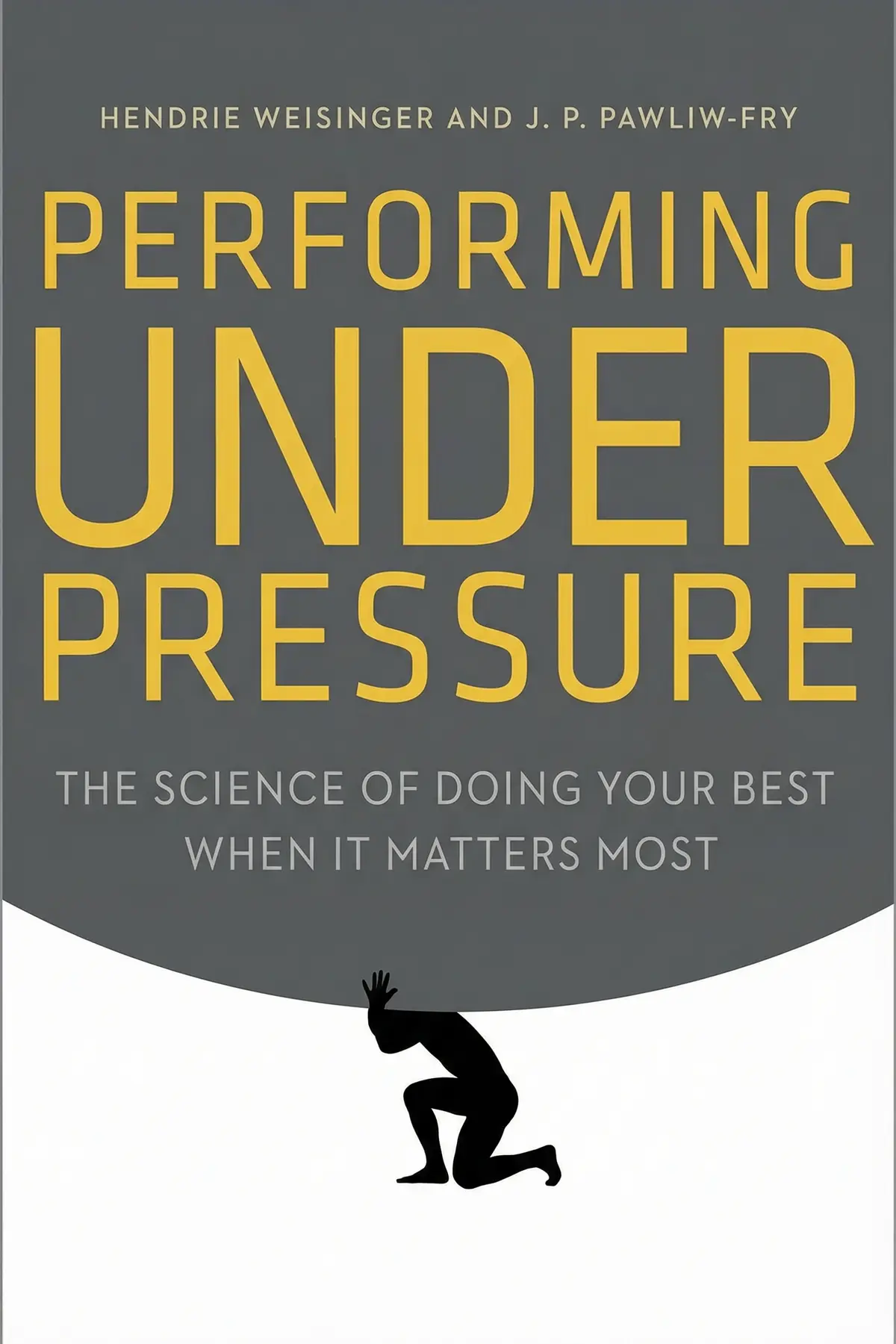
If you trust a looming deadline to bring out your best work, the evidence here says you are probably wrong. Pressure nearly always shrinks creativity and pushes people toward the safest, most ordinary answer. In Performing Under Pressure, psychologist Hendrie Weisinger and performance coach J.P. Pawliw-Fry explain why the moments that matter most so often bring out our worst, from a blank mind during a speech to a fight with a partner.
Their argument is that pressure works on the way you think, so the way you think is where you fight back. Small shifts in focus and wording loosen its grip. Four trained qualities, confidence, optimism, tenacity and enthusiasm, form a kind of armor around you. Along the way you will hear why the word need can make you unwell, why a pianist forgets a piece she knows by heart, and what two minutes of standing tall can do before an interview.
1 min 38 sec
Many people swear they do their sharpest work with the clock running out. A Harvard researcher took that claim seriously and found a gap between how productive people felt and what they actually produced.
1 min 36 sec
A day of back-to-back meetings and a big entrance exam both leave you tense, yet treating them the same way can backfire. The authors give each its own remedy, and the two point in opposite directions.
1 min 37 sec
A pianist rehearses for weeks, walks on stage and cannot find a single note. Her skill did not vanish. Something she did in that moment locked it away, and most of us do the same thing.
1 min 39 sec
Telling yourself you need something seems harmless, almost too small to matter. The authors argue that this kind of phrasing distorts how you see a situation, and that a friend’s annoying question before an interview may be the cure.
1 min 38 sec
In the heat of a negotiation, the easiest move is whatever ends the discomfort fastest. A short exercise done on a calm evening can make the hard choice for you long before anyone is waiting for an answer.
1 min 48 sec
Some people grow steadier as the stakes climb, and it can look like an inborn gift. The authors say the first layers of that steadiness come from a posture held for two minutes and from a young woman’s recovery.
1 min 36 sec
A student terrified of public speaking still steps up to the front of the class. And a feeling you can switch on with music or a memory may be what keeps your thinking from shrinking under pressure.
1 min 04 sec
The pianist in the authors’ example never lost her skill. She lost access to it, because pressure turned her attention onto herself. That one picture holds the book’s case. Pressure leaves your ability in place and goes after how you think in the moment, and those thoughts decide whether your ability shows up at all.
The encouraging part of Weisinger and Pawliw-Fry’s account is that this thinking can be trained, mostly through small, ordinary acts. A word changed from need to want. A list of values put in order on a quiet evening, so a tense negotiation cannot decide for you. A habit of noticing what is good before the day begins.
Before your next big moment, try two things from the book. Spend a couple of minutes standing tall, arms open and shoulders back. Then pick a spot on any object near you and follow your breath until your mind settles. Walk in with the result you want in view, and let the skill you rehearsed run without supervision. The moment will still matter. It just won’t be running your mind.
Most people think a deadline brings out their best. Hendrie Weisinger and J.P. Pawliw-Fry argue the opposite. Pressure usually narrows creativity, pushes people toward ordinary answers, blanks their memory and strains relationships. It does this by changing how they think in the moments that matter most. The authors separate pressure from stress and give each its own remedy. They explain choking, the way watching yourself perform locks away well-rehearsed skills, and how a word like need can distort your view of a situation. Their tools are deliberately small: swap need for want, ask what the worst outcome really is, rank your values before a tense deal, and train your attention on one spot on an object. The book's centerpiece is what they call a COTE of armor, four qualities that can be built: confidence, optimism, tenacity and enthusiasm. Readers get practical ways to strengthen each one, from a two-minute power pose to a morning habit of noticing small good things. The aim is to make sure the skill you already have actually shows up when it counts.
Professionals who freeze or go blank in presentations, interviews and big meetings.
Students facing exams, recitals or competitions where one performance counts.
Managers and negotiators who make high-stakes calls and want to stay creative and fair under strain.
Hendrie Weisinger holds a Ph.D. from the University of Kansas, trained in clinical, counseling and organizational psychology, and is a pioneer of pressure management. He has advised Fortune 500 companies and government agencies and taught executive education at UCLA, Wharton, NYU and Cornell. J.P. Pawliw-Fry is a performance coach who trained at Harvard Medical School's Mind/Body Medical Institute. He founded The Institute for Health and Human Potential and coaches Olympic athletes and business leaders.
Listeners find the material very accessible and value the actionable life advice and mental frameworks provided. It is a thoroughly researched book, with claims supported by various scientific studies, and listeners mention successfully learning how to handle high-stakes situations. They describe it as beneficial for improving performance, and one listener highlights that it offers excellent perspectives on controlling stress and reframing intense moments.
Picked this up during a particularly brutal quarter at work and it was exactly the mindset shift I needed to survive. The most impactful takeaway for me was the distinction between stress and pressure; I realized I was treating every minor task like a life-or-death predator encounter. Weisinger and Pawliw-Fry explain that pressure actually derails our cognitive ability, so 'trying harder' often makes us perform worse. I’ve started implementing the 'slowing down' techniques during meetings to give my working memory a chance to catch up. It works. The writing is accessible and the 'COTE' acronym is easy to remember when you’re in the heat of the moment. While some people might find the sports examples tedious, I thought they illustrated the 'choking' phenomenon perfectly. This is a must-read for anyone who feels like they are constantly under the microscope.
Show moreWow, I never realized how much my own uncertainty was manifesting as physical symptoms until I read the chapter on the London bombing victims. The authors show that unpredictable pressure is far more damaging than consistent stress, which really changed how I view my chaotic work environment. The 'Befriend the Moment' strategy has been a game-changer for my public speaking anxiety. Instead of seeing the audience as judges, I’m learning to see them as partners in a shared opportunity. The book is well-researched, with most assertions backed by studies that feel relevant to modern professionals. I especially appreciated the focus on 'micro-successes' to build confidence. It’s a very easy read that provides a comprehensive toolkit for anyone looking to master their internal environment. I’ve already recommended it to several colleagues who struggle with 'pressing' too hard during sales pitches.
Show moreFinally got around to reading this and I am impressed by how the authors translated complex physiological responses into everyday language. They tackle the 'anatomy of choking' with precision, explaining why our brains freeze up just when we need them most. I loved the list of ten values shared by the top 10% of performers—especially the point about not becoming defensive when criticized. It’s a rare self-help book that actually provides 22 specific, distinct tactics rather than just one big idea stretched over 300 pages. Is some of it a bit 'rah-rah'? Sure. But the techniques for managing 'working memory' are legitimately useful for anyone in a high-pressure field like medicine or law. It helps put high-stakes situations into perspective so you can actually use the skills you’ve spent years developing.
Show moreThis book offers a compelling deep-dive into why we stumble when the stakes are high, effectively dismantling the 'clutch hitter' myth. I found the COTE of armor concept—Confidence, Optimism, Tenacity, and Enthusiasm—to be a refreshing framework for professional development. While the authors lean heavily on sports analogies, the underlying psychology regarding how pressure differs from stress is genuinely enlightening. It turns out that pressure is a selection mechanism, not just a feeling of being busy. I did feel that some of the scientific claims, like the power-posing segments, felt a bit dated and have been contested in recent years. However, the twenty-two practical solutions provided in the latter half of the book are worth the price of admission alone. If you can filter through the occasional fluff, there is a wealth of actionable advice here for anyone in a high-stakes career.
Show moreTo be fair, I was skeptical about another performance book, but the 'Pressure vs. Stress' chapter alone was worth the read. Stress is about volume; pressure is about the outcome. Recognizing that distinction allowed me to categorize my daily tasks much more effectively. I appreciated the emphasis on 'slowdowns'—taking that extra second to breathe and let your cognitive operations catch up. My only gripe is the inclusion of 'power-posing' and some of the more dubious 'placebo' studies which have been widely criticized lately. If you ignore the slightly shaky science in the intro, the actual tools for performance are quite robust. The book is written in a very accessible way that makes it easy to pick up and put down. It's a great practical guide for shifting your mindset from 'crisis' to 'challenge.'
Show moreLook, I found this book to be a very helpful manual for anyone who feels like they 'choke' when all eyes are on them. The authors do a great job of explaining that nobody actually performs *better* under pressure; the best we can do is perform up to our actual capability. That realization alone took a lot of the weight off my shoulders. I really liked the practical life tips, like using humor to break the tension or focusing on the mission rather than the outcome. Some of the jargon can be a bit much, and the 'pseudo-science' warnings from other reviewers aren't entirely wrong, but the practical results are hard to argue with. I’ve felt much calmer during my recent presentations. It's a solid addition to the genre.
Show moreAfter hearing a lot of buzz about this title, I expected something more revolutionary, but it mostly feels like a polished compilation of existing cognitive behavioral techniques. There is some truly great advice for boosting crunch performance, particularly the idea of 'downsizing' the importance of a single event to avoid magnification. However, the book suffers from significant bloat. I found myself skimming through large portions of the middle section that felt like they were just repeating the same three points about the Roy Hobbs myth. The distinction between the amygdala’s emotional memory and the hippocampus’s factual memory was interesting, yet I wish the authors spent more time on application and less on these narrative filler stories. It’s a solid 3-star read: helpful and practical, but certainly not a page-turner that breaks new ground in the field.
Show moreThe core issue with this book is that it’s about 75% too long for the amount of unique information it provides. Frankly, the authors spend way too much time on anecdotes about NBA players and golfers that didn't really resonate with my experience in a corporate setting. While I appreciate the 'COTE' framework, I found the tone to be a bit repetitive after the first few chapters. There are definitely some gems here, like the advice to write down your worries before a test to clear your working memory, but you have to dig for them. It’s a decent resource if you have the patience to sift through the fluff, but a summarized version would probably be more effective for busy people. Not bad, just a bit of a slog to get through.
Show moreEver wonder how much 'pop' is actually in pop-psychology? This book is a prime example of why you should take self-help 'studies' with a massive grain of salt. The authors cite Amy Cuddy’s debunked power-posing work as if it were gospel, which immediately tanked their credibility for me. Then they suggest you can increase physical finger strength just by imagining the exercise? That is magical thinking, plain and simple. It is frustrating because there are a few decent nuggets about 'befriending the moment' buried under layers of pseudo-scientific nonsense and repetitive filler. The book is easily twice as long as it needs to be to convey its core message. To be fair, the section on the 22 strategies has some utility, but I found myself constantly fact-checking their more absurd claims. I would recommend skipping the first 20% and just reading the tactical tips at the end.
Show moreAs someone who appreciates evidence-based psychology, I found this book deeply disappointing. It starts with a promising premise but quickly devolves into a collection of dubious conclusions and 'magical thinking' that permeates the self-help industry. Citing a study that claims you can gain muscle by thinking about it is just irresponsible. It makes me question every other 'study shows' sentence in the entire text. While the twenty-two strategies in section two are somewhat useful, they aren't exactly ground-breaking—most are standard CBT techniques you can find for free online. The writing is easy to read, but the content lacks the rigour I expected from authors with these credentials. If you want real science, look elsewhere. If you want a feel-good book with lots of sports stories, this might be for you.
Show moreHendrie Weisinger and J.P. Pawliw-Fry argue that pressure hurts performance by changing how you think in the moments that matter. It narrows creativity, blocks well-practiced skills and distorts your view of a situation. Because the harm runs through thinking, the remedies do too: aim your focus correctly, change your words, lower the stakes, settle your values in advance and build four qualities they call a COTE of armor.
The authors define stress as having more demands than resources, like a day of back-to-back meetings. Pressure comes when a particular result really matters, like a college entrance exam. Both reduce creativity, but they need opposite fixes. For stress, narrow your attention to what you are doing right now. For pressure, keep your focus on the final result and adjust each move to keep advancing toward it.
COTE stands for confidence, optimism, tenacity and enthusiasm, the four qualities the authors say protect you under pressure. Confidence can be lifted with a two-minute high-power pose. Optimism grows by appreciating small things each morning. Tenacity comes from pursuing a goal you truly want. Enthusiasm keeps your thinking broad and creative, and you can trigger it by laughing, recalling a happy memory or playing upbeat music.
According to the authors, choking happens when pressure disrupts any part of your performance system: physical arousal, thoughts or behavior. A common trigger is monitoring yourself too closely. That self-watching uses up mental resources and blocks procedural memory, which runs practiced tasks automatically. Their example is a pianist who rehearses for weeks, starts tracking her every move on stage and suddenly cannot recall a single note.
The book suggests a few steps. Ask yourself what the worst outcome could really be, so the interview feels like a normal event. Put your energy into research and rehearsal instead of worrying about the questions. Replace thoughts like I need this job with I want this job. Just beforehand, hold a high-power pose for a couple of minutes, then focus on one spot on an object while noticing your breath.
Richard Wiseman





William B. Irvine


Andrew D. Thompson


Deepak Chopra
AUDIO SUMMARY AVAILABLE
Get the key ideas from Performing Under Pressure by Hendrie Weisinger, plus 5,000+ more nonfiction titles.









