

A History of the World in 6 Glasses
Tom Standage
 English
 ไทย
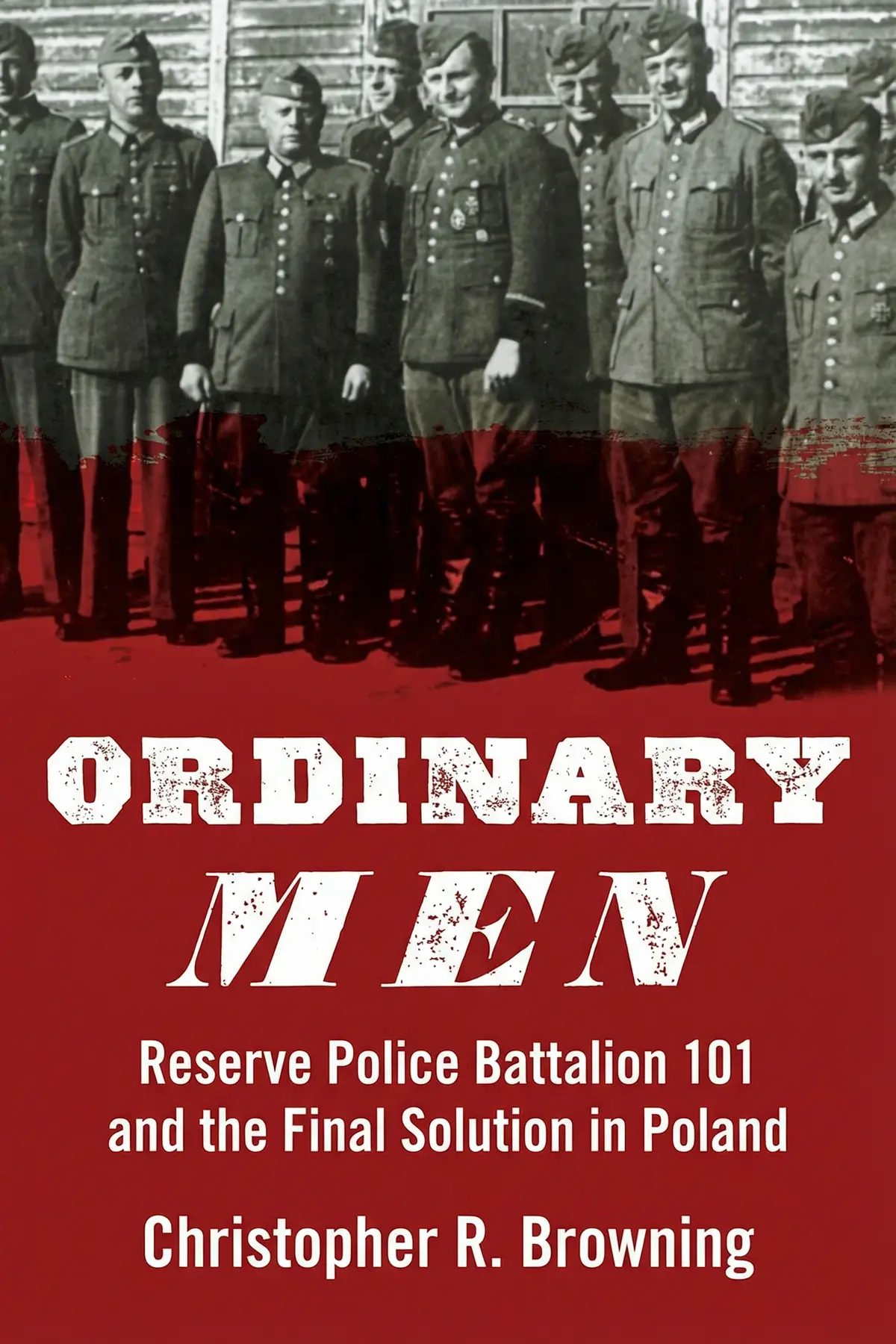
Follows a battalion of middle-aged German policemen through the Holocaust in Poland and shows how war, dehumanization, orders, conformity and a reorganized routine turned unremarkable men into killers of tens of thousands.
1 min 08 sec
Most of us carry a comforting belief: that mass murder is the work of monsters, people nothing like ourselves. In Ordinary Men, historian Christopher R. Browning tests that belief against the record of Reserve Police Battalion 101, fewer than 500 middle-aged policemen from Hamburg. On the morning of their first massacre, their own commander offered them a way out, and at most one in five avoided the killing.
Browning’s argument is unsettling and clear. These men did not arrive as killers. They were made into killers, step by step, by war, by contempt for their victims, by orders, by the pull of their comrades and by a system that kept rearranging the work so it felt easier to bear.
This history is painful, and it includes descriptions of mass killing. What it gives back is a sharper eye for how groups of decent people slide, and a hard question about what any of us would have done in their place.
1 min 47 sec
On paper, this unit was close to the last group anyone would choose for mass murder. Its age, its home city and its politics all point the other way, which makes what came next harder to explain.
1 min 49 sec
Before the first shot at Józefów, the battalion’s commander, close to tears, did something few commanders in that war did. How his men answered him is one of the most revealing moments in the whole history.
1 min 48 sec
A long day in a Polish forest left the battalion drinking heavily and unwilling to talk. The share of men who found a way to avoid the killing is the number readers rarely forget.
1 min 58 sec
After Józefów, nobody tried to make the men believe in the killing. Their commanders changed something else entirely, and a drunk lieutenant in another Polish forest showed how well it worked.
1 min 51 sec
The final searches for people in hiding brought killers and victims face to face again, with real freedom to hold back. What the men did with that freedom shows how far they had come.
1 min 38 sec
Many of the men said they were only following orders. Browning finds a more uncomfortable explanation, and it ends with a question aimed at the reader as much as at the policemen.
1 min 18 sec
This is a history with one hard, plain finding at its center. A group of unremarkable men, older, mostly working class and from one of Germany’s least Nazi cities, was given an open chance to refuse, and most did not take it. What followed was a slope. After Józefów, the killing was made easier to bear by shifting much of it to camp staff and Hiwis, and at Łomazy the men neither faced their victims in pairs nor got an offer to step out. Within months, volunteers filled firing squads, and at least 83,000 people were dead.
The image worth keeping is Trapp in tears, his hand on his heart, while his men carried out the order he hated. Distress stopped no one. Some who held back did so openly and early, as when Buchmann refused the night before and Schimke stepped forward, while others stepped out later, aimed past their victims or quietly slipped away.
That points to what to notice in the groups you belong to: a task split so finely that no one owns the harm, people spoken of as less than human, and the moment when going along simply feels safer than standing apart. The battalion shows how far an ordinary group can slide once the first chance to say no has passed.
Reserve Police Battalion 101 was an unlikely group of mass murderers. Its fewer than 500 men were mostly reservists around forty years old, mostly working class, mostly without military experience, and mostly from Hamburg, one of the German cities least won over by Nazism. Between 1942 and 1943, in the Lublin district of Poland, they shot at least 38,000 Jewish people and sent 45,000 more to the Treblinka extermination camp. Christopher R. Browning reconstructs how that happened. He starts at the village of Józefów, where the battalion's commander, close to tears, offered his men the chance to step out of their first massacre. He then follows the changes that made later killing easier: deportations instead of shootings, Soviet auxiliaries to share the worst work, no more face-to-face pairing and no more open offers to refuse. Readers get a precise account of how a group slides from horror to routine, and an honest look at the forces Browning identifies: war, racial contempt, obedience and the pull of comrades. The book ends with a question that applies to every reader: if these men could become killers, which group could not?
Readers who want to understand how ordinary people came to carry out the Holocaust.
Managers, teachers and trainers who think about group pressure, obedience and responsibility.
Students of history or psychology looking for a documented case behind ideas about conformity.
Christopher R. Browning is an American historian whose work centers on the Final Solution, the people who carried out Nazi policies and the use of survivor testimony. He taught at Pacific Lutheran University from 1974 to 1999, then became Frank Porter Graham Professor of History at the University of North Carolina at Chapel Hill, where he holds emeritus status. A Fellow of the American Academy of Arts and Sciences, he has given expert testimony at several Holocaust-related trials and has won the National Jewish Book Award three times.
Listeners find this account gripping and excellently crafted, noting that the meticulously documented research provides fresh perspectives on historical moments. They value its worth as a teaching tool for history students and its deep reflections on human nature. The storytelling draws varied responses, with some finding it interesting while others find it disturbing.
This book should be required reading for anyone interested in the darker corners of human psychology. Browning meticulously reconstructs the actions of Reserve Police Battalion 101, showing how regular middle-aged men became executioners. It’s not just a history of the Holocaust; it’s a study of conformity and peer pressure. Truth is, the most frightening part isn't the brutality, but how relatable these men's social anxieties feel. They weren't monsters by nature, just followers. The writing is clear and avoids unnecessary sensationalism while remaining deeply impactful. I found the analysis of the Józefów massacre particularly haunting because it highlights that these men actually had a choice to step away. While the subject matter is grueling, the insight into the 'banality of evil' is indispensable for understanding our own capacity for violence.
Show moreAs a psychology student, I was fascinated by how Browning integrates the Milgram experiment and Zimbardo’s prison study into his historical analysis. He provides a nuanced look at why RPB 101 acted the way they did, moving beyond the simple 'they were just following orders' excuse. Look, the fact that their commander, Captain Trapp, offered them a way out is the most damning piece of evidence in the whole book. Most didn't take it because they didn't want to look 'weak' in front of their comrades. It’s a brilliant exploration of social dynamics. The prose is academic yet accessible, making complex sociological theories easy to grasp through the lens of specific historical events. Truly one of the most sobering books I've ever read about the human condition.
Show moreChristopher Browning doesn't pull any punches in this historical masterclass. He takes us through the 'pre-industrial' phase of the Holocaust, where the killing was done face-to-face rather than in gas chambers. These were middle-aged guys, many with families back in Hamburg, who just... did it. They went from village to village, rounding up people and shooting them in the woods. The most striking thing is the 'routinization' Browning describes—how quickly mass murder became just another day at the office. The level of detail regarding the battalion's structure and the specific orders they received is impressive. It’s a harrowing look at what humans are capable of when they stop seeing others as human. Essential reading for any history buff.
Show moreTerrifyingly relevant even decades after it was first published. Browning shows that the line between 'normal' and 'monster' is much thinner than we like to believe. The focus on the 500 men of RPB 101 provides a micro-history that explains the macro-tragedy of the Holocaust better than many broader overviews. I was particularly struck by the stories of the few men who did refuse—it shows that there was always a choice, however difficult it might have been to make. The truth is, this book isn't just about the past; it’s a warning about the future and the dangers of blind conformity. If you want to understand the psychological machinery of genocide, start here. It’s a tough, brutal read, but absolutely necessary.
Show moreWow, this was a heavy one to get through. Browning looks at a group of German 'ordinary men' who weren't even particularly pro-Nazi, yet they ended up slaughtering thousands. Personally, I found the descriptions of the initial shootings in Poland to be incredibly graphic and hard to stomach. It’s one thing to read statistics, but it’s another to read about how these men felt physically ill after their first massacre. The book dragged a bit in the middle with the repetitive nature of the battalion's movements, but the concluding chapters on the psychological factors are brilliant. Not gonna lie, I felt pretty sick reading about the 'routinization' of mass murder. It’s a necessary read, but definitely not for the faint of heart or those looking for a light history.
Show moreEver wonder what you would do if you were placed in an impossible moral situation? This book suggests that most of us would probably fail the test. Browning traces the descent of Reserve Police Battalion 101 from regular citizens to seasoned killers with terrifying precision. The chapter on the Józefów massacre is particularly enlightening because it shows the initial hesitation of the men before they became desensitized. I appreciated how the author didn't just label them as 'monsters' but tried to understand the social mechanics of their actions. My only gripe is that the book focuses so heavily on this one unit that I wonder how applicable these findings are to the SS or more fanatical groups. Still, it’s a thought-provoking and deeply unsettling piece of work.
Show moreAfter hearing about the Goldhagen controversy, I finally decided to read Browning’s take. It’s a much more balanced and convincing argument in my opinion. He shows that you don't need 'eliminationist' anti-Semitism to get regular people to participate in genocide. The peer pressure and the fear of social ostracization are enough. The book is incredibly well-documented, using interrogation records from the 60s to piece together the battalion’s timeline. To be fair, the writing can be quite clinical, which creates a strange distance between the reader and the atrocities being described. Some might find that helpful, but I found it a bit jarring given the subject matter. Overall, it’s an essential text for understanding how the Holocaust functioned on the ground level.
Show moreThese weren't SS fanatics or brainwashed teenagers. They were bakers, clerks, and dockworkers who were too old for the front lines. That’s what makes this book so chilling. I’ve read a lot of WWII history, but focusing on the 'Order Police' gave me a totally different perspective on how the Final Solution was carried out in rural Poland. Browning’s style is very matter-of-fact, which somehow makes the events even more disturbing. I did think some of the sections on the specific legal proceedings in the post-war era were a little dry compared to the rest of the narrative. However, the core message about the power of the group over the individual is something I’ll be thinking about for a long time. It’s a powerful, sobering book.
Show moreIt’s hard to 'like' a book like this, but I appreciate the research that went into it. The truth is, the book gets very repetitive after a while. I understand that the author is trying to show the routine nature of the killings, but the endless lists of towns and dates started to blur together for me. To be fair, Browning is a great historian, and his argument about the 'banality of evil' is compelling. I just felt that some of the psychological conclusions were a bit speculative since he’s relying on post-war testimonies where the men had a clear motive to lie. It’s an important contribution to Holocaust literature, but be prepared for a very dry, albeit disturbing, academic style.
Show moreI had to put this down several times and frankly couldn't finish the last few chapters. The level of graphic detail regarding the execution of children and the elderly by firing squad was just too much for me. I get that it’s history and we shouldn't sugarcoat it, but I felt like the brutality was almost voyeuristic at points. In my experience, I didn't find the 'ordinary men' thesis particularly groundbreaking—we’ve known about peer pressure for decades. If you are sensitive to descriptions of extreme violence against civilians, I would suggest skipping this one. It’s well-researched, sure, but I don't think I gained enough new insight to justify the emotional toll it took on me.
Show moreIt follows Reserve Police Battalion 101, fewer than 500 mostly middle-aged, working-class policemen from Hamburg, through the Holocaust in Poland’s Lublin district in 1942 and 1943. Browning traces how these unlikely men shot at least 38,000 Jewish people and deported 45,000 to Treblinka, starting with a massacre at Józefów where their commander offered them a chance to opt out.
Browning sees several causes working together. The war, he argues, mattered most, because it made killing normal, and Nazi racial stereotypes dehumanized the victims. Many men cited orders and fear of disobedience in an authoritarian state. Many also cited loyalty to comrades, which Browning links to Stanley Milgram’s experiments. Repetition and changes to the work made the killing routine.
When Major Trapp offered his men the chance to step out, Otto-Julius Schimke came forward first and ten to twelve others followed. Lieutenant Heinz Buchmann had refused the night before. Others later asked to be released, aimed past victims or hid. In all, 10 to 20 percent avoided the killing, while about 80 percent took part in murdering roughly 1,500 people.
The book shows how a group can slide from horror to routine when harm is divided into separate tasks, when victims are dehumanized and when going along with comrades feels easier than standing apart. Browning warns readers not to assume they would have acted differently. The practical lesson is to notice those pressures early, before the first clear chance to refuse has passed.
It suits readers who want to understand how the Holocaust was carried out by people who were not fanatics, and anyone interested in obedience, conformity and moral choice in groups. Teachers, managers and students of psychology will find a documented case that shows how ordinary policemen, given an open way out, mostly chose to take part in mass murder.
Tom Standage

Ishmael Beah




William J. Bernstein

Ben Macintyre


Charles C. Mann
AUDIO SUMMARY AVAILABLE
Get the key ideas from Ordinary Men by Christopher R. Browning, plus 5,000+ more nonfiction titles.









