
Bloodlands: Europe Between Hitler and Stalin
Timothy Snyder
 English
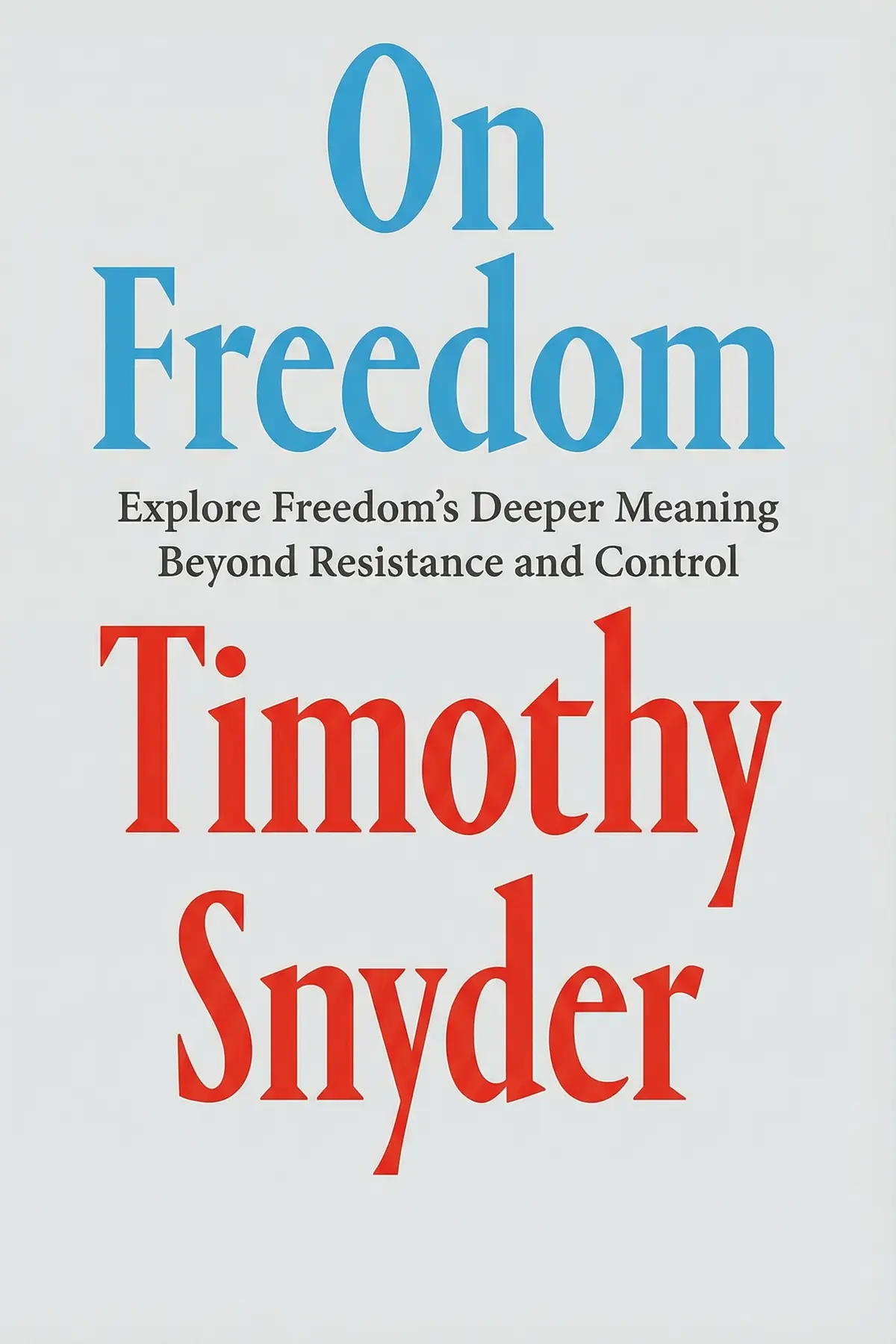
Snyder argues that being left alone is only half of freedom. He sets out five conditions that free people build together and shows how cynicism, algorithms, inequality and big lies wear each one away.
1 min 12 sec
If freedom to you means being left alone, Timothy Snyder thinks you have been sold half the idea. In On Freedom, the historian argues that removing barriers only clears the ground: real freedom is something people build, a set of conditions that let everyone thrive and live with dignity. He starts with a childhood myth. As a boy during America’s 1976 bicentennial, Snyder was told the Liberty Bell rang out for the Declaration of Independence in 1776. It never did. Instead, the bell became a symbol for enslaved people seeking freedom through the underground railroad and for women demanding the vote.
That gap between the story and the struggle runs through the whole book. Snyder names five conditions freedom depends on: sovereignty, unpredictability, mobility, factuality and solidarity. Each one turns out to need other people and good structures, and none of them appears just because a tyrant is gone. What you get is a sharper test for any politician, platform or policy that promises to make you free, and a clearer sense of your own part in keeping freedom alive.
1 min 39 sec
Survivors climbed out of a cellar in a Ukrainian village after the occupiers left. Snyder visited them and came away doubting they were free yet, and his reason changes what the word should mean.
1 min 52 sec
A German philosopher chose one word for the human body over another, and the choice carried a whole theory of freedom. It also explains how dictators persuade ordinary people that others stand in their way.
1 min 54 sec
A Czech dissident noticed that cynicism did more for the communist regime than its police did. Decades later, his warning about predictable people fits the phone in your pocket uncomfortably well.
1 min 59 sec
For one generation, earning more than your parents was close to certain. Then the odds collapsed. Snyder traces what changed, and why leaders who sell a glorious past thrive on the despair that followed.
2 min 00 sec
Some lies work because they are small and believable. Others work for the opposite reason. Snyder explains why the most outrageous falsehoods can be the hardest to shake, and what they do to a democracy.
1 min 59 sec
Efficiency sounds harmless, even admirable. Snyder follows its logic from factory floors to the camps of the twentieth century, and argues that the best defense against it is also good for entrepreneurs.
1 min 52 sec
Snyder turns from diagnosis to repair, with proposals on online platforms, public services and taxes. He also finds common ground between conservative, liberal and socialist views in the work of the philosopher Leszek Kołakowski.
1 min 11 sec
The Liberty Bell sums up Snyder’s argument. It did not ring for independence in 1776. Its meaning came later, from people still fighting for a freedom they did not yet have. Freedom, in his telling, works the same way. It is never simply inherited or granted, and it is never just what remains after a barrier falls. People build it, for one another, and it lasts only while they keep building.
The five conditions give that idea a shape you can carry: seeing others as fully human, keeping your capacity to surprise, having real paths forward, knowing what is true and standing together. Each one fails when freedom is treated as a private possession.
So when a leader promises freedom by removing a group, a fact or a public service, ask what would be built in its place. Set limits on the feed that makes you predictable, and when someone says there is no alternative, look to history for the paths that were always there. In Yahidne, the cellar door opening was only the start. Freedom is what people choose to build afterward.
Many people think of freedom as the absence of interference: fewer rules, less government, no one standing in the way. Historian Timothy Snyder thinks that view is dangerously incomplete. Drawing on his visits to liberated Ukrainian villages, his study of eastern Europe and his reading of thinkers such as Edith Stein and Václav Havel, he argues that real freedom is positive. It is the presence of conditions that let people pursue a purpose and live with dignity. Snyder names five such conditions. Sovereignty means seeing others as fully human. Unpredictability means keeping the ability to surprise in a world that tries to sort us. Mobility means having real paths into the future. Factuality means making choices based on what is true. Solidarity means securing freedom for others as well as ourselves. For each one he shows what threatens it, from Soviet doublethink and the big lie to social media feedback loops and extreme concentrations of wealth. The book ends with concrete proposals for how governments could support freedom, from rules on online transparency to public universities and fairer taxes. Readers get a clear test for judging any promise of liberty.
Professionals who sense that endless feeds, rising inequality and political lies are shrinking their choices.
Team leads and founders who want a clear argument for why security and fairness make people bolder.
Citizens who want a test for judging leaders who promise freedom.
Timothy Snyder, born in 1969, is a historian of modern Europe. He earned his doctorate at Oxford in 1997 as a Marshall Scholar, was Richard C. Levin Professor of History at Yale from 2017 to 2025, and holds a chair in modern European history at the University of Toronto's Munk School. He sits on the United States Holocaust Memorial Museum's Committee on Conscience. His books, including Bloodlands, On Tyranny and The Road to Unfreedom, have been published in more than forty languages.
Timothy Snyder
Timothy Snyder
Timothy Snyder
Timothy Snyder
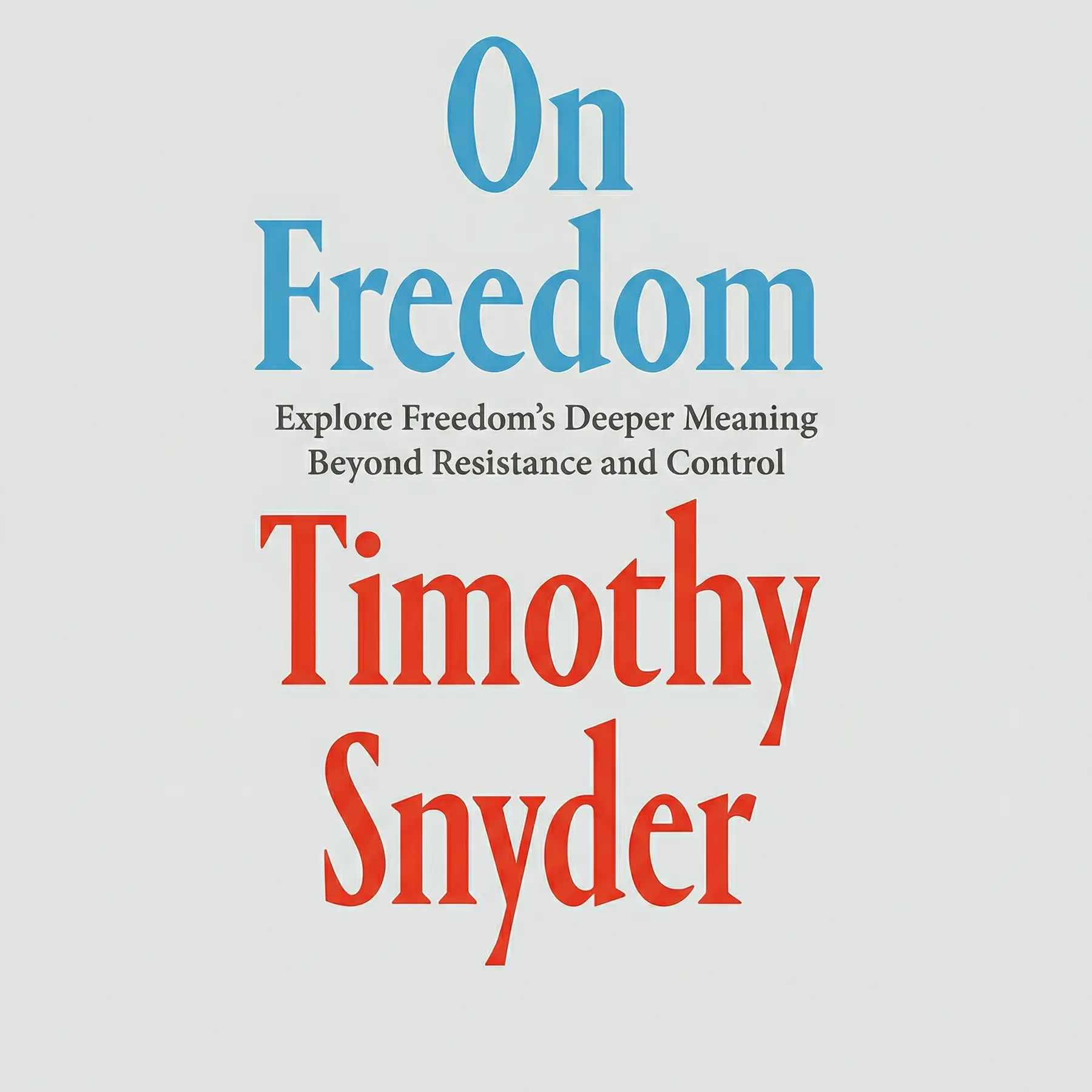
Listeners find this book a vital read, commending its deep research and successful effort to characterize freedom. The way it is written gets favorable reviews, with one listener mentioning its accessible language, and listeners value its reflective tone and ideas regarding building democratic states. Although listeners perceive the work as an easy read, views on its readability are mixed.
Timothy Snyder has a way of distilling complex political philosophy into something that feels urgently personal. While many of us grew up thinking of freedom simply as the absence of government overreach—the "negative freedom" he describes—this book pivots toward a much more robust, "positive" definition. It’s about the capacity to actually choose and create a life worth living. I found the five pillars of sovereignty, unpredictability, mobility, factuality, and solidarity to be incredibly helpful frameworks. Honestly, the chapter on solidarity moved me to tears. He argues that we cannot be truly free if we are isolated or if we view our neighbors as threats to our own "slice of the pie." It’s a dense read at times, but the message about democratic nation-building is vital for our current moment. This isn't just another history book; it’s a manual for how to be a citizen in the 21st century.
Show moreFinally, a book that dares to define what we are actually fighting for, rather than just what we are fighting against. Snyder’s breakdown of "positive freedom" is the most refreshing thing I’ve read in years. We’ve become so used to the idea that freedom is just being left alone, but he shows how that leads to isolation and eventually, the rise of "strongmen." The way he links factuality to freedom is particularly brilliant—you can’t be a free agent if you can’t agree on what is real. I loved the emphasis on mobility and how a stagnant society is a vulnerable one. It’s a thoughtful, deeply researched call to action that doesn't shy away from the moral responsibility we owe to one another. If you’re feeling cynical about the state of democracy, this is the perfect antidote. It’s simple enough to follow but deep enough to keep you thinking for weeks.
Show moreAfter finishing the final chapter, I felt a strange sense of relief. For so long, the word "freedom" has been hijacked by people who use it to justify being selfish or cruel. Snyder takes the word back. He explains that true liberty isn't about throwing the "pie" away so no one else can have a piece; it’s about making sure the pie is big enough and accessible enough for everyone to flourish. His writing is elegant, and despite the heavy subject matter, there’s an underlying sense of hope. He doesn't just point out the cracks in our system—like our capitulation to banks—he offers a blueprint for democratic nation-building. It’s the kind of book you want to buy for every person you know who is tired of the shouting matches on cable news. Truly a masterpiece of modern political thought.
Show moreThe chapter on unpredictability changed my entire perspective on social media. Snyder argues that when we become predictable, we become easy to control, which is the exact opposite of being free. It’s a profound realization. This book is a massive undertaking, covering everything from the Founding Fathers to the ecological impact of our internet usage. I was particularly struck by his "freedom to" vs. "freedom from" distinction. It explains so much of the political divide in America today. While some might find his personal stories about his health or his time in Europe a bit much, I thought they added a necessary human element to the high-level philosophy. He’s telling us that freedom isn't an abstract concept; it’s something that happens in our actual, physical bodies. Essential reading for 2024 and beyond.
Show moreEver wonder why we feel so stuck despite living in a "free" country? Snyder’s latest work provides the answer by looking at the foundations of our democracy. He moves beyond the usual talking points to discuss how mobility and factuality are the literal precursors to a free life. If you can’t move to a new job or if you can’t tell what’s true on the news, are you really free? I love that he doesn't just blame one side of the political aisle; he looks at the systemic ways we’ve allowed our autonomy to be eroded by both the state and massive corporations. The writing is accessible but never feels like it's "dumbing things down." It’s a deeply moral book that asks us to take responsibility for our own liberty. Definitely the most important thing I’ve read this year.
Show morePicked this up because I wanted to see if Snyder could top his work in "On Tyranny," and I found something much more meditative and, at times, a bit rambling. Snyder spends the first half of the book weaving in personal anecdotes and a somewhat clunky distinction between "Leib" (the living body) and "Körper" (the physical object). To be fair, his autobiographical writing isn't as sharp as his historical analysis. However, once he gets into the meat of how our obsession with "freedom from" regulation has actually enslaved us to algorithms and market whims, the book really takes flight. His critique of how we’ve traded our unpredictability for the convenience of touchscreens is spot on. It’s a bit more academic and parochial than his previous work, which might alienate some readers looking for quick answers. Still, the core argument that freedom requires a foundation of truth and social trust is impossible to ignore.
Show moreAs a longtime fan of Snyder’s lectures, I was eager to see how he handled the concept of sovereignty. He argues that the state shouldn't be the one holding all the power; instead, sovereignty must belong to the individual. But here's the catch: we can only be sovereign if we have the health, education, and social safety nets to make real choices. I appreciated the critique of how "freedom" is often used as a shield for corporate corruption and environmental destruction. My only gripe is that the writing style is a bit dense in the middle sections. Some of the philosophical jargon felt unnecessary when his historical examples are usually so clear. Nevertheless, his message about the "notalitarianism" of a world without values is a wake-up call we all need. It’s a necessary follow-up to "On Tyranny" that focuses on building up rather than just resisting.
Show moreDoes anyone else feel like their life is being run by an algorithm? Snyder nails this feeling in his chapter on unpredictability. He suggests that being a "free" person means being capable of doing something that a computer or a marketing firm couldn't have guessed. I found that idea incredibly empowering. The book is structured around five key ingredients, and while some are more compelling than others, they form a cohesive vision for a better society. Look, it’s not always an easy read. The tone shifts between academic history and personal reflection quite abruptly. I found the section on "Polish Solidarity" to be a highlight, showing how collective action is actually the ultimate expression of individual freedom. It’s a book that demands your full attention, which is ironic considering how much he warns us about the distractions of our digital age.
Show moreLook, I really wanted to love this, but it's not what I expected after the directness of his previous work. There is no denying that Snyder is a brilliant historian, but this foray into philosophical memoir feels somewhat self-indulgent. The "Leib" concept he introduces to explain empathy and authoritarianism just didn't land for me; it felt more like an intellectual exercise than a practical tool for the average reader. Frankly, the first hundred pages were a slog of personal history that didn't always connect back to the broader political points. It feels like a book written for a specific class of educated liberals rather than the wide audience that needs to hear this message. That said, his analysis of "negative freedom" in the second half is excellent. He correctly identifies how a lack of guardrails allows the most selfish actors to destroy the environment and the economy in the name of liberty.
Show moreTruth is, I struggled with this one more than his earlier books. While I agree with almost every political point Snyder makes, the structure of this volume felt fragmented. He tries to combine a memoir about his own brush with death and his observations on history into a unified theory of freedom, but the seams are showing. The "Leib" vs. "Körper" stuff felt a bit ham-fisted and didn't really help me understand the political arguments any better. I found myself skimming the autobiographical parts to get to his brilliant insights on "factuality" and "solidarity." It’s a very smart book, but it lacks the populism and punchy "how-to" energy of "On Tyranny." It feels like it was written for a seminar room rather than a protest line. I still recommend it for the insights on "negative freedom," but be prepared for some dense philosophical detours.
Show moreSnyder argues that freedom is not simply the absence of barriers, which he calls negative freedom. Real freedom is positive: the presence of conditions that let people pursue a purpose and live with dignity. People build and maintain it together. He identifies five conditions it depends on, namely sovereignty, unpredictability, mobility, factuality and solidarity, and shows how each one can be worn away.
Sovereignty means recognizing others as fully human, an idea Snyder takes from Edith Stein. Unpredictability means keeping the ability to make real choices that can’t be forecast. Mobility is the ability to chart your own course, socially and physically. Factuality is making decisions based on true facts. Solidarity is working together so that freedom lifts everyone, summed up in Václav Havel’s phrase about no freedom without solidarity.
Following Havel, Snyder warns that technology can sort people into categories and push them toward their most probable behavior. Social media’s dopamine-driven loops fragment attention and make people predictable and easy to steer, both by algorithms and by their designers. He calls for deliberate use of technology and proposes a charter requiring online content to be traceable to real people, opt-in data sharing and the right to correct personal data.
When someone promises freedom, ask what they plan to build and not only what they plan to remove. Watch for messages that treat a group of people as an obstacle. Be deliberate about when you use your phone and feed, and get some news from local reporting you can check. When told there is no alternative, look to history, which Snyder argues always shows multiple possibilities.


Barack Obama

Masaji Ishikawa

John Rawls



Miles Taylor


AUDIO SUMMARY AVAILABLE
Get the key ideas from On Freedom by Timothy Snyder, plus 5,000+ more nonfiction titles.









