


15 min 38 sec
Available in: English
 ไทย
EnglishไทยNonviolent Communication: A Language of Life
Shows how to replace the labels and blame that derail everyday conversations with four plain steps: what you observed, how you feel, what you need and what you are asking for.
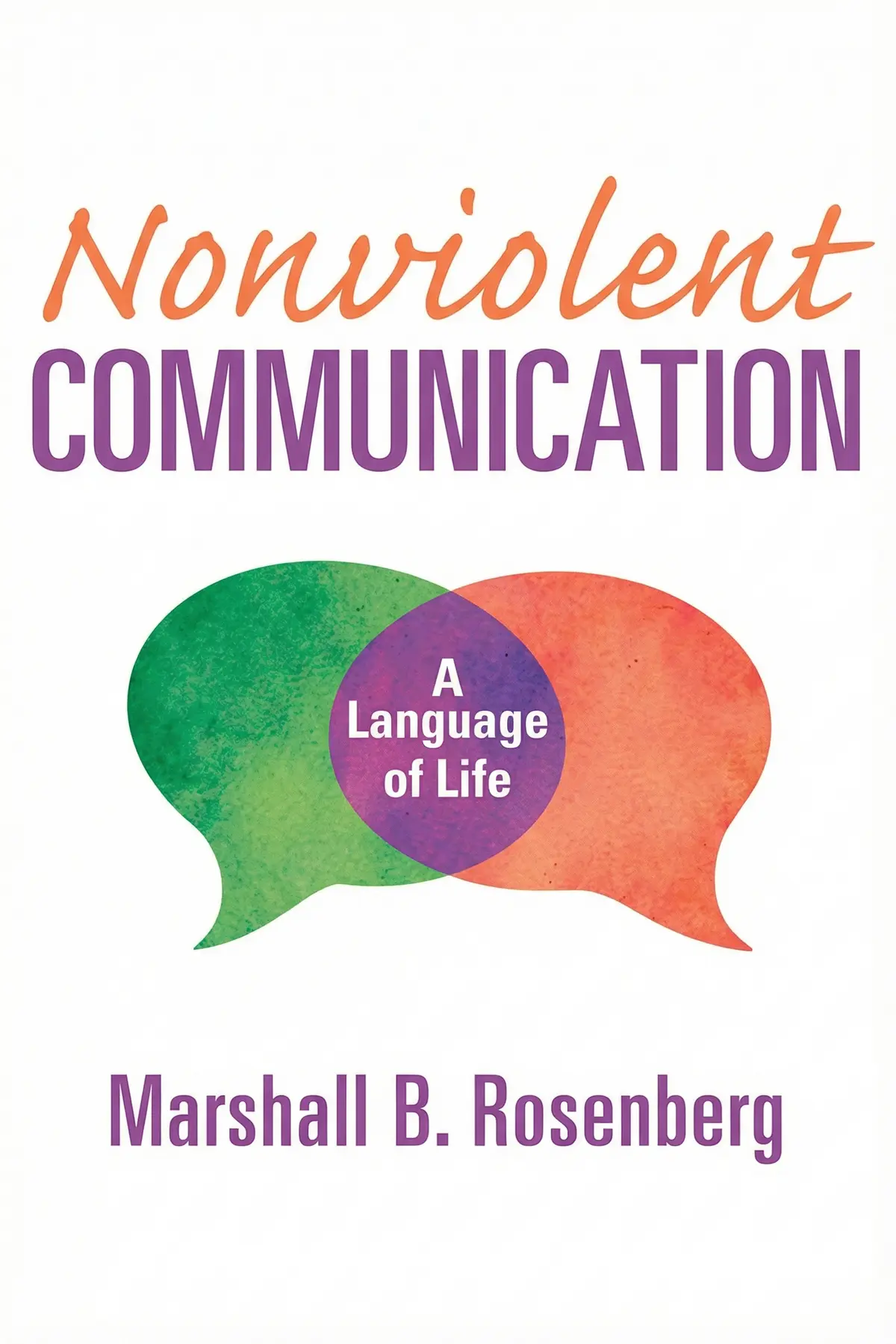
Table of Content
1. Introduction
1 min 04 sec
Many arguments at home and at work go wrong in the first sentence, when someone reaches for a label like selfish and the other person stops listening. In Nonviolent Communication, psychologist and mediator Marshall B. Rosenberg argues that this habit of judging can be replaced with four plain statements: what you observed, how you feel, what you need and what you are asking for.
That pattern is the thread through everything that follows. Judgment breeds conflict, while naming facts, feelings, needs and requests builds connection, whether you are speaking, listening or talking to yourself. The proof comes from ordinary moments: toys on a living room floor, unwashed dishes in the kitchen, and a husband whose complaint sent his wife off on a kayaking trip. The reward is practical: a sentence pattern for your next hard conversation, a way to hear the need behind an attack, and a gentler answer to the critic in your own head.
2. Spot the judgments that turn talks into fights
1 min 39 sec
One small word at the table can turn a friendly moment into a standoff. A psychologist’s count of words in world literature hints that the same habit may reach all the way up to violence.
3. A four-step script for saying hard things
1 min 40 sec
Toys on the floor for the third time today usually end in shouting. Rosenberg offers a slower sequence of four moves that gets the toys moved and keeps the peace in the house.
4. Describe the facts before you judge them
1 min 51 sec
Saying someone is always late feels accurate, yet it almost guarantees an argument. A small change in wording, backed by a philosopher’s view of intelligence, gives the other person nothing to push against.
5. Find the exact word for what you feel
1 min 38 sec
A bit down, fine, everyone ignores me: the phrases we use most about our moods tell people almost nothing. Getting specific changes what others can do for you, though some professions make it hard.
6. Take an insult without guilt or counterattack
1 min 45 sec
Someone calls you the most selfish person they know. There are four ways to respond, and the two that come most naturally are the two that leave the real problem untouched.
7. Make requests people can actually carry out
1 min 28 sec
A husband complained about his wife’s long hours, and she promptly booked a kayaking trip. His mistake is common, and it shows why so many reasonable requests produce exactly the wrong result.
8. Listen and settle conflicts so both sides win
1 min 57 sec
Offering advice feels like help, yet it often stops people from saying what is really wrong. Two plain listening tools can turn a harsh remark from a boss into a problem the whole team can fix.
9. Answer your inner critic with kindness
1 min 27 sec
A spilled yogurt minutes before a lecture sets off a familiar inner voice. Rosenberg argues that the voice is trying to say something, and hearing the unmet need behind it changes how the whole mishap feels.
10. Conclusion
1 min 09 sec
Rosenberg’s method changes where you look. A judgment points at the other person and asks what is wrong with them. His four steps point at the moment instead: what happened, what it stirred in you, what you needed and what could help. The shift holds in every direction, with a child and his toys, a boss with a vague complaint, a couple arguing over the dog, or the voice that scolds you over spilled yogurt. It is how parents who reached for the word selfish might find, underneath it, a simple fear of missing their daughter.
Start where the habit is easiest to forget. When anger rises, ask what it is about before deciding who it is aimed at, and follow it down to the need it is guarding. Before a hard conversation, write a single sentence that names what you observed, how you felt, what you needed and the one thing you are asking for. And when someone attacks you, reflect their words back before you defend yourself.
Most fights begin with a label. Putting the label down and saying what you need is how many of them end.
About this book
What is this book about?
Many conversations with partners, children, colleagues and bosses end in hurt or stalemate, often because of a single label: selfish, lazy, always late. Marshall B. Rosenberg, a psychologist and mediator, argues that this judging habit cuts people off from each other and from their own compassion, and that it can be unlearned. His alternative, Nonviolent Communication, draws its idea of nonviolence from Gandhi and rests on four steps. Observe what happened without evaluating it. Name the feeling it stirred, precisely. Find the need underneath that feeling. Then make a clear, positive request for a concrete action. Rosenberg applies the same steps to listening, to resolving conflicts so that both sides are satisfied, and to the harsh voice in your own head. Readers get usable sentence patterns for everyday tension, from toys left on the floor to a boss's vague criticism, along with a way to answer an insult without collapsing into guilt or striking back.
Book Information
Who it's for
Couples and parents
Partners and parents tired of the same arguments about dishes, toys and chores.
Managers wanting honest feedback
Managers who want honest feedback and need to hear criticism without getting defensive.
Hard on themselves
People whose inner critic turns every small mistake into proof that they are failing.
About the Author
Marshall B. Rosenberg
Marshall B. Rosenberg (1934-2015) was a psychologist, mediator, teacher and author from the United States. He started building the approach he called nonviolent communication in the early 1960s, shaped in part by the Detroit race riot of 1943 and the antisemitism he faced when young. In 1984 he set up an international nonprofit, the Center for Nonviolent Communication, and was its Director of Educational Services. He worked as a peacemaker worldwide, starting peace programs in Rwanda, Burundi, Sri Lanka and Serbia among other places, and wrote 15 books.
Ratings & Reviews
Ratings at a glance
What people think
Listeners find this work remarkably impactful for communication, especially when navigating conflicts, and value the way it facilitates expressing personal requirements while promoting mutual empathy. They characterize it as a perceptive manual that expands perspectives and emotions, featuring actionable advice and illustrations that make the core concepts accessible. The content strengthens interpersonal ties by demonstrating how to bridge gaps with others, and listeners view it as a significant asset that is well worth its cost.
Top reviews
Mo
Finally got around to reading this classic, and it’s genuinely transformative for anyone tired of constant bickering. The four-step process of observation, feeling, need, and request sounds simple on paper, but applying it is where the real work begins. I found the distinction between 'needs' and 'desires' particularly eye-opening because it shifts the focus from winning an argument to finding a connection. You have to stop blaming others and start taking responsibility for your own emotional state. While the examples can feel a bit staged, the underlying logic is bulletproof if you actually want to resolve conflict without leaving scars. I’ve already noticed a shift in my workplace interactions since I stopped using 'wolf' language and started listening for the underlying needs of my coworkers. It’s not a magic wand, but it’s the best toolkit I’ve found for navigating difficult conversations without losing your cool or your dignity.
Show moreSven
Wow, this book actually forced me to look at the way I talk to my kids in a completely different light. Instead of just barking orders or making demands, I’m trying to express what I’m observing and how it makes me feel in a way that doesn't shame them. It is much harder than it looks when there are soiled socks under the coffee table. Rosenberg’s idea that every 'violent' expression is just a tragic way of asking for a need to be met is profound. It moves you away from the binary of 'right vs. wrong' and into a space of mutual understanding and respect. Even if you only take away the concept of 'giraffe' listening, your relationships will likely improve overnight. This should be mandatory reading for parents and teachers everywhere who want to foster emotional intelligence in the next generation.
Show moreNoah
Not what I expected from a book with a flower on the cover, but it’s far more practical than the 'self-help' branding suggests. The focus isn't on being 'nice' or passive; it's about being clear and assertive without being demanding or manipulative. I’ve used these techniques in high-stress meetings, and they really do help in defusing potentially explosive situations by keeping everyone focused on observations rather than evaluations. My only hesitation is that some recipients might find the formulaic approach a bit condescending if you follow it too rigidly. You have to find your own voice within the structure so you don't sound like you're reading from a script. That said, the breakdown of how we use language to dominate others is an essential lesson in modern psychology. This is an insightful guide that opens both minds and hearts if you're willing to do the internal work.
Show moreElias
Marshall Rosenberg has created a literal roadmap for human connection that feels more relevant now than ever. In a world of digital shouting matches, the invitation to listen for the 'needs' behind someone’s 'wolf' language is a radical act of empathy. I loved the practical tips on how to restate what someone is saying so they feel truly heard and understood. It’s not just about the words you use; it’s about a fundamental shift in how you view other people and their motivations. Some of the poems and spiritual overtones are a bit cheesy, but the meat of the book is solid as a rock. I’ve started applying the four components to my self-talk as well, and it’s significantly reduced my own sense of powerlessness and self-blame. Everyone just wants to be loved and understood, and this book shows us how to ask for it the right way.
Show moreCharlotte
After hearing about NVC for years, I'm glad I finally sat down with the source material to see what the hype was about. It’s an insightful guide that manages to be both deeply philosophical and surprisingly practical at the same time. The distinction between making a request and making a demand is something I’ll be thinking about for a very long time. Although the book is a bit long-winded and repeats itself quite a bit, the core principles are easy to grasp and begin using immediately. I’ve already noticed my wife responding better when I lead with my own feelings rather than her perceived shortcomings. It’s definitely a 'fake it until you make it' kind of process, as this way of talking doesn't come naturally to most of us. Overall, it’s a valuable resource that has definitely helped me open my heart to others more effectively. If you can ignore the outdated cover art, there is real wisdom here.
Show moreLiam
As someone who struggles with confrontation, this book provided a much-needed framework for voicing my needs without feeling like an aggressor. The author’s emphasis on empathy—both for oneself and for others—is a refreshing change from the usual 'win-at-all-costs' negotiation tactics found in most business books. I’ll admit, the sugary poetry at the beginning was a bit of a hurdle, and the 70s New Age vibe is definitely present throughout the chapters. However, once you get past the stylistic quirks, the core message about connecting through vulnerability is incredibly powerful. My only real gripe is that the dialogue examples sometimes sound like two therapists talking to each other rather than real human beings in a heated moment. Still, the practical tips for de-escalating tension are worth the price of admission alone. It’s a slow-burn read that requires constant practice to master.
Show moreYuwadee
The concepts here are absolute gold, even if the writing style feels a bit dated and occasionally repetitive. Rosenberg lays out a communication theory that is astonishingly simple yet difficult to execute in the heat of a real-life disagreement. I appreciate how he breaks down the tendency to moralize and judge others, which usually just shuts down any chance of a productive dialogue. Frankly, the book could have been fifty pages shorter if he hadn't included so many long-winded anecdotes and bits of questionable verse. Despite those minor stylistic annoyances, the core methodology for identifying unmet needs is a game-changer for my marriage. We’ve stopped arguing about the 'toothpaste' and started talking about the deeper issues of respect and support that were actually bothering us. It’s a bit ‘woo-woo’ for some, but the results are hard to argue with.
Show moreSkylar
Truth is, I was skeptical about the whole 'nonviolent' branding because it sounded like a recipe for being a doormat. I couldn't have been more wrong; this book actually gives you the tools to stand your ground while maintaining a connection with the other person. By focusing on specific observations rather than general labels, you avoid triggering the defensiveness that usually kills a conversation. The chapter on expressing anger was particularly useful because it teaches you how to address the root cause rather than just reacting to the surface behavior. I gotta say, it takes a lot of mental energy to pause and identify your feelings before speaking, but the payoff is a total lack of regret after the conversation. It isn’t magic, and it won’t solve every irreconcilable difference, but it gives you a fighting chance. It’s an invaluable resource for anyone who feels stuck in a cycle of toxic communication.
Show moreNikolai
Ever wonder why every argument with your partner ends in a stalemate despite your best intentions? This book might have the answer, as it digs deep into how our habitual language creates barriers instead of bridges. Rosenberg explains how compliments can even be problematic if they aren't rooted in specific observations, which was a real 'aha' moment for me. While the formulaic nature of the sequence can be a bit clunky at first, it forces you to slow down and think before you speak. Personally, I found the examples regarding international conflict resolution a bit far-fetched, like the hypothetical Putin scenario mentioned in some other critiques. However, on a micro-level within a family or a small team, these tools are incredibly effective for fostering a sense of safety. It takes courage to be this vulnerable with your speech, but the depth of relationship it creates is worth the initial awkwardness.
Show moreWin
Look, I understand why people like this, but the dialogue examples feel incredibly robotic and unrealistic for any real-world situation. If I told my partner, 'I feel frustrated because I need more order in our shared space,' they would probably laugh or think I was having a breakdown. The book makes several bold claims about its effectiveness without much scientific backing, relying instead on anecdotes that feel conveniently tailored to the author's theories. Furthermore, the idea that we should never judge or analyze seems to remove critical thinking from the equation entirely. I also found the 'would you rather be right or happy' dilemma to be a bit of a false choice that can be used to silence legitimate grievances. While the listening tools are helpful, the overall system feels too steeped in a specific 1970s psychotherapy mindset to be universally applicable today. It just didn't work for me.
Show moreQuestions about this book
What is the main idea of Nonviolent Communication?
Marshall B. Rosenberg argues that judgmental language, such as labels, insults and criticism, builds walls between people and even makes societies more violent. He offers a replacement in four steps: observe what happened without evaluating it, name the feeling it stirs, identify the need behind that feeling, and make a clear request. The same steps apply to speaking, listening, settling disputes and the way you talk to yourself.
What are the four components of nonviolent communication?
Observations, feelings, needs and requests. Rosenberg’s example is a parent whose son Jim has left toys on the living room floor again. The parent states what they see, says they feel frustrated, names a need for an orderly shared space, and asks Jim to take his toys to his room when he finishes playing. Each step replaces the shouting or blaming that would usually come first.
How should you respond when someone calls you selfish?
Rosenberg describes four reactions. Blaming yourself leads to guilt and misses the other person’s grievance. Blaming them back, by denying it angrily, leaves the real issue untouched. Voicing your own feeling and its reason is better. Best of all is turning toward the speaker’s feelings and needs, asking which action of yours led them to say it and how you could show more consideration.
How do you make a request that people will act on?
Use positive language that asks for something to be done, and name a concrete action. Rosenberg tells of a husband who told his wife she worked too much; she booked a kayaking trip, when he wanted an evening a week with her and the kids. Likewise, a manager who asks staff to feel free to speak up should instead ask what he could do to make that easier.
Who should read Nonviolent Communication?
It suits anyone whose conversations keep sliding into blame: couples arguing about chores, parents dealing with messy children, managers who want honest feedback or face vague criticism, and people with a harsh inner critic. Its tools are small and concrete, from describing a boss who doesn’t arrive before 8:30 instead of calling them always late, to reflecting a complaint back before defending yourself.
Readers also enjoyed






AUDIO SUMMARY AVAILABLE
Listen to Nonviolent Communication in 15 minutes
Get the key ideas from Nonviolent Communication by Marshall B. Rosenberg, plus 5,000+ more nonfiction titles.
- 5,000+ titles
- Listen as much as you want
- 7-day free trial
- Cancel anytime









