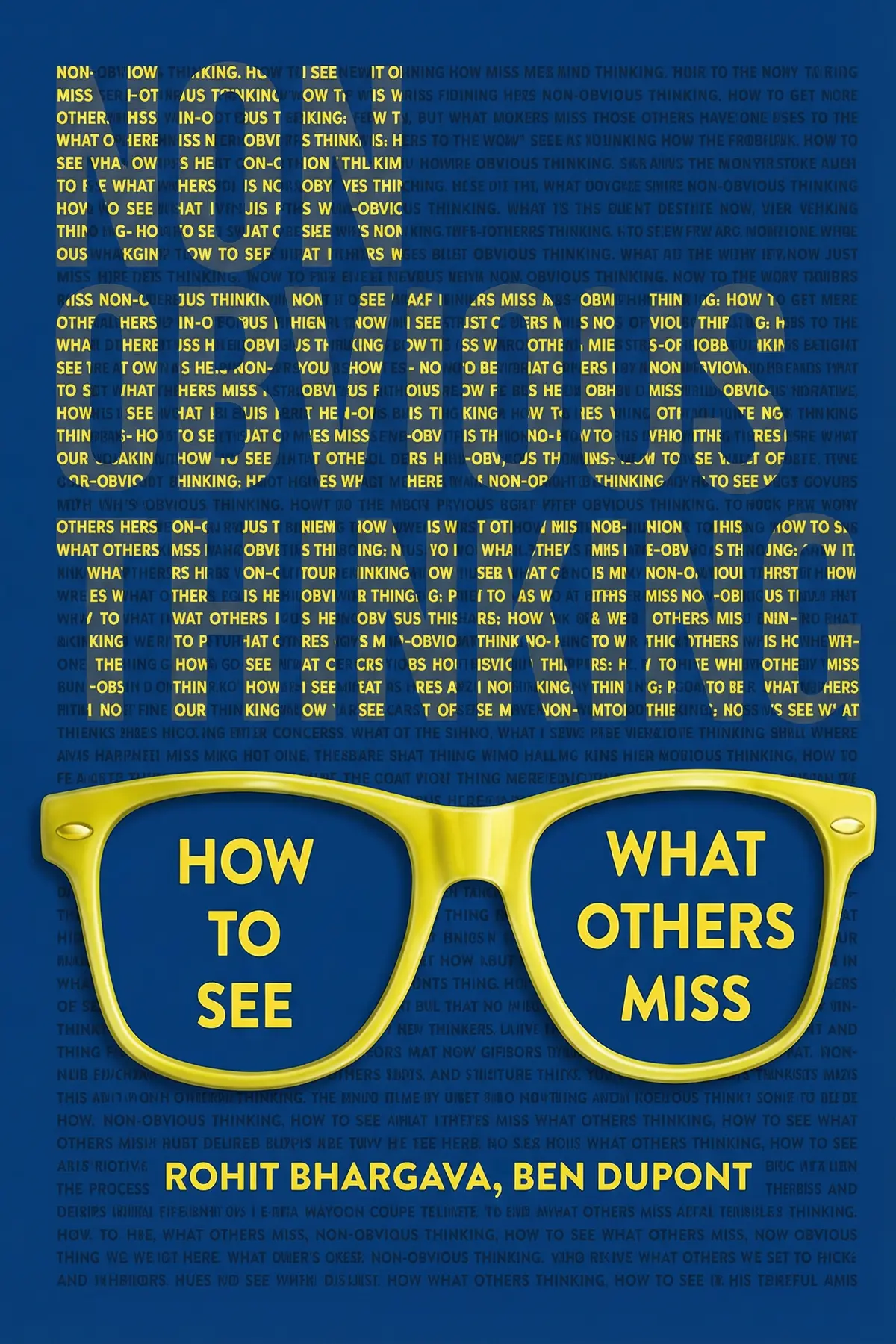
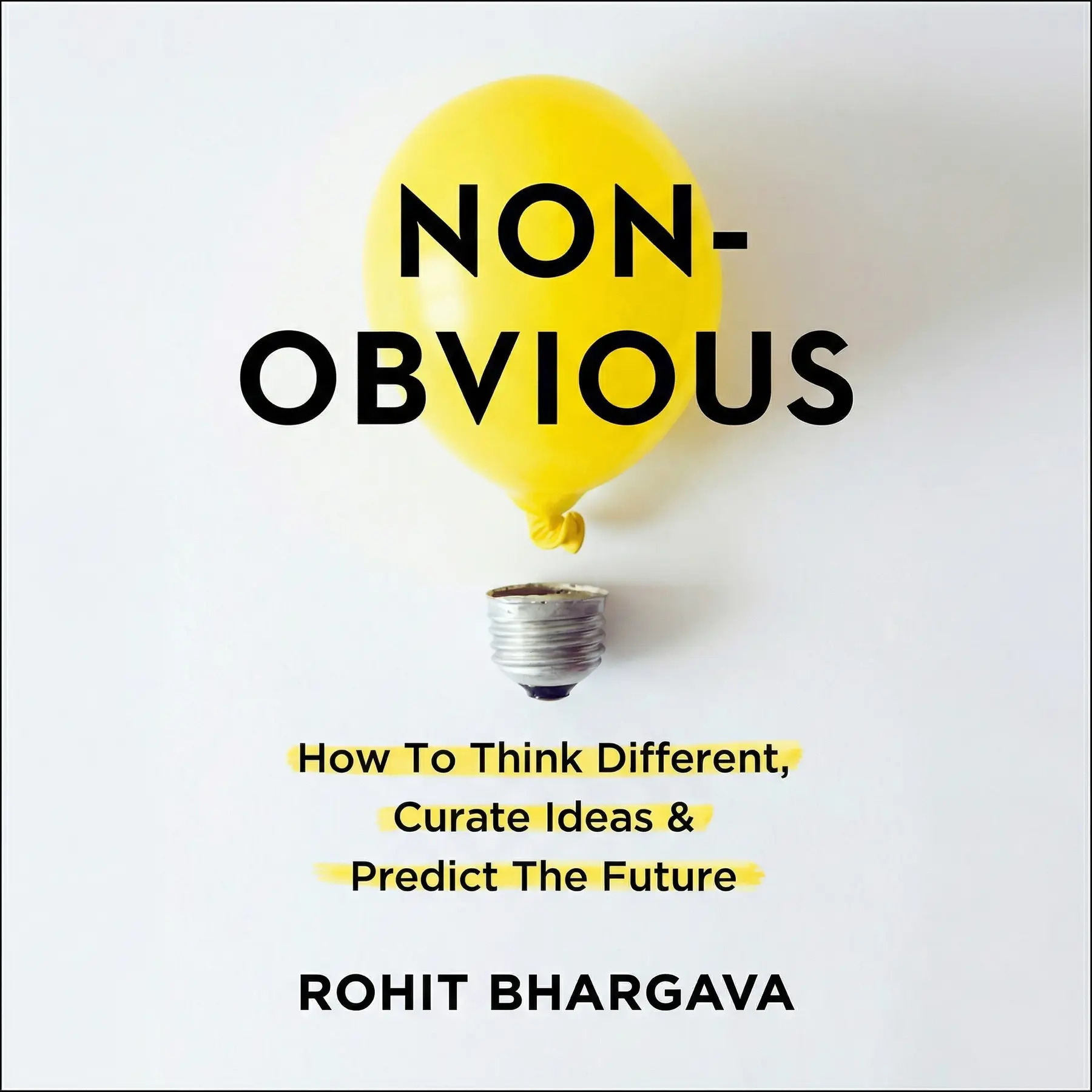
Non-Obvious Thinking: How to See What Others Miss
Rohit Bhargava
 English
Shows why obvious forecasts usually fail and teaches a five-step method for spotting hidden trends early, the habits of mind that make it work, and ways to turn trends into products.
55 sec
Most guesses about the future fail for one reason: they take whatever looks biggest today and stretch it forward. During the space race, a popular science fiction show called Space 1999 imagined humanity’s first moon colony, and a solar system full of people by the year 2000 seemed like common sense.
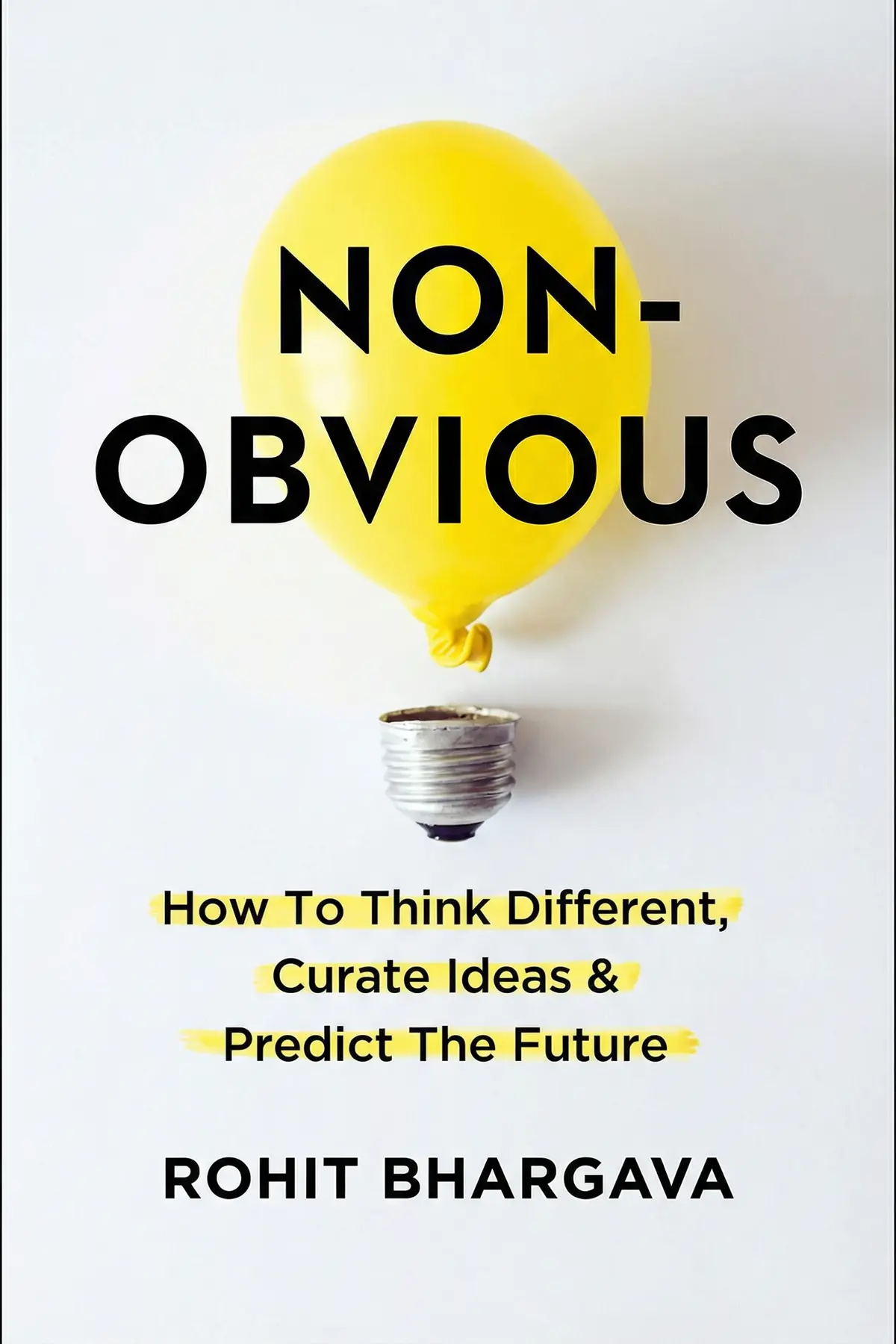
In Non-Obvious, marketing writer and Georgetown adjunct professor Rohit Bhargava explains why such forecasts keep failing and offers a better approach. The trends worth betting on are buried, he argues, and you find them the way a museum curator builds an exhibit: collect widely, connect patiently, name what you see and test it before you trust it.
What follows is his five-step routine for spotting patterns early, the habits of mind that make it work, two ways to turn a pattern into a product, and the consumer trends he saw coming.
1 min 52 sec
A whole generation once felt sure it would commute by air within a few decades. Their reasoning sounded solid, and the way it went wrong reveals the trap hiding inside almost every confident forecast you hear at work.
1 min 48 sec
A medicine price tool and a department store app seem to have nothing in common. Put side by side, they hint at something bigger, and a five-step routine shows how to find such links on purpose.
1 min 44 sec
A Viking sailor reached an unknown continent and turned straight around without exploring it. His story explains why two people can read the same news for a year and only one of them sees what is coming.
1 min 54 sec
Most comments under an online article vanish without a reply, yet a few get answered by the author. The difference points to the two traits that separate a sharp observation from one anybody will act on.
1 min 40 sec
A new drink blending rum with a milky cinnamon almond drink succeeded because it drew on several growing trends at once. The way it happened offers a repeatable route from spotting a pattern to building something people buy.
1 min 48 sec
A theme park bracelet that knows your name and plans, a football team doing yoga, a wristband that nags you to stand up. Bhargava saw one shift in customer expectations behind all three.
1 min 50 sec
A Barcelona comedy club once charged its audience by the laugh. That odd experiment, alongside Apple stores and an Oreo contest, shows how shoppers were rewriting the rules of what they pay for and where.
1 min 05 sec
The moon colony of Space 1999 and the flying cars of the 1960s and 1970s failed for the same reason: they were built from whatever filled the headlines. Bhargava’s book argues for a slower, stranger kind of attention. In his view, the future leaks into the present in small, unrelated places: a theater billing by the laugh, a bracelet that knows your name, a store designed mainly for how it makes you feel. Anyone can see those things. Few people gather them, connect them and give the pattern a name.
Bhargava treats that as a learnable skill, and it can start this week. Keep one place where every surprising story goes, and once a month sort it into groups and look for what links them. When a theme appears, give it a blended name and hunt for enough examples to prove it, dropping the ideas that fail the test. Before you pitch it, look for a second trend it crosses, the way rum met horchata.
The obvious future belongs to everyone, which is why it is worth so little. The useful one is hiding in the pile, waiting for someone curious enough to look.
Everyone in business wants to see the next big thing before their rivals do. Yet most predictions simply take whatever dominates the present and push it forward, which is how earlier generations ended up expecting moon colonies and flying cars. Rohit Bhargava argues that the trends worth acting on are buried under a mass of unrelated information, and that finding them is a skill anyone can learn. His answer is to think like a museum curator. You collect observations from many fields, sort them into groups, look for the theme that links them, give it a memorable name and then test whether it really holds. He calls this the haystack method, and he pairs it with the personal habits that make it work: curiosity, a healthy fickleness, sharp observation, thoughtful reflection and elegant expression. Readers also get two tools for turning trends into action, intersectional thinking and well-run workshops, plus Bhargava's own forecasts for 2015, illustrated by Disney's smart bracelets, Apple stores, a Barcelona theater that charged by the laugh and Taylor Swift's pizza party for fans.
Marketers and product managers who want to see shifts in customer behavior before competitors do.
Founders and strategists tired of forecasts that just repeat the headlines.
Team leads who run planning sessions and want a method for turning scattered observations into ideas.
Rohit Bhargava writes about marketing, innovation, diversity and trends. His books have appeared on the Wall Street Journal bestseller list, and Non-Obvious Megatrends reached number one. Non-Obvious was his second bestselling book. He is a keynote speaker who has been invited to events in 32 countries, has spoken twice at TEDx events, and teaches as an adjunct professor at Georgetown University. Away from work, he is a fan of the Olympics.
Rohit Bhargava
Listeners find the writing both clear and accessible, noting that it is packed with valuable insights and hands-on instructions. They particularly enjoy the stimulating take on innovative thought and spotting market trends, as one listener points out that it delivers the resources needed to become a trend curator. The book is also highly regarded for its practicality, with one listener highlighting its specific usefulness for business owners.
Finally got around to diving into this year's report, and it has quickly become my favorite way to kick off my professional planning sessions. The author's approach is truly refreshing and unique. He provides actual tools rather than just making vague predictions about the future. I found the sections on how to become a curator especially useful for my current role in digital marketing where everything moves at light speed. While some might find the 25-chapter structure a bit daunting, the brevity of each section makes it very easy to digest during a morning commute. This is definitely a book I will keep on my shelf for years.
Show moreHonestly, the framework provided for trend curation is worth the price of the book alone because it turns a mysterious skill into something manageable. Most books in this genre just tell you what is happening. This one actually shows you how to figure it out for yourself. It is incredibly thought-provoking and offers a wealth of information for anyone who needs to understand where their industry is headed next. I did find the sheer number of chapters a bit overwhelming at times. Despite that, the practical utility of the advice makes this a must-read for any serious entrepreneur or creative professional looking to sharpen their vision.
Show moreAs a small business owner, I am always hunting for strategies to stay ahead of the competition without spending a fortune on consultants. Frankly, this book serves as an excellent starting point for anyone looking to sharpen their creative thinking skills through practical, real-world examples. Bhargava does a fantastic job of breaking down how to spot patterns in everyday life. He successfully turns the act of trend curation into a repeatable process for the average reader. Some chapters felt more relevant than others, particularly the ones focused on consumer behavior and authentic marketing, yet the shift in mindset is well worth the time.
Show moreI've been following Rohit’s work for quite a while, and I appreciate how he translates complex market shifts into something approachable. The book is remarkably well-written, avoiding the dense jargon that usually plagues the entrepreneurship category, which makes for a very quick and enjoyable read. By providing a practical guide to spotting patterns, he empowers the reader to become a trend curator in their own right. My only real gripe is that some of the later chapters felt a bit rushed compared to the deeply insightful opening sections. Still, the overall focus on being more authentic in a digital world is a message that every professional needs to hear.
Show moreQuick read with some genuinely great content for anyone interested in marketing or the future of entrepreneurship. I can’t believe I didn’t pick this up earlier, especially given how much I struggle with staying relevant in a constantly changing industry where new ideas become obsolete overnight. The practical guides are excellent for any professional. Personally, I found the chapter on unperfection to be the most relevant to my current projects because it encouraged me to embrace brand flaws. While some sections are definitely stronger than others, the good parts are absolutely worth your time and will help you think much more creatively.
Show moreNot what I expected when I first saw the cover, but this book turned out to be a pleasantly surprising look at modern culture. Many of the insights regarding how we perceive authenticity in an increasingly automated world really hit home for me on a personal level. The truth is that many of us are tired of 'perfect' marketing, and Bhargava's call to embrace the imperfect is a welcome change of pace. While the book is quite long with 25 chapters, the easy-to-read style means you can breeze through it in a weekend. It provides a unique lens through which to view the world, even if some predictions feel dated.
Show moreThe chapter on unperfection and authenticity was the highlight of the experience for me because it challenged the way I view brand flaws. I gotta say, there is a powerful distinction between something being broken and something being intentionally imperfect to show its human side. While I appreciated that specific takeaway, other parts of the book felt a bit repetitive or perhaps a little too obvious for a book titled 'Non-Obvious.' It is an easy read with plenty of thought-provoking moments. However, it lacks the deep technical meat I usually look for in a business text. It sits comfortably in the middle for me—good, but not life-changing.
Show moreEver wonder if those 'experts' on the news actually know what they are talking about when they predict the next big thing? In my experience, most business books are just fluff. This one actually attempts to give you a methodology for seeing what everyone else misses. Look, not every trend mentioned here will be a 'eureka' moment, and some of them felt like things I had already seen on Twitter months ago. However, the value lies in the mindset of trend curation and learning how to connect disparate dots to form a larger picture. It is a solid read that offers enough utility to justify the purchase.
Show moreThis book had so much potential considering the rave reviews, but the truth is it suffers from a classic case of a good idea with poor execution. While the first three chapters provide a solid foundation for understanding modern curation, the remaining twenty-two sections felt like unnecessary filler. To be fair, I did find a few of the specific trends insightful. However, the writing style became increasingly difficult to navigate as the book progressed because the structure lacked a clear narrative to keep me engaged. I wanted to love it given the marketing hype, but it just didn't hold my interest until the very end.
Show moreAfter hearing all the hype about this being a Wall Street Journal bestseller, I went in with very high expectations that weren't entirely met. To be fair, the information provided is technically interesting, but the writing style felt a bit disconnected after the first few chapters. It felt like I was reading a series of separate articles rather than a cohesive book with a strong narrative arc from start to finish. I struggled to get through the middle portion because the pace slowed down significantly and the insights became less actionable. It is a decent resource for a broad overview, but don't expect it to provide a deep, technical masterclass.
Show moreBhargava argues that obvious predictions, built by stretching today’s biggest stories forward, are almost always wrong, as the old expectations of moon colonies and flying cars show. Real trends are buried in scattered information. To find them you act like a museum curator: collect observations widely, group them, find the theme that links them, name it and test it before trusting it.
It is Bhargava’s five-step process for finding hidden trends. Gathering collects stories and ideas from many fields. Aggregating sorts them into groups. Elevating finds the bigger theme connecting the groups. Naming gives that theme a short, memorable label, often a blend of two words like Likeonomics. Proving checks that there are enough examples and that the trend is meaningful, changes behavior and is likely to last.
He names five. Curious people keep asking why things happen. Fickle people move between ideas instead of fixating on one, which yields more material. Observant people catch small details, and he suggests imagining a child asking questions about everything around you. Thoughtful people reflect before reacting. Elegant people explain ideas simply and vividly, borrowing metaphors from poetry so the idea is remembered.
Keep a running file of surprising stories and sort it regularly into groups to find links. Once you spot a trend, look for where it intersects with others, as RumChata did by combining authenticity, interest in Latin American culture and inventive food. In team workshops, build on ideas with Yes, And, and choose a leader who guides discussion well rather than the topic expert.
It suits marketers, founders, product teams and strategists who need to anticipate how customers will behave. The method works for anyone who reads widely and wants to turn that reading into insight. The book’s examples, from Disney’s MagicBand bracelets to Apple stores and Taylor Swift reaching fans directly, make it especially useful for people working in customer experience, retail and media.
AUDIO SUMMARY AVAILABLE
Get the key ideas from Non-Obvious by Rohit Bhargava, plus 5,000+ more nonfiction titles.