

14 min 51 sec
Available in: English
New Sales. Simplified.: The Essential Handbook for Prospecting and New Business Development
A plain plan for winning new clients: choose a short list of the right accounts, build a sales story around the buyer's problems, then make calls and run meetings in time you protect.
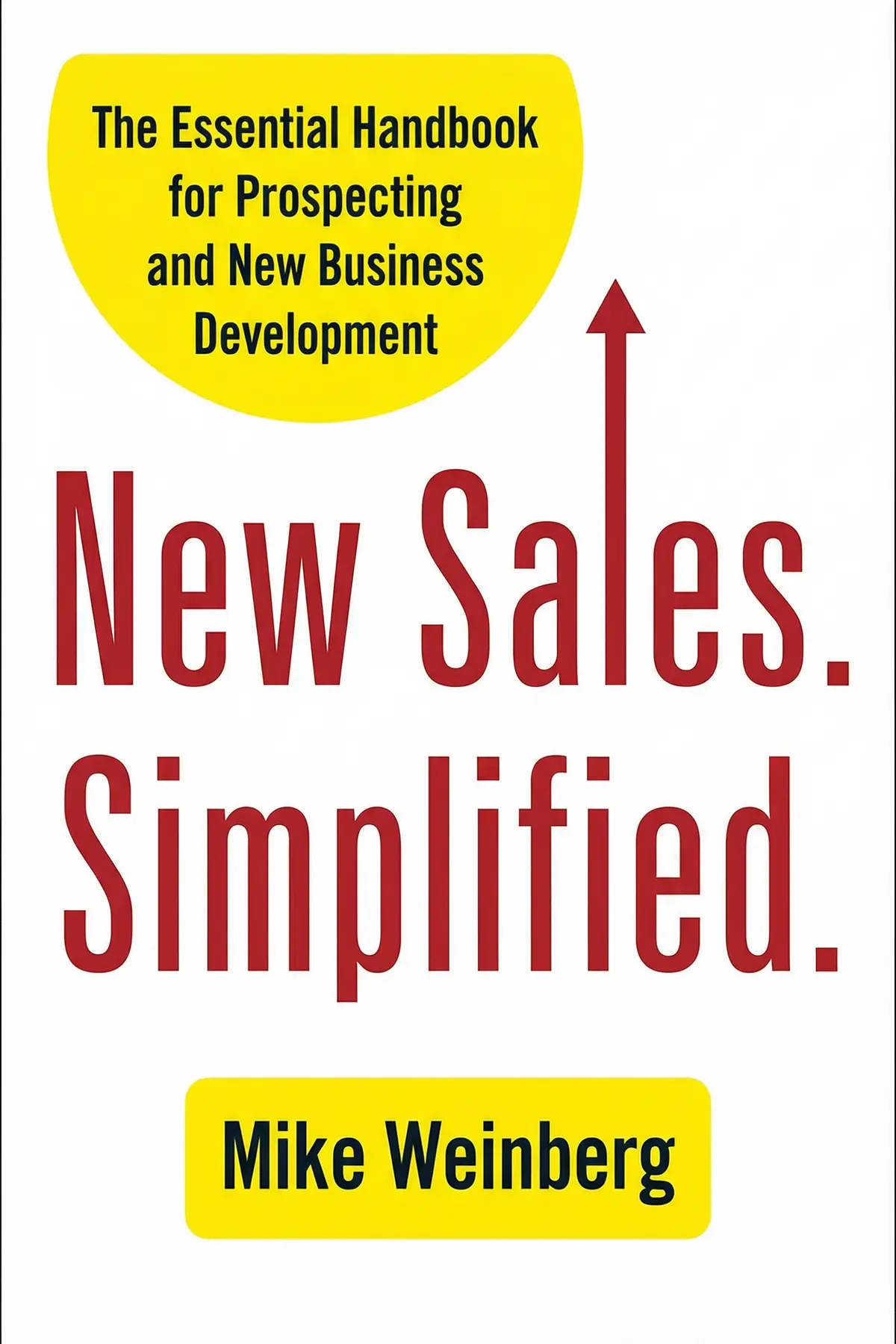
Table of Content
1. Introduction
1 min 05 sec
Plenty of salespeople are excellent with the clients they already have and still struggle to win new ones. In New Sales. Simplified., sales coach Mike Weinberg argues that finding new business holds no mystery and no magic. It is groundwork, done in the right order.
His plan borrows three words from warfare: select your targets, build your weapons, then attack. When new business stalls, Weinberg says, the fault almost always sits in one of those three parts. His case, followed through every step below, is simple. A finite list of the right accounts, a story about the client rather than about yourself, and time guarded for prospecting will bring in more new business than talent left to chance.
Along the way come the habits that sink capable sellers, the order a sales story must follow, a phone call without the telemarketer voice, a seven-phase sales meeting and a presentation of just four slides. Each one gives you a way to find the weak part of your own pipeline and repair it this week.
2. Spot the habits that stall good sellers
1 min 53 sec
Some salespeople keep clients happy for years and still bring in almost nothing new. The cause is rarely skill. It is a set of habits so ordinary that most people never notice they have them.
3. Work a short list until it pays off
1 min 47 sec
Chasing every possible buyer feels productive, yet it often leaves a seller with nothing to show. Weinberg’s alternative looks almost too modest, and it fits on a single sheet of paper.
4. Lead your sales story with the client's pain
1 min 54 sec
Most sellers open by explaining what their company does and how good it is. Weinberg reverses the order, and the reversal changes whether a prospect leans in or starts looking for an exit.
5. Make calls that sound like a person talking
1 min 37 sec
A telemarketer gives themselves away through tone of voice alone, and the uncomfortable twist is that you may sound just like that when you make your own cold calls. Fixing that tone matters as much as what you say.
6. Run a first meeting that ends on a date
1 min 46 sec
Many promising meetings close with warm handshakes and no next step. Weinberg’s structure for a first visit is built so the final minutes end with both people reaching for their calendars.
7. Lower the shields, then trade slides for dialogue
1 min 53 sec
Prospects tense up the moment they sense a pitch, and a long slide deck makes it worse. Four quick self-checks and a much shorter presentation can turn that reflex around.
8. Guard your prospecting hours like client meetings
1 min 41 sec
There is never a free half hour for prospecting, and waiting for one guarantees it never happens. The fix is simple to describe and hard to keep, which is exactly why it works.
9. Conclusion
1 min 15 sec
Weinberg’s framework came out of a bad stretch: a job where everything went wrong and a method he was not allowed to use. Perhaps that is why it feels so unglamorous. Nothing in it depends on charm or luck. A seller who knows who to call, what to say first and when the calling happens has removed most of the reasons new business fails.
The book supports a few concrete moves. Write your one-page list of accounts that look like your best customers, and stay with it. Rewrite your power statement so the client’s pain comes before anything about you. Book two prospecting blocks next week and defend them.
Weinberg adds one more piece of advice that sounds small. Manners matter. Receptionists, assistants and other gatekeepers stand between you and almost every prospect. Be kind to them and smile, even on the phone. When your calls go unanswered, ask them for help, because they often know what you need to do. And when you meet them in person, take time to talk, so they feel important and appreciated.
New business, in the end, is won by sellers who make each person on the other side of the conversation feel that the call is about them.
About this book
What is this book about?
Many salespeople look after existing clients well and still struggle to bring in new ones. Mike Weinberg argues that the gap has nothing to do with talent or secret techniques. Prospecting, in his view, is groundwork done in the right order, and when it fails, the cause sits in one of three places. His framework, which he developed in an earlier job and resolved to share after a painful stint at a learning management company that wouldn't let him use it, borrows three metaphors from warfare. Targets: a finite, written list of accounts that resemble your best customers. Weapons: above all a sales story that opens with the client's pains before it mentions what you sell or why you are different. Attack: proactive phone calls made in a normal voice, first meetings with a clear agenda, short presentations that turn into dialogue, and time on the calendar that nothing else is allowed to take. Readers get a self-diagnosis for why new business stalls, a recipe for a power statement, a seven-phase meeting structure (eight with an existing customer), a four-slide presentation and a way to protect prospecting time from everything else in the week.
Book Information
Who it's for
Account managers
Account managers who keep clients happy but rarely bring in new ones.
Founders and business owners
Founders and small business owners who must sell and want a clear prospecting routine.
Leaders of sales teams
Sales leaders who need a simple way to diagnose why a team's pipeline is thin.
About the Author
Mike Weinberg
Mike Weinberg is a coach, speaker, trainer and consultant who specializes in new business development and sales management. Before starting his own firm he was the top producer at three different companies, and he has spoken on five continents. Forbes and OpenView Labs have named him a Top Sales Influencer. New Sales. Simplified. became a number one best-seller, his later Sales Management. Simplified. was named by Inc. magazine the top book for sales managers, and in late 2021 he launched a podcast on sales management.
Ratings & Reviews
Ratings at a glance

What people think
Listeners find this sales guide highly pragmatic and accessible, viewing it as essential material for those in sales and marketing roles. The book's sequential strategy and practical tips are highly valued, with one listener highlighting its ability to simplify intricate sales ideas. Listeners commend its success in driving new client acquisition and producing remarkable outcomes, while also feeling it is an excellent investment.
Top reviews
Arthit
Weinberg gets right to the point without the fluff usually found in corporate training manuals. I found the section on 'The Power Statement' particularly transformative because it moves away from the tired, generic elevator pitch. Truth is, most of us talk about our own company history way too much. This book forces you to lead with client pains and actual problems you solve, which is a game-changer for new business development. It decodes the complex mess of a sales cycle into something practical and repeatable. While he does brag a little about his past wins—giving off a bit of a blowhard vibe at times—the tactical value outweighs the ego. It's a must-read if you're struggling to fill your pipeline with qualified opportunities. Every penny was worth it for the 'so what?' test alone.
Show moreVipawan
Finally got around to this after hearing a dozen people call it a must-read for anyone in a growth role. It did not disappoint. The way Weinberg decodes the sales process is brilliant because he focuses on the 'why' before the 'how.' In my experience, most reps fail because they lead with their product features, which immediately triggers the prospect's reflex resistance. By switching the focus to client issues—the bedrock of the sales spear—you actually get people to listen. The book is very practical and offers specific templates that you can adapt to your own industry. It’s refreshing to read something that isn't just dry theory but actually tells you what to do. The results speak for themselves if you actually follow the plan.
Show moreAnthony
Look, sales isn't rocket science, but we make it so hard by overcomplicating our message. This book takes all that noise and simplifies it down to the essentials of hunting. The advice is no-nonsense: you have to pick up the phone, you have to have a compelling story, and you have to accept that not everyone is cut out for this. I love the bluntness. Weinberg isn't here to hold your hand; he’s here to give you a blueprint for achieving incredible results. This is one of those books you keep on your desk and mark up with a highlighter. It’s practical, actionable, and straight to the point. Highly recommended for anyone who actually wants to close more business and stop making excuses.
Show moreElise
Ever wonder why your prospects just aren't biting? Weinberg explains that it’s probably because your sales story is self-focused drivel that has no meaning to the customer. I started implementing his transitional phrases and focusing on client issues last week, and the response from cold leads has been night and day. This book is a masterclass in new business development because it gives you a step-by-step formula for the Power Statement. It combines headlines, pains, and differentiators into a two-minute pitch that actually works in the real world. Honestly, this is worth every penny for the clarity it provides. It’s a rare sales book that is actually engaging to read while being intensely practical.
Show moreKanokporn
If you want a blueprint for hunting new business, buy this. Weinberg hits the nail on the head regarding why most salespeople struggle: they lack a compelling, client-focused story. The concept of 'No Issues = No Sale' is a simple but profound truth that changed my entire qualification process. I stopped wasting time on prospects who weren't in pain and started focusing on those who actually needed my help. The book is packed with actionable insights that you can use the same day you read them. It’s direct, easy to digest, and focuses on the high-impact activities that actually move the needle for your commission check. This is definitely going on my list of top five sales books of all time.
Show moreFatou
As a veteran in the business development space, I've seen my share of Sandler-style methodology, but Mike Weinberg’s approach feels more grounded in today’s reality. The book is essentially a step-by-step guide to hunting new business instead of just managing existing accounts. Personally, I appreciated the focus on the 'Sales Story' and the reminder that our prospects don't care about us—they care about their own issues. My only real gripe is that the middle section feels slightly repetitive, almost like he’s trying too hard to sell the reader on his own expertise. Still, the frameworks for the power statement and differentiating yourself are incredibly actionable. If you’re looking to re-charge your prospecting habits and get back to basics, this is a very solid pick.
Show moreSirirat
The chapter on the 'Sales Story' changed how I look at my pitch entirely. I used the 'so what?' test on my current slide deck and realized I was spending 80% of the time talking about our history and 0% on the prospect's actual pain. That was a major wake-up call for me. The book is extremely easy to read, with a layout that makes it simple to flip back and reference specific tactics later. To be fair, it can feel a bit like a late-night infomercial at times when he’s describing his consulting wins. But the results I’ve seen from implementing the Power Statement are very real. It’s a foundational piece of work for any sales professional looking to improve their conversion rates without getting bogged down in jargon.
Show moreLaor
Picked this up on a recommendation from my manager, and while it wasn't exactly a 'fun' leisure read, it was incredibly helpful for my daily workflow. The layout is great for busy people because you can jump to specific sections on prospecting weapons or story building. I particularly liked the focus on 'Client issues addressed' as the lead-in to everything. It’s not overly preachy, which I appreciate, though it does get a little repetitive with the author's personal success stories. The truth is, the advice works. It’s a very solid, actionable guide for anybody who needs a framework to improve their sales playbook without all the usual corporate nonsense. It definitely helps decode the tougher parts of prospecting.
Show morePui
Wait, another sales book? Frankly, I went into this hoping for something revolutionary, but it felt like a polished collection of standard advice wrapped in a lot of 'look how great I am' anecdotes. He hits on the basics: tell a good story, prospect a bunch, and call people. To be fair, the structure is clean and easy to follow, making it a decent overview for someone brand new to a hunter role. However, the self-congratulatory tone can be a bit grating after three chapters, and it starts to feel like an infomercial for his consulting business. It’s not a bad book, but it’s definitely not the 'Holy Bible of Sales' some people claim it is. It's probably better as a library loan than a permanent purchase.
Show moreDuangjai
Not gonna lie, the ego here is a bit much. It’s hard to get through the actual advice when the author keeps pausing to remind us how prolific he is at selling. Some sections felt like a long-winded infomercial for his consulting business, giving me major Shamwow or Slapchop vibes with the repetitive self-praise. While there are a few nuggets about differentiating yourself, it mostly felt like recycled Sandler material with a different title. If you’ve never read a sales book before, you might find it useful, but for experienced pros, it’s a lot of fluff and 'Yay, I’m so awesome!' stories. I was expecting more specifics and less self-congratulation. I am moving onto something that doesn't ramble so much.
Show moreQuestions about this book
What is the main idea of New Sales. Simplified.?
Mike Weinberg argues that winning new business is groundwork done in order, not magic. His framework has three parts taken from warfare: select a finite list of target accounts, prepare your weapons, above all a client-centered sales story, and then attack through proactive calls and meetings in time you protect. He says that when new business stalls, the cause nearly always sits in one of those three parts.
What is a power statement in sales according to Mike Weinberg?
A power statement is a short version of your sales story. It opens with a headline that sets context, then names what you offer, then lists what makes you different and better. Weinberg stresses that the story behind it must start with the client’s pains, problems, opportunities and desired results, not with how good your company is. He says having it ready gives you confidence to explain your business to anyone.
How should I structure a first sales meeting?
Weinberg describes seven phases, plus an eighth for existing customers. Build rapport, share your agenda and ask what the prospect wants, then handle open issues if they already buy from you. Deliver your power statement in about three minutes, ask questions about results, decision makers, timescales and competitors, then sell using their words. Check the fit, and finish by asking what an appropriate next step would be.
How many slides should a sales presentation have?
Weinberg recommends four: a title, a suggested agenda, a couple of reasons clients choose your company, and your understanding of the client’s situation. Then ask for feedback. He argues that presenting is not the same as selling, so you should meet to listen before any presentation, or turn its first 15 minutes into a discovery session where the client does most of the talking.
How do I find time for prospecting in a busy week?
Weinberg’s answer is time blocking. Decide how much time new business development needs, perhaps two 90-minute sessions a week or as many as eight or nine two-hour blocks, and put them in your calendar as appointments with yourself. Once set, keep them, and during each block ignore email, messages and incoming calls so the time goes only to prospecting.
Featured in

Readers also enjoyed







AUDIO SUMMARY AVAILABLE
Listen to New Sales. Simplified. in 15 minutes
Get the key ideas from New Sales. Simplified. by Mike Weinberg, plus 5,000+ more nonfiction titles.
- 5,000+ titles
- Listen as much as you want
- 7-day free trial
- Cancel anytime









