

15 min 08 sec
Available in: English
Never Lost Again: The Google Mapping Revolution that Sparked New Industries and Augmented Our Reality
By Bill Kilday
Tells how Keyhole, a small mapping start-up that barely survived the dot-com crash, became Google Maps and Google Earth, and what its turning points teach about survival, attention and the value of open tools.
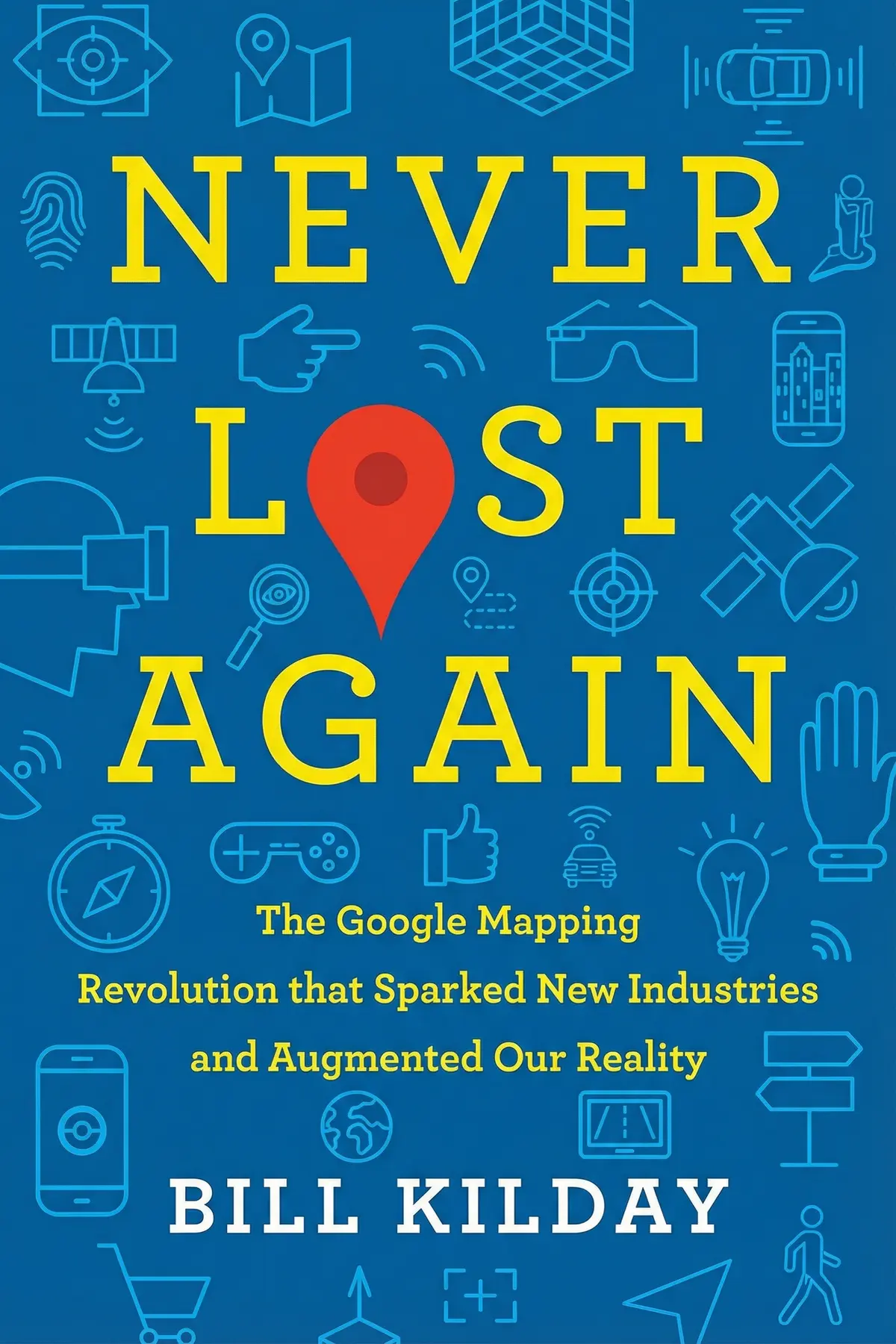
Table of Content
1. Introduction
1 min 01 sec
The map on your phone feels as if it was always there, yet it began as a demo set up in a friend’s spare room, built by a start-up that nearly died in the dot-com crash. In Never Lost Again, Bill Kilday, who ran marketing at that start-up, Keyhole, and later led marketing for the launches of Google Maps and Google Earth, tells that story from the inside.
His account shows that the tool most of us now carry was shaped by a few hard choices: finding new buyers when one market failed, trading money for exposure, and finally giving the product away so others could build on it. That last choice made it the base of companies like Uber and Yelp, and a rescue tool in a hurricane.
The story offers more than history. It holds lessons on keeping a small company alive and on how openness multiplies what a product is worth, along with a murder case cracked with GPS data and an overnight fax from CNN during the Iraq War.
2. Win people over by showing them their own house
1 min 56 sec
A spinning globe on a screen left two friends completely unmoved. A few seconds later they were astonished, and the reason holds a lesson for anyone who has ever struggled to make an idea feel real.
3. Survive a downturn by selling one product many ways
1 min 58 sec
When investors fled tech in 2001, most young companies simply vanished. Keyhole stayed alive by asking a different question about its product, and one answer ended up in a courtroom.
4. Turn a small deal into worldwide attention
1 min 52 sec
A cable news contract that was not especially lucrative was waiting in the fax machine one morning. One extra clause in it brought so many visitors that the servers collapsed the next day.
5. See why Google treated maps as search
1 min 51 sec
A cofounder walked into a meeting straight from a volleyball game, ignored the presentation and stared at his laptop. What he showed the room next changed the direction of a 27 billion dollar company.
6. Great products come from combining different teams
1 min 44 sec
Free juice, Segways and a massage room greeted the new arrivals. The real surprise was the work itself, where no single group could have built the map that now loads before you even ask.
7. Give a tool away and let others build on it
1 min 52 sec
A frustrated animator who could not find an affordable apartment spent three days with some freshly released code. What he made pointed to a way of creating value that charging customers never could.
8. Discover how a free map saved lives
1 min 50 sec
During a flood, a street address is almost useless to a helicopter crew circling overhead. A voice mail from a staff sergeant revealed how rescuers solved that problem with a program built for something else entirely.
9. Conclusion
1 min 04 sec
What Kilday’s story adds up to is a reminder that ordinary things have makers and turning points. The blue dot on your phone exists because a small company refused to die in a crash, accepted a cheap contract in exchange for its name on screen, and then joined a company willing to give its work away. Each choice gave up something in the short term for reach. That reach is what let a Coast Guard sergeant, an animator hunting for an apartment and a campaigner defending redwoods each find their own use for the same picture of the earth.
The book supports a few habits worth trying. When you pitch, show people their own house before you show them the planet. When your main market dries up, ask who else could use what you already make. When a partner offers little money, ask what visibility they can give instead. And when you build something, think about who might build on top of it.
Children growing up now may never learn what being lost feels like. Kilday’s story at least lets them know who drew the way home.
About this book
What is this book about?
Almost no one with a smartphone gets lost anymore, but the maps that make this possible have an origin story few people know. It begins in 1999 with a demo of the whole earth zooming down to the roof of a house, built by a tiny Silicon Valley company called Keyhole. Bill Kilday was Keyhole's marketing director, and he tells the story from inside. The company stayed alive after the dot-com bubble burst by selling its EarthViewer program to real estate developers, fire crews and even prosecutors in a murder case. A cheap contract with CNN during the Iraq War put its web address in front of the world. Then Google bought it, and its team helped build Google Maps. Readers get a close look at Google in the mid-2000s and at the decision to make its maps free and open. That choice let developers and companies such as Uber, Yelp and Zillow build on top of it, and it helped Coast Guard crews pull people from flooded roofs after Hurricane Katrina. The story carries practical lessons about surviving downturns, winning attention and building products that others can extend.
Book Information
Who it's for
Founders and business operators
Founders and operators who want real examples of surviving a downturn and turning small deals into big exposure.
Tech and product workers
Tech and product people curious about how Google Maps and Google Earth were built.
Using map apps daily
Readers who use map apps daily and want to know their origin story.
About the Author
Bill Kilday
Bill Kilday was marketing director at Keyhole, the mapping company that became part of Google, and at Google he led marketing for the launches of Google Maps and Google Earth. He went on to become Vice President of Marketing at Niantic, a company spun off from Google whose GPS-based games include Ingress, Pokémon GO and Harry Potter: Wizards Unite.
Ratings & Reviews
Ratings at a glance
What people think
Listeners find the book engaging and accessible, with one listener highlighting it as an exhilarating insider account. They also praise the storytelling, with one listener characterizing the work as a fascinating start-up story. Furthermore, the writing style earns positive marks, and one listener remarks that it delivers an easily understood overview of the technology.
Top reviews
Lillian
Bill Kilday delivers a backstage pass to the digital mapping revolution that we now take for granted every single day. This is an exhilarating insider account that captures the sheer desperation of a startup on the brink of collapse. I was gripped by the stories of the Keyhole team taking pay cuts just to keep the lights on before Google stepped in. The writing quality is top-notch, turning what could have been a dry technical manual into a high-stakes corporate thriller. You really get a sense of the '10X thinking' that Larry and Sergey brought to the table. It completely changed how I look at that little blue dot on my phone screen. Truly, it is a fascinating start-up story that everyone should read.
Show morePlernpiriya
Who knew a book about maps could be this addictive? I found myself flying through the chapters, completely hooked on the drama of the Keyhole startup days. The story about the CNN deal, where reporters had to verbally credit the software on air, was a particular highlight. Kilday has a knack for storytelling that makes the complex process of satellite imagery feel accessible and exciting. It’s inspiring to see how a small, scrapping team eventually birthed global phenomena like Google Earth and even Pokemon Go. The pace is fast, the tone is fun, and the insight into Google’s culture is second to none. This is easily one of the most captivating business books I have read in years. Five stars.
Show moreLiam
Finally got around to reading this, and it’s easily one of the most inspiring business books on my shelf. I never realized how close Google Maps came to never existing at all. The author’s writing style is informative and highly appealing, making the 'boring' parts of data collection feel like an adventure. Seeing the evolution from a floundering startup to a global utility is just incredible. Kilday introduces us to characters at Google in a way that feels intimate and real. It really makes you appreciate the immense work and vision required to map the entire planet. If you are looking for a page-turner about innovation, this is it. I've already recommended it to three colleagues this week!
Show morePenelope
An exhilarating insider account that manages to turn corporate history into a genuine page-turner. I was fascinated by the technological innovation required to stitch together a seamless view of the Earth. Bill Kilday has a gift for explaining complex systems through the lens of human drama and startup survival. The book doesn't just talk about code; it talks about the people, the pay cuts, and the risky bets that paid off. It’s a captivating look at how John Hanke and his team changed our relationship with geography forever. I finished it in two sittings because the storytelling was just that good. This is a must-read for anyone who loves a good underdog story in the tech world.
Show moreWichai
Ever wonder how a tiny, floundering startup became the foundation for how the entire world navigates today? This book answers that question with a level of detail and excitement I didn't think possible for a book about software. Kilday's style is addictive. He brings you right into the room during the high-stakes meetings with Larry Page and Sergey Brin. The story of how they mapped the world in such a short period is nothing short of miraculous. It provides a fascinating start-up story that highlights the importance of persistence and vision. From the early days of Keyhole to the global phenomenon of Google Earth, this is a masterclass in tech history. Truly a fantastic and informative read.
Show morePichaya
How did we go from paper Rand McNally atlases to having the entire globe in our pockets in less than a decade? This book provides a clear technology overview that explains exactly how that Herculean task was accomplished. Kilday’s perspective as an insider is invaluable, especially when detailing the early days of Keyhole and their struggle for recognition. John Hanke comes across as a visionary leader, finally getting the credit he deserves alongside names like Zuckerberg or Gates. The prose is captivating and easy to read, though it does get a bit 'tech-y' during the data acquisition chapters. If you can move past the occasional Google cheerleading, it’s a brilliant history of the mapping revolution. I highly recommend it for any tech enthusiast.
Show moreYui
The struggle is real in this fascinating chronicle of Keyhole’s early days before the big Google acquisition changed everything. Kilday does a great job illustrating the 'scrapping' years when they were literally begging for floor space at trade shows. It’s a wonderful technology overview that doesn't shy away from the messy human elements and people issues involved in high-growth startups. I appreciated the deep dive into how Ingress paved the way for future AR gaming. My only minor gripe is that the narrative occasionally wanders into fluff territory when discussing the Google 'celebrities' like Marissa Mayer. Still, it’s a well-written and compelling look at a tool we use every day. Definitely worth your time if you love tech history.
Show moreLucas
Look, if you use Google Maps daily—and who doesn't?—you owe it to yourself to see how it was built. Kilday provides an exhilarating insider account of the mapping revolution that is both well-written and easy to understand. I loved the details about the early tensions between the small startup team and the growing Google corporate machine. It captures that specific era of tech history perfectly. The chapter on the development of Niantic and Pokemon Go was an unexpected but welcome addition to the story. Some parts feel a bit like a PR puff piece for Google’s 10X thinking, but the core story of survival is too good to ignore. It’s a fast-paced, fun read for anyone interested in the giants of Silicon Valley.
Show moreAnchalee
While the subject matter is undeniably important, the narrative structure felt a bit disjointed at times. It functions more as a personal memoir of the author’s time at the company than a definitive history of digital mapping. I enjoyed learning about the transition from Keyhole to Google Earth, but the 'Google worship' got a little exhausting after a while. The book is definitely an easy read, yet I wanted more technical depth regarding the actual satellites and data processing. It’s a decent start-up story, but it lacks the objective distance I prefer in non-fiction. It is a solid 3.5-star effort that provides an interesting look behind the curtain, even if it feels slightly biased. Good, but not great.
Show moreDome
To be fair, I expected a rigorous history of GPS technology, but what I got was more of a corporate memoir lacking any serious research. There isn't a single citation in the entire text, which makes it hard to take the historical claims seriously. It feels like typical Silicon Valley self-congratulatory nonsense at times. The author spends way too much time on personal anecdotes rather than the actual science of mapping. Also, the premise that we are 'never lost again' is quite a stretch for the millions of people without smartphones. If you want real substance, read Greg Milner instead. This was just too much Google worship for my taste, and the execution simply didn't live up to the interesting concept.
Show moreQuestions about this book
What is Never Lost Again by Bill Kilday about?
It tells the inside story of Keyhole, a small Silicon Valley start-up whose EarthViewer program became Google Earth and Google Maps. Kilday, Keyhole’s marketing director, follows the company from a 1999 demo through the dot-com crash, a CNN contract during the Iraq War and Google’s purchase in 2004, then shows how the free maps reshaped business and helped rescuers during Hurricane Katrina.
How did Keyhole survive the dot-com crash?
When investors stopped funding start-ups in 2001, Keyhole dropped its focus on consumers and sold EarthViewer to many kinds of customers. Real estate developers scouted land at trade show demos, San Bernardino County used it while fighting forest fires, and the Santa Clara district attorney’s office used it to analyze GPS data in the Scott Peterson murder case.
Why did Google buy Keyhole?
Sergey Brin saw EarthViewer during an unrelated meeting and said Google should buy the company. Larry Page later explained that maps fit Google because, like search, they organize information: search connects people to the best websites, while a map connects them to everything on a street or in a city. Keyhole’s whole 29-person team joined Google.
What business lessons does Never Lost Again offer?
Several, drawn from Keyhole’s turning points. Sell one product to many kinds of buyers when your main market fails. When a partner offers little money, ask for visibility, as Hanke did by requiring CNN to show Keyhole’s web address. And consider making a product open, since free Google Maps let developers and companies like Uber, Yelp and Zillow build on it.
How was Google Earth used during Hurricane Katrina?
Google loaded fresh aerial images of New Orleans into Google Maps and Google Earth so people who had fled could see the damage. Coast Guard rescue teams also typed the street addresses of trapped callers into Google Earth, took the GPS coordinates and radioed them to helicopters, which helped them rescue hundreds of people.
Readers also enjoyed



7 Powers: The Foundations of Business Strategy
Hamilton Helmer






Alibaba: The House That Jack Ma Built
Duncan Clark
AUDIO SUMMARY AVAILABLE
Listen to Never Lost Again in 15 minutes
Get the key ideas from Never Lost Again by Bill Kilday, plus 5,000+ more nonfiction titles.
- 5,000+ titles
- Listen as much as you want
- 7-day free trial
- Cancel anytime









