

15 min 44 sec
Available in: English
Net Positive: How Courageous Companies Thrive by Giving More Than They Take
Shows how a company can profit by solving global problems and owning every impact it has. It also covers the leadership courage, bold goals and partnerships it takes to leave the world better off.
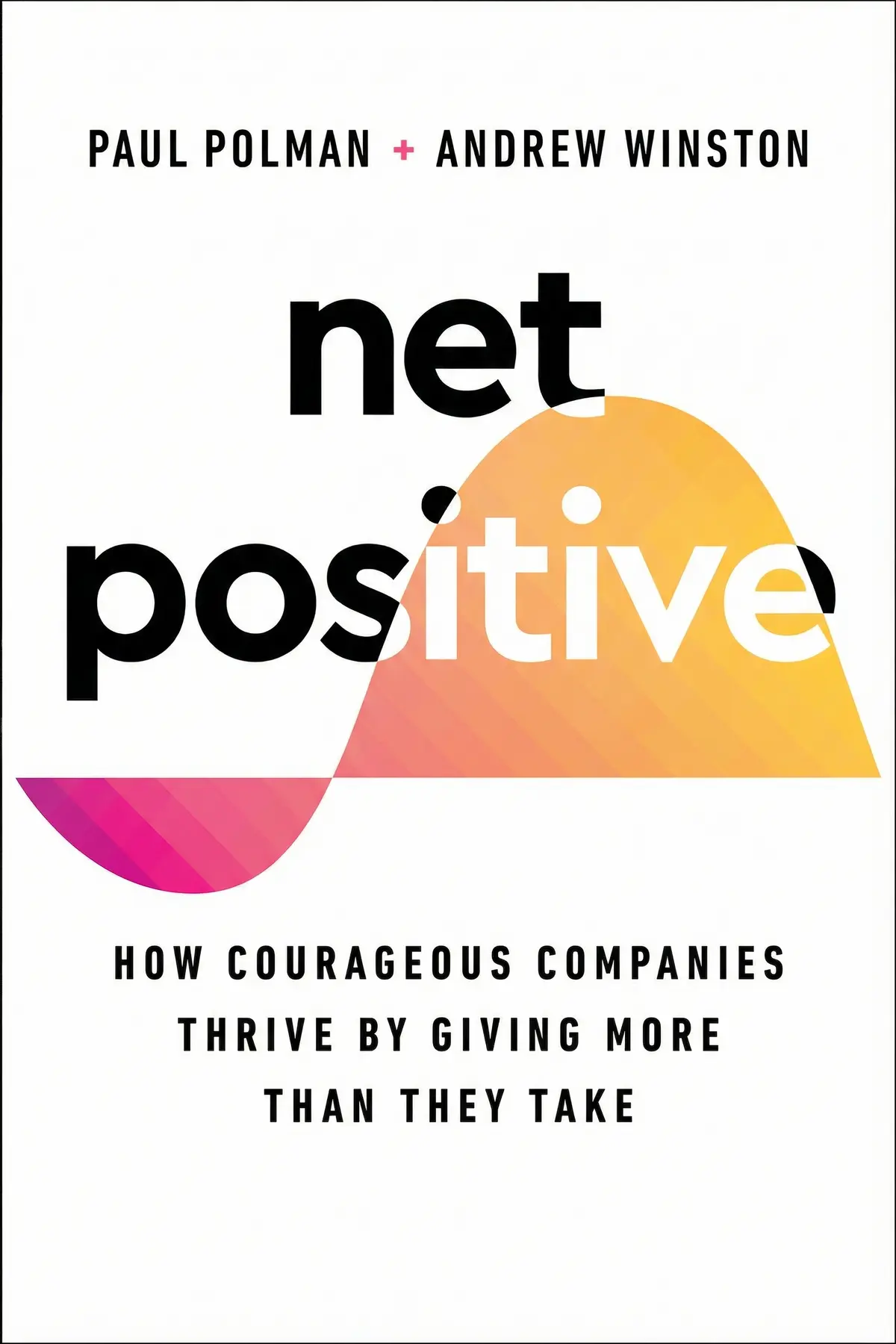
Table of Content
1. Introduction
1 min 03 sec
Most leaders are judged on a number that says nothing about whether the world gained or lost from their work. In Net Positive, former Unilever CEO Paul Polman and sustainability expert Andrew Winston offer a blunter measure: whether the world is better off because a company exists. A net positive company, in their definition, earns its profits by solving global problems and lifts the well-being of everyone it touches. The question for business has flipped, they argue. It used to be why anyone would pursue sustainability. Now it is why anyone would not.
Their case is that a company does best over time when it owns everything it touches. Getting there takes leaders with the courage to look past the quarter and beyond their own walls. The examples run from Unilever to Microsoft, CVS Health and a cement maker capturing its own carbon. Together they give you a way to judge any company, your own included, and to move it a step toward giving more than it takes.
2. Judge any company by what the world would lose
1 min 42 sec
Profit tells you whether a company won. It says nothing about whether everyone else lost. The authors offer a simple test for any firm, and they admit that no company, not even Unilever, has fully reached net positive yet.
3. Own every impact, from supplier to customer
2 min 02 sec
Most firms draw the line of responsibility at their own factory gate. The authors push it much further, and their numbers on wages and pay gaps show what has been left on the other side of that line.
4. Lead with heart to find your courage
1 min 55 sec
A survey of top bosses shows how rarely they rank stakeholders ahead of shareholders. Breaking from that majority takes a quality the authors trace back to an old Latin word.
5. Give your whole company a reason to care
1 min 48 sec
A purpose statement on the wall rarely changes what anyone does on Monday morning. Unilever went looking for something deeper in its own Victorian origins, and in a leadership week with an unusual goal.
6. Set targets big enough to feel uncomfortable
1 min 56 sec
Cutting a little harm each year can feel like progress while the underlying problem keeps growing. Some companies chose targets that looked reckless, and one gave up billions in sales to stay true to its name.
7. Partner with others and shape policy to multiply your reach
2 min 00 sec
Rivals helping each other make a vaccine, a company walking out of powerful business groups, factories left standing during riots. The authors argue that the biggest gains happen where one company’s control ends.
8. Bring the awkward issues into the open
1 min 56 sec
Every leadership team has topics it steps around in meetings, from top salaries to who gets hired. One company found a direct way to turn executive restraint into a raise for hundreds of its lowest-paid workers.
9. Conclusion
1 min 22 sec
Net Positive asks business to change its scoreboard. Profit still counts, but as the reward for solving problems, never as permission to create them. The test Polman and Winston leave behind is short enough to carry into any workday: whether the world would miss this company, this product or this team if it disappeared.
The book is more than a sermon because it is full of real choices with real costs. A new CEO announced within three weeks that quarterly reports would end. One company gave up around 2 billion dollars in cigarette sales across its 8,000 stores. Another firm froze its top salaries to more than double the pay of its lowest earners. None of them became net positive overnight, and the authors admit no one has yet. Each moved toward a North Star.
You can begin where you sit. Put the authors’ test to the work you control, and trace one product or service far enough to see the people and places it touches. Check that the groups speaking in your name argue for what you believe. And raise the issue your team keeps stepping around.
Companies helped break the world, the authors argue. By the authors’ logic, that is exactly why they own the damage and must take responsibility for it.
About this book
What is this book about?
Most companies are judged on profit, and profit says nothing about whether the world gained or lost from their work. Paul Polman, who ran Unilever for a decade, and sustainability expert Andrew Winston propose a blunter standard. A net positive company earns its money by solving global problems, and it improves the lives of everyone it affects, from employees and suppliers to customers and communities. The authors build the model on five principles. A company owns every one of its impacts. It thinks long term. It serves all of its stakeholders. It sees shareholder returns as a result of doing good. And it partners with others to change whole systems. They then show what this demands of leaders: courage, humility and a personal sense of purpose. Their examples include Unilever dropping quarterly earnings reports, CVS Health giving up cigarette sales and Microsoft's carbon goals. Readers get a practical test for any business, including their own. They also get a set of moves for pushing an organization toward giving more than it takes: bigger targets, open reporting, unusual partnerships, honest lobbying and facing the issues most leaders avoid.
Book Information
Who it's for
Leaders building responsible companies
Founders and executives who want growth that does not come at the expense of people or the planet.
Advocates for long-term goals
Managers and sustainability leads making the case for long-term goals inside a company focused on the next quarter.
Employees weighing their impact
Professionals deciding whether their employer, or their own work, leaves the world better off.
About the Author
Paul Polman
Paul Polman is a Dutch business executive who was CEO of Unilever from 2009 to 2019. He campaigns on climate change, inequality and human rights, including disability inclusion, and set up the Kilimanjaro Blind Trust with his wife Kim. Andrew Winston is an author and speaker on megatrends and sustainable business, and he was ranked number one on the Thinkers50 list of influential management thinkers. His books, including Green to Gold and The Big Pivot, have sold more than 300,000 copies in 15 languages. The Financial Times named Net Positive one of its Business Books of the Year.
Ratings & Reviews
Ratings at a glance

What people think
Listeners find this work to be a top recommendation for industry professionals, as it provides quality perspectives and is packed with real-world applications. They also value the book’s emphasis on corporate responsibility and ecological footprint, with one listener remarking that it represents a noteworthy contribution to environmental and business literature. Furthermore, they find the message quite motivating, with one review pointing out how a focus on purpose and sustainability can serve to inspire employees.
Top reviews
Book
Wow, what a refreshing and deeply inspirational take on the role of business in society. This isn't just another dry manual on corporate social responsibility; it’s a call to arms for leaders to rediscover their purpose. I was particularly struck by the stories of leaders who prioritized long-term health over short-term financial metrics, like the example of CVS removing cigarettes. The book successfully argues that purpose-led companies attract better talent and build more resilient brands. In my experience, seeing sustainability as an innovation driver rather than a cost center is the mindset shift we desperately need. Each chapter offers a vision of a more equitable world where businesses help fix global problems instead of creating them. It’s easily one of the most noteworthy contributions to environmental and business literature I’ve read in years.
Show moreTang
Finally got around to reading this, and I’m impressed by how Polman and Winston explode fifty years of corporate dogma. The stories about Unilever’s refusal to report quarterly earnings were particularly fascinating and show what real courage looks like in finance. They provide a compelling argument for why we must move toward a circular economy where less than 9% of products are wasted. I loved the emphasis on 'the heart' and the Latin roots of courage, reminding us that leadership is deeply personal. This book doesn't just talk about the environment; it addresses inequality, living wages, and the future of humanity. It’s a seminal work that every CEO should keep on their desk as a reminder of what’s at stake. If you care about the intersection of climate change and business, this is essential.
Show moreSelin
Not what I expected, but in the best way possible. I thought this would be a dry business text, but it’s actually a very human look at how we can reshape global systems. The chapter on partnerships alone is worth the price of the book, as it provides a roadmap for scaling solutions that no single company could handle alone. Polman's first-hand account of the Unilever turnaround is legendary, and hearing the 'why' behind those decisions is incredibly powerful. The authors effectively argue that transparency and radical honesty are the only ways to build trust in a skeptical world. Personally, I found the data points on diversity and the financial outperformance of ESG-focused indexes to be the perfect ammunition for internal debates. This is a brilliant, necessary, and ultimately hopeful book for the next generation of leaders.
Show moreBee
This book serves as a vital blueprint for anyone navigating the complex world of modern corporate sustainability. Polman and Winston move beyond the usual buzzwords to explain how a company can actually thrive by giving more than it takes from the planet. While the focus on Unilever is heavy, the practical examples from other giants like IKEA and Microsoft provide a necessary broader perspective. The authors make a compelling case that profit should be a result of doing good, not the only goal. Personally, I found the sections on courageous leadership particularly moving because they highlight the need for a moral compass in the boardroom. It isn’t perfect—some sections feel a bit like a victory lap—but the overall message is too important to ignore in our current climate.
Show moreSin
As a consultant working in the ESG space, I found the 'Net Positive' framework incredibly useful for framing difficult client conversations. The authors do a great job of explaining the 'quarterback' role of the sustainability officer and how that role must permeate every department. One of the best takeaways for me was the six-level framework for impact, which challenges companies to look far beyond their own internal operations. I appreciate how they tackle the 'SMART' goal obsession, suggesting that truly net-positive goals must often be uncomfortably ambitious. Some might find the tone a bit preachy, but the sense of urgency they establish is entirely appropriate given the scale of the climate crisis. It is a highly recommended read for professionals who want to see how sustainability can be embedded into core strategy.
Show moreFord
Ever wonder how a massive global corporation can actually contribute to biodiversity or social equity? This book attempts to answer that by breaking down the traditional profit-centric approach. The narrative underscores the importance of visionary leadership, specifically traits like humility and empathy which are often ignored in business schools. I particularly liked the discussion on partnerships, showing how collaborating with competitors and NGOs is the only way to drive systemic change. Not gonna lie, some of the personal political injections felt a bit out of place and potentially polarizing for a global audience. However, the core message about taking ownership of all social and environmental impacts—even 'spillover' ones—is a game changer. It’s a thick read, but the insights on turning around a giant like Unilever are genuinely valuable.
Show moreNarong
After hearing Polman speak on a podcast, I had high expectations for this book, and for the most part, it delivered. The writing is clear and the sense of urgency regarding the climate and social inequality is palpable. It’s not just about minimizing harm anymore; the bar has been raised to actually improving the lives of everyone a company touches. I did find the sections on supply chain ethics and living wages particularly eye-opening, especially the stats on the gender pay gap. While it can feel a bit repetitive if you read it cover-to-cover in one sitting, it’s great to dip in and out of for inspiration. It provides a noteworthy contribution to the debate on the future of capitalism. Definitely a must-read for anyone in a leadership position who wants to stay relevant.
Show moreOtt
Picked this up after seeing it recommended during my MBA, but I found the experience to be a bit of a mixed bag. To be fair, the core concepts regarding 'Net Positive' companies are transformative and necessary for today’s business landscape. However, the writing style can feel quite repetitive, especially in the middle chapters where it feels like they are just circling the same ideas. You get the sense that you’ve read the same message ten times by the time you reach page 150. Truth is, if you are already well-versed in ESG or stakeholder capitalism, there might not be enough 'new' material here to keep you fully engaged. It’s a solid introduction for those new to the space, though the memoir-style reflections on Polman’s time at Unilever occasionally distract from the actionable advice.
Show moreJoy
Look, the core message here is noble, but the execution often feels like it's circling back to the same points without adding much depth. I appreciated the specific examples, such as the comparison between the long-term focus of certain companies versus the cost-cutting obsession at places like Kraft Heinz. That being said, the prose can be quite dense and the tone is somewhat academic at times. It took me a while to get through because it didn't feel like the concepts were being progressively unpacked. Instead, it felt like a series of essays that all reached the same conclusion about 'giving more than you take.' It is an interesting book that tables important concepts, but it could have been much tighter and half as long without losing its impact.
Show morePlernpiriya
The focus on Polman’s tenure at Unilever felt less like a strategic business guide and more like a self-congratulatory memoir. Frankly, it felt like the authors were mostly preaching to the choir throughout the entire narrative. I was looking for concrete data and new frameworks to convince skeptical CEOs, but instead, I found mostly anecdotes and 'decent human being' platitudes. By the ninth chapter, the repetitive nature of the arguments made it difficult to stay focused. It’s hard to see how this would move the needle for a conventional executive who is solely focused on quarterly returns. While the intentions are clearly noble, the execution lacks the analytical depth I expected from such high-profile authors. It’s a bit of a letdown if you’re looking for a deep dive into the mechanics of ESG.
Show moreQuestions about this book
What does net positive mean in business?
Polman and Winston define a net positive company as one that earns its profits by solving global problems and improves the well-being of everyone it affects, from employees and suppliers to customers and communities. It goes further than net zero, which is mostly about carbon, because it covers the whole environmental and social agenda. The simple test is whether the world would be better off because the business exists.
What are the five principles of a net positive company?
The authors list five. A company owns all of its impacts, including those of suppliers and customers. It focuses on long-term value. It serves all of its stakeholders. It treats shareholder value as a result of doing good. And it shows collective courage through partnerships that change whole systems. Winston says the standard should apply to each product, each factory and each country of operation.
Has Unilever actually become net positive?
No. Winston describes net positive as a North Star that no company has reached, and the authors do not claim that Unilever has. The book uses Unilever’s transformation under Polman as a working model. One example is his decision, three weeks after becoming CEO, to stop quarterly earnings reporting so managers could invest for the long term.
Does pursuing sustainability hurt profits?
The authors argue it does not have to. They cite data showing that in 2020, 81 percent of sustainable indexes beat their benchmarks. They also report that two-thirds of consumers would switch to an unfamiliar brand with a clear purpose and 70 percent pay more for sustainable products. Some bold moves do cost money at first, like CVS Health giving up about 2 billion dollars in cigarette sales.
How can I apply Net Positive if I am not a CEO?
Start with the book’s test on the work you control: who would miss your product or team if it disappeared. Trace one product from raw material to disposal and note everything it touches. Find your personal purpose, as Unilever’s leadership program asked each leader to do. Check whether the groups that speak for your organization support what it claims to stand for, and raise the issue your team avoids.
Readers also enjoyed



A Year with Peter Drucker: 52 Weeks of Coaching for Leadership Effectiveness
Joseph A. Maciariello




Acting with Power: Why We Are More Powerful Than We Believe
Deborah Gruenfeld

All In: How Great Leaders Build Unstoppable Teams
Mike Michalowicz

AUDIO SUMMARY AVAILABLE
Listen to Net Positive in 15 minutes
Get the key ideas from Net Positive by Paul Polman, plus 5,000+ more nonfiction titles.
- 5,000+ titles
- Listen as much as you want
- 7-day free trial
- Cancel anytime









