

13 min 46 sec
Available in: English
Negotiation Genius: How to Overcome Obstacles and Achieve Brilliant Results at the Bargaining Table and Beyond
A Harvard-tested method for getting better deals: set your walk-away point, find trades that make the deal bigger for both sides, catch your own biases, and handle lies, threats and a weak position calmly.
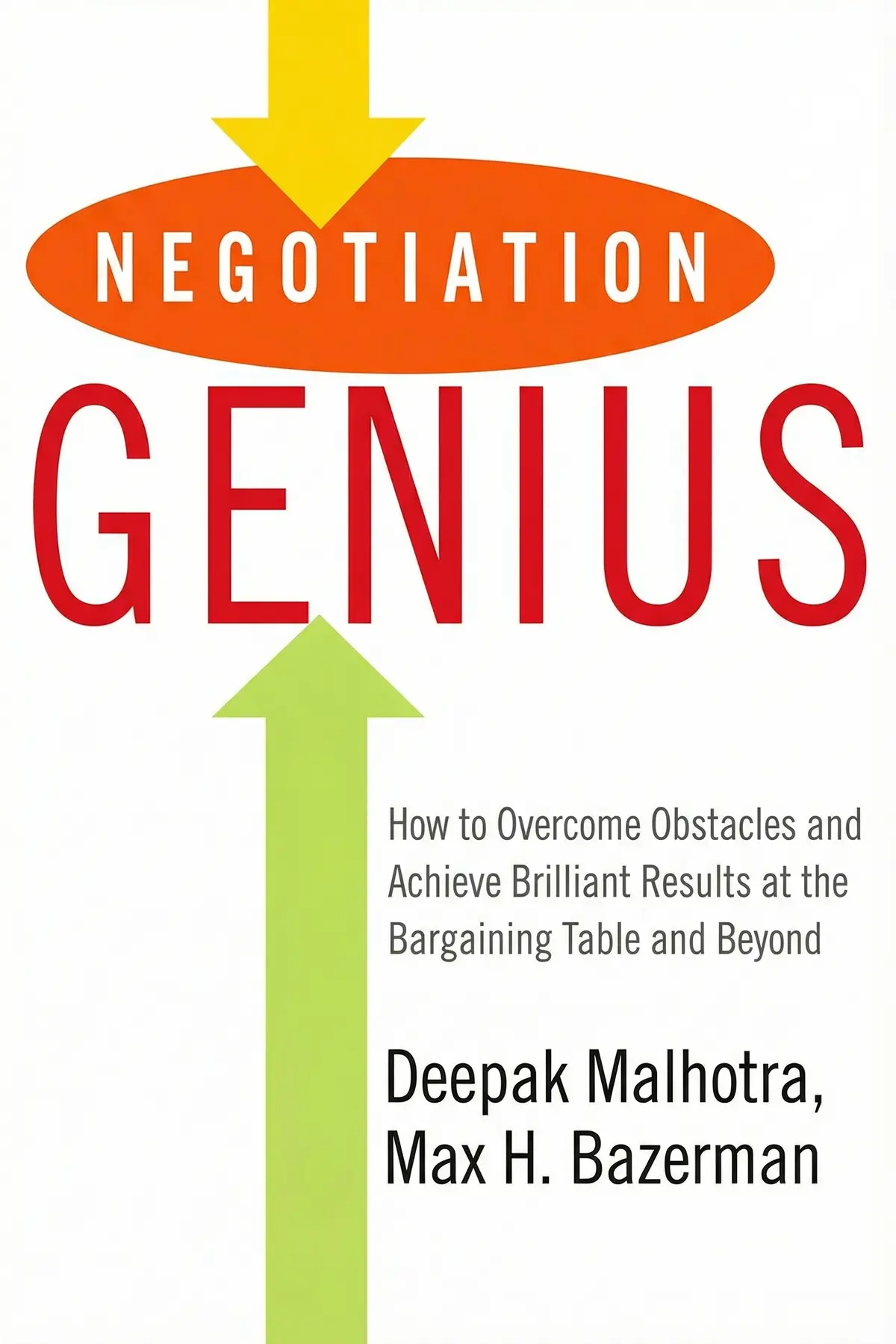
Table of Content
1. Introduction
1 min 03 sec
Most people walk into a negotiation ready to haggle and walk out having split a difference that never needed splitting. In Negotiation Genius, Harvard Business School professors Deepak Malhotra and Max H. Bazerman argue that brilliant results come from a method anyone can learn. They reject the common belief that negotiating ability is fixed, and they warn against leaning on gut instinct alone, because in their view negotiation is a science as well as an art.
They refined the method in Harvard MBA and executive classrooms and in work with more than fifty major corporations in over twenty-five countries. It runs like this. Know your numbers. Grow the deal by learning what the other side really needs. Correct the biases in your own head, and stay steady when the talks turn hostile or your hand is weak. Each step comes with a question to ask or a move to make, ready for your next salary talk, supplier meeting or tense conversation at home.
2. Know your walk-away point before talking price
1 min 40 sec
Many bad deals are signed by people who never decided what failure would look like. One number, settled before the first meeting, changes how hard you can push and when an offer deserves suspicion.
3. Grow the deal before you divide it
1 min 46 sec
A US ambassador needed 190 countries to accept a bigger bill so his own could pay less, with a hard deadline looming. Progress came only when he dropped the approach most negotiators reach for first.
4. Ask why, then ask why not
1 min 39 sec
Two companies agreed on price, volume and nearly everything else, then froze over one word. Chris, the firm’s in-house negotiator, flew to Europe and within minutes built a deal both sides accepted, with no threats. How he did it comes in Chapter 3.
5. Spot the mental traps in your own thinking
1 min 41 sec
Experienced dealmakers make the same predictable mistakes as beginners, and many happen before the other side says a word. A few simple habits catch the errors your own mind is built to make.
6. Keep deception from steering the deal
1 min 38 sec
Almost everyone believes they have been lied to at the bargaining table, yet outright lies are the smaller danger. A supplier’s carefully true answer about price shows the kind of deception worth watching for.
7. Answer threats and anger with questions
1 min 42 sec
An ultimatum with a deadline tonight feels like a trap with only two exits. Kennedy’s choice during the Cuban Missile Crisis points to a third response that takes the force out of threats and outbursts.
8. Win more from a weaker position
1 min 27 sec
Feeling outgunned by a big customer, a boss or a spouse is common. One clinic turned its opponents into fundraisers, and one of the authors chose not to bargain over his own first job offer.
9. Conclusion
1 min 10 sec
What Malhotra and Bazerman teach is a way of thinking you can bring into any conversation where interests differ. They describe their principles as being about dealing with mostly well-meaning people who see things differently. For a true negotiation genius, they say, a complex business deal feels no different from a social conversation. The method is what makes that ease possible: you know your alternative, you are curious about theirs, and you treat your first impressions with some suspicion.
Before your next negotiation, write down your BATNA and your reservation value, then make a careful guess at the other side’s. In the room, meet every demand with why and every refusal with why not, and look for an issue they value more than you do that you could trade. When a threat or an outburst arrives, ask a question before you answer it. Afterward, measure the deal against your walk-away point and ask whether you learned what the other side truly cared about. If you did not, there was more to find.
Chris settled a stalled deal in minutes because he went to Europe to learn, not to win an argument. That habit can be practiced.
About this book
What is this book about?
Many people think good negotiators are born tough or charming, and that the rest of us should split the difference and hope. Deepak Malhotra and Max H. Bazerman, both professors at Harvard Business School, disagree. They argue that negotiation genius is rarely innate. It comes from preparation, a clear framework, awareness of the biases that distort judgment, and a systematic way of structuring deals. The book starts with claiming value: knowing your best alternative to agreement, your reservation value and the zone where a deal is possible. From there it moves to the authors' main point: negotiators who work with the other side to enlarge the deal do better than those who only fight over its size. Their investigative approach, built on asking why and why not, shows how to uncover what the other party really needs. The later chapters deal with harder situations: cognitive and emotional biases, deception, threats, angry counterparts, negotiating without power and knowing when not to negotiate at all. Examples range from a stalled supplier deal and United Nations dues to the Cuban Missile Crisis. Readers come away with a set of steps that fit million-dollar contracts and salary talks alike.
Book Information
Who it's for
Managers and founders negotiating
Managers and founders who handle supplier, client or partnership deals and want a repeatable method.
Professionals facing tough talks
Professionals preparing for a salary talk or a tough conversation with a boss.
Usually splitting the difference
Anyone who usually splits the difference and suspects they leave value behind.
About the Author
Deepak Malhotra
Deepak Malhotra is a professor at Harvard Business School who works on negotiation strategy, deal-making, trust and the resolution of international and ethnic disputes. He advises CEOs and governments trying to end or prevent armed conflict, and Poets and Quants named him MBA Professor of the Year in 2020. Max H. Bazerman holds the Jesse Isidor Straus chair at Harvard Business School, where he teaches and researches negotiation, behavioral economics and ethics. In 2019 he received a Lifetime Achievement Award from the Academy of Management's Organizational Behavior Division.
Ratings & Reviews
Ratings at a glance

What people think
Listeners find this guide on negotiation both educational and accessible, praising the clear explanations and interesting real-world examples. The content is enjoyable and deemed vital for professional interactions, though one listener points out that its lessons apply to daily life as well. The prose earns high marks, with one listener describing the content as practical for actual use, while another draws attention to the impressive expertise of the authors. Overall, the work is lauded for being highly effective, as one listener remarks on how helpful it proves across a wide range of bargaining situations.
Top reviews
Pop
Finally, a manual that treats negotiation like a science rather than just a personality trait. I love how this book moves past the 'just be nice' or 'just be tough' tropes to focus on actual strategy like identifying the ZOPA and utilizing logrolling to create value. Honestly, the chapter on logrolling changed my entire perspective on how to trade off different priorities to make both parties happier. The authors provide a brilliant framework for structuring deals that I’ve already started using in my sales calls. Not gonna lie, I used to think I was a natural, but this book highlighted several cognitive biases I didn't even know I had. It’s practical, it’s evidence-based, and it’s written in a way that makes complex economic theories feel like common sense. Buy it for your team if you want to see immediate improvements in how they handle difficult clients.
Show moreKoi
Deepak and Max have crafted something truly special here. Most business books are fluff, but this is a deep dive into the psychology of the deal that stays grounded in reality. I particularly appreciated the focus on 'claiming value' without destroying the relationship, which is a nuance that most other guides gloss over entirely. Frankly, the case studies are the best part because they show the principles in action rather than just preaching them from an ivory tower. The writing style is surprisingly friendly and accessible, making it an easy read even if you aren't an academic. I’ve already bought three extra copies to give to my colleagues because the lessons on building trust and navigating 'morally nebulous' situations are just too good to keep to myself. This isn't just a book you read once; it’s a reference guide you’ll return to before every major contract discussion.
Show morePlernpiriya
After hearing so much buzz in my MBA circle, I decided to see if the hype was real. I was pleasantly surprised to find that it wasn't just another dry academic text. The authors have this way of making you feel curious and inspired about the art of negotiation. I actually used the 'logrolling' technique last week during a project deadline negotiation, and it worked exactly like they said it would! It’s amazing how much value you can uncover just by asking the right questions and looking for non-obvious trade-offs. The book is very realistic about the fact that most negotiations aren't one-off events but part of a long-term relationship. This realization changed how I approach my vendors entirely. If you want to move beyond basic salesmanship and start thinking like a strategist, this is the book you need. It’s easily one of the best investments I’ve made in my career development this year.
Show moreWillow
This is hands-down the most practical guide I’ve encountered for professional deal-making. What sets it apart is the friendly, easy-to-understand manner in which the concepts are explained. I didn't feel like I was being talked down to, even when the topics got into complex behavioral economics. The chapter on lying and ethical boundaries was particularly thoughtful, offering a way to stay moral without becoming a doormat for more aggressive negotiators. It's a great tool for anyone in a business or professional setting who needs to structure complex agreements. I’ve already noticed a shift in my confidence levels during meetings because I now have a repeatable process for preparation. The authors have managed to take a stressful topic and turn it into something that feels like an engaging puzzle to be solved. Highly recommended for anyone who wants to sharpen their soft skills and increase their bottom line.
Show moreAmara
Look, I’ve read a lot of business books that promise the moon and deliver nothing, but this isn't one of them. The principles presented simply make sense. I’ve been using this as an interim solution for training my junior sales staff, and the general consensus is that it’s incredibly effective. We've been reviewing it chapter by chapter, and the enthusiastic class discussions it sparks are a testament to how engaging the writing is. It’s not just about 'salesmanship'—it’s about research, patience, and understanding the other side's needs as well as your own. The book manages to be both a compendium of the best work from the Harvard Negotiation Project and a fresh take on modern dilemmas. Whether you’re negotiating a job offer or a multi-million dollar contract, the strategies here are gold. Buy a few copies for your team; it's an investment that will pay for itself in a single afternoon.
Show moreViolet
As someone who has always dreaded the haggling process, this was a breath of fresh air. It takes the mystery and the intense stress out of the room by giving you a step-by-step process to follow. The discussion on how to handle liars and those who use 'dirty' tactics was particularly eye-opening for me. I’ve always been too trusting in negotiations, but now I feel like I have a shield against manipulation. That said, it can be a bit repetitive in the middle chapters, and some of the scenarios felt a bit tailored for high-level corporate mergers rather than everyday life. Still, the core principles of preparation and research are universal. It taught me that being a 'genius' isn't about being charismatic—it's about being more prepared than the person sitting across from you. Definitely worth a spot on your shelf if you want to improve your professional leverage.
Show moreSirinat
The section on cognitive biases alone is worth the price of admission. It’s one thing to know you’re being irrational, but it’s another to see the specific traps laid out so clearly that you can avoid them in real-time. Personally, I found the quantitative elements—calculating your walk-away point and the zone of possible agreement—to be the most helpful part of the entire framework. It adds a level of objectivity to a process that usually feels very emotional and messy. My only minor gripe is that the book feels a little long-winded at times, especially when they revisit the same concepts across different chapters. However, the insights into how to handle ongoing relationships while still being firm on value are incredibly thoughtful. It's a solid, well-researched compendium of negotiation wisdom that I’ll be recommending to my MBA students this semester.
Show moreNarong
Ever wonder why some people just seem to 'get' what they want without burning bridges? This book explains the mechanics behind that success. It focuses heavily on the 'how' of building value, which I found much more refreshing than the typical win-lose mentality found in older business books. The authors are quite realistic about the scope of negotiation, acknowledging that you won't win every time but you can always improve your odds through better information. I especially liked the Part II section on psychology; it’s a fascinating look at how our brains sabotage us when the stakes are high. My only complaint is that the 'Genius' branding feels a bit gimmicky for a book that is actually very grounded in data. Regardless of the title, the content is stellar and provides a robust framework that any professional—from entry-level to CEO—can utilize immediately.
Show moreSelin
While the content is undeniably high-quality, the structure felt a bit like a textbook in several spots. I picked this up hoping for a quick guide to help with a salary negotiation, and while I found the information I needed, I had to dig through a lot of dense theory to get there. To be fair, the authors' credentials are top-notch, and the real-world scenarios they include are genuinely useful for context. But the pacing is a bit slow for my taste. If you have the patience to sit down and study this like a course, you’ll get a ton of value out of it. If you’re looking for a quick 'how-to' for a meeting tomorrow morning, this might be overkill. It’s an excellent reference for the library, but not necessarily an entertaining page-turner. It lacks an acknowledgement section too, which felt a bit weird given how much they build on previous research.
Show moreSin
I’m going to go against the grain here and say that I found this quite disappointing compared to the classics. To be fair, the authors clearly know their stuff, but the writing is dense and it feels like a redundant, over-complicated version of 'Getting to Yes.' If you've already read Fisher and Ury, you’re not going to find many groundbreaking revelations here that justify the extra page count. I struggled to stay engaged with the academic tone, which felt more suited for a lecture hall than a busy professional's commute. It’s not a bad book, per se, but it lacks the punch and clarity I was expecting from such high-profile Harvard professors. Truth is, I found myself skimming large sections just to get to the point, only to realize the point had already been made better elsewhere. If you’re a completionist in the field of negotiation, pick it up, otherwise, there are more concise options out there.
Show moreQuestions about this book
What is the main idea of Negotiation Genius?
Malhotra and Bazerman argue that negotiation genius is rarely innate. It comes from preparation, a clear framework, awareness of biases, and a systematic way of structuring deals. Their main point is that negotiators who work with the other side to enlarge the deal do better than those who only fight over how to split it. They back this with tools for claiming value, creating value and handling deception, threats and weak positions.
What are BATNA, reservation value and ZOPA?
BATNA is your best alternative to a negotiated agreement, meaning what happens if the talks fail. Your reservation value is the worst deal you will accept, based on that alternative. The zone of possible agreement, or ZOPA, is the range between the seller’s minimum and the buyer’s maximum. The authors advise estimating all three for both sides before you start, because together they show how hard you can push.
What is investigative negotiation?
It is the authors’ mindset and method for uncovering the other side’s interests, priorities, needs and constraints, even when they resist sharing them. Like a detective at a crime scene, you gather information before and during the talks. You ask why to find the interest behind a position, ask why not to learn what blocks agreement, and treat every demand as a clue rather than an attack.
How does Negotiation Genius suggest handling threats and lies?
For threats and ultimatums, the authors suggest ignoring them, addressing the concern behind them early, or signaling that they are not credible while letting the other side save face. For deception, they advise asking questions that approach the truth from several angles, using contingency contracts and never lying yourself. If you catch a lie but want the deal, help the other person correct course without humiliation.
Who should read Negotiation Genius?
It suits anyone who negotiates regularly, from managers closing supplier contracts to employees discussing salary. The publisher says it covers deals from multimillion-dollar agreements to salary offers, including strategies that work against hostile, unethical or more powerful counterparts. Readers who feel weak at the table, or who tend to split differences, will find concrete steps they can use in their next conversation.
Readers also enjoyed





AUDIO SUMMARY AVAILABLE
Listen to Negotiation Genius in 15 minutes
Get the key ideas from Negotiation Genius by Deepak Malhotra, plus 5,000+ more nonfiction titles.
- 5,000+ titles
- Listen as much as you want
- 7-day free trial
- Cancel anytime









