

12 min 34 sec
Available in: English
Narrative and Numbers: The Value of Stories in Business
Shows how to judge what a business is worth by pairing its story with its numbers. It also gives three tests that expose pitches too good to be true, whether you are pitching or investing.
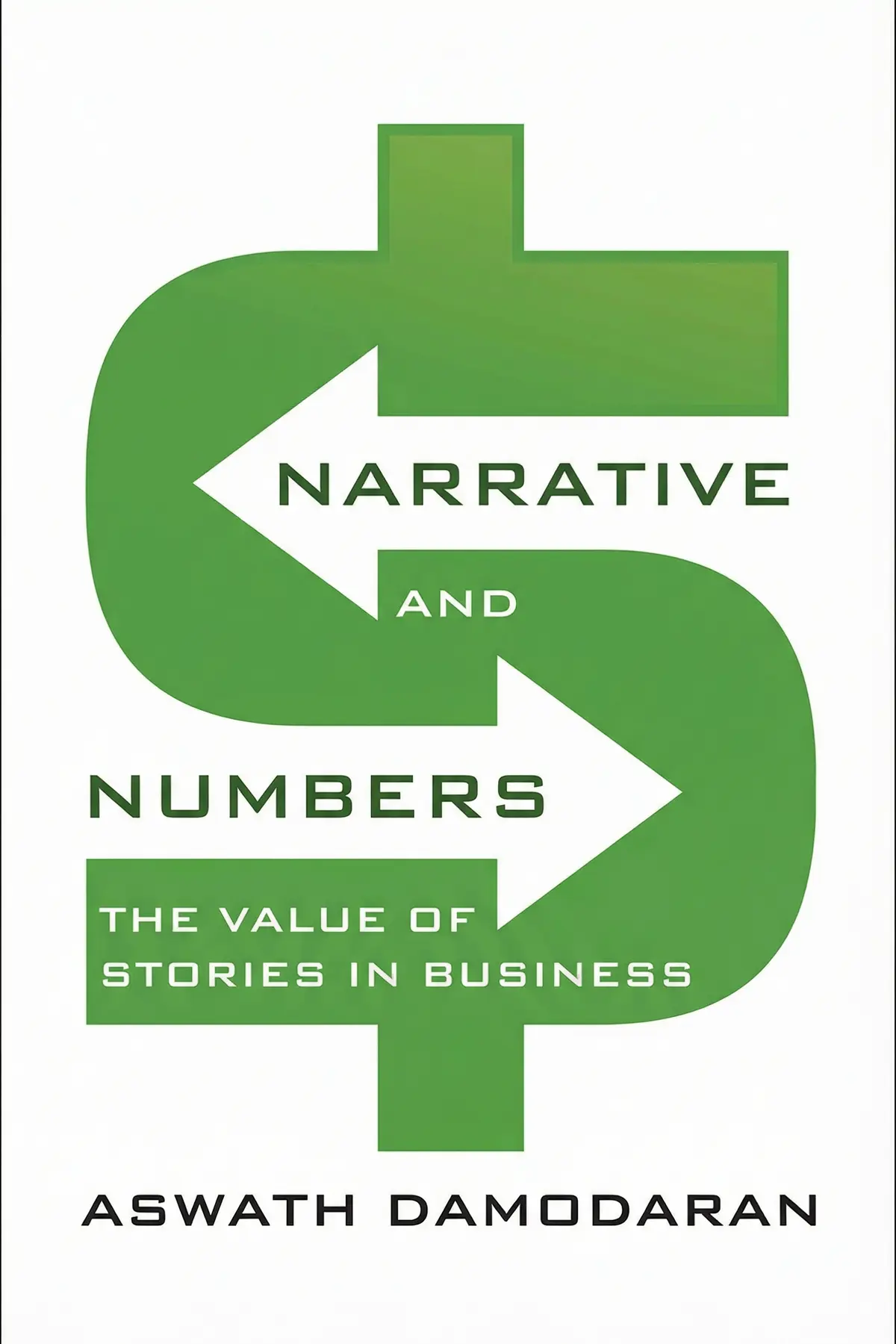
Table of Content
1. Introduction
1 min 05 sec
Founders often pitch on vision alone, and analysts often trust a spreadsheet alone, and both groups misjudge what a business is worth. In Narrative and Numbers, finance professor Aswath Damodaran argues that value lives where the two meet: a story with no figures drifts into fantasy, while figures with no story can mislead. Think of Ferrari. Nobody values the prancing horse as a pile of earnings. People buy into a story of luxury, speed and craftsmanship, and that story still has to show up in the accounts.
The book’s case is that a company’s worth is a story disciplined by data. You tell it clearly, turn it into numbers such as a discount rate and a terminal value, test it against reality, and keep revising it as results arrive. Along the way come Amazon’s rise, the Theranos scandal, Apple’s Think Different campaign and a thought experiment about Alibaba. What you take from it is three questions that can expose a weak pitch, whether it is your own or one someone is selling you.
2. Value a business with both story and numbers
1 min 36 sec
Storytellers and number crunchers rarely trust each other, and each side has good reasons. Ferrari and its prancing horse show why neither camp can value a company alone, and why the balance between them keeps shifting.
3. A good story wins investors and customers
1 min 43 sec
The same force that turned a small online bookseller into a global giant also let a compelling story hide the fact that a company’s technology did not exist. Understanding that force is the first defense against it.
4. Build a brand story people can check
1 min 43 sec
Apple once tied its name to Einstein and Gandhi, and a generation saw the company differently. Matching that depth takes more than a clever slogan, and the missing ingredient is usually the least glamorous one.
5. Question the numbers before you trust them
1 min 45 sec
Figures look like the cure for wishful thinking, yet they can create a confidence that is just as false. Two numbers at the heart of every valuation show how much opinion hides inside arithmetic.
6. Pick the right story and let it grow
1 min 43 sec
Uber and Alibaba both described themselves as something far bigger than a taxi app or an online shop. Choosing that frame is only half the work; the other half belongs to someone the founder does not control.
7. Spot a story that is too good to be true
1 min 51 sec
A giant company promises to conquer the world, keep very high margins and pay for it mostly out of the cash it already generates. It sounds thrilling. Three simple questions reveal where a story like that starts to come apart.
8. Conclusion
1 min 08 sec
What Damodaran offers in the end is a way of seeing a company as a living argument. The story makes a claim about the future. The numbers are how that claim gets checked, first on paper through a discount rate and a terminal value, then in the real world through results. Neither side gets the last word, because the story is never finished. Markets shift, strategies change, and fresh data has to keep flowing in for investors, buyers and the wider market to stay interested.
That view changes how you act on both sides of a pitch. If you are telling a company’s story, write it plainly, choose the plot it truly fits, and set each claim beside the figure that would prove it. If you are hearing one, run it through possibility, plausibility and probability before you believe the numbers attached to it, and remember how far Theranos traveled on a story alone. Either way, return to the story when results arrive, and let it change.
A prancing horse is worth more than its earnings because people believe its story. It stays worth that only as long as the numbers keep agreeing.
About this book
What is this book about?
Business people tend to fall into two camps. Founders and marketers trust a good story. Analysts and accountants trust the spreadsheet. Aswath Damodaran, a finance professor who has spent decades teaching valuation, argues that each camp sees only half of the picture. A story without numbers drifts into fiction, and numbers without a story can lead you the wrong way. Narrative and Numbers shows how the two fit together. Damodaran explains why stories persuade, using Amazon's rise and the Theranos scandal. He shows how to build a credible brand story, as Apple did with Think Different, and why figures such as the discount rate and terminal value carry hidden assumptions of their own. He also describes how founders and investors share the work of turning a narrative into a valuation. The most useful tool is a three-part test of possibility, plausibility and probability. Readers learn to apply it to any business story, including a thought experiment about Alibaba, and to keep their own company's story honest as markets and results change.
Book Information
Who it's for
Founders and managers
Founders and managers who need a company story that investors will believe and check.
Wary of too-good pitches
Investors and analysts who want a clear test for pitches that sound too good.
MBA and finance students
MBA students and finance learners connecting valuation numbers to business strategy.
About the Author
Aswath Damodaran
Aswath Damodaran holds the Kerschner Family Chair in Finance Education at Stern, where he teaches corporate finance and equity valuation to MBA students. He joined NYU in 1986. In 1990 he won its university-wide Distinguished Teaching Award, becoming the youngest winner up to that point. He earned his MBA and PhD at the University of California, Los Angeles. His other books include Investment Valuation, Damodaran on Valuation and The Little Book of Valuation, and he publishes data for people doing valuation work.
Ratings & Reviews
Ratings at a glance
What people think
Listeners find the book to be excellently written and value its lucid explanations, with one listener highlighting that it's incredibly easy to read. Furthermore, the text successfully merges storytelling with numbers, and listeners value the actionable takeaways, as one mentions it provides a good framework for understanding different types of companies. Ultimately, they view this as a significant resource for anyone with an interest in business.
Top reviews
Rod
Finally got around to reading this, and it is easily one of the most practical finance books on my shelf. Damodaran has a gift for taking the 'black box' of valuation and making it accessible through clear, structured thinking. Marrying the cold, hard numbers of a DCF with the qualitative narrative of a company’s future is a brilliant framework that actually feels actionable. I particularly enjoyed the case studies on Ferrari and Uber, as they show how the same set of data can lead to wildly different conclusions depending on the story you believe. While some might find his conservative assumptions frustrating, the truth is that his '3P' test—possible, plausible, and probable—is a necessary reality check for any investor. It is a well-written resource that provides a phenomenal bridge between financial journalism and accounting. Truly an important read for anyone trying to understand the 'why' behind the market price.
Show moreJoy
Wow, this was exactly the bridge I needed between my qualitative business intuition and the quantitative reality of finance. I’ve always respected Damodaran’s academic work, but this feels much more personal and conversational than a standard textbook. He successfully argues that the surge in big data has actually made good storytelling more important, not less. The way he breaks down the 'Big Market Delusion' is particularly relevant for today’s tech-heavy market. It’s an incredibly easy-to-read guide that doesn't shy away from the fact that valuation is an art as much as a science. I found the feedback loop concept in Step 5 to be a great reminder to stay humble and open to new information. If you want to move beyond just plugging numbers into a template, this is an essential resource. It really brings the concepts to life through real-world examples.
Show morePenelope
After hearing the 'Dean of Valuation' speak on various podcasts, I had high hopes for this book, and it did not disappoint. It is a phenomenal resource that effectively combines the art of storytelling with the science of DCF modeling. The 3P test (Possible, Plausible, Probable) is such a simple but powerful tool for filtering out investment hype. The book feels incredibly easy to read despite the complexity of the subject matter. Damodaran is a 'teacher first,' and his desire to help the reader understand the feedback loop of valuation is evident on every page. He doesn't just give you a formula; he gives you a way of thinking. Whether you are a startup founder trying to raise capital or a public market investor looking for an edge, this book provides the practical insights needed to navigate today's markets. It is truly an important resource.
Show moreThongchai
Honestly, this is the most useful thing Damodaran has written for the average investor. It moves away from the pure academic theory of his textbooks and into the real-world application of how we perceive value. The concept that every number in a spreadsheet should have a story behind it changed how I look at my own models. It’s well-written, clear, and focused on the drivers of value like cash flow and risk. The examples of Alibaba and Amazon provide excellent context for how narratives evolve over time. While some might find it familiar if they already follow his work, having the entire framework in one cohesive book is invaluable. It’s a great addition to my mental models and a very rewarding read for anyone serious about business.
Show moreNarong
As someone who has struggled with valuation spreadsheets for years, this book provided the missing piece of the puzzle. The central premise is that a valuation without a story is just a math exercise, and a story without numbers is just a fairy tale. Damodaran’s 5-step process for converting a narrative into value drivers is incredibly helpful and surprisingly easy to read. In my experience, the section on 'The Better Mousetrap' and 'The Disruptor' models helped me categorize my own portfolio companies more effectively. My only minor gripe is that the writing can feel a bit dense in the middle sections when he dives deep into the quantitative mechanics. However, the insights on how narratives must shift as a company ages are worth the price of admission alone. It’s a solid framework that adds a layer of discipline to the often-chaotic world of stock picking.
Show moreSelin
The chapter on the life cycle of a business really stuck with me because it explains why investors often talk past each other. Early on, it's all about the story; as the company matures, the numbers take the driver's seat. Damodaran’s writing is clear and structured, though occasionally it leans into the academic side. I appreciated the discussion on the limitations of different investor types, specifically how 'pure' quants often miss the forest for the trees. The book provides a great checklist of issues to consider when doing your own research. While I found some of the valuation examples a bit dated, the underlying logic is timeless. It’s a very didactic form of teaching that ensures you actually learn the 'how' rather than just the 'what.' Definitely a rewarding read for those willing to put in the mental effort to follow his logic.
Show moreKoi
Look, I’m no math whiz, but this book made me feel a lot more comfortable with the idea of intrinsic value. It’s a well-written guide that avoids getting lost in excessive jargon, focusing instead on the 'human' side of the numbers. I loved the idea that a company’s story should be bounded by the laws of physics and economics. It stops you from falling into the 'Eureka moment' trap where you assume a startup will just magically conquer the world. The structure is very logical: develop a hypothesis, test it, and then convert it into value. I did feel that some of the case studies were a bit dry, but they serve their purpose as templates. Overall, it’s a practical insight into a complex subject. It’s a must-read for any retail investor who wants to understand why a stock price might be moving against the fundamentals.
Show moreBook
Ever wonder why some startups get billion-dollar valuations with zero revenue? Damodaran breaks down how a compelling narrative can sustain a business in its early stages before the numbers catch up. I found his breakdown of the 'Disruptor' versus the 'Bully' models to be a fascinating way to look at market share and pricing power. The book is heavy on quantitative valuation, which is expected, but the effort to integrate qualitative 'scuttlebutt' is what makes it unique. My only criticism is that the tone can be a bit dry at times, and the Estonian translation (if you're reading that version) is apparently quite poor. However, the original English text is clear and offers a debuggable way to value any business. It provides a solid framework that I'll be using for my own investment analysis moving forward. Great addition to any finance library.
Show moreNong
Frankly, I expected a bit more fresh material from the 'Dean of Valuation.' If you are a regular reader of Damodaran’s blog, much of this book will feel like a retread of his previous posts and lectures. The core idea is valid—narratives drive the numbers—but the execution feels a bit repetitive after the first few chapters. He spends a lot of time on the theory of storytelling, yet the actual 'narratives' he provides for companies like Amazon or Alibaba are quite brief and mostly intuitive. To be fair, it is a well-structured book and great for someone who hasn't encountered his work before. But for long-time followers, it lacks the intellectual spark or 'newness' I was hoping for. It’s a good reference guide, but perhaps not the groundbreaking masterpiece the title suggests. Stick to his YouTube channel if you want the same information for free.
Show moreEvelyn
Not what I expected based on the title, which suggests a balanced look at storytelling and data. In reality, the 'narrative' side of this book is quite thin and lacks the depth of a true business strategy text. The author is clearly a 'numbers guy' trying to write about stories, and it shows. The end result reads more like an academic paper than a smooth business narrative. I found the examples—like the Uber valuation—to be bogged down by overly conservative assumptions that don't reflect how venture capital actually works. To be fair, the quantitative valuation parts are executed with his usual rigor, but if you’re looking for a book on the art of the pitch or strategic storytelling, this isn't it. It feels more like a blog compilation than a cohesive book. I’d recommend 'Measuring and Managing the Value of Companies' for a more professional approach.
Show moreQuestions about this book
What is the main idea of Narrative and Numbers?
Aswath Damodaran argues that a company’s value comes from combining its story with its numbers. A story without figures drifts into fiction, while figures without a story can mislead. Good valuation turns a narrative into numbers such as a discount rate and terminal value, tests it against reality and keeps revising it as the business matures and results come in.
What are the three Ps in Narrative and Numbers?
The three Ps are possibility, plausibility and probability. Possibility rules out stories that break basic limits, such as impossible market sizes or margins. Plausibility asks whether a possible story holds up, as in Damodaran’s example of Alibaba expanding globally at 50 percent margins without major investment. Probability checks whether a real strategy and sound financials support the growth claims.
Who should read Narrative and Numbers?
It suits founders who must pitch their company to investors, investors and analysts who judge such pitches, and students learning valuation. Readers who are comfortable with stories but nervous about spreadsheets get a clear view of how figures like the discount rate work. Readers who trust numbers alone learn why context and narrative matter just as much.
How can I apply Narrative and Numbers to my own business?
Write your company’s story in a few sentences after researching your market and competitors, and choose which of the five story types fits: vision, opportunity, turnaround, growth or entrepreneurial. Place the supporting figures beside each claim. Then test the story for possibility, plausibility and probability, ask experts to challenge it, and update it as real results arrive.
Readers also enjoyed


7 Powers: The Foundations of Business Strategy
Hamilton Helmer



Alibaba: The House That Jack Ma Built
Duncan Clark




AUDIO SUMMARY AVAILABLE
Listen to Narrative and Numbers in 15 minutes
Get the key ideas from Narrative and Numbers by Aswath Damodaran, plus 5,000+ more nonfiction titles.
- 5,000+ titles
- Listen as much as you want
- 7-day free trial
- Cancel anytime









