

A History of the World in 6 Glasses
Tom Standage
 English
 ไทย
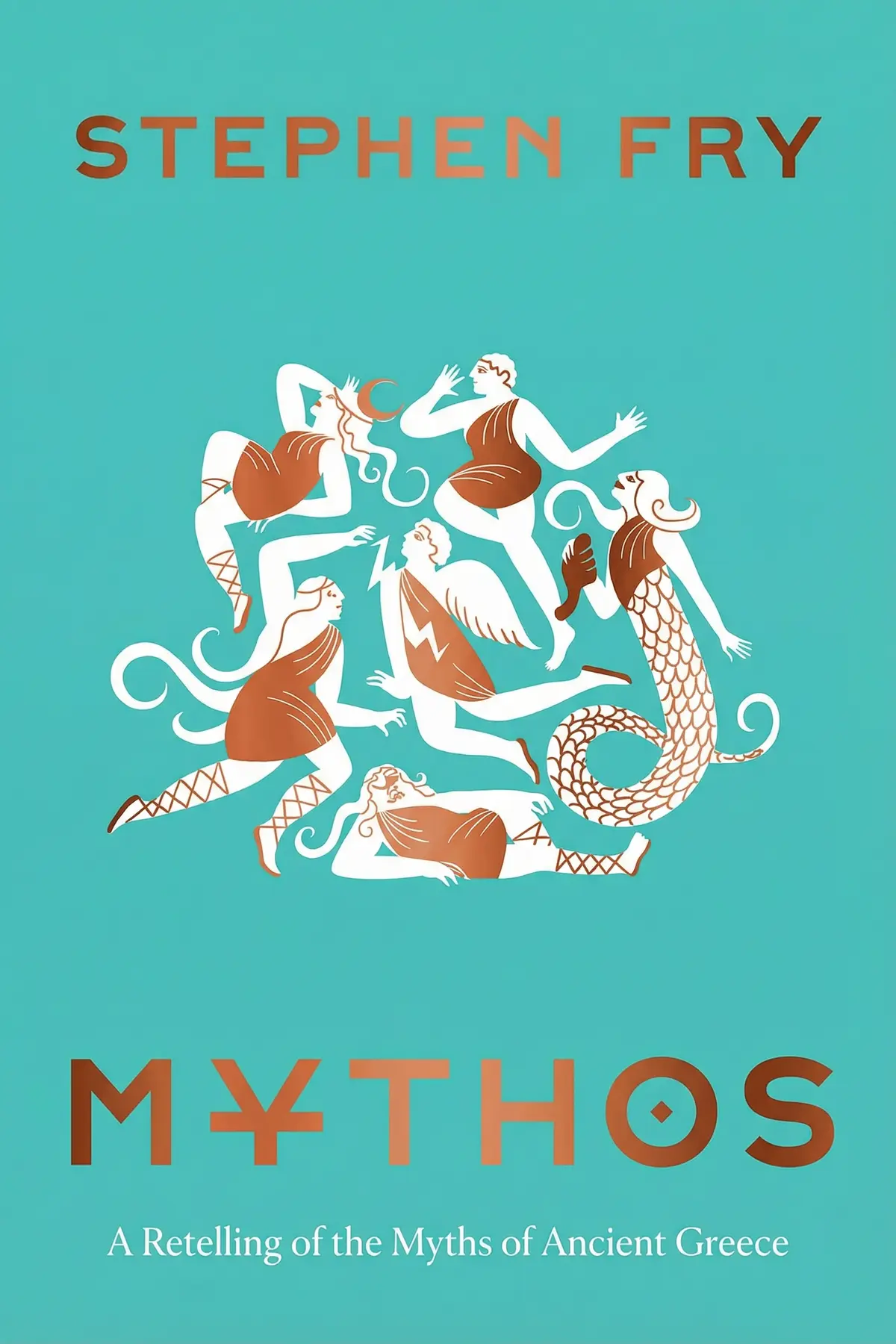
Stephen Fry retells the Greek creation myths as one connected family saga, from Chaos and the first primordial beings through Kronos and Zeus to Prometheus's stolen fire and Pandora's jar, with wit and vivid detail.
1 min 01 sec
Most people know a handful of Greek names, Zeus, Prometheus, Pandora, without knowing the family story that links them. In Mythos, comedian, actor and writer Stephen Fry retells that story from its first instant, when the Greeks pictured nothing but Chaos, with no time and so no before. Fry says the Greek myths were the ones that “lit me up inside,” and he credits the Greeks with first turning such tales into connected narratives full of color and detail.
Follow his retelling and one pattern keeps coming back. Each ruler of the cosmos tries to hold power by crushing what he fears, and each time the crushed thing returns to undo him. It runs from the sky god Ouranos to Zeus himself, and it ends with humans, fire and a jar that should have stayed shut. By the last chapter the old names form one story you can tell at dinner, along with the oldest Greek account of why suffering and hope share our world.
1 min 48 sec
Ask what came before the start of everything and the Greeks had a startling reply. Their first beings were not gods at all, and nobody ever told a single story about them.
2 min 00 sec
The first king of the cosmos had everything, including a mother of his children who loved him. One act of disgust turned her into a weapon maker, and his own son into the blade.
1 min 50 sec
A new king hears that his children will ruin him and takes the most direct precaution imaginable. His wife answers with a bundle of linen, a goat and a convincing performance.
1 min 57 sec
The mightiest Titan cannot be killed with his own weapon, and a teenager cannot beat him in a fight. What the boy brings instead is a goblet, a disguise and two very patient teachers.
1 min 50 sec
The young gods were probably outmatched by the older Titans in a straight fight. The deciding force came from an unlikely place, the very creatures one king had found too ugly to keep.
1 min 55 sec
The first humans lived without disease, hunger or war, and a kindly Titan still thought something essential was missing. His answer was the one gift Zeus had forbidden outright.
2 min 05 sec
Zeus’s revenge arrived as a wedding gift: a bride blessed by every god and a jar she must never open. What escaped explains a great deal, and so does the one thing that did not.
1 min 08 sec
What Fry’s retelling adds up to is a family story about fear. Every master of the cosmos, from the sky itself to Zeus, tries to stay safe by burying, swallowing or withholding something, and the buried thing always finds its way back. Out of that repeated mistake the Greeks drew a whole world: time, the shape of the mountains, fire in human hands, suffering on every road, and hope just out of reach.
The pattern is worth carrying into ordinary life. When someone in charge tries to control a threat by hiding it or shutting people out, watch for the alliance forming in the shadows, the way Rhea, Metis and the rejected giants came together. When you are tempted to keep someone small for your own comfort, remember that Prometheus judged a safe life without zest to be no life at all.
And the next time Pandora comes up in conversation, you can explain that Zeus himself handed her the jar, that every evil flew out, and that one creature never left. Hope is still in there.
Most people know a few Greek names, such as Zeus, Prometheus and Pandora, without knowing the family story that ties them together. Stephen Fry, who fell for these myths as a child, sets out to tell that story from the very first moment, when the Greeks imagined only Chaos and time did not yet exist. His retelling follows three generations of divine rulers. The sky god Ouranos rejects some of his own children. His son Kronos overthrows him, then swallows his own offspring to escape a curse. Zeus, the one child Kronos misses, takes power through patience and a well-made potion, wins a ten-year war and builds a new order of twelve gods. Then come the first humans, shaped from clay by Prometheus, who steals fire for them and pays a terrible price, while Pandora opens a jar that changes the world. Readers get the Greek origin story as one clear, connected narrative, told with humor and concrete detail. They also get a pattern worth remembering: in these myths, power that rules by fear keeps creating the very enemies that bring it down.
Curious adults who half remember Zeus and Pandora and want the whole Greek origin story in order.
Students and teachers looking for a lively, connected way into Greek mythology.
Fans of Stephen Fry's humor who enjoy old stories told with modern wit.
Stephen Fry was born in London in 1957 and made his name in the 1980s on Alfresco and Blackadder, then as half of Fry and Laurie with Hugh Laurie. He was the first host of QI and played Oscar Wilde in the film Wilde. He has written newspaper and magazine columns, published four novels beginning with The Liar, and recorded the audiobooks of all seven Harry Potter novels. President of the mental health charity Mind since 2011, he was knighted in 2025.
Listeners find this reimagining of Greek mythology charming and absorbing, highlighting Stephen Fry’s expert storytelling and clever wit. The work is simple to follow and beautifully composed, acting as an excellent resource. They value the stunning layout, with one listener mentioning that the illustrations far exceeded their expectations.
Stephen Fry’s voice practically leaps off the page in this delightful collection. If you have ever found Greek mythology a bit dry or overwhelming, this is the remedy you didn't know you needed. Fry takes these ancient, often brutal tales—like the bizarre birth of Aphrodite from sea foam and severed parts—and injects them with a very British, very clever wit. It feels less like a history lesson and more like a chat with a particularly erudite friend over a few drinks. I was particularly impressed by the physical quality of the book; the illustrations and photographs included are far better than I anticipated for a standard hardcover. While some purists might find his modern asides a bit much, I think they add a necessary layer of accessibility. It’s a masterful retelling that manages to be both informative and genuinely hilarious.
Show morePicked this up after finishing Gaiman’s Norse Mythology and I have to say, Fry brings a much bigger personality to the table. He doesn't just retell the myths; he roasts them, celebrates them, and inhabits them. The way he describes Zeus’s headache leading to the birth of Athena is pure comedy gold, yet he still manages to convey the awe-inspiring power of these figures. I actually listened to the audiobook while following along with the physical copy, and hearing Fry’s cadence makes the experience even better. He has this knack for making the weirdness of the Greek gods feel perfectly logical in their own twisted way. It’s a gorgeous book that looks stunning on a shelf, especially with those high-quality plates inside. Truly, it’s a must-read for anyone who loves a good story told by a master of the craft.
Show moreAfter hearing so much hype, I finally dived into Mythos and it is absolutely brilliant. Fry turns these distant, marble-statue gods into relatable, bickering, and fascinating characters. The stories are easy to comprehend without losing the "brutal weirdness" that makes Greek mythology so unique. I loved the little details, like how he explains the origin of certain words or the specific dynamics between Zeus and his five regurgitated siblings. It’s witty, it’s educational, and it’s just plain fun to read. The book itself is a work of art—the cover and the internal illustrations are top-notch. It’s definitely earned a permanent spot on my favorites list, and I'm already looking forward to reading the sequels, Heroes and Troy.
Show moreGotta say, this book is good enough to eat! I’ve spent the last week savouring every chapter, and it’s been an absolute joy. Stephen Fry has this incredible ability to make you feel like you’re sitting by a fire listening to these tales for the first time. The humor is spot on—especially the parts about Cronos and his digestive issues with his children. It’s rare to find a book that is this informative while also making you laugh out loud. The quality of the physical book is also worth mentioning; the pictures are beautiful and really add to the experience. It’s an absolute masterpiece of a retelling. If you have even a passing interest in the gods of Olympus, you need this on your nightstand immediately. My kind of ending!
Show moreFinally got around to reading Mythos and it’s a winner. Fry breathes life into these well-known tales without being patronizing. He assumes the reader is intelligent but doesn't require you to be a scholar of the classics to enjoy it. The way he handles the "absolute brutal weirdness" of the gods is perfect; he leans into the absurdity rather than trying to sanitize it. It serves as a great reference book but reads like a novel. I was pleasantly surprised by how much I learned about the origins of common phrases and words. It’s a delightful, engaging read that I’ll likely return to many times. Plus, the book itself is just beautiful. Five stars all the way.
Show moreEver wonder why we use the word "tantalize" or how the Greeks explained something as simple as a bee’s sting? Fry weaves these etymological nuggets throughout his narrative, making the myths feel relevant to our modern tongue. He structures the book chronologically, starting with the sheer chaos of the Primordials and moving into the reign of the Olympians. It’s a great reference for anyone wanting to get their bearings in the complex web of Greek genealogy. To be fair, his dismissal of the deeper religious significance of these stories might rub some scholars the wrong way. He treats them more as entertainment than sacred texts, which is a specific choice that colors the whole experience. However, the sheer readability makes it a winner for the average reader. The chapter on Prometheus was a personal highlight, capturing the tension between him and Zeus perfectly.
Show moreThe chapter on Prometheus alone makes this book worth the price of admission. Fry captures the tragic friendship between the fire-bringer and Zeus with surprising emotional depth, moving beyond the usual surface-level retelling. Throughout the book, he strikes a fine balance between humor and heart. To be fair, he does sacrifice some breadth for depth, cherry-picking specific myths rather than providing an exhaustive encyclopedia. But the ones he chooses are told with such panache that you hardly mind what’s missing. I did find myself wishing for a more detailed table of contents to navigate the various stories more easily. Despite that small gripe, the writing is effortlessly engaging and the presentation is superb. It’s a wonderful way to brush up on your classics without feeling like you're back in a stuffy classroom.
Show moreAs someone who has read a fair share of mythology retellings, I appreciated how Fry acknowledges the variations in these stories. He openly admits to taking liberties, which is necessary when you’re dealing with myths that shifted for over a thousand years. His modern references mostly work, though a couple felt a bit dated already. The book is remarkably easy to follow, even when the family trees get complicated. I particularly liked the section on Eros and Psyche—it was beautifully written and really showcased his more poetic side. My only real complaint is that his personal views on religion occasionally bleed into the text in a way that feels a bit jarring. Still, the storytelling is so masterful that it’s easy to overlook those moments. It’s an engaging, witty, and thoroughly modern take on the classics.
Show moreWhile I can't deny that Fry is a talented writer, I found the pacing of Mythos a bit too frantic for my liking. There is an absolute deluge of names and relationships to keep track of, and by the halfway mark, I was struggling to remember who was a Titan and who was an Olympian. The writing style is undeniably charming, but at times it feels a bit self-indulgent with its witty asides that don't always land. Truth is, if you already know these stories well, you might find yourself wishing he’d just get on with the plot instead of pausing for another linguistic joke. It’s a beautiful object to hold, and the pictures are lovely, but the content felt a bit like a "Greatest Hits" album that skips over the more nuanced b-sides. It's a solid introduction for beginners, but perhaps not the definitive version for everyone.
Show moreNot what I expected given all the glowing praise surrounding this release. Frankly, the tone felt a bit too patronizing for me. Fry’s insistence on reducing these complex cultural symbols to "primitive explanations" for natural phenomena feels incredibly dated and frankly a bit arrogant. It ignores the deep spiritual and psychological layers that make these myths endure for millennia. The humor also felt quite forced in several places, breaking the immersion of what could have been a powerful narrative. I found the structure a bit messy too; it jumps around so much that the epic scale of the Titanomachy gets lost in a sea of footnotes and clever remarks. If you want a serious look at mythology, look elsewhere. This is more of a light comedy routine that happens to use Greek names.
Show moreMythos retells the Greek creation myths as one connected saga. It starts with Chaos and the first primordial beings, follows the sky god Ouranos and his overthrow by his son Kronos, then Zeus’s victory over Kronos and the ten-year war with the Titans. It ends with Prometheus creating humans, stealing fire for them, and Zeus taking revenge through Pandora and her jar.
After Kronos overthrew his father Ouranos, the defeated sky god cursed him, saying his own children would destroy him. To escape that fate, Kronos swallowed each child Rhea bore, five in all. Rhea tricked him with a stone wrapped in linen, hid the infant Zeus on Crete, and Zeus later used a potion from Metis to make Kronos vomit up his siblings.
In Fry’s telling, Zeus gave Pandora a sealed earthenware jar called a pithos and told her never to open it. When temptation won, a cloud of evils escaped, descendants of the dark children of Nyx and Erebus: hardship, pain, starvation, anarchy, lies, quarrels, wars and murders. When she closed the lid, only hope remained inside, trapped there for eternity.
The war between the young gods and the Titans lasted ten years and reshaped the earth. Fry suggests the Titans would probably have won a straight fight, but Zeus freed the Cyclopes and the Hecatonchires, giants their father Ouranos had rejected. Their help proved decisive, the Titans called a ceasefire, and Zeus punished his enemies, sentencing Atlas to hold up the sky.
Read as a sequence, the myths repeat one pattern. Ouranos rejects his ugly children, Kronos swallows his to escape a curse, and Zeus withholds fire from humans, and each act of suppression comes back to bite. For a modern reader, the stories show how ruling through fear tends to produce the very rebellion it was meant to prevent.
Tom Standage

Ishmael Beah




William J. Bernstein

Ben Macintyre


Charles C. Mann
AUDIO SUMMARY AVAILABLE
Get the key ideas from Mythos by Stephen Fry, plus 5,000+ more nonfiction titles.









