

15 min 11 sec
Available in: English
Myanmar’s Enemy Within: Buddhist Violence and the Making of a Muslim “Other”
By Francis Wade
Explains why Buddhist mobs turned on their Muslim neighbors just as Myanmar left military rule. It traces the hatred from colonial race thinking through the dictatorship's citizenship laws to a democracy movement that stayed silent.
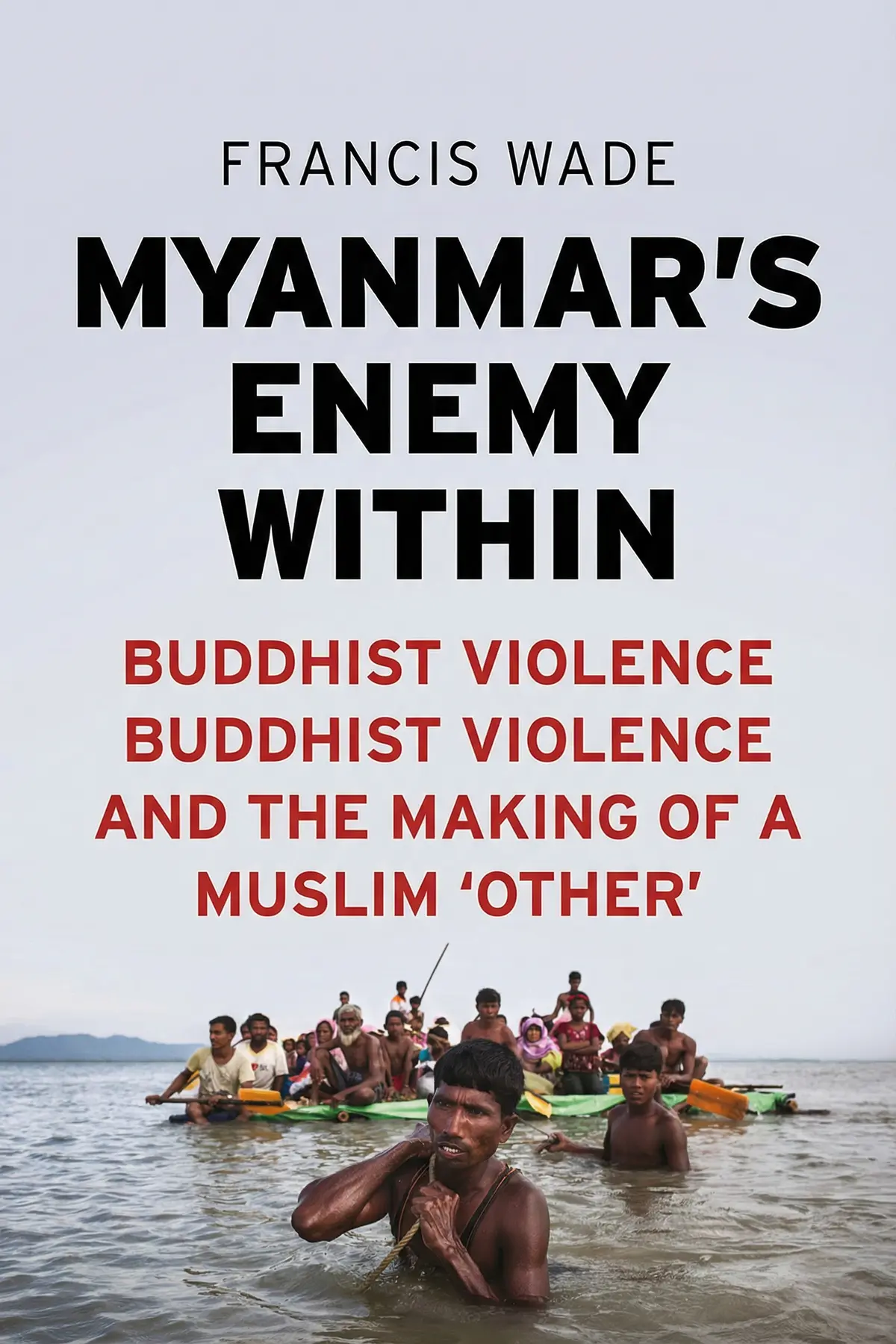
Table of Content
1. Introduction
1 min 01 sec
If your picture of Myanmar is a gentle Buddhist nation held down by generals, the year 2012 makes no sense. Just as military rule eased and democracy arrived, mobs began burning Muslim neighborhoods, and this time the aggressors were Buddhists. In Myanmar’s Enemy Within, journalist Francis Wade explains how that reversal happened.
His answer is that the violence was no sudden madness. It grew from an idea of who belongs to the nation, planted under British rule, written into law by the dictatorship and set loose once censorship ended.
Wade starts on a burning street in a fishing town, reaches back through census tables, identity cards and a strange resettlement scheme, then turns to the democrats who stayed silent. Followed to the end, the Rohingya crisis becomes one connected story. Its warning signs, about how a neighbor gets recast as an enemy, apply well beyond one country.
2. Understand the link between freedom and violence
1 min 49 sec
In a seaside town where Muslim and Buddhist children shared classrooms, armed buses rolled in one June morning. The timing points to an uncomfortable link between a long-awaited reform and the fear it set off.
3. Spot the story that turns a crime into a plot
1 min 49 sec
Ten men with no link to a murder were beaten to death in revenge for it. Making sense of that requires looking at what scholars, monks and journals had been saying a full year earlier.
4. Watch hatred widen from one group to many
1 min 48 sec
The attacks began against one disputed minority in one coastal state. Within months, a rice trader, a 94-year-old woman and a neighborhood hundreds of miles away had all been caught in the same fire.
5. Trace today's resentment back to colonial Burma
2 min 01 sec
Muslims have lived on Myanmar’s coast for more than a thousand years, so the charge that they are intruders needs explaining. The explanation involves a vanished border, a flood of workers and a census.
6. See how an identity card can erase a people
2 min 01 sec
A sign at the immigration office warned visitors about races swallowing races. Behind it sat a theory of fixed blood, a list of 135 groups and a missing name that would decide who counted as a citizen.
7. See how a regime engineers a region's population
1 min 44 sec
In the 1990s, convicted thieves and even murderers were offered early release, a house, cows and a monthly allowance. The catch was a single condition, and it reveals what the generals feared most.
8. Understand why the democrats stayed silent
1 min 41 sec
The activists who spent decades in prison for freedom might have been expected to defend the persecuted. Their response surprised Wade, and the reason behind it is harder to dismiss than simple prejudice.
9. Conclusion
1 min 17 sec
Myanmar’s Enemy Within turns the familiar story inside out. The danger to Myanmar’s Muslims did not leave with the generals, because the generals had never owned it alone. A colonial census taught the country to sort people into fixed races. Nationalists named Muslims as the race that would never fit, and the dictatorship wrote that verdict into citizenship law and ID cards. When censorship lifted, the idea reached the public with no brake, and it turned out to be held by roadside crowds, senior monks, a president and former prisoners of conscience alike.
The book gives a few signs worth watching for, in Myanmar and anywhere. Notice when one person’s crime is told as a group’s plot, because that framing turned a murder into the killing of ten unrelated men. Notice when belonging starts to depend on ancestry and a printed label, as it did under the 1982 law. And notice when even reformers say equal rights are only for the rightful members.
The red sign at the immigration office claimed a race dies only at the hands of another race. Wade shows what happens when a whole society learns to see its neighbors through that sentence.
About this book
What is this book about?
For decades, outsiders saw Myanmar as a peaceful Buddhist people suffering under a brutal army. Then, in 2012, soon after the generals began stepping back, Buddhist vigilantes started burning Muslim neighborhoods in Rakhine State, and the violence spread across the country. Journalist Francis Wade sets out to explain how a long-awaited democracy arrived together with a wave of persecution. His answer reaches back more than a century. British rule opened the country to Indian migration and sorted its people into fixed races. Nationalists cast Muslims as outsiders who would not blend in. The military regime then built citizenship around a list of 135 national races, left the Rohingya off it, took away their identity cards and paid Buddhist prisoners to settle their region. When censorship ended, extremists spread these ideas freely. Readers get a clear, connected account of the Rohingya crisis and a sharp lesson about how a neighbor can be recast as an enemy. The book also shows why even revered pro-democracy figures, including Aung San Suu Kyi, would not side with the victims.
Book Information
Who it's for
Curious about the Rohingya
Readers who knew Myanmar as heroes versus generals and want to understand the Rohingya crisis.
History and politics students
Students of history and politics studying how colonial rule shapes ethnic conflict.
Journalists, policymakers, rights advocates
Professionals in media, policy or human rights who want to recognize how a minority is turned into a national enemy.
About the Author
Francis Wade
Francis Wade is a journalist who reports on Myanmar and Southeast Asia. He began covering the country in 2009 as an editor and reporter at the Democratic Voice of Burma, a news organization founded by exiled dissidents from Myanmar. He went on to report on the country's move away from military rule and the violence that came with it. His work has appeared in The Guardian, TIME and Foreign Policy, among other outlets. He is based in London.
Ratings & Reviews
Ratings at a glance
What people think
Listeners find the book to be extremely educational, with one individual highlighting its thorough examination of Myanmar. The standard of writing earns praise from several listeners.
Top reviews
Fang
Finally sat down with this after the headlines faded, and it is a masterclass in investigative reporting on a heartbreaking topic. Wade provides a comprehensive discussion of Myanmar’s internal struggles that most Western media outlets completely ignored. The way he explains the 'enemy within'—how neighbors were turned against each other through state-sponsored fear—is absolutely haunting. Truth is, I hadn't fully grasped how much the opening of media controls actually allowed hate speech to proliferate among the Buddhist majority. The writing quality is top-notch, balancing raw emotional accounts from the Rohingya camps in Bangladesh with a sober analysis of the military junta's legacy. This isn't just a book about one country; it's a warning about how fragile social cohesion is everywhere. Truly essential reading for anyone interested in human rights.
Show moreChloe
Stunningly written but incredibly difficult to stomach. The stories of everyday persecution in the final chapters really brought home the human cost of these political maneuvers. Wade has a gift for taking complex geopolitical shifts and making them feel personal. I found the sections on the rise of radical messages through social media particularly relevant to what we are seeing globally today. It’s a quick read in terms of pacing, but the weight of the subject matter stays with you long after you close the cover. My only minor gripe is the lack of a clear map to help visualize the specific villages mentioned, but that doesn't detract from the 5-star impact. Everyone should read this to understand how propaganda functions in the modern world.
Show moreSin
Grabbed this after reading Bertil Lintner's work, and it serves as a fascinating, if sometimes flawed, companion piece. What Wade does differently is focus on the psychological impact of the 'divide-and-conquer' strategy on the populace. The interviews with people who lived through the riots are chilling and offer a perspective you won't find in academic texts. In my experience, most books on this topic are either too dry or too sensationalist, but this hits the sweet spot. It’s a comprehensive discussion that doesn’t shy away from the grim reality of the camps in Bangladesh. Even with the minor organizational issues, it remains one of the best books on the subject. A powerful, haunting, and necessary contribution to the literature on Myanmar.
Show moreViolet
As someone who has followed the political landscape in Southeast Asia for years, I found Wade’s analysis of the Rakhine crisis deeply compelling. He manages to move beyond the superficial headlines to expose the military’s calculated 'divide-and-conquer' strategy that has fueled ethnic friction for decades. The book is remarkably well-researched, and it’s clear the author spent significant time on the ground conducting interviews. To be fair, the organization is a bit of a mess, as the narrative jumps chronologically in a way that can be disorienting for those not already familiar with the names and dates. However, the insights into how the transition to democracy actually empowered radical Buddhist nationalists are chilling. It is a dense, necessary read for seasoned Burma-watchers, though it requires patience to navigate the repetitive themes in the middle chapters.
Show moreBrooklyn
The historical deep-dive in the early chapters of this book is where Francis Wade truly shines. He connects the dots between British colonial 'othering' and the modern-day nationalism that has led to such horrific violence. Look, the transition to democracy is usually framed as a success story, but this book shows the dark side of that shift. I was particularly struck by the description of how the military redirected public anger away from the government and toward minority groups. While I agree with other reviewers that the organization is a bit scattered, the content itself is vital. It’s a sobering look at how nation-building can go horribly wrong when it’s built on the exclusion of a specific group. It definitely deepened my understanding of the conflict.
Show moreNing
Frankly, it's rare to find a journalistic account that balances on-the-ground reporting with high-level political theory so effectively. Wade captures the paradoxical nature of group violence—how disenfranchisement leads to misplaced anger. I learned a great deal about the specific legal mechanisms used to strip the Rohingya of their citizenship, which was far more complex than I initially thought. The writing is clear and accessible, making it perfect for someone who isn't a regional expert but wants to understand the 'why' behind the crisis. There is some conjecture here and there regarding the military's motives, but given the closed nature of the junta, that’s almost unavoidable. It’s a solid, informative piece of work that humanizes a group often reduced to statistics.
Show moreOtt
After hearing so much about the Rohingya crisis on the news, I wanted a resource that went beyond the surface-level soundbites. This book delivered exactly that. It isn't just a play-by-play of the violence; it's a deep exploration of identity and what it means to belong to a nation. The author does a great job of explaining how the 'othering' process works. My only real critique is that it felt a bit like a collection of essays that didn't always flow into each other seamlessly. Still, the quality of the prose is excellent, and the insights into the Buddhist nationalist movement were eye-opening. It definitely challenged my assumptions about the country’s path to democracy. Well worth your time.
Show moreSelin
This is an important book for the current moment, but I have mixed feelings about how the information is presented. On one hand, the middle sections provide a fascinating look at how the military manipulated the scarcity of resources to create horizontal violence. On the other hand, the text is incredibly repetitive, often restating the same historical points in every other chapter. Personally, I would have appreciated seeing more raw interview transcripts rather than the author’s interpretations of them. The ending felt a bit like a 'template' resolution, trying to find a silver lining in a situation that is overwhelmingly bleak. It works well as background reading for a layperson, but if you’ve already read work by Bertil Lintner, you might find some of this a bit redundant.
Show moreSayan
Why does a book with such vital subject matter feel so disorganized in its execution? I really wanted to like this, but the structure is frustratingly non-linear, making it difficult to track the actual progression of the 2012 violence. Frankly, the author’s voice often drowns out the very interviewees we are supposed to be learning from. Just as a story becomes interesting, Wade pulls back into academic conjecture or personal opinion without enough hard evidence to bridge the gap. I also found it troubling that certain identities were exposed without clear safeguards; in a country as volatile as Myanmar, that feels reckless. While the historical context regarding British colonialism is solid, the book feels like a series of expanded journalistic articles rushed into a single volume. It’s informative, yes, but could have been much tighter.
Show moreIsabelle
Wow, talk about a biased perspective. This book is a prime example of the 'Rohingya lobby' ignoring the nuances of the situation on the ground to push a specific narrative. Wade completely ignores the fact that Muslims in Myanmar are not a monolith; many are fully integrated into society and hold high positions in government. Most egregious is the total omission of the crimes committed by Rohingya militants against Buddhist villagers. By painting one side as purely innocent victims and the other as mindless aggressors, the author does a disservice to the complex history of Rakhine State. Not gonna lie, I found the tone condescending and the research one-sided. If you want the full picture, look elsewhere. This is misleading journalism at its worst.
Show moreQuestions about this book
What is Myanmar's Enemy Within about?
Francis Wade explains why Buddhist mobs attacked Muslims, especially the Rohingya, just as Myanmar moved from military rule toward democracy after 2011. He argues the violence grew from a long-built idea of who belongs to the nation. British rule sorted people into fixed races, nationalists cast Muslims as outsiders, and the dictatorship tied citizenship to a list of 135 national races that left the Rohingya off. When censorship ended, extremists spread these ideas freely.
Why did violence against the Rohingya begin in 2012?
Wade gives two layers. The trigger was the rape and murder of a Buddhist seamstress in May 2012, after which 300 Buddhists killed ten unrelated Muslim men. The deeper cause was a story, built in 2011 by scholars, monks and journals, that the Rohingya were invented outsiders plotting to take over. The end of military censorship let that story spread, and the democratic transition made Rakhine Buddhists fear losing their position.
How did British colonial rule shape anti-Muslim feeling in Myanmar?
After annexing the country in 1885, Britain opened the western border in 1886 and encouraged Indian migration to supply labor. In the 1920s about 250,000 Indians arrived each year, and by 1931 Indians outnumbered Bamar in Yangon and owned half the farmland. Nationalists resented the newcomers, and they singled out Muslims as British stooges. Britain’s habit of classifying fixed races, 139 in all, was later copied by the military regime.
Why didn't Aung San Suu Kyi condemn the attacks on the Rohingya?
With 115,000 Rohingya in camps, she said both sides were at fault. Some suspect personal prejudice, but Wade offers a simpler reason: a political trap. Opposing nationalists who claim to defend Buddhism would get the pro-democracy movement labeled pro-Muslim and cost it support. Staying silent harms its reputation for justice. Wade also shows that leading democrats, such as Ko Ko Gyi, shared the regime’s view that the Rohingya do not belong.
What is the main lesson of Myanmar's Enemy Within?
Wade shows that ending a dictatorship does not end the ideas it spread. A belief in fixed races and rightful members can outlive the regime that wrote it into law, and freedom of the press can carry hatred as easily as truth. The warning signs he documents, such as treating one crime as a group’s plot and tying citizenship to ancestry, are worth recognizing in any society.
Readers also enjoyed

All About Love: New Visions
bell hooks


A Promised Land
Barack Obama

A River in Darkness: One Man’s Escape from North Korea
Masaji Ishikawa

A Theory of Justice
John Rawls



A Warning
Miles Taylor

AUDIO SUMMARY AVAILABLE
Listen to Myanmar’s Enemy Within in 15 minutes
Get the key ideas from Myanmar’s Enemy Within by Francis Wade, plus 5,000+ more nonfiction titles.
- 5,000+ titles
- Listen as much as you want
- 7-day free trial
- Cancel anytime









