

15 min 43 sec
Available in: English
Moore’s Law: The Life of Gordon Moore, Silicon Valley’s Quiet Revolutionary
Follows chemist Gordon Moore from homemade explosives to co-founding Fairchild and Intel, showing how his forecast about chips came true and what his wins and costly mistakes teach about judgment.
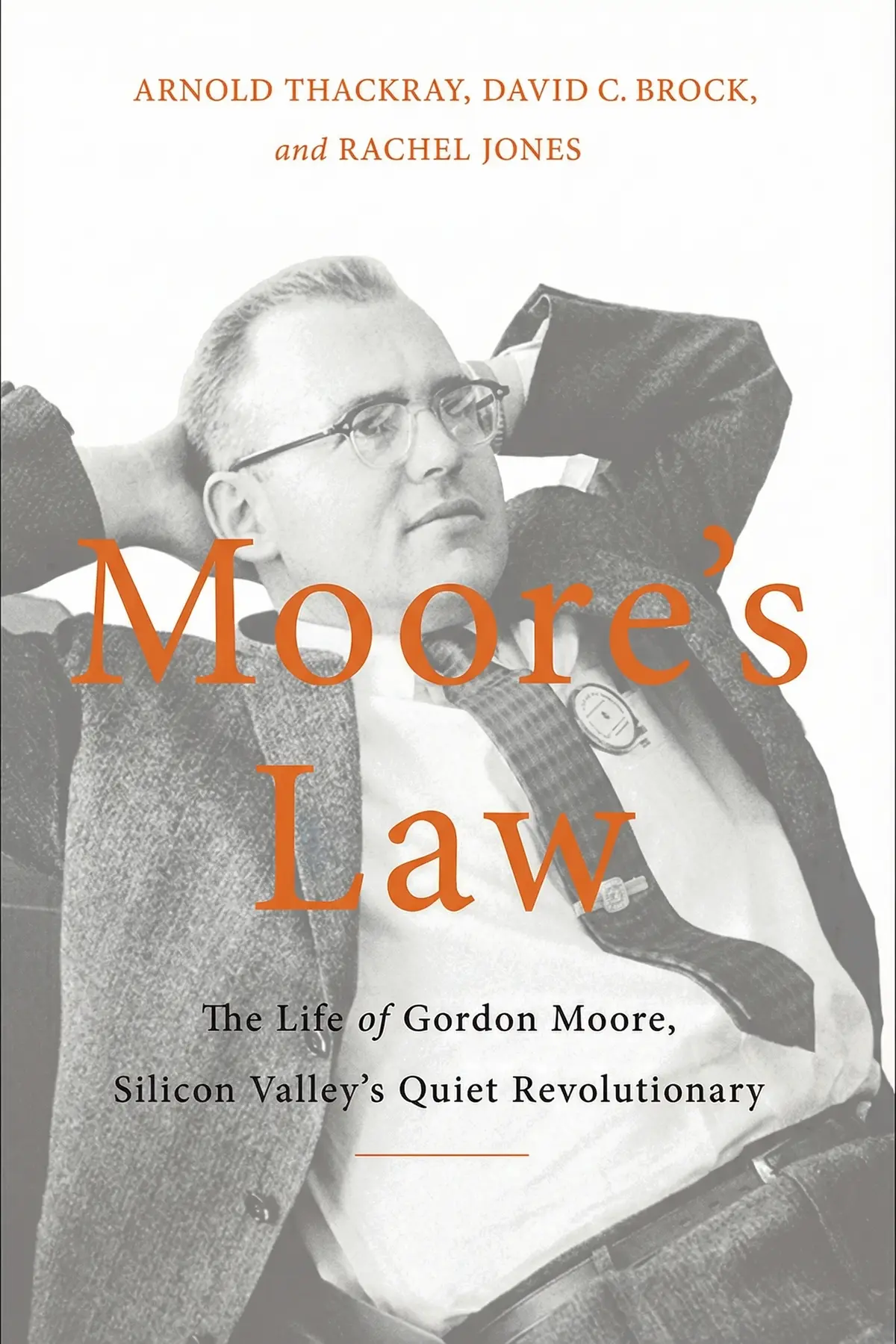
Table of Content
1. Introduction
1 min 01 sec
Almost everyone has heard of Moore’s Law, yet few could say who Gordon Moore was, or how a shy chemist predicted in 1965 that chips would double in complexity every year. In Moore’s Law, historians Arnold Thackray and David Brock and journalist Rachel Jones tell the life of the man who co-founded Fairchild Semiconductor and Intel.
Their story suggests his foresight was no lucky guess. It grew from a lifelong habit of trusting experiment over accepted opinion, and from knowing exactly what he was good at. When Moore stayed close to those strengths, he kept being right, from a fast silicon transistor to the microprocessor. When he strayed, it cost him millions, and he wore the reminder on his wrist for years.
Follow his path and the computer in your pocket gains a history. You also get a working model of how to read where a field is heading, and when to stay out of a market that looks tempting.
2. Learn to doubt the experts, as young Moore did
1 min 49 sec
A boy who blew up mailboxes with homemade firecrackers became one of the most careful minds in electronics. The turn came from a teacher who told his students something most professors would never say about published science.
3. Spotting the technology that will matter next
1 min 53 sec
A young chemist with a fresh doctorate and a Navy research job drove east, certain of his plans. Then a small solid device first invented at Bell Laboratories changed his mind, and the same car carried him back.
4. Beat richer rivals with one clear target
2 min 05 sec
Eight frustrated scientists walked out on a Nobel Prize winner and soon found a backer. Their race against far wealthier labs for a military-grade chip ended with a delivery packed in the least likely container imaginable.
5. Learn why Moore's 1965 prediction came true
1 min 45 sec
In 1965 a chip held 64 transistors, and one engineer said that within ten years it would hold a thousand times more. Even his peers scoffed. His reasoning offers a method anyone can borrow.
6. Find the market the giants are ignoring
1 min 47 sec
Two founders knew they could not fight the biggest names in electronics head-on. Then Moore noticed what was still being stored on stiff paper cards, and a visitor arrived with a chip that kept its memory.
7. Know your limits before chasing a hot market
1 min 57 sec
Electronic wristwatches were the exciting new gadget, with the first one selling for $2,100, roughly $12,000 in today’s money. Moore had the best chips in the business and money to invest. So why did he end up wearing his loss for years?
8. Bet heavily when your old market starts slipping
2 min 06 sec
Intel’s most profitable business began losing ground to faster, cheaper and better rivals overseas. Moore’s response was a nine-figure wager on a product that was only just reaching the market, and it decided who would power the personal computer.
9. Conclusion
1 min 20 sec
Moore left Intel in 2001 at age 72, following a year when revenue hit $10.5 billion and the share price rose threefold. By then his interest had moved to philanthropy. He donated generously to Caltech and other schools, and in 2005 Forbes called him the most charitable person of the year, as his foundation, the Gordon and Betty Moore Foundation, took its place among donors who had given billions. The partnership that began with a journalism student from San Jose State ended up funding the kind of schools that had trained him.
His life reads as a portrait of judgment more than genius. The boy who wanted to see chemistry change things became the man who counted components on chips and believed the count. The one time he left his field, he paid for it and remembered.
His law is now nearing physical limits, as chip features approach the size of single atoms, so someone will have to find the next curve. Two habits from his story travel well. Doubt the accepted view until your own data backs it, and before chasing a new market, ask whether it needs what you do best. Moore learned the second one from a watch he kept wearing long after it had cost him a fortune.
About this book
What is this book about?
Most people know the phrase Moore's Law. Far fewer know the reserved California chemist behind it, or how he came to predict in 1965 that computer chips would keep doubling in complexity while their cost kept falling. Arnold Thackray, David Brock and Rachel Jones trace Gordon Moore's life from a boyhood chemistry set to Berkeley and Caltech, then to William Shockley's lab and the walkout that created Fairchild Semiconductor. They follow him through the founding of Intel with Bob Noyce, the memory chips that made it rich, a failed bet on electronic watches, and the turn to microprocessors that gave Intel more than 80 percent of the PC market. The book is a biography, but it also reads as a study of judgment. Readers see how a habit of doubting the experts, a clear sense of his own strengths and a willingness to commit heavily at the right moment shaped the computers we use today, and how one step outside his expertise cost Moore millions.
Book Information
Who it's for
Choosing markets to enter
Founders and engineers deciding which markets to enter and which to leave alone.
Professionals curious about computing
Professionals curious about how Fairchild, Intel and the personal computer actually came to be.
Science students weighing careers
Students of science weighing research against industry and wondering what a career built on experiment looks like.
About the Author
Arnold Thackray
Arnold Thackray is a retired University of Pennsylvania professor who founded its Department of History and Sociology of Science and led the Chemical Heritage Foundation, now the Science History Institute, for 25 years. David C. Brock is a historian of technology at the Computer History Museum and co-wrote Makers of the Microchip, a documentary history of Fairchild Semiconductor. Rachel Jones is a London journalist who covers technology and entrepreneurship. Together they wrote this authorized biography of Gordon Moore.
Ratings & Reviews
Ratings at a glance
What people think
Listeners find the work clear and comprehensive, with one noting it covers much of the early history. The account earns favorable feedback, with one listener describing it as providing a much broader narrative.
Top reviews
Rung
As someone who has followed the semiconductor industry for years, I found this biography to be an essential, definitive account of Gordon Moore’s life. It is a sweeping narrative that successfully links his quiet, methodical personality to the explosive growth of Intel. Many people focus on Andy Grove’s intensity, but this book correctly elevates Moore’s technical brilliance and manufacturing insights. The explanation of the economics behind Moore’s Law—how scale and 'learning by doing' drove prices down—was particularly enlightening. While it’s a hefty read, the depth of research is staggering. Truly an outstanding look at the man who essentially architected our digital age.
Show moreMia
Picked this up on a whim at the library and was blown away by the sheer depth of the research provided by Thackray and his team. Gordon Moore is often overshadowed by bigger personalities, but this book proves he was the real engine behind the microprocessor market. The authors don't just explain what Moore's Law is; they explain why it happened, highlighting the crucial role of government demand and the Cold War in scaling the industry. It’s a phenomenal piece of history that makes you appreciate the microchips in your pocket. It is long, but every page feels necessary to understand the scale of his influence.
Show moreTanyaporn
Finally got around to this massive tome, and it is a masterpiece of corporate and personal history. The authors provide a much broader narrative than I expected, reaching all the way back to the Moore family's journey during the California gold rush. While some readers might find the ancestral history a bit much, it sets the stage for Gordon’s own pioneering spirit in the tech world. The book is strongest when it dives into the infancy of Silicon Valley and the high-stakes manufacturing battles at Intel. I was particularly fascinated by the discussion of how the Cold War and government demand provided the necessary scale for Moore's Law to actually function in the real world. It wasn't just magic; it was economics and hardware. My only minor gripe is that the environmental impact is mostly glossed over, but it’s still a phenomenal, detailed achievement.
Show moreSomrutai
Look, if you want to understand how the modern world was built, you have to understand Gordon Moore. This is a very readable, surprisingly emotional journey from his early days as a chemist to his time leading the microprocessor revolution. I loved the focus on his personal character—how he stayed consistent and dedicated for decades without the ego you usually find in Silicon Valley. The book beautifully illustrates how he turned a simple observation about transistors into a global mandate for innovation. It’s detailed, it’s insightful, and it’s a fitting tribute to a man who changed everything. Highly recommended for any tech fan or history buff.
Show moreHemp
This book offers a remarkably detailed look at the man behind the most famous 'law' in computing. It’s more than just a dry business history; it’s a comprehensive look at the infancy of Silicon Valley. I was struck by how Moore remained a consistent, stabilizing presence at Intel for decades without getting bored or losing his edge. The authors do a great job of showing how his background in chemistry led him to rethink what was possible with silicon. My only real complaint is that the early chapters about his ancestors felt a bit disconnected from the rest of the story. Once it gets into the Fairchild and Intel years, however, it’s hard to put down.
Show morePraepimon
The early chapters regarding Moore’s family history in the American West felt a bit unnecessary, but the narrative hits its stride once the silicon starts flowing. It is a quite enjoyable combined history of Intel and the man who founded it. I appreciated the technical depth regarding the manufacturing process; it wasn't just 'business talk,' but actual science. You really get a sense of how Moore’s passion for chemistry revolutionized memory processing. The book is very readable despite its length, though the ending drags slightly as it shifts toward his later charitable work. It’s a solid 4-star read for anyone interested in tech history.
Show moreNora
After hearing 'Moore's Law' cited in nearly every tech podcast I listen to, I finally decided to learn about the man himself. This book is a deep dive into how Gordon Moore followed his talents from chemistry into the world of microchips. It was fascinating to see how Intel dominated the market through sheer innovation and intellectual discipline. The authors provide great insights into the role of returns to scale and how manufacturing improvements actually worked. It does start slow with the pioneer heritage stuff, which didn't really land for me, but the rest of the book is a goldmine of information. Highly recommended for techies.
Show moreWorawit
Ever wonder if a biography can actually be too thorough? This book is an absolute unit. Moore’s Law is obviously a cornerstone of modern life, and the authors do a great job explaining the chemistry and the microchips, but the pacing is a struggle. We start with the family in the 1800s and don't hit the semiconductors for a long time. To be fair, Gordon Moore is a fascinating, underrated figure compared to the flashy CEOs we see today. His move into philanthropy is touching, but I really had to push myself through the middle sections. It’s a good book, just incredibly long.
Show moreFon
Truth is, I appreciated the information in this book more than the presentation. It’s an incredibly broad narrative that covers everything from the 19th century to modern day philanthropy. While it’s detailed, the authors sometimes lose the forest for the trees. I wanted more about the rivalry between companies and maybe a bit more about the 'dirty business' of chip making, which was only briefly mentioned. Gordon Moore is a legend, and he deserves a biography of this scale, but you definitely need a lot of patience to finish it. It’s a very informative read, but definitely not a fast one.
Show moreWipawan
Not what I expected, and frankly, a bit of a slog to get through. While Gordon Moore is undoubtedly a titan of industry, this biography feels like it was written more for an archive than for a casual reader. The authors spend an exhausting amount of time on his family's genealogy dating back to the Gold Rush before even mentioning a transistor. The technical details of Intel's rise are there, but they are buried under mountains of dry prose. I also found the lack of critical focus on the environmental toll of semiconductor manufacturing to be a massive oversight. It’s too long and too reverent for my taste.
Show moreQuestions about this book
What is Moore's Law, according to the book?
In a 1965 article, Gordon Moore observed that the number of components on a microchip had doubled every year since the chip was developed. He predicted the doubling would continue while manufacturing costs halved each year, leading to an explosion in computing power. He forecast 65,000 transistors on a chip by 1975, when chips held only 64. Many peers found it far-fetched, but the prediction proved right.
Who was Gordon Moore?
Moore was a chemist born in San Francisco in 1929 who studied at Berkeley and earned his doctorate at Caltech in three years. He worked in William Shockley’s lab, led the group that left to found Fairchild Semiconductor, and later co-founded Intel with Bob Noyce. He retired in 2001 and turned to philanthropy through the Gordon and Betty Moore Foundation.
Why did Gordon Moore call his watch the 15 million dollar watch?
In the early 1970s Moore invested heavily in Microma, a small company making LCD wristwatches. Its watches had technical problems and Texas Instruments drove prices down, so Microma failed. Moore concluded that consumer products needed more than chip expertise. He kept wearing his own electronic watch for years and joked about its price, and the loss made him wary when Noyce later proposed selling personal computer kits.
What lessons can founders take from Moore's life?
The book points to several. Moore trusted his own evidence when experts disagreed, as with integrated circuits and his 1965 forecast. He found niches giants ignored, like memory chips. He learned from the Microma failure to stay close to his strengths. And when Japanese competition squeezed memory profits, he committed $100 million to the 386 microprocessor instead of hedging, which helped Intel win over 80 percent of its market.
Readers also enjoyed

A Promised Land
Barack Obama


A River in Darkness: One Man’s Escape from North Korea
Masaji Ishikawa

A Spy Among Friends: Philby and the Great Betrayal
Ben Macintyre


A Year in the Life of William Shakespeare: 1599
James Shapiro



AUDIO SUMMARY AVAILABLE
Listen to Moore’s Law in 15 minutes
Get the key ideas from Moore’s Law by Arnold Thackray, plus 5,000+ more nonfiction titles.
- 5,000+ titles
- Listen as much as you want
- 7-day free trial
- Cancel anytime









