

14 min 07 sec
Available in: English
Moneyland: Why Thieves and Crooks Now Rule the World and How to Take It Back
Explains how the rich and corrupt use offshore islands, anonymous bonds and American trusts to hide wealth, and why laws that end at national borders leave governments chasing money they cannot catch.
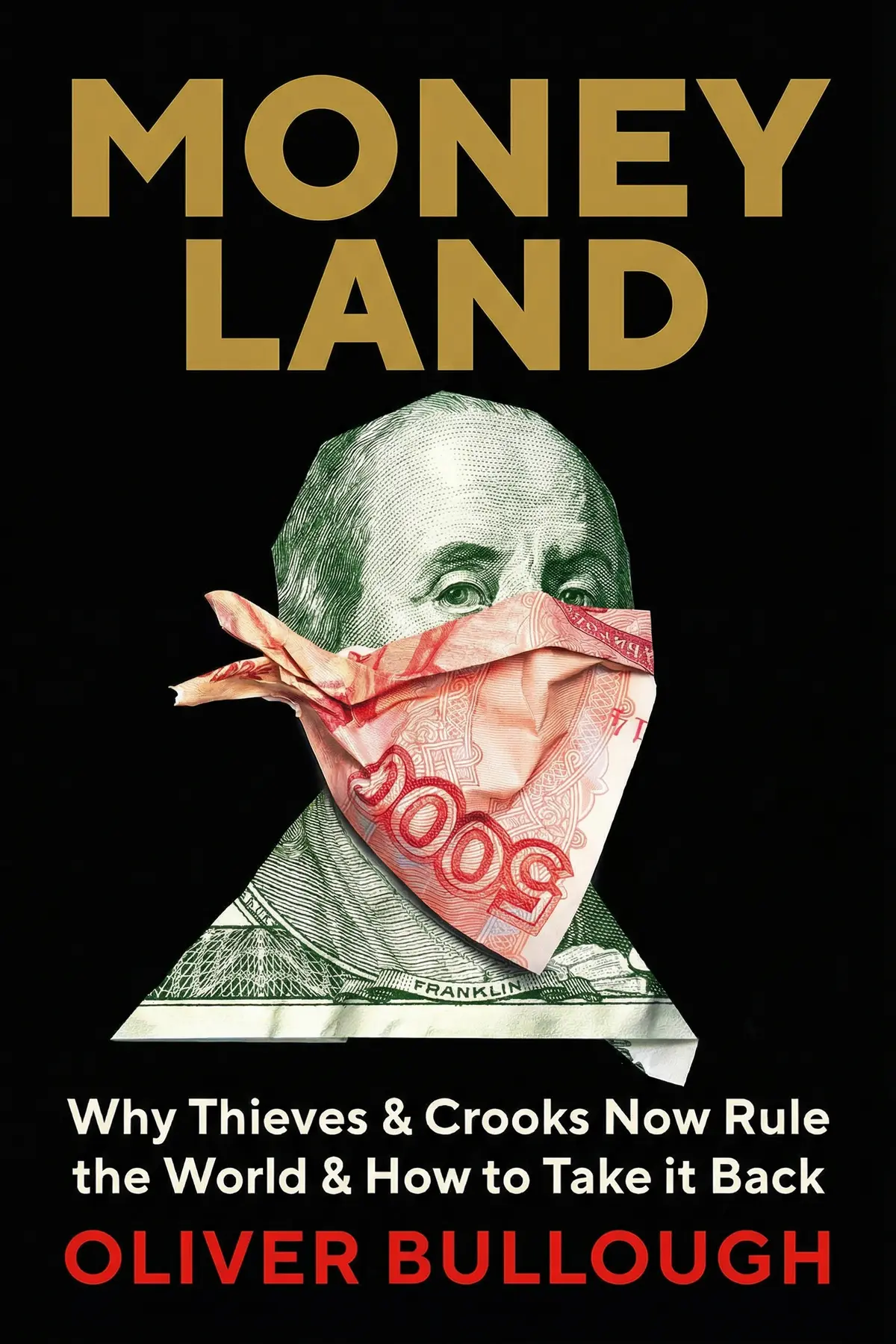
Table of Content
1. Introduction
1 min 03 sec
Most people pay tax on every salary they earn, while some of the richest pay little and pass on fortunes untouched. In Moneyland, former Reuters reporter Oliver Bullough argues that this comes from a simple mismatch, not from luck or talent: money crosses borders freely, but laws stop at them. Clever and wealthy people have learned to live in the space between.
Bullough follows that money from London banks after World War II to a tiny Caribbean island, a New York bridal shop and a poisoning in London, and finally to a surprising place, the American state of Nevada. His argument holds the whole way through. Wherever rules end at a border, the rich and the crooked find a place to hide, and ordinary taxpayers and poor countries pay the bill. By the end, a headline about a shell company or a leaked bank file will make sense, and you will know which question to ask when politicians promise to close the loopholes.
2. See how global money escaped its postwar rules
1 min 47 sec
The Allies built a careful system to stop money from wrecking the world again. Within years, bankers in one city had found a way around it, and the tools they invented still shape how fortunes hide.
3. Spot the features that make a haven safe
2 min 02 sec
A Caribbean island of eleven thousand people became a favorite vault for stolen fortunes. A few small legal details explain why, and a Russian prosecutor learned what happens to those who come looking.
4. See poverty and plunder in one shopping bill
2 min 00 sec
A reality show about wedding dresses seems like the last place to learn about global finance. One episode in 2015 linked a luxury New York store to a country where most people live in poverty.
5. What a London poisoning teaches about borders
2 min 01 sec
A former spy moved to Britain, where the rule of law looked solid. Two months after one of his tips wrecked a powerful man’s deal, he was dead, and the suspects were out of reach.
6. Judge every tax reform by who it exempts
1 min 55 sec
A banker’s confession about a Swiss tax scheme made him rich and sent him to prison, and after it the era of Swiss banking secrecy came to an end. The rules that followed look strong, until you notice the one country left out.
7. Find the new tax havens inside America
2 min 00 sec
Ask anyone to name a tax haven and they will picture a sunny island. Some of the booming hiding places Bullough describes are in two American states, and in Nevada fortunes held in trusts can stay secret and untaxed for centuries.
8. Conclusion
1 min 19 sec
Moneyland adds up to a map of a country with no flag. From anonymous eurobond coupons to a 365-year trust, every hiding place Bullough describes rests on one fact: money moves freely across borders, but courts, police and tax collectors stop at them. Each new rule closes one door and leaves another open, so governments end up chasing fortunes around the globe, usually a step behind.
The cost is real and personal. It falls on Angolans who can expect to live to 42 while $32 billion disappears from their budget. It falls on a prosecutor fired after a television smear, and on an informer poisoned in a London he thought was safe.
The book leaves a useful habit of mind. When you read about a company with huge flows of money and no visible business, ask where it is registered and what that place refuses to share. When leaders promise to end tax evasion, check who the new rules leave out, remembering that the United States demanded openness from Swiss banks while Nevada stayed closed.
The wedding dress was bought in New York. The bill was paid in Angola.
About this book
What is this book about?
Most people pay tax on every salary they earn. Some of the richest people on Earth pay little, hide what they have and pass fortunes to their children untouched. Oliver Bullough sets out to show how they do it and who pays for it. His explanation starts with a mismatch. After World War II, the Allies built rules to keep money steady, but bankers soon found gaps, first with stateless dollars in London and then with tax-free, anonymous eurobonds. Once money could move freely while laws stayed inside national borders, it became possible to hide almost anything. Bullough follows that money to Nevis, a tiny Caribbean island where suing is made very hard, to a Russian prosecutor smeared on television, to a $200,000 wedding dress bought by an Angolan minister's daughter, and to a poisoning in London. He ends in an unexpected place. After a banker exposed a huge Swiss tax evasion scheme and the era of Swiss secrecy came to an end, the United States emerged as a haven for hidden wealth, through trusts in South Dakota and Nevada. Readers come out able to follow offshore scandals and to judge whether a promised crackdown will really work.
Book Information
Who it's for
Following offshore scandals
Readers who follow offshore scandals and leaks and want to understand how the money really moves.
Professionals facing shell companies
Professionals in finance, law, compliance or journalism who meet shell companies and trusts at work.
Frustrated by untouchable fortunes
Anyone frustrated that ordinary people pay their taxes while some fortunes seem untouchable.
About the Author
Oliver Bullough
Oliver Bullough grew up in mid-Wales and studied at Oxford University. He moved to Russia in 1999, later joined Reuters and was posted to Moscow, where the first major story he reported was the 2002 Moscow theater siege. His first book, Let Our Fame Be Great, won the Oxfam Emerging Writer Prize, and The Last Man in Russia followed. Moneyland appeared in 2018, and its follow-up, Butler to the World, in 2022.
Ratings & Reviews
Ratings at a glance
What people think
Listeners find the material to be thoroughly investigated and deeply intriguing.
Top reviews
Praepimon
This book is a gut-punch for anyone who still believes the global financial system is fundamentally fair. Bullough strips away the facade of international law to reveal a borderless "Moneyland" where the ultra-wealthy hide assets with impunity. It’s infuriating to read about how accountants in London or lawyers in Nevada facilitate the pillaging of developing nations. While the research is impeccable, the sheer scale of the corruption described makes for a rather grim afternoon. Frankly, it’s hard to look at luxury real estate in major cities the same way after finishing these chapters. I wish there were more concrete solutions offered, but as a diagnostic tool, this is essential reading for understanding modern inequality. The writing is sharp, clear, and perfectly paced for such a complex subject.
Show moreSamira
As someone who has worked in the financial sector for a decade, I found Bullough’s exposé to be shockingly accurate and deeply disturbing. He perfectly captures the "race to the bottom" where jurisdictions compete to offer the most opaque secrecy laws. The anecdote about the banker smuggling diamonds in a toothpaste tube for UBS clients really highlights the absurdity of the lengths these people will go to. It isn’t just about the criminals; it’s about the enabling infrastructure provided by supposedly reputable Western nations like the UK. My only minor gripe is that the book occasionally leans into sensationalism when the dry facts are already horrifying enough. Still, it’s a masterclass in investigative journalism that every taxpayer should read.
Show moreBun
Finally got around to reading this after seeing it on several "best of" lists, and it definitely lived up to the hype. Bullough defines "Moneyland" not as a physical place, but as a virtual jurisdiction where the laws of the home country simply don't apply. The way he describes the use of "diplomatic immunity" through tiny island nations to dodge divorce settlements was particularly clever and infuriating. It’s clear that the gap between the ultra-wealthy and the rest of us is wider than we think, largely because we can't even see where their money is. The book is well-paced, though I did find the final chapter on "taking it back" to be the weakest part of the narrative. It’s much easier to describe the problem than to fix it.
Show moreMonthon
This book is an absolute standout in the growing genre of "inequality literature," sitting comfortably alongside Piketty or Shaxson. Bullough manages to turn the dry world of offshore trusts and tax neutrality into a high-stakes thriller filled with villains and "law-abiding" accomplices. I found the chapter on the 2014 Ukrainian revolution and the subsequent discovery of the president's opulent estate to be particularly moving. It shows the real-world consequences of what happens when a country’s wealth is sucked dry by those at the top. To be honest, it’s a bit of a horror story for the modern age, but one that is told with incredible wit and clarity. If you care about why public services are failing globally, the answers are all right here.
Show moreBook
Ever wonder how a disgraced politician manages to live in a London mansion while their home country’s treasury is empty? Oliver Bullough provides a chilling roadmap of the mechanisms used to vanish trillions of dollars into thin air. From the tiny island of Nevis to the prestigious offices of Harley Street, the author traces the circular ownership structures that keep the world's elite untouchable. I was particularly fascinated by the "nominee officers" who sell their names for a pittance to front for billion-dollar shell companies. The prose is sharp and moves quickly, though the density of the financial jargon can be a bit overwhelming in the middle sections. It’s an eye-opening look at how the rich play by a completely different set of rules than the rest of us.
Show moreTen
Wow, this was a difficult but necessary journey into the dark heart of global finance. I was stunned by the story of Chinese officials using Japanese surrogacy laws to effectively "launder" their children and secure foreign citizenship. It’s one thing to hide a bank account, but seeing how people treat sovereignty as a buffet of legal options is mind-blowing. Bullough writes with a lot of passion, and you can tell he’s spent years tracking these trails through Ukraine and beyond. Personally, I think the book is at its best when it focuses on these human stories rather than the abstract billions. It’s a fascinating, if depressing, look at why the world feels so increasingly lopsided for the ordinary person.
Show morePia
After hearing so much about the "Panama Papers," this book felt like the missing piece of the puzzle for understanding how it all works. Bullough explains the "Eurodollar" and the history of offshore banking in a way that is accessible without being patronizing. I appreciated the focus on how this isn't just a "them" problem in distant dictatorships, but something actively encouraged by the US. The level of detail regarding the "Deluxe Privacy Incorporation Pack" in Nevada was both enlightening and terrifying. It makes you realize that the laws we follow are basically optional for anyone with an extra thousand dollars to spend on lawyers. This is a must-read for anyone interested in the future of democracy and the rule of law.
Show moreWorawit
Picked this up hoping for a solution to global corruption, but I mostly just walked away feeling incredibly cynical. The book is undeniably well-researched and covers a staggering amount of ground regarding tax havens and kleptocracy. However, after about two hundred pages of hearing how the super-rich exploit every possible loophole, the stories started to blend together for me. Bullough is a talented writer, but the repetitive nature of the "shell company after shell company" examples felt a bit tedious by the end. To be fair, it’s an important topic that deserves this level of scrutiny, even if it’s not exactly a "fun" beach read. It’s a solid deep dive, just be prepared for a heavy dose of reality and not a lot of hope.
Show moreKru
The chapter on the island of Nevis and its 18,000 corporate structures for just 11,000 people stayed with me long after I closed the book. It’s an absurd reality where an entire nation’s constitution is essentially drafted by foreign lawyers to facilitate global tax avoidance. Bullough does a great job of explaining how "Moneyland" residents are more loyal to each other than to their actual neighbors or countries. Look, the book isn't exactly uplifting, and the ending is a bit of a letdown in terms of actionable advice, but the education provided is invaluable. It’s a thoroughly researched indictment of a system that has clearly spiraled out of any single government's control. A decent read, but be prepared for some very dry sections in the middle.
Show moreMan
Not what I expected, and to be honest, a bit of a slog to get through despite the interesting premise. While the author is clearly an expert, the narrative often gets bogged down in endless lists of shell companies and obscure legal definitions. I was hoping for more of a narrative flow, but it often felt more like a series of long-form articles stitched together without a strong central arc. The "sparkly facts" like the surrogacy loophole are few and far between in a book that is otherwise quite dry and technical. If you’re a policy wonk, you’ll likely love the granularity, but for the average reader, it’s a lot of pages for very little payoff. It’s an important subject, but the execution didn't quite hold my interest.
Show moreQuestions about this book
What is the main idea of Moneyland by Oliver Bullough?
Bullough argues that money became global while laws stayed national, and the rich and corrupt exploit that gap. They hide wealth in places with friendly laws and strict secrecy, from the Caribbean island of Nevis to trusts in Nevada. As a result, stolen money flows out of poor countries, critics can be silenced across borders, and governments are left chasing fortunes they cannot reach.
How did global finance escape the postwar rules?
After World War II, the Allies tied currencies to the dollar and banned short-term money flows between countries. Bankers in London soon used dollars held outside American control, known as eurodollars, which could move freely again. Then came eurobonds, which paid tax-free profits and recorded no owner’s name, only a coupon to redeem. Together they reopened global money flows and made hiding wealth much easier.
Why does Moneyland call some US states tax havens?
Because of trusts. South Dakota’s trustees went from holding $32.8 billion before 2007 to $226 billion a decade later. Nevada allows trusts lasting 365 years, delaying tax until they end, and makes assets untouchable after two years. A trust can also count as foreign for American tax purposes but as American under the Common Reporting Standard, which the United States does not follow, so neither system reports it.
Did the Swiss banking scandal end tax evasion?
Not fully. After banker Bradley Birkenfeld exposed a Swiss scheme costing the US Treasury $100 billion a year, the United States forced foreign banks to report American clients, and many countries began sharing account data automatically. But Bullough notes two gaps: poor countries lack the staff to use the data, and the United States does not share its own data in return.
Who should read Moneyland?
It suits readers who want to understand offshore finance through real cases rather than theory: the $200,000 wedding dress of an Angolan minister’s daughter, the poisoning of Alexander Litvinenko in London, and the secret world of Nevada trusts. It is especially useful for people in finance, law, journalism or public policy, and for anyone who wants to judge whether promised crackdowns on hidden wealth will actually work.
Readers also enjoyed

A River in Darkness: One Man’s Escape from North Korea
Masaji Ishikawa

A Splendid Exchange: How Trade Shaped the World
William J. Bernstein

A Theory of Justice
John Rawls






A Warning
Miles Taylor
AUDIO SUMMARY AVAILABLE
Listen to Moneyland in 15 minutes
Get the key ideas from Moneyland by Oliver Bullough, plus 5,000+ more nonfiction titles.
- 5,000+ titles
- Listen as much as you want
- 7-day free trial
- Cancel anytime









