

14 min 59 sec
Available in: English
Million Dollar Consulting: The Professional’s Guide to Growing a Practice
By Alan Weiss
Shows independent consultants how to win bigger projects and higher fees by selling results instead of hours, choosing clients who help them grow, and building the kind of trust that makes them hard to replace.
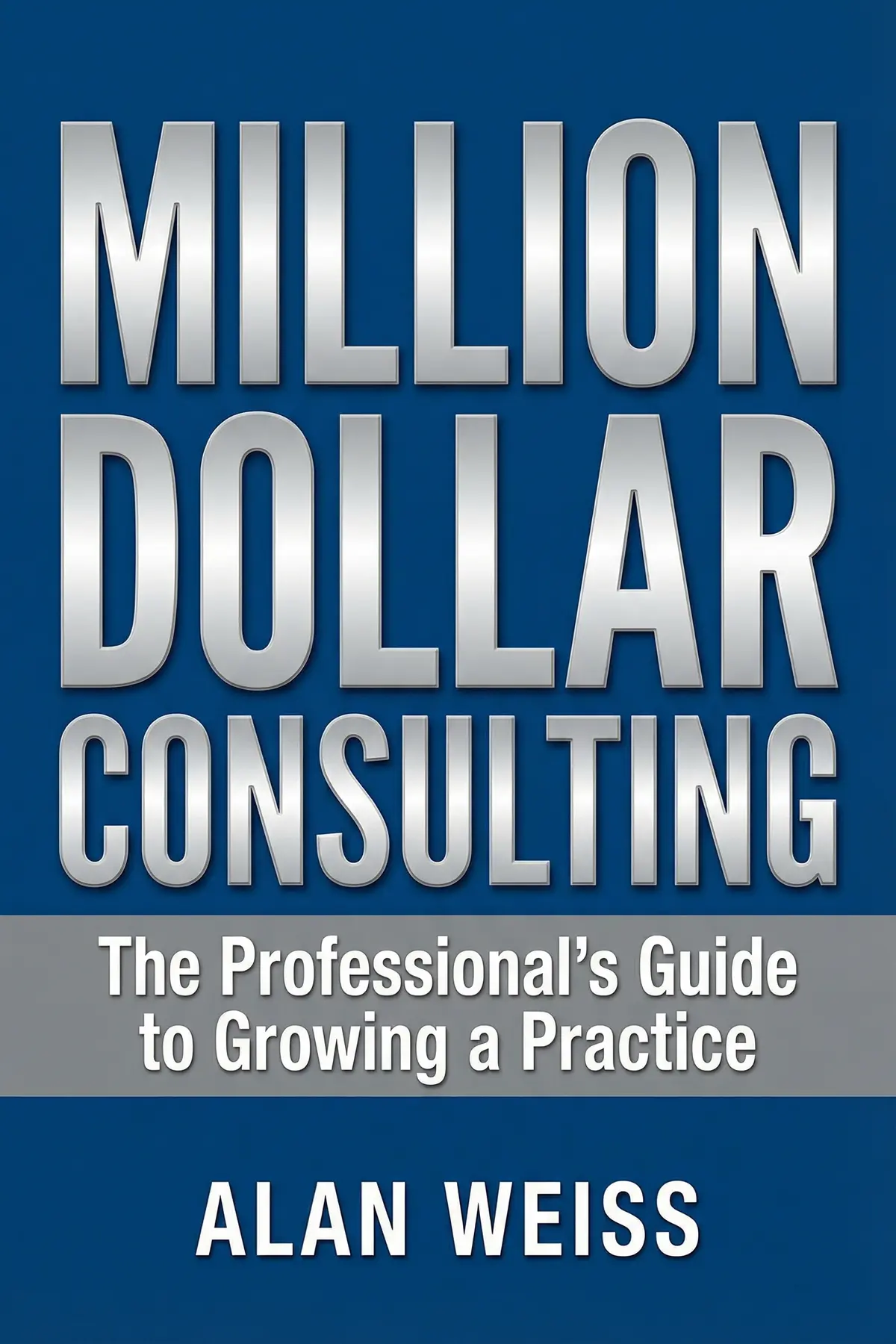
Table of Content
1. Introduction
1 min 02 sec
Many skilled professionals leave a corporate job to consult and end up busy, underpaid and chasing every small project. In Million Dollar Consulting, Alan Weiss argues that the fix starts with one change in thinking. Clients never buy your time or your methods. They buy the improvement you bring to their business.
Weiss, who built Summit Consulting Group, sees consulting as a relationship business, where value and trust count for far more than hours billed or reports written. Price by the result, choose clients who help you grow and earn enough trust to become hard to replace, and the money tends to follow. He also makes a claim that may surprise you: the biggest prize is free time, more than the fortune.
His tools are specific and sometimes odd. They include dropping your weakest clients every two years, refusing to negotiate with anyone who can’t say yes, saying a $50,000 fee out loud without flinching, and keeping the work coming when the economy turns.
2. Sell the skill that works in any industry
1 min 25 sec
Anyone can print a business card that says consultant, and that is exactly the problem. One kind of expertise opens many more doors for someone working alone, even with little knowledge of a client’s sector.
3. Let your finished work bring the next client
1 min 34 sec
The most effective way to win consulting work is also the one you can’t control. Weiss explains how to make it work anyway, and why your logo and legal status matter more than many experts assume.
4. Agree on the result before the proposal
1 min 32 sec
Meetings held and reports delivered can look like progress while proving nothing. One conversation before you write a proposal changes how a client judges you, and it decides which kind of consultant you become.
5. Grow by firing your weakest clients
1 min 43 sec
A soft drink company wants every buyer it can get. A consultant who thinks the same way stays small and cheap. Weiss offers a simple two-year routine that pushes a practice toward bigger, better work.
6. Get past the four reasons clients say no
1 min 35 sec
The friendly manager across the table may have no power to hire you. Weiss shows who you should insist on meeting, and how to answer the four objections that end most consulting deals before they start.
7. Charge for the outcome, never the hours
1 min 36 sec
Billing by the day feels fair and safe, yet Weiss calls it counterproductive and even unethical. His reasoning changes how you build a fee, and it ends with an exercise you can do in front of a mirror.
8. A pipeline that holds through a downturn
1 min 41 sec
A busy month can hide the early signs of a bad year. Weiss explains how to read your future workload, and why some consulting firms grew during the 2008 crisis while others cut back.
9. Become the advisor a client can't replace
1 min 34 sec
Weiss will sometimes accept a lower fee on purpose. The reason is a slow method of learning a client’s organization from the inside, and it ends with a consultant the client can’t do without.
10. Conclusion
1 min 17 sec
Weiss’s business case ends in an unexpected place. Many consultants chase the biggest income they can get, and they end up spending most of their days on planes and in client offices. Weiss treats discretionary time as the real wealth and money as the way to pay for it. For someone who thinks this way, growing the business can mean becoming poorer in the way that matters most. A balanced life, he argues, also makes you a better consultant, because it brings energy and creativity.
So he suggests dropping the line between work and private life, since you only have one life. If it suits you, put in a few hours on Sunday and head for the beach on Monday, because an independent consultant controls the calendar. Keep learning, help other people and stay fit. He borrows Nietzsche’s image of a day with a hundred pockets, waiting to be filled.
The practice that pays for that life comes down to a few habits. Agree on results before you propose. Price the outcome and say the number calmly. Value the relationship that brings repeated $50,000 projects over any single deal. Clients will never ask about your degree or your methods. They remember what changed in their business, and those results are what buy back your time.
About this book
What is this book about?
Plenty of people tired of the corporate nine-to-five take their skills into consulting, a more lucrative line of work, but success there takes more than piling up money. Alan Weiss, founder of Summit Consulting Group, argues that the problem is how they think about the work. Clients don't buy hours, reports or methods. They buy an improvement to their business, and everything about a practice should be built around that. Weiss treats consulting as a relationship business. He explains how to tell content expertise from process expertise, how to get found through referrals and a visible body of work, and how to agree on measurable results before writing a proposal. He also covers how to get past the four reasons clients say no, and why charging by the day sets you against your own client. He adds advice that sounds odd at first: fire your weakest clients, never negotiate with a gatekeeper, practice saying a $50,000 fee in a mirror, and keep investing when a recession hits. It ends with his view that the real reward of a successful practice is the time it gives you, more than the money.
Book Information
Who it's for
Thinking of going independent
Professionals thinking of leaving a corporate job to work as independent consultants.
Solo consultants feeling underpaid
Solo consultants who bill by the day, take every project offered and still feel underpaid.
Hoping for steadier work
Advisors and coaches who want steadier work, larger fees and clients who keep coming back.
About the Author
Alan Weiss
Alan Weiss, born in the United States in 1946, founded Summit Consulting Group, Inc., whose clients have included Merck, Hewlett-Packard, GE and Toyota. The National Speakers Association placed him in the top 1 percent of professional speakers, and he is in the Professional Speaking Hall of Fame. He holds a Ph.D. in psychology and has taught as visiting faculty at Case Western Reserve University and Boston College. Million Dollar Consulting is now in its sixth edition.
Ratings & Reviews
Ratings at a glance

What people think
Listeners find this book highly practical for those in consulting, with one mentioning it is overflowing with excellent suggestions. They view it as essential reading, especially for newcomers, and find the cost reasonable. The work earns praise for its educational material, with one listener pointing out the writer's inclusion of actual client scenarios. Listeners cherish the book's perspectives, with one stating it shifted their entire business mindset.
Top reviews
Gioia
Finally got around to reading this classic, and the concept of 'market gravity' alone made the purchase worth every penny. Instead of chasing leads like a desperate salesperson, Weiss teaches you how to build a presence that naturally pulls clients toward you through speaking, publishing, and referrals. I’ve already started implementing his 'three options' proposal structure, and the response from my prospects has been immediate and positive. They stop haggling over the price and start discussing which level of value they want to invest in. It’s a scholastic, dense guide that doesn't hold your hand, which I found refreshing in a sea of 'get rich quick' business books. This isn't just about consulting; it's about mastering the psychology of the buyer-seller relationship. If you are serious about becoming a top-tier advisor, this is the foundational text you need on your shelf. Simply put, it changed how I define my own business success.
Show moreChatchai
After hearing so many people recommend this on various podcasts, I was skeptical that a classic could still hold up today. Wow, was I wrong. The emphasis on outcomes over activities is the most important lesson any consultant can learn. Weiss teaches you how to present yourself as a 'rockstar' who solves problems, which allows you to demand fees that would make an hourly worker's head spin. I loved the section on 'Propulsion and Volition,' specifically the idea of providing a choice of yeses so the client focuses on *how* to use you, not *whether* to use you. It’s a very confident, almost aggressive style of business, but it works if you have the skills to back it up. If you're just starting out, some of this might feel out of reach, but it gives you a perfect North Star to aim for. The advice on retainers for access is worth ten times the book's price.
Show moreKaen
Look, if you want to stop being a 'freelancer' and start being a professional advisor, this is the foundational text you need. Weiss gets a lot of flak for his ego, but the man knows how to build a practice that generates serious revenue without burning out. The transition from hourly billing to project-based fees is the only way to scale, and he explains the 'why' and 'how' better than anyone else. I particularly valued the section on 'Market Gravity' and the idea of having six different marketing prongs moving at once. It’s a holistic look at the business of consulting that covers everything from the initial proposal to long-term retainer agreements. Some people find his 'rockstar' attitude off-putting, but I found it motivating. This book forces you to value your own expertise and charge accordingly. If you apply even 20% of the techniques in here, you'll see a massive ROI on your time.
Show moreMethinee
As someone who has spent years trading hours for dollars, Weiss’s focus on value-based pricing felt like a bucket of cold water to the face. The book forces you to stop acting like a temporary employee and start acting like a high-level partner who provides real business outcomes. I particularly appreciated the tactical breakdown of the 'value distance,' which helps bridge the gap between what a client thinks they want and what they actually need to succeed. While some of the advice regarding personal grooming and basic etiquette felt like filler for a professional audience, the core methodology for structuring retainers is pure gold. It’s a challenging read because it demands that you raise your own standards before asking for higher fees. Truth is, if you can’t stomach the idea of charging $10k for a result rather than a timesheet, you might struggle with his philosophy. However, for those ready to scale, the logic is flawless.
Show moreFort
The chapter on proposal structure is worth the price of admission because it provides a literal roadmap for landing larger contracts. I used to send over simple quotes, but now I focus on 'measures of success' and 'joint accountabilities,' which makes me look much more professional. Weiss is a bit of a contrarian, but in a way that makes you question your own limiting beliefs about what a consultant actually does. He correctly identifies that we are in the marketing business, not the consulting business, and that 50% of our time must be spent on visibility. Personally, I found his advice on 'unbundling' services to be a game-changer for my profitability this year. It’s not a perfect book—some sections on administrative stuff are definitely skippable—but the high-level strategy is undeniable. It’s a must-read for anyone who is tired of being treated like a commodity in the marketplace.
Show moreOn
This book essentially argues that you aren't in the consulting business, but rather the marketing business. That single realization shifted my entire weekly schedule toward building relationships rather than just 'doing the work.' I appreciated the scholastic approach to things like situational appraisals and intervention techniques. Weiss provides actual real-world examples of how to rebut objections like 'we have no money' by refocusing the client on the cost of inaction. It’s a very practical handbook for anyone who wants to move away from being a 'freelancer' and toward being a high-income professional. Some of the advice on using 'pithy phrases' felt a bit cheesy, but the logic behind it—making your intellectual property memorable—is sound. It’s a dense read that requires you to take notes, but it’s packed with insights that you won't find in more basic business guides. Definitely geared toward the established practitioner.
Show moreCherry
Weiss exudes a level of confidence that borders on arrogance, yet his tactical advice on retainers and 'the choice of yeses' is undeniable. I found his breakdown of the 10% discount for full advance payment to be a brilliant way to manage cash flow. The book is essentially a manual on how to become a thought leader rather than just another service provider. While I don't agree with his total dismissal of social media, I do agree that high-level consulting is built on relationships, not clicks. He provides a wealth of practical advice on how to handle objections and structure joint accountabilities so you don't get stuck doing the client's work for them. It’s a bit of a 'blow your own horn' manifesto, but if you can ignore the fluff, the core business model he proposes is the most profitable one I've seen. Just be prepared for a very direct, no-nonsense tone.
Show moreSelin
Is it possible to be both brilliant and incredibly annoying at the same time? Alan Weiss certainly makes a strong case for it in this volume. The advice regarding relationship building and the 'choice of yeses' in proposals is some of the best I’ve encountered in any business text. But man, you really have to navigate through a dense thicket of self-congratulation to find those gems. He mentions his 60+ books so often it starts to feel like a sales pitch for his other titles, which—frankly—are often just rehashed versions of this one. I also found his disdain for social media and modern digital marketing to be a bit out of touch with how business is done today. It’s hard to take advice on 'market gravity' seriously when the author suggests avoiding the very platforms where most modern authority is built. Still, the fundamental shifts in how to view your own worth make it worth a skim.
Show moreFang
To be fair, there is some gold buried in here, but you have to shovel through a mountain of the author’s ego to find it. I’ve read 'The Consulting Bible' and 'Million Dollar Launch,' and I realized about halfway through this book that they are essentially the same content rephrased. Weiss uses these pithy sound bites and dictionary definitions of metaphors that feel a bit like padding. He tells you to avoid social media and instead focus on 'market gravity' through pro bono work and trade associations, which feels a bit 1995. That said, the actual advice on value-based fees and how to talk to a CEO as a peer is excellent. If you can get past his persistent self-compliments and the 'old school' vibe, there are about 50 pages of world-class advice in here. Just don't expect it to be a revolutionary look at modern digital consulting because it simply isn't that.
Show moreArjun
Not what I expected from a book that claims to be a modern guide for high-level practitioners. My biggest gripe is that the 5th edition, despite being updated, feels remarkably old-fashioned and dismissive of current technology. The author basically tells you to ignore social media because he couldn't get it to work, which is bizarre advice in an era where podcasts and YouTube are primary drivers of brand authority. Furthermore, the tone is incredibly snobby; it feels like the author spends 30% of the book bragging about his own success and another 20% giving common-sense advice like 'show up on time.' If you are a brand new consultant looking for actionable steps to land your first client, you will likely find this useless. It seems written exclusively for people who are already millionaires. There are a few interesting thoughts on retainers, but you can find that info online without the ego trip.
Show moreQuestions about this book
What is the main idea of Million Dollar Consulting?
Alan Weiss argues that consulting is a relationship business in which clients care about one thing: the value you add to their business. Methods, hours and degrees don’t matter to them. From that idea he builds a whole practice: agree on measurable results before proposing, charge for outcomes instead of time, drop low-value clients, build deep trust and invest in hard times. He also argues that a consultant’s real wealth is free time, more than money.
Why does Alan Weiss say consultants should not charge by the day?
Weiss calls daily fees counterproductive and even unethical, because the client gets nothing from your hours in themselves. When pay depends on time, the consultant gains from a longer project while the client wants fast improvement, so their interests clash. A fee based on value lets the project be shorter, gives the client quicker results and gives the consultant room to grow. He suggests practicing a line like “the fee will be $50,000” in a mirror.
Why should a consultant fire clients?
Weiss argues that a consultant who keeps every client stays small and gets known as the cheap option. Since selling a big project takes about the same effort as selling a small one, one $50,000 project is worth more than ten $5,000 ones. His routine is to review all assignments every two years, find the bottom 15 percent and stop accepting that kind of work, which frees time for better business.
How do you overcome client objections in consulting, according to Weiss?
Weiss names four reasons clients turn you down: a lack of money, urgency, need or trust. Talking only about value deals with money and urgency, especially if you show how the problem will get worse. For need, identify what the client actually needs, which may differ from what they want, and explain why it matters. For trust, give honest feedback and act as a partner. And never negotiate with a gatekeeper who can only say no.
Who should read Million Dollar Consulting?
It suits people starting an independent consulting practice and solo consultants who feel overworked and underpaid. Its advice is concrete: tell process expertise from content expertise, build visibility through referrals and published work, keep a 12-month pipeline, spread services across industries that do well in booms and in slumps, and spend roaming time inside a client’s organization until you become hard to replace.
Readers also enjoyed









AUDIO SUMMARY AVAILABLE
Listen to Million Dollar Consulting in 15 minutes
Get the key ideas from Million Dollar Consulting by Alan Weiss, plus 5,000+ more nonfiction titles.
- 5,000+ titles
- Listen as much as you want
- 7-day free trial
- Cancel anytime









