

A Spy Among Friends: Philby and the Great Betrayal
Ben Macintyre
 English
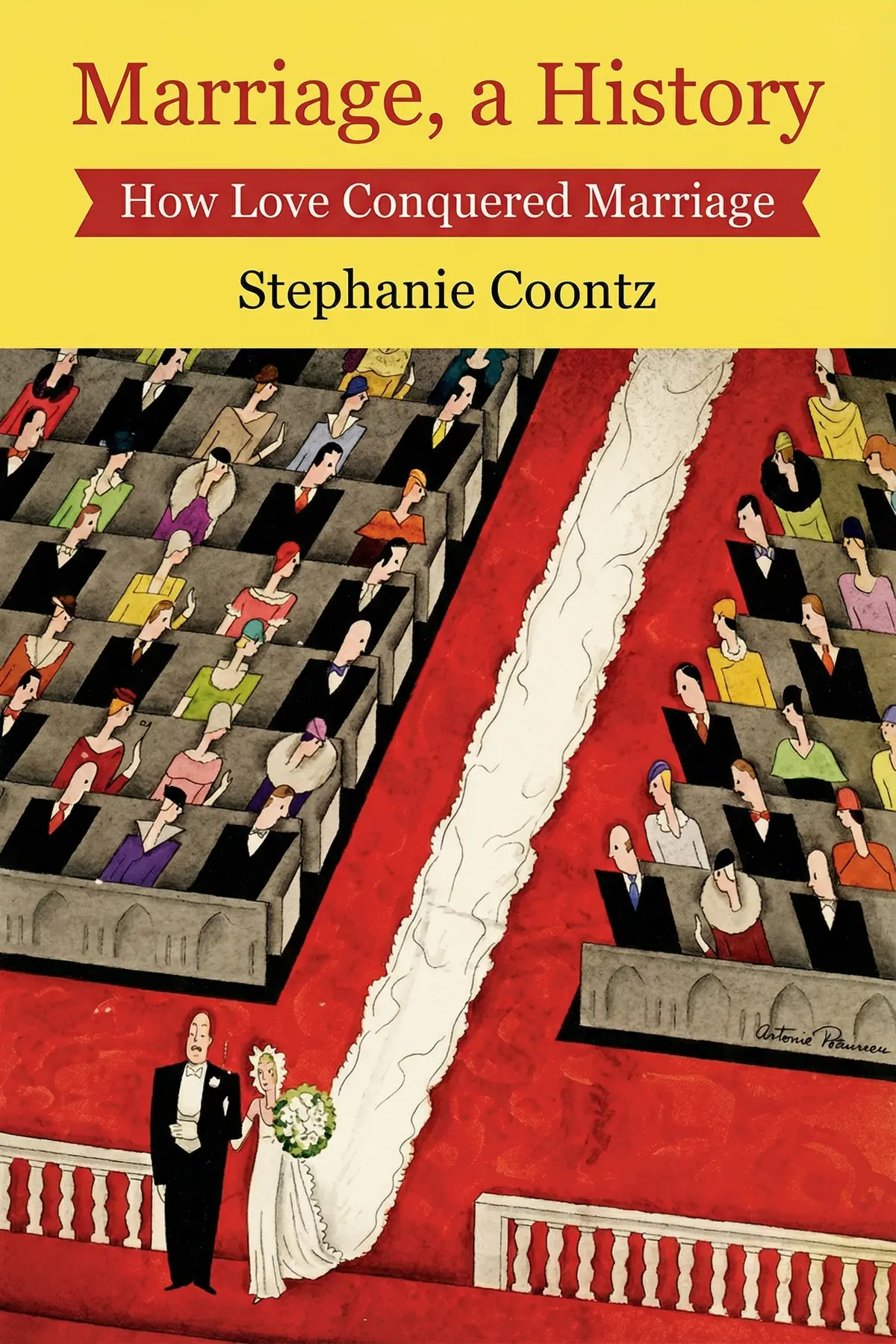
Historian Stephanie Coontz shows how marriage moved from a tool for making peace, trading partners and political power to a bond built on love, and why that change made it both richer and easier to break.
1 min 02 sec
If you assume a good marriage starts with falling in love, you hold a belief that is only about two centuries old. For most of human history, as historian Stephanie Coontz shows in Marriage, a History, people married to make peace, gain trading partners and win power, and love was at best a pleasant extra. Coontz, who spent years teaching history and family studies, traces how love moved from the edge of marriage to its center, and what that move cost.
Her argument fits in one line: love made marriage more rewarding than ever before, and also more fragile. Along the way come hunter-gatherer bands turning enemies into relatives, a Pacific Northwest marriage contract signed with a dog, Victorian doctors treating hysteria, and the brief 1950s boom that many people still call traditional. By the end, the family model often described as timeless looks like a recent experiment, and today’s arguments about marriage become much easier to read.
1 min 43 sec
In medieval Europe the word love was rarely used for husbands and wives, and in India romance was once seen as a threat. So why did people invent marriage at all, if not for love?
1 min 45 sec
Two societies in the Pacific Northwest sometimes married a person to a dog or to someone’s foot. The strange practice reveals what early marriage was really built to collect, and it was not romance.
1 min 44 sec
For thousands of years, letting young people pick their own spouse seemed absurd. Then, in a single era, two very different changes made it possible, and one of them had nothing to do with ideas.
1 min 56 sec
Victorian couples wrote each other letters of near religious devotion, yet doctors were busy treating a widespread female complaint. The gap between the two explains an invention few people connect with the nineteenth century.
1 min 52 sec
The stay-at-home mother and earning father are often held up as the timeless ideal. Coontz shows that the arrangement was rare for centuries, and only one unusual decade made it common.
1 min 52 sec
Couples had married for love for well over a century before divorce suddenly soared. Coontz explains why the crisis waited until the 1970s, and why its cause was the very thing modern marriage was proudest of.
1 min 40 sec
Two-earner couples, wives who out-earn husbands and legal partnerships with a best friend all look like signs of decline. Coontz reads the evidence very differently, and the numbers on health and happiness back her up.
1 min 13 sec
Coontz’s history turns out to be a story about trade-offs. A peace weaver between wandering bands became a deal between trading partners, then a tool of generals and queens, then a matter of the heart. Each step gave individuals more freedom, and each step placed more weight on the feelings between two people. Love won the right to decide who marries. It also gained the power to end a marriage when it fades.
That is why the book closes on something more modest than romance. Psychologists and sociologists, Coontz reports, have found no magic formula for a lasting marriage, but they keep pointing to mutual respect and friendship as the most important ingredients. In daily life, that means accepting your partner’s differences and not trying to push them into being someone they are not. It also means listening with some doubt whenever a family model is sold to you as ancient. Much of what we call traditional, from marrying for love to the stay-at-home wife, is far younger than it sounds.
Marriage began as a way to stop strangers from fighting. Its best modern form still asks the same of two people: treat each other as allies worth keeping.
Many people talk about the traditional family, with a husband who earns and a wife who keeps house, as if it had always existed. Stephanie Coontz, a historian of the family, shows that it is one of the newest models of all. For thousands of years, people married to turn enemies into relatives, gain trading partners and seal political alliances. Love was a pleasant extra, and in some cultures a danger. Coontz follows marriage from wandering hunter-gatherer bands through Antony and Cleopatra, the Enlightenment, the rise of wage labor, the Victorian era, the 1950s marriage boom and the divorce wave of the 1970s, to today's two-earner couples and new legal partnerships. Her central point is an irony. Once love became the main reason to marry, marriage became more satisfying than ever before, and also more fragile, because a union built on feeling can end when the feeling fades. Readers get a clear history of an institution they may be living in, a way to judge claims about what is traditional, and the book's closing advice on what keeps a modern marriage strong.
Couples and people considering marriage who want to understand what they are signing up for.
Readers tired of debates about the traditional family who want the actual history behind it.
Students of history, sociology or gender studies looking for a clear overview of how marriage changed.
Stephanie Coontz, born in 1944, is an American historian and author. She taught history and family studies at The Evergreen State College in Olympia, Washington, where she is now emeritus faculty. She has served as research and public education director of the Council on Contemporary Families and chaired the group from 2001 to 2004. Her books on the history of marriage and the family have been translated into a dozen languages.
Listeners find the work both thoroughly researched and captivating, as it delivers information in a compelling manner that feels much like reading a novel. It offers an extensive look at marital customs and perspectives across the globe, and one listener points out how it follows the institution's development across many generations. They enjoy the prose and find the content instructive, with one review emphasizing its appeal for American cultural history nerds. Listeners consider the material to be stimulating, with one review calling out the concluding chapters as especially perceptive. The total length receives varying feedback from listeners.
Ever wonder why we think the 1950s was the "golden age" of marriage? Coontz absolutely deconstructs that notion in this brilliantly researched volume. It’s rare to find a history book that flows with the pace of a novel, but she manages to turn dry census data and legal codes into a compelling narrative of human connection. I was especially struck by how the shift from economic alliances to "love matches" actually made the institution more fragile. If you’re looking for an educational deep dive into how we got to where we are today, this is it. It’s thought-provoking and stays with you long after you close the cover. Truly, it's a must-read for anyone interested in American cultural shifts.
Show moreAs a self-proclaimed history nerd, I was totally hooked by the "un-common" facts sprinkled throughout this book. Did you know women in the Middle Ages were considered the "lusty" sex? The reversal of those stereotypes in the 19th century was eye-opening. Coontz traces the evolution of marriage from a political tool to a quest for soulmates with such precision that it’s hard to argue with her conclusions. The writing style is accessible enough for a casual reader but deep enough for a classroom setting. My only real gripe is that it was published in 2005, so the section on same-sex marriage feels like a time capsule from a different era.
Show moreWow, just wow. I didn't think a book about the history of marriage could be this much of a page-turner! Coontz manages to debunk so many myths about the "way things used to be" that my head was spinning. The truth is, there was never a single "traditional" marriage model; it's always been a moving target shaped by money and power. The sections on the 1950s Gallup polls were particularly fascinating—women were "satisfied" but didn't want their daughters to live the same way. That contradiction says it all. If you want to understand the messy, complicated reality behind the white dress and the cake, read this book.
Show moreThe myth of the "traditional" marriage is officially dead for me after reading this. Coontz provides a comprehensive overview that is both fascinating and deeply grounded in facts. It’s an educational journey that takes you from the tactical alliances of the ancient world to the self-fulfillment models of the 21st century. The writing style is punchy and direct, avoiding the jargon that usually kills academic books. Personally, I think the most important takeaway is that marriage has always adapted to survive. It’s a resilient, shifting thing, and this book captures that fluidity perfectly. A great read for anyone who loves deep dives into social history.
Show moreCoontz has a way of making complex sociological shifts feel incredibly personal. I went into this expecting a dry academic text, but instead found an engaging exploration of how gender roles have mutated over centuries. The chapter on the Victorian era was a highlight for me, specifically how the "cult of purity" was used to control women's agency. To be fair, the book is quite long and some of the middle chapters felt like they were retreading the same ground. However, the analysis of the "marriage crisis" and how technology influenced birth control and dating is top-tier stuff. It’s an essential piece of scholarship for understanding the modern family structure.
Show moreFinally finished this beast of a book, and the last three chapters alone make it worth the price of admission. While the early history of Roman and Greek unions was interesting, Coontz really hits her stride when she moves into the 20th century. The transition from history into sociology and psychology felt like a natural evolution of the topic. Look, the data on how economic inequality affects marital stability in low-income communities was heartbreakingly relevant. It really challenged my assumptions about why people choose not to marry today. It’s an educational read that forces you to question what we consider "traditional."
Show moreI picked this up after a friend recommended it, and I'm glad I took the plunge. The way Coontz links the feminist movement and the invention of the pill to the "de-institutionalization" of marriage is masterfully done. It’s not just a list of dates; it’s an emotional and economic history of how we relate to one another. Not gonna lie, some of the legal history in the middle ages was a bit dense, but the payoff in the later chapters is huge. It really helped me understand why my own views on commitment are so different from my grandmother’s. A truly comprehensive and insightful look at a complex topic.
Show moreWhile I appreciate the sheer amount of effort that went into these 100 pages of references, the book is frustratingly Western-centric. The author mentions other cultures briefly in the intro, but then spends the rest of the time focused almost exclusively on Europe and North America. It felt like a bait-and-switch for someone looking for a truly global history of the institution. Frankly, calling it a "history of marriage" without more than a passing glance at Asian or African traditions feels a bit narrow. That said, the breakdown of how the Enlightenment changed marital expectations was insightful. It's a solid 3-star read for what it covers, even if it leaves out a huge chunk of the world.
Show moreThe scholarship here is undeniable, but the book is starting to show its age. Reading a 2005 perspective on "contemporary" marriage in 2024 feels a bit like looking through a foggy window. There is so much that has changed regarding legal rights and societal acceptance that Coontz couldn't have predicted. Also, the lack of attention given to non-heterosexual unions is a glaring omission by today's standards. In my experience, the first few chapters are the strongest, but the narrative loses steam once it hits the industrial revolution. It’s still a valuable resource for American cultural history, but I’d love to see a modernized, more inclusive update.
Show moreThis felt like a slog, to be perfectly honest. I know people rave about how well-researched it is, but for me, it was just too much undigested information. I found myself skimming the middle sections because the "and then this happened" structure became very repetitive. If you aren't already obsessed with the history of the family, you might find the 400+ pages a bit daunting. I was hoping for more cross-cultural analysis, but it stayed very white and Western. It’s definitely a one-stop-shop for researchers, but as a general read, it didn't spark much joy or interest for me. I respect the work, but I didn't enjoy the experience.
Show moreCoontz argues that for most of history people married for peace, trade and political power, not love. Love became an accepted reason to marry only in the late eighteenth century, thanks to the Enlightenment and wage labor. That shift made marriage more fulfilling than ever, but also more fragile, because a marriage built on love can end when the love fades.
Coontz traces marriage to hunter-gatherer bands who sometimes met hostile groups while searching for food. When one band’s member wed someone from the other band, strangers became relatives, and peace grew more likely. In-laws also meant trading partners, so groups with family ties prospered. The old Anglo-Saxon word for wife carried the meaning peace weaver.
Not in Coontz’s account. For centuries husbands, wives and children worked together at home, and even after wage labor arrived many wives had to earn money too. Only the economic boom and rising wages of the 1950s made the single-earner family common. That decade also saw unusually early marriage: in 1959, nearly half of American 19-year-old women were married.
Coontz says the root cause was the belief that love alone should hold a marriage together, which makes marriage fragile when love fades. That belief had existed for over a century, but money and culture kept people from acting on it. In the 1970s more women earned degrees and wages, so they could leave without falling into poverty, while younger people questioned gender roles and married later.
The book notes that there is no magic formula, but psychologists and sociologists point to mutual respect and friendship as the most important ingredients. That means accepting your partner’s differences instead of pushing them to become someone else. Coontz also reports that many studies find married people, on average, happier and healthier, and better able to cope with financial setbacks and depression.
Ben Macintyre


Charles C. Mann

James Shapiro

Andrew Ross Sorkin
Pankaj Mishra

Fay Bound Alberti

Ben Macintyre

AUDIO SUMMARY AVAILABLE
Get the key ideas from Marriage, a History by Stephanie Coontz, plus 5,000+ more nonfiction titles.









