

12 min 56 sec
Available in: English
Map It: The Hands-On Guide to Strategic Training Design
By Cathy Moore
Shows how to stop treating every performance problem as a lack of information, and how to design training, when it is needed at all, around real job decisions and a measurable business goal.
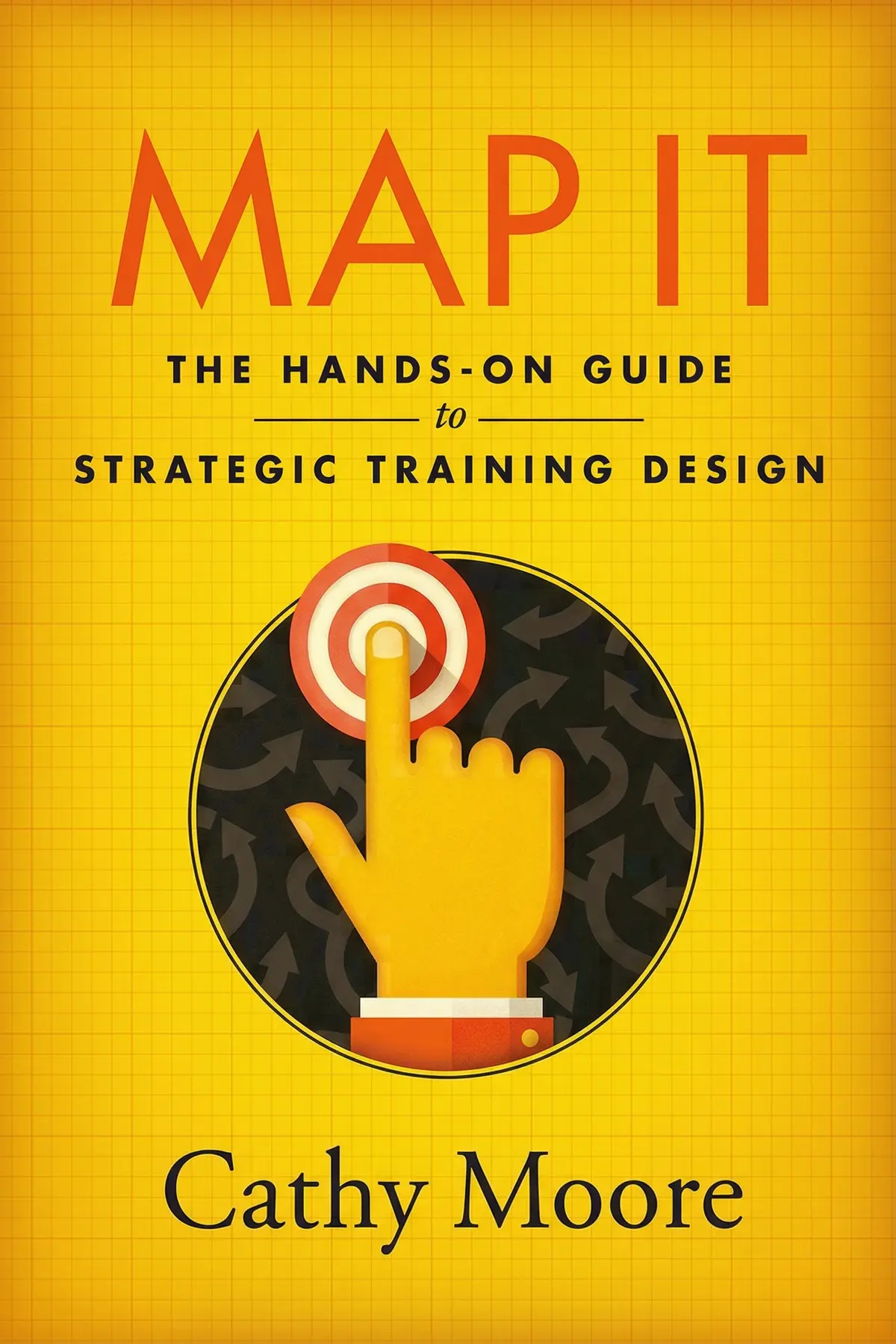
Table of Content
1. Introduction
1 min 06 sec
When injuries rise or sales stall, the usual response is another slide-heavy course, and it often changes nothing because nobody asked why people were struggling. In Map It, training designer Cathy Moore argues for a different starting point, which she calls action mapping: before building anything, find out what actually stops people from doing the job well. Often it isn’t missing knowledge at all.
Moore draws the contrast through two trainers. Tom, the veteran, would produce a polished deck packed with safety facts, as he always does. Amy, the newcomer, would hold off and keep asking until she understood why the existing safety measures were failing. Moore’s case is that Amy’s way works better: define the problem, agree on a number to hit, find the actions that matter and why they’re skipped, and only then build practice that looks like the job. The next time someone asks you for training, you’ll know how to turn the request into a problem you can actually solve, with or without a course.
2. Find out why people fail before building anything
2 min 12 sec
A worker fell from a ladder after walking past three signs telling him to wear a harness. The warehouse had plenty of safety information, which raises an awkward question about what another course could possibly add.
3. Turn a training request into a measurable goal
2 min 10 sec
Someone buying a new faucet for a puddle under the sink may be paying to fix the wrong thing. Many training requests make the same mistake, and a single number can expose it.
4. Find what people must do and what stops them
1 min 59 sec
Salespeople at a printer company kept selling the cheapest model to customers who needed more. They hesitated to question customers who asked for the cheapest model, so what was holding them back, and what would actually change it?
5. Practice that feels like the real job
2 min 14 sec
Operators who ignore one more forklift seminar may pay close attention when a bad choice costs them an imaginary limb. Moore explains how to build that kind of practice, step by step.
6. Let a few testers break your prototype first
2 min 07 sec
Four or five people can tell you whether a training activity will work, yet the experts among them may be the least reliable judges. One kind of feedback outweighs all the rest.
7. Conclusion
1 min 08 sec
Moore’s method changes what a trainer is for. Tom delivers courses. Amy solves problems, and sometimes the solution is a course, built from real decisions and refined until a number moves. The ladder fall past three signs is the image worth keeping: the information was everywhere, and it changed nothing, because the obstacle was somewhere else.
The approach travels well beyond training. Moore suggests action mapping any goal, personal ones included. Pick something you have been meaning to tackle and give it a realistic number and a date. List the actions that would get you there, then ask honestly why you aren’t doing them yet, because the blocks that surface are often ones you had not seen. Turn those blocks into small, realistic challenges for yourself, and keep measuring as you go.
At work, the habit can start with a single question. The next time someone asks you for training, ask what people would be doing differently if the problem were solved, and what stops them now. Often the answer turns out to be a harness hanging in the wrong place.
About this book
What is this book about?
Organizations reach for training whenever performance slips. Injuries go up, so schedule a safety course. Sales disappoint, so run a product webinar. Cathy Moore argues that this reflex wastes time and money, because it assumes the cause is missing information before anyone has checked. Her alternative is action mapping. It begins by investigating the problem with the people who live it, then sets a specific, measurable goal with stakeholders. Next it identifies the few actions that would reach that goal and asks why people are not taking them already. Only where training can genuinely help does it design anything, and what it designs are realistic decision challenges drawn from the job, sketched as prototypes, tried on a handful of testers and revised against the original metrics. Through an imagined warehouse with rising injuries and a printer company whose sales team sticks to the cheapest model, the book shows each step in practice. Readers get a method for turning vague training requests into solvable problems, and Moore suggests it works on personal goals too.
Book Information
Who it's for
Trainers and course designers
Instructional designers and trainers tired of building courses that change nothing on the job.
Team leads and managers
Team leads and managers asked to fix performance problems with another workshop or webinar.
Operators
Operators who want a step-by-step way to diagnose why people skip the actions a goal depends on.
About the Author
Cathy Moore
Cathy Moore has spent more than 30 years arguing for better workplace performance built on respect for people and real challenge. She developed action mapping, a model for designing training, and teaches it worldwide to Fortune 500 companies, government agencies and international non-governmental groups. Organizations including the United Nations World Food Program have used her system to strengthen their instructional design. She also speaks and blogs about how corporate learning should be designed.
Ratings & Reviews
Ratings at a glance

What people think
Listeners find the material highly beneficial for learning, and one listener describes it as a fundamental resource for instructional design. The book's content also draws praise, with one listener highlighting the way it leads people through step-by-step processes. Perspectives on readability vary significantly; while some listeners consider it very easy to follow, others label it as completely unreadable. Listeners also value the work's overall impact, with one noting how it helpfully repeats crucial ideas. However, reactions to the performance technology elements remain mixed.
Top reviews
Jiraporn
Finally got around to reading this after hearing my colleagues rave about it for years, and I can confirm the hype is real. Cathy Moore has produced something rare: a technical guide that is actually a page-turner. Her background in technical writing shines through in every punchy, witty sentence. The core of the book—Action Mapping—is a paradigm shift that moves us away from the 'Tom' style of information dumping toward 'Amy’s' focus on performance. I particularly loved the 'choose your own adventure' practice scenarios that pop up in every chapter. They aren't just filler; they genuinely challenge your decision-making and force you to apply the logic immediately. If you are tired of being a 'content stenographer' and want to start solving actual business problems, this is your roadmap. It is worth every penny of the cover price.
Show moreWillow
This book is a masterclass in stripping away the fluff that plagues modern corporate learning departments. Moore’s core philosophy—that we should focus on what people need to DO rather than just what they need to KNOW—is a total game-changer for anyone tired of building boring slide decks. I found the sections on setting measurable goals particularly illuminating because they force you to have difficult, necessary conversations with stakeholders before a single slide is ever drafted. While the narrative is punchy and the Amy vs. Tom scenarios make the concepts stick, it’s the sheer volume of practice activities that makes it special. Most books give you two examples; Moore showers you with a dozen. If you want to stop being an information dumper and start being a problem solver, buy this book.
Show moreMonthon
The chapter on prototyping was the exact 'aha' moment I needed. For years, I’ve been over-designing modules before testing the actual logic, but Moore’s process of building stripped-down challenges first is a lifesaver. It saves time, money, and a massive amount of ego. I love how she frames the 'Amy' character as someone who takes a step back to ask 'why' before diving into the 'how.' The book is packed with insight for training designers who are sick of the status quo. It’s a pure delight to read, which is a sentence I never thought I’d write about a business manual. Sentence lengths vary, the tone is conversational, and the logic is airtight. It’s staying on my professional reference shelf forever. I cannot recommend it enough for people who want results.
Show moreWatcharin
Not what I expected from a business guide! Usually, these books are dry and repetitive, but Cathy Moore writes with a sharp wit that kept me engaged from cover to cover. The 'Amy vs. Tom' comparison is a genius way to illustrate the difference between helpful intervention and useless information-dumping. I especially appreciated the 'would you steal that?' scenarios which help you identify what truly belongs in a training session. Most IDs include way too much 'nice to know' info, but this book gives you the permission—and the tools—to cut the fat. It’s an expensive investment, but considering how much it improves the quality of your work, it pays for itself in a single project. Buy it. Read it. Map it.
Show moreMalee
Picked this up because my team’s training metrics were stagnant, and I’m so glad I did. The focus on measurable goals—like reducing warehouse injuries by a specific percentage—changed the way I pitch projects to leadership. Moore’s narrative style is fantastic. She makes you feel like you’re having a coffee with a very smart, very blunt mentor. The advice to 'lose an imaginary limb' in training scenarios to show consequences is both funny and effective. I’ve already started applying the prototyping phase to my current project, and the feedback from my beta testers has been night and day compared to my old methods. This isn't just a book about instructional design; it's a book about solving problems through better thinking. Every manager should read this.
Show moreKomsan
In my experience, most ID books are incredibly dry, but Moore’s technical writing background makes this a genuine page-turner. I love the way she showers you with examples and then provides her own rationale. It feels like a personalized coaching session. The distinction between 'education' and 'challenging people in areas that reflect on-the-job experience' is such a vital point. We often treat adult learners like children, and Moore calls us out on it in the best way possible. Personally, I found the practice sections in each chapter to be the most valuable part. They aren't easy, and they don't always have a single 'right' answer, which is exactly like the real world. If you’re serious about your career, you need this on your desk. Period.
Show moreLucas
Ever wonder why your company’s safety training feels like a total waste of time? This book answers that question by exposing the flaw in the 'school model' of corporate instruction. Moore’s step-by-step process for identifying measurable goals is brilliant. She doesn't just tell you to improve; she shows you how to prove that your training actually moved the needle. I appreciated the emphasis on non-training solutions, which most instructional designers are too afraid to suggest. My only real complaint is that some of the references to her website felt a bit disconnected, and I struggled to find a few of the specific examples she mentioned online. To be fair, though, the printed content is so strong that the website issues are just a minor annoyance. This is foundational stuff for anyone in L&D.
Show moreThawee
Frankly, the price tag initially made me hesitate. Fifty dollars is a lot for a paperback, but after finishing the first three chapters, I realized I would have paid double. This is essentially the Bible for anyone who takes instructional design seriously. Moore uses a witty, punchy style to dismantle the traditional 'information dump' approach that most of us were unfortunately taught to replicate. Instead of building another snazzy slide deck that everyone ignores, she teaches you how to map out actual behaviors that drive business results. My only gripe is that some of the performance technology discussions felt a little dated. But that is a minor flaw in an otherwise transformative work. It has completely changed how I talk to my clients about their training needs. Stop designing content; start mapping actions.
Show morePraepimon
Truth is, I was stuck in the Tom mindset for a long time. I thought my job was to make the most beautiful, interactive slides possible, regardless of whether they actually changed behavior. This book was a much-needed wake-up call. Moore’s step-by-step approach to defining performance problems is incredibly practical. She forces you to look at the environment, the tools, and the motivation before you even think about teaching a skill. My only criticism is that the performance technology aspect of the book felt a little bit glossed over in favor of the conceptual mapping. I would have liked more on the technical implementation of these complex branching scenarios. Still, the foundation it provides is unparalleled in the field. It’s a must-read for anyone who wants their work to matter.
Show moreBoss
As someone who has worked in both K-12 and corporate environments, I have some complicated feelings about this text. On one hand, Moore’s action mapping process is logically sound and offers a brilliant framework for diagnosing whether training is even the right solution. The focus on measurable performance goals is exactly what our industry needs to move away from 'completion rate' metrics. However, I found her frequent disparagement of the 'school model' to be a bit reductive and outdated. Modern education has moved far beyond the rote memorization she describes, and using it as a constant foil felt unnecessary after the first few chapters. Additionally, some might find the layout distracting or even 'unreadable' if they prefer a more traditional textbook structure. Truth be told, it’s a solid methodology wrapped in a tone that didn't always sit right with me.
Show moreQuestions about this book
What is action mapping in Map It by Cathy Moore?
Action mapping is Moore’s method for solving workplace performance problems. It starts by investigating the problem and setting a precise, measurable goal with stakeholders. It then identifies what people must do to reach that goal and why they are not doing it already. Only when training is part of the answer does it design anything, and then it builds realistic decision challenges that let learners see the consequences of their choices.
Who should read Map It?
It suits anyone who designs or requests training: instructional designers, corporate trainers, team leads and managers. It also helps people who want to solve business problems without defaulting to another webinar or costly training day. Moore’s examples, a warehouse with rising injuries and a printer sales team stuck on the cheapest model, show how the method applies outside the training department too.
How do you set a goal using action mapping?
Moore says the goal should describe a change in on-the-job performance, as specific and measurable as possible, agreed with stakeholders and tied to a deadline. In her warehouse example, a vague aim of cutting injuries by 15 percent turns into a goal of lowering overall injuries by 10 percent, and lowering ladder-related ones by 18 percent, ahead of the next review cycle, which matches best practice.
How can I apply the ideas in Map It right away?
Before building any training, ask whether people already know what to do and what gets in their way. Write down the number that would prove success. For each key action, note why it isn’t happening and whether training could help at all. If it can, sketch a realistic decision scenario with four or five choices and test it on four or five people, focusing on realism and difficulty.
Readers also enjoyed



A Year with Peter Drucker: 52 Weeks of Coaching for Leadership Effectiveness
Joseph A. Maciariello




Acting with Power: Why We Are More Powerful Than We Believe
Deborah Gruenfeld


All In: How Great Leaders Build Unstoppable Teams
Mike Michalowicz
AUDIO SUMMARY AVAILABLE
Listen to Map It in 15 minutes
Get the key ideas from Map It by Cathy Moore, plus 5,000+ more nonfiction titles.
- 5,000+ titles
- Listen as much as you want
- 7-day free trial
- Cancel anytime









