

13 min 38 sec
Available in: English
Main Street Millionaire: How to Make Extraordinary Wealth Buying Ordinary Businesses
Shows how to build wealth by buying the plain local businesses most investors ignore. It covers how to choose them, check their cash, finance the purchase with little money down, and grow them after the sale.
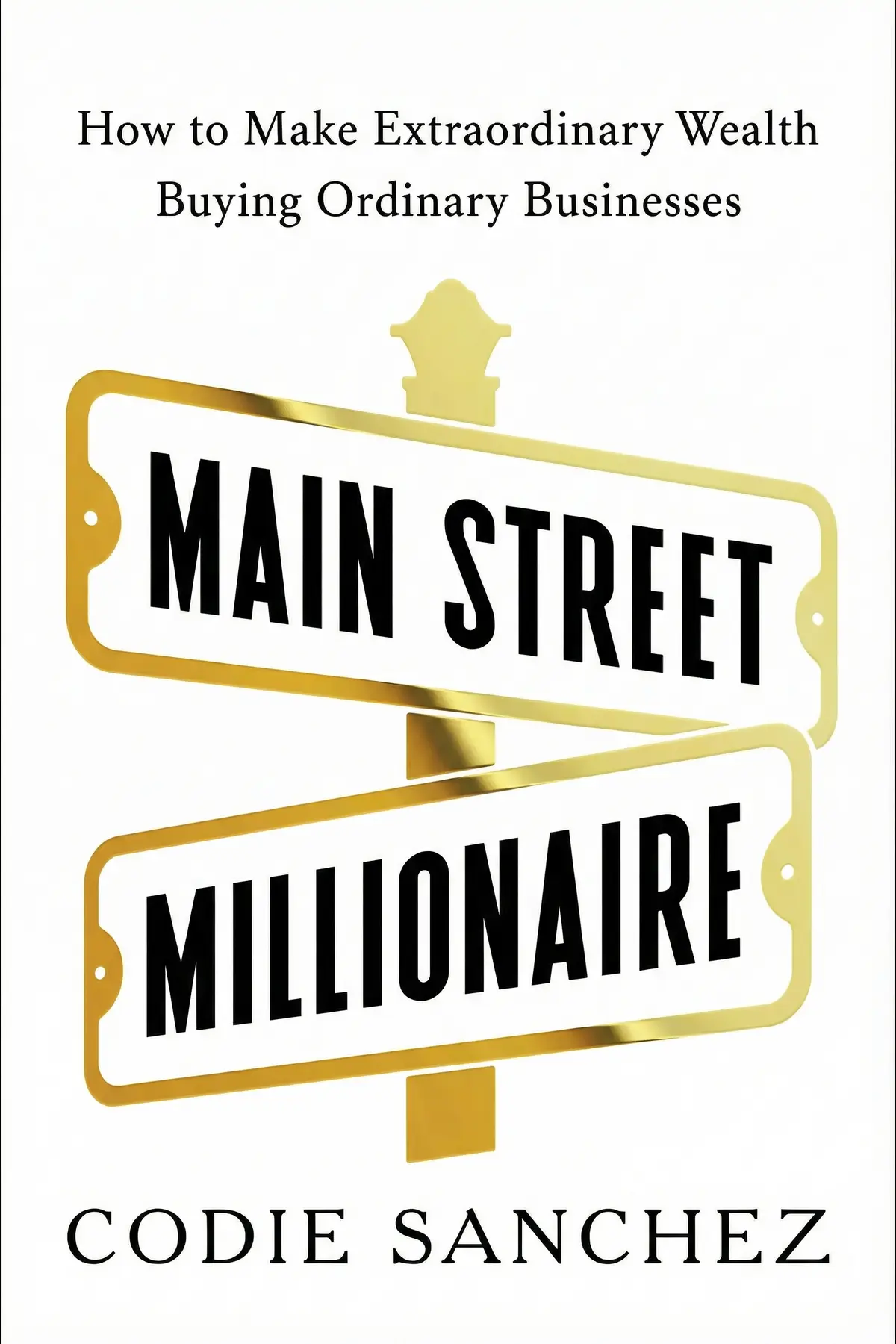
Table of Content
1. Introduction
1 min 03 sec
If your money is sitting in savings or riding on the next startup idea, there is another route to wealth you have probably never considered: buying a business that already works. In Main Street Millionaire, finance veteran and business buyer Codie Sanchez builds her case around people like Wayne Huizenga, who started out selling trash pickup door to door. In 1962 he talked his employer into letting him buy a $500 share of Porter’s Rubbish Service. He grew it into Waste Management, the world’s biggest waste disposal company, and later did the same with Blockbuster Video and AutoNation, the biggest chain of car dealerships in the United States.
Sanchez argues that plain local businesses, many owned by people ready to retire, can be found, tested, bought largely with their own future profits and then grown with simple fixes. Her method runs from start to finish: where to look, what to check, how to pay without a fortune upfront, and what to change once the keys are yours.
2. Find wealth where others refuse to look
1 min 50 sec
While most investors chase crypto and trading apps, trillions of dollars a year flow through businesses nobody brags about. A wave of retiring owners is creating an opening, but it comes with a timeline few people will accept.
3. Choose a business built on what you know
2 min 03 sec
Some businesses look like safe bets and quietly drain their owners, while others earn money in two ways at once. The difference often comes down to one question about you, not about the business.
4. Spot a strong business and its warning signs
2 min 02 sec
A business can look busy and profitable and still leave its new owner working for less than a salary. Sanchez’s tests turn four flaws into strengths and catch the problems sellers would rather you missed.
5. Buy a business without the full price in hand
1 min 44 sec
A half-million-dollar purchase can start with a down payment of a tenth of that. The trick is getting the seller, the government or even a closing rival to share the cost with you.
6. Win your new team in the first four months
1 min 47 sec
On the day after the sale, every employee is wondering what the new owner will break. Two simple questions, asked one person at a time, can tell you where to start and who to trust.
7. Grow profits with prices, packages and speed
1 min 53 sec
Many owners leave money on the table out of fear, and their slowest habit costs them sales every day. Sanchez’s growth moves are modest one by one, which is exactly why owners overlook them.
8. Conclusion
1 min 16 sec
Main Street Millionaire adds up to a trade most people refuse to make: excitement for reliability. Sanchez’s buyer gives up the thrill of the next big thing and takes on two years of patient, often dull work. In return, they get a business that meets a need people will always have, bought largely with its own cash from an owner who wanted an exit. Huizenga’s $500 stake is the image to keep. In 1962 it was a small share of a garbage company.
The method also guards you against your own enthusiasm. The four cash tests, the SOWS and BRRT filters and the long funnel from 100 candidates down to one all exist so the numbers decide before the story does.
If you are serious, start by naming your zone of genius and writing down the kinds of businesses it points to. Let accountants and lawyers know you want to buy. When you meet a seller, ask early whether they would accept payments over time. And whatever you end up owning, check whether its prices have moved in years.
Sanchez calls her approach get-rich-for-sure rather than get-rich-quick. Her bet is that the slow road stays wide open because so few people are willing to take it.
About this book
What is this book about?
Most people looking for wealth chase the same things: crypto, day trading or a startup idea. Codie Sanchez points them toward laundromats, plumbing services and cleaning companies instead. Many of these businesses earn steady money, and many belong to owners who are ready to retire and have no successor. Sanchez sets out a full method for buying one. She explains how to match a business to your skills, why restaurants and drop-shipping are traps, and how to narrow 100 candidates down to a single purchase. Her checklists, the four cash tests and the SOWS and BRRT filters, help you separate a real business from an expensive job. She then shows how seller financing and government-backed loans let buyers close deals without paying the full price upfront. The book continues past the purchase. It covers the first four months of ownership, how to win over the staff, and growth moves such as raising prices, recurring revenue, fast responses to leads and reviews. Readers come out with a patient, practical plan for owning cash-producing businesses.
Book Information
Who it's for
Professionals with savings
Professionals with some savings who want an income-producing asset instead of another stock pick or startup gamble.
Career switchers seeking ownership
Career switchers ready to run a laundromat, cleaning company or trade business rather than build one from zero.
Owners hoping to acquire
Small business owners looking to grow by acquiring a closing competitor.
About the Author
Codie Sanchez
Codie Sanchez studied journalism at Arizona State University and won the Robert F. Kennedy Award for her print reporting from Juarez, Mexico. She moved into finance in 2008 at Vanguard and later worked at Goldman Sachs, State Street and First Trust. She also earned an MBA from Georgetown University and bought and built businesses of her own, including laundromats and cannabis companies. In 2020 she founded Contrarian Thinking, a finance and media company that helps people reach financial independence by acquiring small businesses. This is her first book.
Ratings & Reviews
Ratings at a glance

What people think
Listeners find this business guide both instructive and entertaining, noting a prose style that ensures they remain attentive and involved. The book provides a hands-on perspective on acquiring and expanding small companies, mapping out the required phases and delivering concrete guidance. Listeners value the accessible methodology, with one listener mentioning how it simplifies business valuations, and consider it essential reading for prospective buyers. They describe the work as highly motivating, with one listener emphasizing how it helps build something meaningful for their community.
Top reviews
Wararat
Finally got around to reading this after seeing Codie all over my YouTube feed for months. It’s a solid blueprint for anyone tired of the corporate ladder and looking to actually own something tangible. The way she breaks down "boring" businesses like car washes and HVAC companies makes them seem like gold mines hiding in plain sight. I especially appreciated the sections on seller financing; it’s a concept that sounds intimidating until you see it laid out step-by-step. The tone is exactly like her videos—very direct, slightly sarcastic, and zero fluff. While some might say it's just an intro, I think the simplicity is the point. It’s meant to get you moving, not to bury you in 600 pages of legal jargon. If you want a clear path to buying a boomer's business, start here.
Show moreAisha
Wow. This wasn't just a business book; it felt like a wake-up call for my entire career path. I’ve always wanted to build something meaningful for my local community, but the idea of starting from scratch was paralyzing. Codie’s approach of buying existing businesses is a total game-changer. She simplifies complex topics like business valuations so well that I actually felt confident enough to start looking at listings in my town. The writing style is punchy and keeps you engaged from start to finish. I love the "no-nonsense" friend vibe she brings to the table. Some might call the war metaphors a bit much, but I found them incredibly motivational. It’s about taking control of your life and keeping Main Street alive. A must-read for anyone feeling stuck in a cubicle.
Show moreAir
This book is essentially a masterclass in pragmatism wrapped in a very entertaining package. Codie Sanchez has a way of making "boring" industries sound like the most exciting opportunities on the planet. I finished it in two sittings because the pacing is just that good. Look, most finance books are a total snooze-fest, but this one actually kept me focused with its sharp wit and real-world examples. The RICH framework is something I’ll be referencing for years. It’s rare to find a book that balances the "why" with the "how" so effectively without getting bogged down in useless filler. It’s a practical, actionable roadmap for anyone who wants to stop trading time for money. I’ve already bought copies for my brother and my business partner. Absolutely brilliant.
Show moreTod
After hearing Codie on a few podcasts, I had high expectations for this book, and it delivered. It's a dense, actionable guide that cuts through the noise of modern entrepreneurship. She isn't telling you to build an app; she's telling you to fix a problem in your neighborhood and get paid for it. The step-by-step instructions on identifying promising businesses are incredibly valuable. I specifically liked how she breaks down the transition of operations—it's usually the part everyone skips. This book feels like a conversation with a mentor who actually wants you to succeed. It’s motivational, practical, and honestly quite empowering. If you’re tired of the "hustle culture" that leads nowhere, give this a read. It’s about building a legacy, not just a paycheck.
Show moreKan
Picked this up on a whim and I’m so glad I did! I’ve been feeling so burnt out at my corporate job, and "Main Street Millionaire" gave me the spark I needed to start thinking differently about my future. The way Codie talks about "buying a job" versus "buying a business" was a huge lightbulb moment for me. She makes the whole process of acquiring a small company feel totally doable, even if you don't have an MBA. The tone is encouraging but realistic—she doesn't sugarcoat the challenges. It’s the kind of book that you’ll want to highlight and take notes in. I’m already scouting out some local service businesses in my area. If you want a clear, entertaining guide to taking control of your financial life, this is the one.
Show moreWorawit
As a seasoned entrepreneur, I found the "Main Street Millionaire" perspective quite refreshing compared to the typical "Silicon Valley" startup hype. Sanchez makes a compelling case for the "RICH" framework, emphasizing cash flow over speculative growth. To be fair, if you’ve been in M&A for a decade, you might find some of the valuation math a bit oversimplified, but for the average person, it’s a perfect entry point. My only gripe is that it occasionally feels like a teaser for her more expensive coaching programs. However, the actionable advice on finding retiring business owners is worth the price of the book alone. It's a high-energy read that actually makes you want to get out and look at laundromats. This isn't just theory; it’s a tactical guide for the modern era of local commerce.
Show moreIsabelle
Ever wonder why everyone is obsessed with tech startups while the guy who owns the local plumbing company is driving a Porsche? This book answers that question and then gives you the keys to do it yourself. It’s a very tactical look at the silver tsunami of retiring boomers and how to capitalize on it ethically. I appreciated the emphasis on seller financing, which makes business ownership feel accessible to people without millions in the bank. In my experience, the biggest hurdle is just knowing where to start, and Codie provides that map. My only hesitation is the recurring "war" rhetoric which can feel a bit intense at times. But hey, if you need a kick in the pants to change your financial trajectory, this is it. Solid four stars for clarity and punchiness.
Show moreSukit
Not what I expected from a typical finance book, in a good way! I thought it would be dry, but Codie’s sarcasm and humor make the "boring" business talk actually fun to consume. The focus on HVAC, laundromats, and car washes is brilliant because it’s so grounded in reality. To be fair, she doesn’t shy away from the fact that this is hard work; it’s not just "passive income" magic. I found the section on negotiating with owners particularly insightful. It’s about more than just numbers; it’s about people. While I wish there were more case studies with actual P&L statements, the general framework is solid. It’s a fantastic motivator for anyone looking to build wealth outside of the stock market. Truly a fresh perspective on the American Dream.
Show moreKamol
Direct and to the point. Codie Sanchez doesn't waste your time with 300 pages of fluff. She gets right into the meat of why small businesses are the best investment vehicle right now. The writing is sharp, and the logic is hard to argue with. I especially liked the "RICH" acronym—it's a simple way to vet deals quickly. Personally, I would have liked a bit more on the legal side of things, but I get that this is meant for a broader audience. It’s a great primer for anyone curious about M&A but intimidated by the jargon. Well worth the read if you're looking for a non-traditional path to financial independence. It's refreshing to see someone championing the local plumber over the Silicon Valley CEO.
Show moreTang
The chapter on sourcing deals was helpful, but I have to be honest: this feels more like a 200-page marketing funnel than a definitive guide. Personally, I was expecting more technical depth on the due diligence phase. Instead, we get a lot of high-level concepts and "rah-rah" energy. It’s not a bad book, and the "buy a boomer" thesis is interesting, but it leaves out the messy reality of managing blue-collar staff or dealing with aging equipment. Frankly, it’s a bit too glossy. If you follow her on Instagram, you’ve probably heard 70% of this already for free. It’s a decent starting point for a complete novice, but for someone ready to sign a contract, you’ll need much more than what’s provided here. Good for motivation, but thin on execution.
Show moreQuestions about this book
What is the main idea of Main Street Millionaire?
Codie Sanchez argues that ordinary local businesses, such as laundromats, plumbing services and cleaning companies, are an overlooked path to wealth. Many owners are retiring without successors, so buyers can find steady, cash-producing businesses, check them carefully, finance them largely from their own earnings, and grow them with simple improvements like better pricing and faster responses to customers.
How can you buy a small business with little money?
Sanchez’s main answer is seller financing, which she says is used in 60 percent of small business deals. In her example, a buyer pays $50,000 down on a $500,000 business earning $200,000 a year, then pays the seller $4,000 a month for ten years from the profits. She also describes government-backed SBA loans and revenue share or customer acquisition deals.
What businesses does Codie Sanchez recommend buying?
She favors online stores with proven income, everyday services such as lawn care and pool cleaning, professional practices if you are qualified, and businesses tied to property, like laundromats, which earn from operations and rising land value. She warns against restaurants, hotels, retail storefronts and drop-shipping businesses that depend on platforms such as Amazon.
What are the SOWS and BRRT frameworks?
SOWS asks whether a business is stale, old, facing weak competition and simple to run, all signs of room to improve. BRRT asks whether it gets paid before doing the work, resists recessions, can raise prices when costs rise, and would benefit from basic technology. Sanchez uses both after confirming the business’s cash flow passes her four tests.
What should you do after buying a business?
Sanchez recommends hiring a capable operator, meeting the whole staff with the previous owner, and asking each employee about their roadblocks and rockets. By month two, aim for smooth operations and a clear vision, with weekly goal updates and financial reviews. From month three, speed up customer payments, cut weak services, automate and outsource.
Featured in
Readers also enjoyed


7 Powers: The Foundations of Business Strategy
Hamilton Helmer



Alibaba: The House That Jack Ma Built
Duncan Clark




AUDIO SUMMARY AVAILABLE
Listen to Main Street Millionaire in 15 minutes
Get the key ideas from Main Street Millionaire by Codie Sanchez, plus 5,000+ more nonfiction titles.
- 5,000+ titles
- Listen as much as you want
- 7-day free trial
- Cancel anytime









