

12 min 07 sec
Available in: English
Magic Words: The Science and Secrets Behind 7 Words That Motivate, Engage, and Influence
By Tim David
Shows how seven everyday words, from yes and a person's name to because, if and thanks, can win attention, supply reasons and motivate colleagues, clients and family to cooperate without pressure.
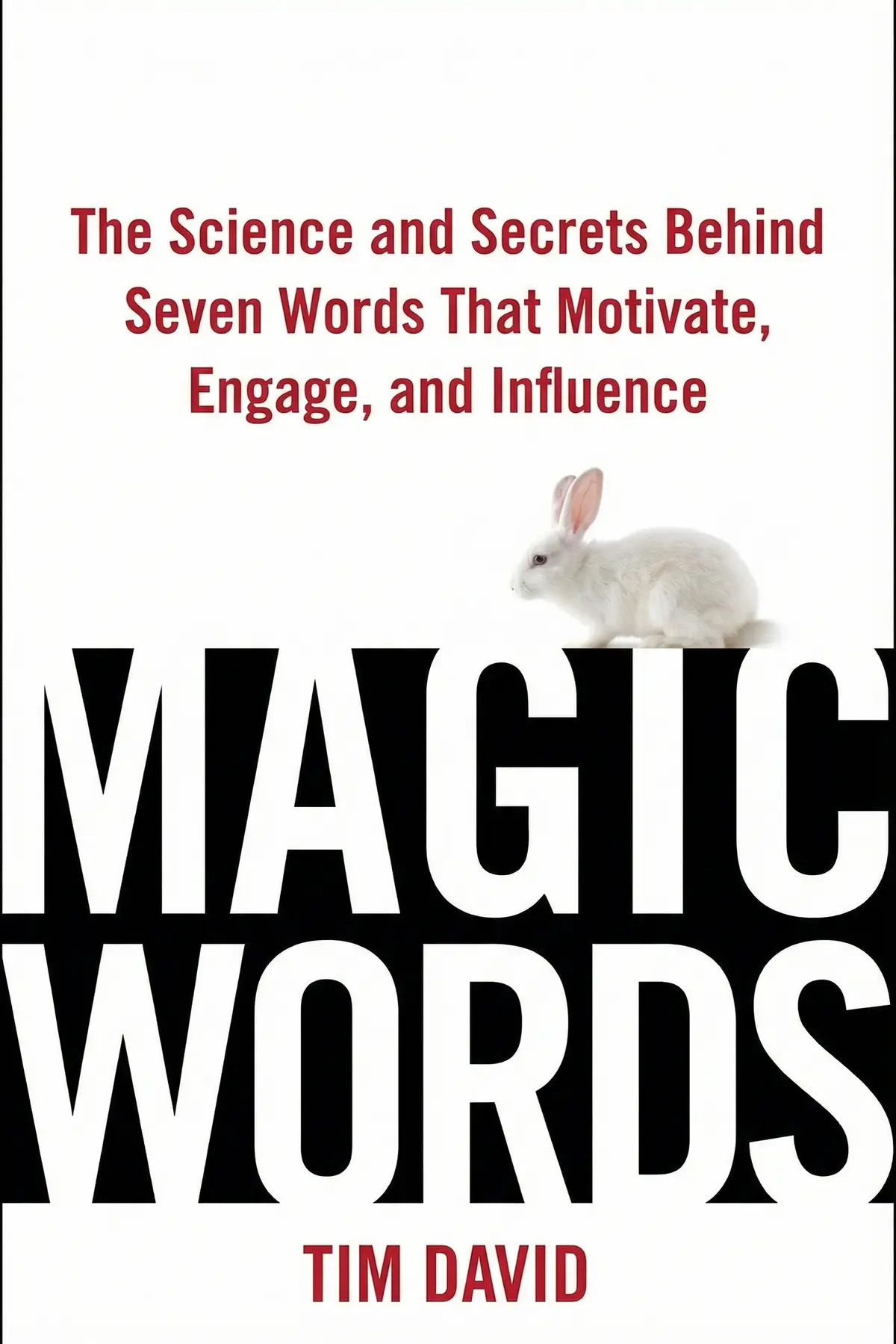
Table of Content
1. Introduction
1 min 08 sec
Ordering people around rarely gets them moving, and pleading does not work much better. In Magic Words, former magician and mentalist Tim David argues that a few ordinary words can do what pressure cannot. In one study he describes, salespeople who collected at least three small yeses from customers before asking for the sale saw their closing rate climb from 18 to 32 percent.
David’s case is that seven everyday words work with the way people’s minds already respond. They are yes, a person’s name, but, because, if, help and thanks. Each one grabs attention, steers it, supplies a reason or makes someone feel valued.
None of them works as a trick on its own, though. The words carry their force only when real care stands behind them.
By the end, you will have a short set of phrasings to try this week on a colleague, a client or a stubborn teenager, and a clear sense of the moment to drop them and say no.
2. Get cooperation without bossing anyone around
1 min 30 sec
A late night, unfinished homework and a teenager glued to the TV usually end the same frustrating way. David uses that familiar scene to show why the usual approach backfires, and what has to be in place first.
3. Collect small yeses before the real request
1 min 28 sec
One short word sits deep in human evolution, and hearing it changes how likely someone is to follow through. A group of salespeople found that when it is heard matters almost as much as whether it is heard.
4. Say their name first to win attention
1 min 21 sec
In a crowded, noisy room, one sound cuts through everything else. The same reflex shapes which soft drink people pick and even which names show up where, and it can be put to work in any meeting.
5. Use but to decide what people remember
1 min 24 sec
A tiny connecting word can make half of a sentence fade and the other half stand out. A doctor about to give an injection shows how to choose which half your listener carries away.
6. Give a reason, even a weak one, to win cooperation
1 min 15 sec
A Harvard professor tested how often people would let her cut into the photocopier queue at her office. Adding one word changed the answer dramatically, even when the excuse that followed made almost no sense.
7. Turn pushback into fresh thinking with one small if
1 min 24 sec
Give some people advice and they will do the opposite just to prove they are free. A betting experiment on two evenly matched football teams shows how to give the same advice and have it taken.
8. Make people feel needed, then thank them
1 min 29 sec
Should a beginner be trusted with a task you could do better yourself? David’s answer surprises many managers, and it connects to a slow drain on motivation that hits people who do the same work every day.
9. Conclusion
1 min 08 sec
The seven words share one trait. Each works with something people already feel: the need to belong, the pull of their own name, a hunger for reasons, a dislike of being pushed, and the pleasure of being needed and noticed. David’s lesson is that influence comes from working with those feelings, and that it holds only when you genuinely care about the person on the other side.
Go back to the teenager on the couch. Shouting has a predictable ending. Saying her name, asking a question she can answer with yes, and asking her why the homework matters to her gives the evening a better chance.
Start small this week. Turn one demand into a request that invites agreement. Put the point you want remembered after a but. Thank someone for a task they do so often that nobody mentions it anymore.
One hard word stays in your pocket for protection. When someone is trying to take advantage of you, David is clear that no is the right answer, said firmly. The magic words build cooperation; they were never meant to give you away.
About this book
What is this book about?
Telling people what to do rarely makes them do it. Orders breed resistance, and even a reasonable request can land badly when the words are wrong. Tim David, who spent years as a magician and mentalist before turning to business, argues that a small set of ordinary words can move people where pressure fails. His seven magic words each tap something people already feel. Yes answers the deep fear of rejection. A person's name grabs attention. But decides which half of a sentence sticks. Because supplies a reason, if sidesteps the urge to rebel, and help and thanks make people feel needed and valued. David backs these with studies and statistics, from salespeople who collected small yeses before the sale to a Harvard professor cutting into a photocopier queue. Readers get phrasings they can try at once with coworkers, clients or children, along with two warnings: the words fail without genuine connection, and no remains the right answer when someone is taking advantage of you.
Book Information
Who it's for
Leading without giving orders
Managers and team leads who want staff to act without being ordered.
Salespeople and client-facing staff
Salespeople and client-facing professionals looking for wording that earns a yes.
Parents wanting calmer cooperation
Parents tired of homework standoffs who want calmer ways to get cooperation.
About the Author
Tim David
Tim David spent eight years earning his living as a magician and mentalist, touring the country with his act. After starting a family, he began applying what show business taught him about people to the world of business. He now speaks at conferences and events about human connection in a digital world, runs a YouTube channel on building better communication skills and blogs about using brain science to connect with and influence colleagues, clients and family. He lives in Massachusetts with his wife and children.
Ratings & Reviews
Ratings at a glance
What people think
Listeners find this work accessible and clear, featuring thoroughly researched material that provides impactful insights into the art of persuasion and influence. They also value the actionable tips and the author's direct way of writing, pointing out its effectiveness in enhancing personal connections and overall communication. Furthermore, the book earns praise for its focus on terminology, with one listener emphasizing how simple words can make a significant impact.
Top reviews
Elan
Wow, I didn't expect a book about seven simple words to be this impactful. It’s rare to find a business book that is actually fun to read, but David’s magician background shines through in his storytelling and pacing. I’ve already started using the "If" strategy with my kids, and it’s been a game-changer for getting chores done without the usual whining. Frankly, it’s all about how you frame things. The book explains that words are simple, but they have an incredible amount of power when used correctly. I loved the section on "Thanks" and how it validates the other person's effort. This isn't just for business; it's for anyone who wants to build stronger connections with the people in their lives. I’m seriously considering printing the seven words out and putting them on my office wall as a daily reminder to speak more mindfully.
Show moreSaengdao
Finally got around to reading this, and I’m kicking myself for waiting so long. If you enjoyed "How to Win Friends and Influence People," this is the natural modern successor. It takes those classic principles and distills them into seven words that you can start using today. The writing is straightforward and the advice is incredibly practical. I especially loved the part about eliciting "yeses" to build momentum in a difficult conversation. It’s a very fast read, but don't let the brevity fool you; there is a lot of psychological weight behind these suggestions. I've already shared several of these tips with my management team because the lessons on "Help" and "Thanks" are so vital for office morale. Words truly are the anchor of human interaction. This is a must-read for anyone in a leadership position who wants to improve their communication game immediately.
Show moreSirinat
The beauty of this book lies in its simplicity. Many business authors try to overcomplicate things with complex frameworks and confusing jargon, but David sticks to what actually works: the words we use every single day. I found the analysis of the word "If" to be a brilliant way to motivate others without being demanding. By creating a hypothetical scenario, you lower the other person's defenses and invite collaboration. Gotta say, the way he explains the word "But" as a way to bury a lead phrase changed how I frame constructive criticism. No longer do I say "You did great but...", because I know they will only hear the criticism. Now I flip it. The book is well-researched and delivers powerful messages about the impact of vocabulary. Even though it's a quick read, the insights are lasting and highly effective.
Show moreLuke
The chapter on the word "Because" alone makes this worth the read for any professional. David references some classic social psychology studies to show how just giving a reason—any reason—can increase compliance significantly. It’s a well-researched little book that avoids the typical academic boredom found in many communication guides. I appreciated the straightforward writing style; it gets straight to the point without meandering through endless personal stories. While it’s true that some of this information is available in broader books like 'Influence' by Cialdini, this specific focus on vocabulary is quite refreshing. One minor criticism is that the "magic" metaphor is laid on a bit thick at times, which can feel a little cheesy. Regardless, the core message about how communication is the anchor of human interaction is spot on. It provides a concise toolkit that almost anyone can use to improve their daily conversations.
Show moreTantipat
Not what I expected, but in a good way. When I saw the title and the author’s background as a magician, I thought it was going to be a book about card tricks or stage presence. Instead, it’s a smart look at how we influence others through basic vocabulary. Look, it’s not reinventing the wheel, but it packages communication theory in a way that is immediately actionable. I finished it in about ninety minutes and walked away with at least three new tactics I can use in my next sales meeting. The "But" technique for redirecting focus is particularly clever. It’s a quick, punchy read that delivers powerful messages without the fluff. My only complaint is that I wish there were more "magic" words included in the list, as seven feels a little short for a full book. Still, the quality of the content is undeniable.
Show moreFatou
Ever wonder why some people just seem to get what they want without being aggressive? This book answers that by looking at the micro-level of our daily speech. Tim David shows that influence isn't about being loud; it's about being precise. I found the section on using a person's name to be particularly enlightening, as it triggers a specific neurological response that makes them more attentive to your message. The book is easy to read and understand, which is a huge plus for busy people. Not gonna lie, I was skeptical at first, but after trying the "Because" technique at the store, I'm a believer. It’s a great resource for anyone looking to refine their persuasion skills without coming across as a manipulator. I just wish there was a bit more depth on how to handle situations where the other person is also using these tactics on you.
Show moreCholada
Picked this up on a whim after seeing it mentioned in a leadership forum online. The central premise is that seven specific words can drastically change how people respond to you in everyday situations. Truth is, the concept is fascinating, especially the section on how the word "but" can effectively erase everything said before it. I've started watching how I use it in emails, and it really does make a difference in how my team perceives constructive feedback. However, the writing style is a bit too "salesy" for my taste, and some of the examples felt a little dated or overly simplistic for modern workplace dynamics. It's a decent toolkit for basic communication, but don't expect it to solve every interpersonal conflict you have instantly. It works well as a primer for beginners, though more experienced managers might want something with more meat on the bones.
Show moreGift
As someone who struggles with making requests at work, this was a surprisingly helpful guide. I never realized how much weight the word "help" carries until David broke down the psychology behind human connection and cooperation. By framing a task as a request for help rather than a command, I've noticed people are much more willing to jump in without resentment. The book is short and punchy, which I appreciate because I don't have time for 400 pages of fluff. My only gripe is that some of the "magic" feels a little manipulative if you aren't careful with your intent. You have to use these tools ethically or people will see right through your tactics. Still, the practical advice on using someone's name to grab attention is solid gold. It’s a nice set of tools that uses words we all know but applies them with a more deliberate strategy.
Show moreFrida
After hearing several people recommend this for team building, I decided to give it a go. It’s a very accessible book, though it does feel a bit simplified compared to some of the heavier leadership literature out there. I agree with other reviewers that it might have felt more revolutionary back when it first hit the shelves. In today’s hyper-partisan world, sometimes just saying "Thanks" or "Help" isn't enough to bridge deep divides or change minds. To be fair, the author does provide research to back up his claims, which I appreciated. The advice is definitely actionable, but you have to keep in mind that these aren't literal magic spells; they are just tools to nudge people in the right direction. It's a solid 3-star read for me—good for a plane ride, but maybe not a permanent fixture on my "must-read" list.
Show moreNew
This book felt more like a long blog post than a fully fleshed-out resource. While Tim David has an interesting background as a magician, the transition to business psychology feels a bit thin in several chapters. Personally, I found most of the advice to be common sense masquerading as groundbreaking "magic" tactics. The seven words—like 'Yes' and 'Because'—are obviously important for communication, but the book doesn't offer enough deep research to back up its bolder claims about influence. It's a very quick read, taking maybe an hour, which makes it feel like it's lacking substance for the price point. To be fair, some of the anecdotes about rearranging sentences to change impact were okay, but overall it felt like a watered-down version of better interpersonal books. If you are brand new to the world of communication, you might find a nugget or two, but seasoned professionals will likely find it underwhelming and a bit repetitive.
Show moreQuestions about this book
What is the main idea of Magic Words by Tim David?
Tim David argues that seven everyday words can motivate people far better than commands. Yes, a person’s name, but, because, if, help and thanks each work with something people already feel, such as the fear of rejection, the pull of their own name or the wish for a reason. He stresses that the words only work when a warm, genuine connection stands behind them.
What are the seven magic words?
David’s seven are yes, the other person’s name, but, because, if, help and thanks. Yes builds agreement, a name grabs attention, but decides which part of a sentence sticks, because supplies a reason, if invites hypothetical thinking and defuses reverse psychology, and help and thanks make people feel needed and appreciated. He also advises avoiding no in general while keeping it for moments when someone tries to exploit you.
What is the But Eraser?
The But Eraser is David’s name for how the word but weakens whatever comes before it, while the But Enhancer strengthens whatever follows. His advice is to open with the information you want someone to let go of and close with what you want them to remember, as a doctor might mention an upcoming injection and then invite the patient to relax and look out the window.
How can I use Magic Words at work?
Phrase requests as questions that earn a yes, and try to collect a few yeses before the main ask. Say a colleague’s name before your point. Give reasons with because, or ask your team why a problem such as missed deadlines keeps happening so they find their own reason. Let beginners try when they offer help, and thank people for routine work, not just big wins.
Who should read Magic Words?
It suits managers who want motivated teams, salespeople and client-facing staff who need more people to say yes, and parents caught in daily standoffs with their children. Its tools are short phrasings rather than long techniques, such as asking what someone would do if they could, so readers can try them in their next conversation.
Readers also enjoyed









AUDIO SUMMARY AVAILABLE
Listen to Magic Words in 15 minutes
Get the key ideas from Magic Words by Tim David, plus 5,000+ more nonfiction titles.
- 5,000+ titles
- Listen as much as you want
- 7-day free trial
- Cancel anytime









