
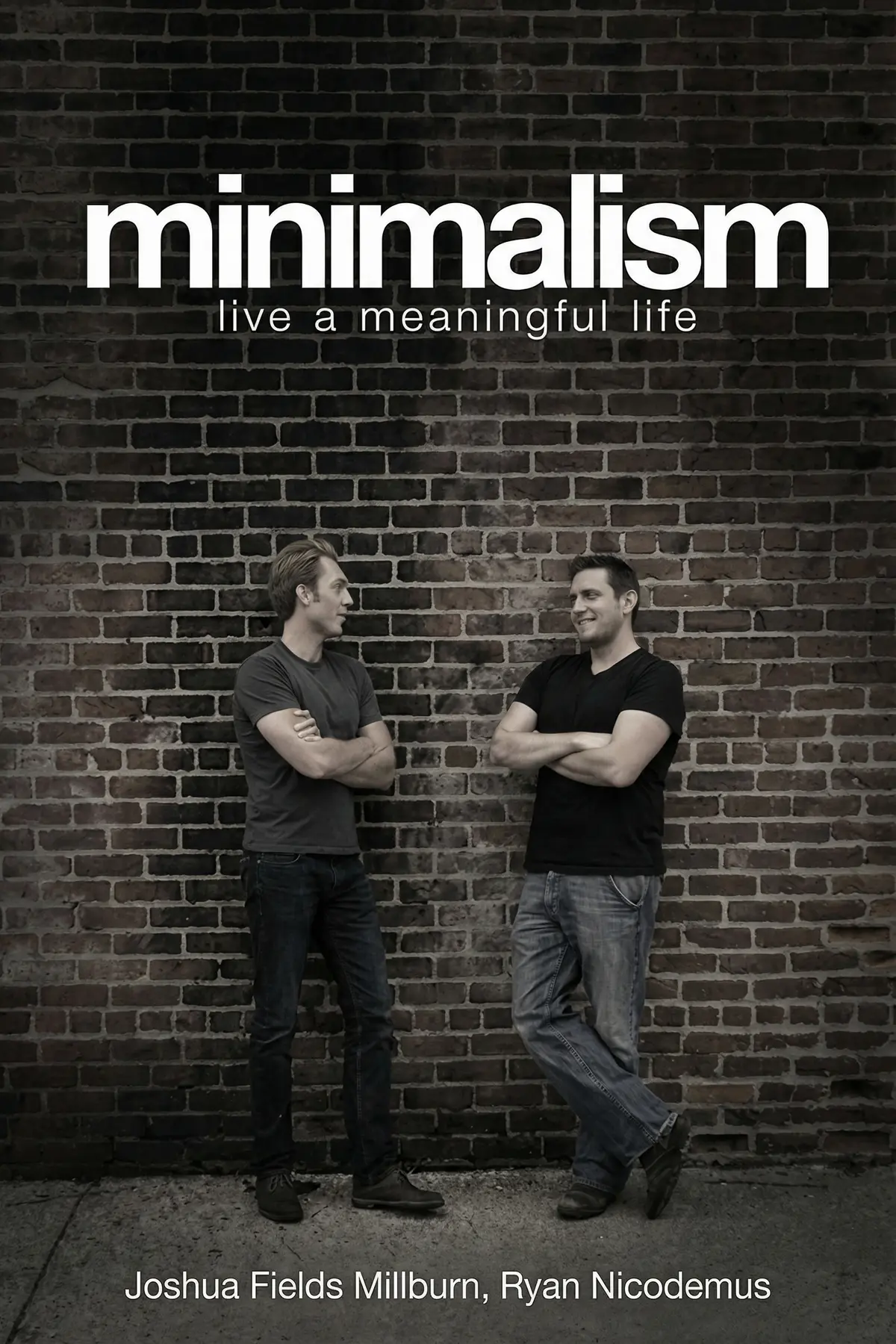
Minimalism: Live a Meaningful Life
Joshua Fields Millburn
 English
Shows how clearing out unused possessions, self-deception, debt and screen time frees money, energy and attention for what matters most: honest values, creative work and the people you care about.
1 min 03 sec
If your home is full and your life still feels empty, the stuff itself may be part of the problem. In Love People, Use Things, Joshua Fields Millburn and Ryan Nicodemus, the pair known as The Minimalists, argue that things bought for happiness mostly give a short thrill and then sit there taking up space, money and attention. Their answer is minimalism, which they describe as living a fuller life with fewer possessions.
The book goes well past tidy shelves, though. Clearing physical clutter, the authors argue, is the first step toward clearing the other kinds: the small lies, the impulse purchases, the debt, the endless phone checking and the relationships that drain you. Every resource freed that way can go where the title points, toward people.
What follows is a sorting method for your belongings, a way to test big decisions against your values, a debt plan in a clear order, a month-long break from screens and a test for which relationships deserve your energy.
1 min 42 sec
A family loaded a dumpster with everything they no longer needed, and then something went badly wrong. Strangely, the fire turned out to be the best thing that ever happened to them.
1 min 39 sec
On paper, Millburn had the ideal life: the salary, the suburban house, the high school sweetheart. Privately he gave it a six out of ten, and the reason he never said so cost him dearly.
1 min 43 sec
A glass of wine, a scrolling thumb and one tap on Buy. Outside forces make far more of our decisions than we admit, and the authors offer a four-part map for taking them back.
1 min 57 sec
Two luxury cars by 25, then a third, and a wallet holding a stack of maxed-out credit cards. Millburn’s twenties show how a big salary can still leave you trapped, and what the way out looks like.
1 min 49 sec
You may not think of yourself as creative, yet the authors insist you probably are. What has gone missing is the focus to use it, and they point to one small object as the main thief.
1 min 38 sec
A former pastor and an outspoken atheist disagree about nearly everything. Yet they share one idea about happiness, and the authors show how it can change something as routine as lunch.
1 min 51 sec
Millburn’s first date with the woman he later married involved a massage table and very little clothing. The awkward start turned out to be a model for what every good relationship needs.
1 min 23 sec
The title warns against getting the order wrong. When things are loved and people are used, the house fills up while the relationships thin out, the way the Kirkendolls had everything except time for each other. Millburn and Nicodemus treat every kind of excess as one problem wearing different clothes. A cupboard of unused gadgets, a fib about a failing marriage, 14 maxed-out cards and 150 phone checks a day all consume what a person has least of: time, energy and attention.
Clearing them out is not self-denial. It is how you take those resources back for reflection, for making things and for the people who strengthen you.
The book’s tools are small enough to try this weekend. Sort one room into essentials, nonessentials and junk, and let the 20/20 rule decide the close calls. Before your next big decision, ask which of your values it serves and which it puts at risk. If debt weighs on you, build the $1,000 emergency fund before anything else. Then give some of what you win back to someone you love.
The Kirkendolls lost a house and found they had lost nothing that mattered. Most people can learn the same lesson with a dumpster that never catches fire.
Many people did everything they were told would make them happy: a good job, a bigger house, nicer cars, more stuff. Many of them still end up with crowded homes, maxed-out credit cards and the sense that something is missing. Joshua Fields Millburn and Ryan Nicodemus, the duo known as The Minimalists, argue that the excess itself is often the problem. Their minimalism starts with belongings but does not stop there. The authors treat the small lies we tell, purchases made on autopilot, debt, constant phone checking and draining relationships as clutter too. Each one eats time, money or attention. Drawing on Millburn's own years of buying cars on credit and a marriage that ended badly, plus stories like a family whose dumpster of junk burned along with their house, they show what changes when the excess goes. Readers get practical tools: a three-pile method and a 20/20 rule for sorting belongings, four kinds of values for testing decisions, a step-by-step plan for getting out of debt, a 30-day digital declutter and three marks of a relationship worth keeping.
Professionals with full homes, full calendars and a nagging sense that something is missing.
People carrying credit card debt who want a clear order of steps to get out.
Anyone whose phone, purchases or draining relationships keep crowding out creative work and time with loved ones.
Joshua Fields Millburn and Ryan Nicodemus were both born in 1981 and raised in Dayton, Ohio, and together they are The Minimalists. Millburn is a New York Times bestselling author of five books, including the memoir Everything That Remains, and also podcasts, teaches writing and produces. Nicodemus left a six-figure corporate career at 30 to write and speak. Both have spoken at Harvard, Apple and Google, and Nicodemus's documentary MINIMALISM is available on Netflix.
Joshua Fields Millburn

Listeners find the work well-crafted and a useful minimalist guide, and one listener remarks that it is a great choice for the entire family. They appreciate the evocative material, as one review emphasizes its role in helping individuals assess their values and connections, while another listener says it offers a profound look at minimalist theory. The text earns praise for its message regarding intentional living, and listeners value its uncomplicated approach. However, opinions among listeners are split regarding the specific word choices.
Finally got around to reading this after hearing the Minimalists on a podcast, and it really shifted my perspective on family priorities. Instead of just talking about tossing out your junk, Joshua and Ryan dig deep into the values that drive our consumption habits. The way they frame relationships versus possessions felt incredibly timely as we navigate a world that feels increasingly cluttered and disconnected. Truthfully, the chapter on creativity sparked a conversation with my spouse that led to us re-evaluating our financial goals and even our future car purchase. It’s a well-written guide that doesn't just demand you live in a bare white room but encourages you to find more room for what matters. We’ve started implementing the rules slowly, and the simplicity is a breath of fresh air for our household.
Show moreAfter hearing the Minimalists speak online, I wasn't sure if a book could offer more, but this is a truly deep dive into their philosophy. It’s not just about cleaning out your closet; it’s about a total stewardship program for your life and your time. The stories Joshua shares about his mother and his own past mistakes are vulnerable and provide a necessary context for why these changes matter. I found the section on "Creativity" particularly inspiring, as it helped me realize how much "stuff" was actually blocking my artistic output. This is a book that encourages responsible growth and contribution over mindless accumulation, which is exactly what I needed to hear right now. Highly recommended for families who want to simplify their lives and focus on building lasting memories together.
Show morePicked this up during a move, and it was exactly the motivation I needed to stop lugging around a decade’s worth of useless junk. The authors' point about memories being inside us, rather than in the objects themselves, really helped me let go of some sentimental items I was clinging to out of guilt. I love the focus on making room for "more"—more passion, more freedom, and more contentment—rather than just focusing on the "less." It’s an easy-to-read, welcoming book that provides simple steps that never felt overwhelming even when my house was in total chaos. The focus on intentional living has already made my new home feel much more peaceful and manageable. This is a must-read for anyone who feels weighed down by the cycle of unrestricted acquisition.
Show moreEver wonder why we keep buying things we don't need to impress people we don't even like? That’s the core question here, and the authors do a decent job of unpacking the psychological baggage behind our stuff. I appreciated the specific questions they suggest asking before making a purchase, as it’s already helped me curb some impulsive online shopping habits. While the structure is a bit messy—fluctuating between a memoir and a self-help workbook—the emotional core of the book remains strong. Some of the sections on "Self" felt a little oversimplified, especially regarding mental health, but the overall message about intentional living is worth the read. It’s a thought-provoking deep dive for anyone looking to reset their relationship with the material world.
Show moreThe chapter on 'Self' really challenged me to look at my internal clutter rather than just the boxes sitting in my garage. It’s an interesting take on minimalism that moves beyond the physical and into the mental and emotional spheres of our daily lives. I actually enjoyed the sophisticated vocabulary, though I can see why some might find it a bit pretentious or unnecessary. The book isn't a quick read because it forces you to stop and reflect on your own relationships after every few pages. To be fair, some of the advice assumes a level of financial stability that not everyone possesses, but the underlying philosophy is still quite valuable. It’s a great guide for anyone who feels like they are drowning in "stuff" and wants to reconnect with their human side.
Show moreLook, the message is solid, but the execution is far from minimalist in terms of writing style or structure. I agree that we should love people and use things, but did it really take over 300 pages to drive that point home? Some of the anecdotes felt like unnecessary digressions that didn't move the needle on the actual advice being given. I also noticed that several of the statistics cited seemed a bit dated, which made me question some of the broader arguments about consumer trends. That being said, the "Coda" sections at the ends of chapters provided some of the most practical and actionable tips in the whole book. It’s a decent starting point for beginners, but seasoned minimalists might find it a bit bloated and repetitive.
Show moreWhile the core ideas are great, I found the book's organization to be a bit frustrating at times. It jumps between the two authors' perspectives in a way that feels disjointed, and the tone shifts dramatically from chapter to chapter. Personally, I think it works better as a memoir than as a self-help guide, as the personal stories are much more engaging than the "rules" which are often recycled from other sources. I did appreciate the discussion on money management and the importance of having values-aligned spending habits. However, the writing is occasionally so dense that it defeats the purpose of a book promoting a simpler life. It's an insightful read with some good takeaways, but it definitely could have benefited from a more rigorous edit to remove the fluff.
Show moreAs someone who has followed the podcast for years, I felt like I was reading a transcript of episodes I’ve already heard multiple times. There is very little "new" information here, and the repetitive nature of the stories made it a bit of a slog to get through. The book struggles with an identity crisis; it can’t decide if it wants to be Joshua’s personal biography or a practical manual for decluttering. I found the tone occasionally condescending, particularly when the authors describe people who haven't yet seen the "light" of minimalism. While there are a few golden nuggets of wisdom buried in the chapters on money and values, they are hidden under layers of flowery prose. You’re better off watching their Netflix documentary and saving yourself the time.
Show moreThis book was a massive disappointment that felt more like a wealthy man’s vanity project than a helpful guide for the average person. I found the comments about how this book could have "saved" people during the pandemic to be incredibly tone-deaf and dismissive of real struggle. Throughout the text, Joshua constantly mentions his high corporate salary in Dayton, which frankly starts to feel more like bragging than a cautionary tale after the fifth time. There is a pervasive sense of privilege here that ignores anyone who can’t simply "decide" to have three months of emergency savings or buy expensive organic food. For a book that preaches minimalism, the writing is ironically long-winded and stuffed with unnecessary words that add zero value. If you want actual advice on living with less, skip this ego trip and find someone more grounded in reality.
Show moreTo be fair, I wanted to like this, but the overwhelming sense of privilege made it impossible to finish without rolling my eyes. The authors suggest that everyone can just "pull themselves up" or move through depression by staying active, which is a dangerous and reductive viewpoint. There is almost zero acknowledgment of how systemic issues or race might affect one's ability to live this supposedly simple lifestyle. I was also put off by the constant self-promotion of their other projects and their friends' businesses throughout the text. It feels less like a book about using things and more like a tool to sell the Minimalist brand to a wider audience. If you aren't already a wealthy professional, most of these suggestions will feel completely out of reach.
Show moreJoshua Fields Millburn and Ryan Nicodemus argue that excess possessions, and the habits around them, crowd out happiness. Physical clutter, small lies, impulse purchases, debt and constant phone use all eat time, money and attention. Clearing them out frees those resources for introspection, creative work and, above all, relationships. The title sums it up: things are meant to be used and people to be loved, and reversing that order never works.
The 20/20 rule is the authors’ tiebreaker for decluttering. If you are unsure whether to keep something, ask whether you could replace it in under 20 minutes for less than $20. If you could, it is probably not worth holding onto, so let it go. It pairs with their three-pile method, which separates belongings into essentials, useful nonessentials and junk to sell, donate or discard.
The authors sort values into four groups. Foundational values are what nearly everyone wants, like health and good relationships. Structural values are personal qualities such as sincerity, humility and autonomy. Surface values are preferences like aesthetics or hobbies. Imaginary values feel urgent but are not, such as answering emails or watching a favorite show. Testing a decision, like a job offer, against these groups shows what it really costs.
They recommend a strict order. First save a $1,000 emergency fund. Then pay off debts one by one, from the smallest to the largest. After you clear your debts, set aside a minimum of 15 percent of what you earn for retirement savings. For investing, they suggest a mutual fund, which bundles many stocks and spreads risk, over volatile choices like individual stocks or gold and silver.
Start with one room and sort it into essentials, nonessentials and junk, using the 20/20 rule for close calls. Name one truth you have been avoiding. Before your next big choice, check which of your values it supports. Consider Cal Newport’s 30-day digital declutter, dropping nonessential apps and services. And look at your relationships for shared values, trust and reciprocity.

Richard Wiseman





William B. Irvine


Andrew D. Thompson


Deepak Chopra
AUDIO SUMMARY AVAILABLE
Get the key ideas from Love People, Use Things by Joshua Fields Millburn, plus 5,000+ more nonfiction titles.









