

A Spy Among Friends: Philby and the Great Betrayal
Ben Macintyre
 English
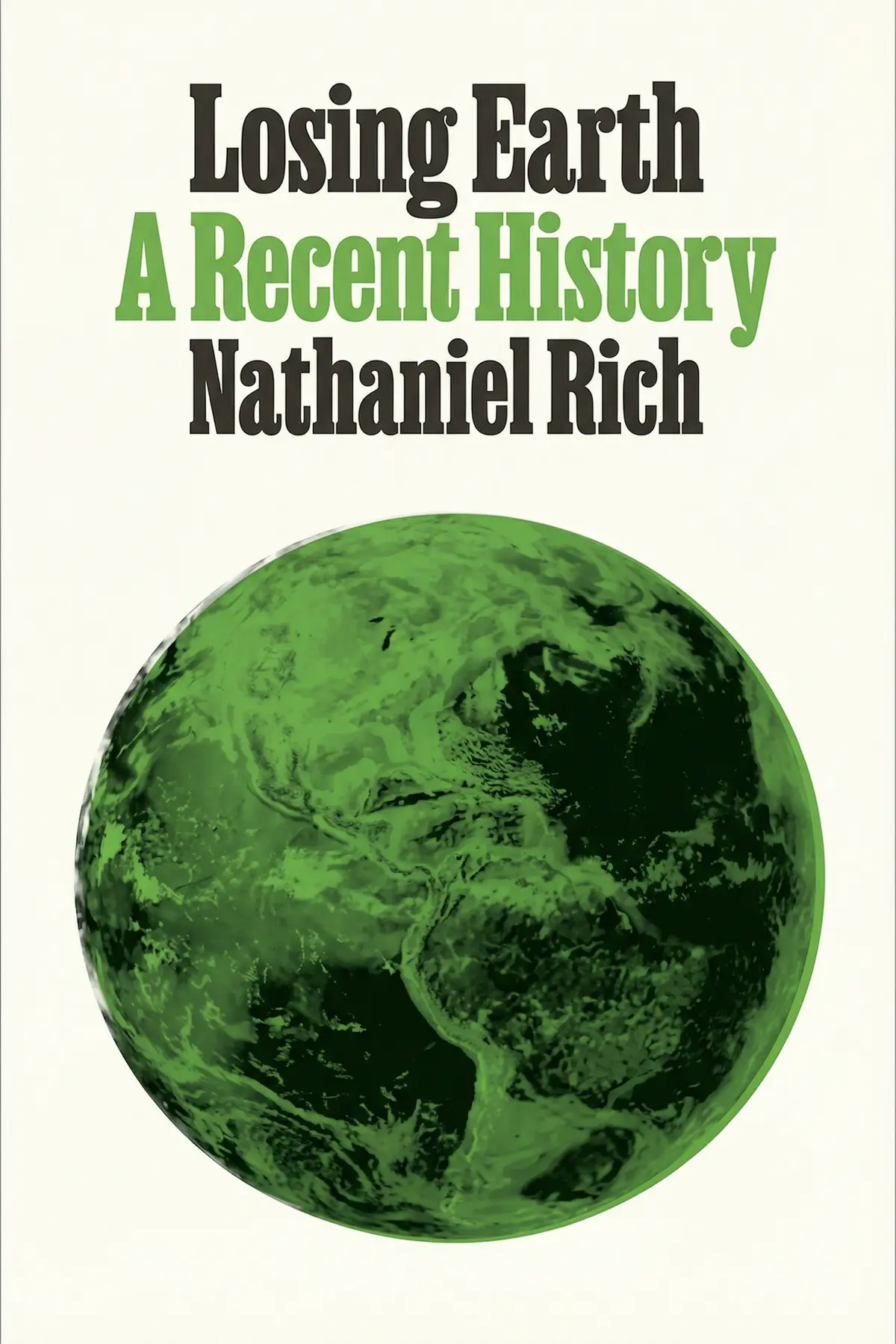
Nathaniel Rich tells how scientists and activists understood global warming by 1979, came close to a binding treaty within ten years, and lost the chance through hesitation, manufactured doubt and an American withdrawal from binding targets at the last moment.
58 sec
If you assume the world only recently understood climate change, Nathaniel Rich has an unsettling correction. In Losing Earth, he shows that by 1979 the essentials of global warming were already known, arguably more clearly than today, and that over the next ten years the major powers came within a few signatures of a binding deal to cut carbon. The science fits one rule: more carbon dioxide in the air means a warmer planet.
Everything around that rule is what failed. Rich’s case is that in that decade the science was settled, both American parties took the threat seriously and the oil industry had not yet organized against action, yet people hesitated until the chance was gone. Following the lobbyist Rafe Pomerance and the NASA scientist James Hansen through those years shows why slow, distant problems stall, at work as much as on a planet, and what it takes to break the stall.
2 min 01 sec
A warning issued by scientists from dozens of nations sounds like it came from this week’s news. It did not. The date on it removes the most comfortable excuse anyone has for the decades that followed.
2 min 04 sec
A group of experts gathered at a flamboyant beach hotel with a mandate, a deadline and the facts. Nobody stood in their way. What they produced in the end reveals a trap anyone presenting a slow risk can fall into.
2 min 05 sec
Front-page coverage, televised hearings and a 500-page scientific study all arrived within a few years. Each one should have settled the matter. Instead a reassuring phrase kept winning, and it is one you hear in meetings every week.
2 min 22 sec
A Republican aide gave a climate lobbyist blunt advice about what politicians will and will not touch. Then refrigerators and hairspray changed the political mood, and even rival superpowers found something to agree on.
2 min 15 sec
For a few months the world had a target, public opinion and a presidential candidate on its side. Then a series of private industry meetings settled on a single sentence, and it proved remarkably effective.
2 min 08 sec
A NASA scientist’s testimony came back from the White House rewritten, and the culprit stayed hidden for thirty years. Months later, in a small Dutch city, the closest the world has come to a carbon treaty fell apart overnight.
1 min 15 sec
Losing Earth turns out to be a story about ordinary people more than villains. For ten years the warning was clear, the fixes were affordable and leaders of both parties wanted credit for them. Rich’s point is that the early failure came from human inertia: hedged language, faith that someone in charge would handle it, and a habit of waiting. He calls the question of why acting is so hard a blind spot, and argues the crisis cannot truly be addressed until we confront it.
The bill is arriving. Rich describes the 2016 Paris agreement as nonbinding and cites a study giving only a 1 in 20 chance of keeping warming to 2 degrees, a level Hansen called a prescription for long-term disaster and that Rich now calls the best case. Still, he refuses to treat climate as win or lose. Outcomes run from not very good to apocalyptic, and the distance between them is worth fighting for.
So state the conclusion before the caveats, and count waiting for certainty as the choice it is. Pomerance and Hansen went from alarm, to doubting that the powerful would act, to accepting they had to act themselves. Rich says that is now everyone’s position.
Most people assume climate change is a recent discovery, and that we failed to act because the science was unclear. Nathaniel Rich shows the opposite. By 1979, the basics of global warming were already understood, and over the following decade the world's major powers came within a few signatures of a binding agreement to cut carbon emissions. Rich tells the story through two men who were present at every turning point: Rafe Pomerance, a restless environmental lobbyist, and James Hansen, a NASA scientist who kept warning Congress. Their path runs from a Florida resort where a commission could not agree on anything, through Reagan's rollbacks, the ozone victory and a bipartisan push for a treaty, to a conference in the Netherlands where the United States walked away. The book's uncomfortable argument is that the early failure was mostly our own. Hedged science, the hope that someone else would act, and the habit of waiting for more certainty did the damage before the oil industry organized its doubt campaign. Readers come to understand how a solvable problem slipped away, and why that question about human inaction now matters more than any single villain.
Readers who believe climate inaction came from unclear science and want the real record.
Professionals who present slow, long-term risks to boards, teams or clients and keep hearing "let's wait".
Students of politics and history curious how a bipartisan cause became a partisan divide.
Nathaniel Rich, born in 1980, writes both fiction and non-fiction. His novels include King Zeno, Odds Against Tomorrow and The Mayor's Tongue. He has worked as an editor at The Paris Review and writes for the New York Times Magazine and The New York Review of Books. Losing Earth won prizes from the Society of Environmental Journalists and was a finalist for the PEN/E.O. Wilson Literary Science Writing Award.

Listeners find the book articulate and accessible, with one listener noting that the writing feels like a novel. Furthermore, they appreciate the wealth of information provided, as one listener highlights the clear explanation of climate change history. The narrative style also receives positive remarks, with one listener comparing the book's structure to a detective story.
This book is a gut punch to anyone who thinks the climate crisis is a recent political development. Nathaniel Rich masterfully reconstructs the decade between 1979 and 1989, showing exactly how close we came to solving the problem before it was sabotaged by greed and inertia. The narrative focuses on figures like Rafe Pomerance and James Hansen, making the history feel personal and immediate rather than like a dry textbook. It reads with the propulsion of a high-stakes political thriller. I found myself holding my breath even though I already knew the tragic ending. It is infuriating to realize that the same arguments we are having today were already settled forty years ago. The prose is clean, accessible, and deeply moving. We aren't just losing the Earth; we are losing the legacy of our own foresight. This is essential reading for understanding how we arrived at this precipice.
Show moreWow. I finished this in two sittings and feel completely hollowed out. Rich captures the sheer 'stupidity' of our collective inaction with such clarity that it’s almost painful to read. We often hear that we didn't know enough back then, but this book dismantles that myth entirely. They knew. The politicians knew, the scientists knew, and even the fossil fuel companies knew. The book highlights the tragic reality that human beings seem incapable of sacrificing present convenience for a future we can't yet see. It’s a haunting look at the 'holes' in our political systems and our psychology. The afterword, in particular, hits hard with its assessment of our current trajectory. If you care about the future of our species, you need to sit with this discomfort. It is not an easy read emotionally, but it is a necessary one.
Show moreThe truth is that we’ve been standing on the edge of the cliff for forty years, and this book shows us exactly who pushed us toward the brink. Rich’s writing is evocative and rhythmic, making the political history of carbon emissions feel like a tragedy of Shakespearean proportions. I was particularly struck by the descriptions of the early computer models—it’s amazing how accurate they were even back in the late seventies. The book does a wonderful job of illustrating the 'selfishness' of the neoliberal state. It’s not just about the science; it’s about the philosophy of greed that governs our world. This is one of those rare books that changes how you look at the evening news. It makes the abstract threat of climate change feel like a very tangible, very preventable disaster that we simply let happen.
Show moreFinally got around to reading this account of the 1979-1989 era, and it feels like a detective story where the victim is the entire biosphere. As someone who usually finds political history a bit tedious, I was hooked by the way Rich frames the struggle of the early climate pioneers. The book is incredibly easy to read and does an excellent job of distilling complex issues into a compelling story about human nature. It’s hard not to feel a sense of 'righteous indignation' as you read about the deliberate obfuscation by the fossil fuel industry. They had the data. They knew the risks. And yet, here we are. This book is a vital piece of the puzzle for anyone trying to understand the mess we're in today. It’s stunning, heartbreaking, and impossible to put down.
Show moreEver wonder exactly when we blew our best chance to save the planet? This book provides a sobering, meticulously researched answer. Rich avoids the usual scientific jargon to focus on the human drama—the meetings, the missed connections, and the burgeoning political cowardice of the eighties. It’s written with a novelistic flair that keeps you turning pages, even when the subject matter makes you want to scream. To be fair, it is very US-centric, which might frustrate international readers looking for a broader global perspective. However, as a study of how American policy shaped the current world, it is unparalleled. The author does a great job of showing that this wasn't just a failure of science, but a failure of imagination. It's a fast read that leaves a lasting, albeit heavy, impression on your conscience.
Show morePicked this up after seeing the buzz on social media, and I was surprised by how much it felt like a detective story. Most climate books focus on melting ice caps and carbon parts-per-million, but this is a story about people in rooms making decisions. The level of detail regarding the 1980 congressional hearings is fascinating. You get a real sense of the idiosyncratic personalities involved. My only real gripe is that it occasionally drags during the middle chapters when the focus shifts to more obscure administrative hurdles. Still, the writing is sharp and the message is clear: we had the map and we chose to get lost. It serves as a perfect companion piece to more science-heavy books like 'The Uninhabitable Earth.' Highly recommended for history buffs and environmentalists alike.
Show moreAfter hearing so much about the 'lost decade' of the 80s, I finally sat down with this account. It’s a fascinating, if depressing, look at how bipartisan agreement on the environment completely evaporated. Rich does a brilliant job of humanizing the scientists who were desperately trying to sound the alarm before global warming became a culture war issue. The transition from the Carter era to the Reagan administration is particularly well-handled, showing how quickly progress can be undone by a change in leadership. Some of the chapters feel a bit brief, leaving me wanting more depth on the international reactions of the time. However, the author's ability to synthesize complex political maneuvering into a readable story is impressive. It’s a sobering reminder that our current crisis was not inevitable; it was a choice.
Show moreLook, the narrative flow here is fantastic, even if the subject matter makes you want to scream into a pillow. Nathaniel Rich manages to take a decade of scientific reports and legislative failures and turn them into a page-turner. It’s an amazing companion to books that focus on the 'what' of climate change, because this explains the 'why.' Why didn't we act? Why did the momentum stall? The book answers these questions with a focus on human behavior and political inertia. While I agree with other reviewers that it could have used more formal citations to satisfy the skeptics, the core reporting feels solid and deeply researched. It’s a brief but powerful glimpse into a turning point in human history. It really makes you think about what we owe to future generations.
Show moreWhile Nathaniel Rich is clearly a gifted storyteller, I struggled with the lack of academic rigor regarding the citations. As a reader who values transparency, I found it incredibly frustrating that the book provides almost no formal bibliography or direct source notes for the many conversations and private thoughts it reconstructs. How are we supposed to distinguish between historical fact and the author's narrative embellishments? This trend in modern non-fiction is worrying. Look, the story itself is compelling and the prose flows beautifully, but without clear proof to back up these specific interactions, it feels more like historical fiction than a definitive record. It’s a great introduction to the political history of global warming, yet I can’t fully trust the material without seeing the receipts. If you want a casual overview, this is fine, but researchers should look elsewhere.
Show moreNot what I expected at all. Based on the title, I thought this would be a deep dive into the actual biological impacts of climate change, but it’s really just a dry history of American bureaucracy. If you enjoy reading about 1970s subcommittees and white men in suits having meetings about meetings, then you'll love this. For me, it was a bit of a slog. It lacks the 'narrative drive' that the jacket blurb promised. I found myself skimming through the endless descriptions of political conferences after about 60%. Truth is, the book is too narrow in scope. It ignores almost everything happening outside of the US during this period. It’s a well-written piece of journalism, I suppose, but it didn't tell me anything new about the environment itself.
Show moreIt covers the decade from 1979 to 1989, when the science of global warming was already settled and the major powers came close to a binding treaty to cut carbon emissions. Rich follows the lobbyist Rafe Pomerance and the NASA scientist James Hansen from the Charney report and the Pink Palace meeting to the failed 1989 talks at Noordwijk in the Netherlands, where the United States refused binding limits.
Partly, but Rich’s emphasis is elsewhere. He argues the industry’s organized doubt campaign began in earnest only in the late 1980s, including paying scientists $2,000 per opinion piece. Before that, he says, the failure came mostly from human inertia, hedged science and weak political will. Critics such as Robinson Meyer of The Atlantic said this goes too easy on the industry; Rich replied that its later campaign was already well documented.
Rich presents John Sununu, chief of staff to George H. W. Bush, as the closest thing to a villain. Sununu told the American delegation at Noordwijk to disrupt the talks, and they ended with no binding limits. He also admitted to Rich that he was responsible for censoring Hansen’s 1989 congressional testimony, a scandal whose culprit had been unknown for thirty years.
The book shows how a clear, distant risk can stall even when nobody opposes action. Scientists’ careful hedging read as permission to wait, and politicians moved only once a solution looked winnable, as the ozone treaty showed. Practical lessons follow: state conclusions before caveats, treat waiting for certainty as a real choice with costs, and offer people a first step they believe they can achieve.
Ben Macintyre


Charles C. Mann

James Shapiro

Andrew Ross Sorkin
Pankaj Mishra

Fay Bound Alberti

Ben Macintyre

AUDIO SUMMARY AVAILABLE
Get the key ideas from Losing Earth by Nathaniel Rich, plus 5,000+ more nonfiction titles.









