

59 Seconds: Change Your Life in Under a Minute
Richard Wiseman
 English
Dave Gray shows how beliefs formed from a thin slice of experience keep people stuck in problems that feel permanent. He then offers nine practices for exposing those hidden assumptions and shifting situations at work and at home.
59 sec
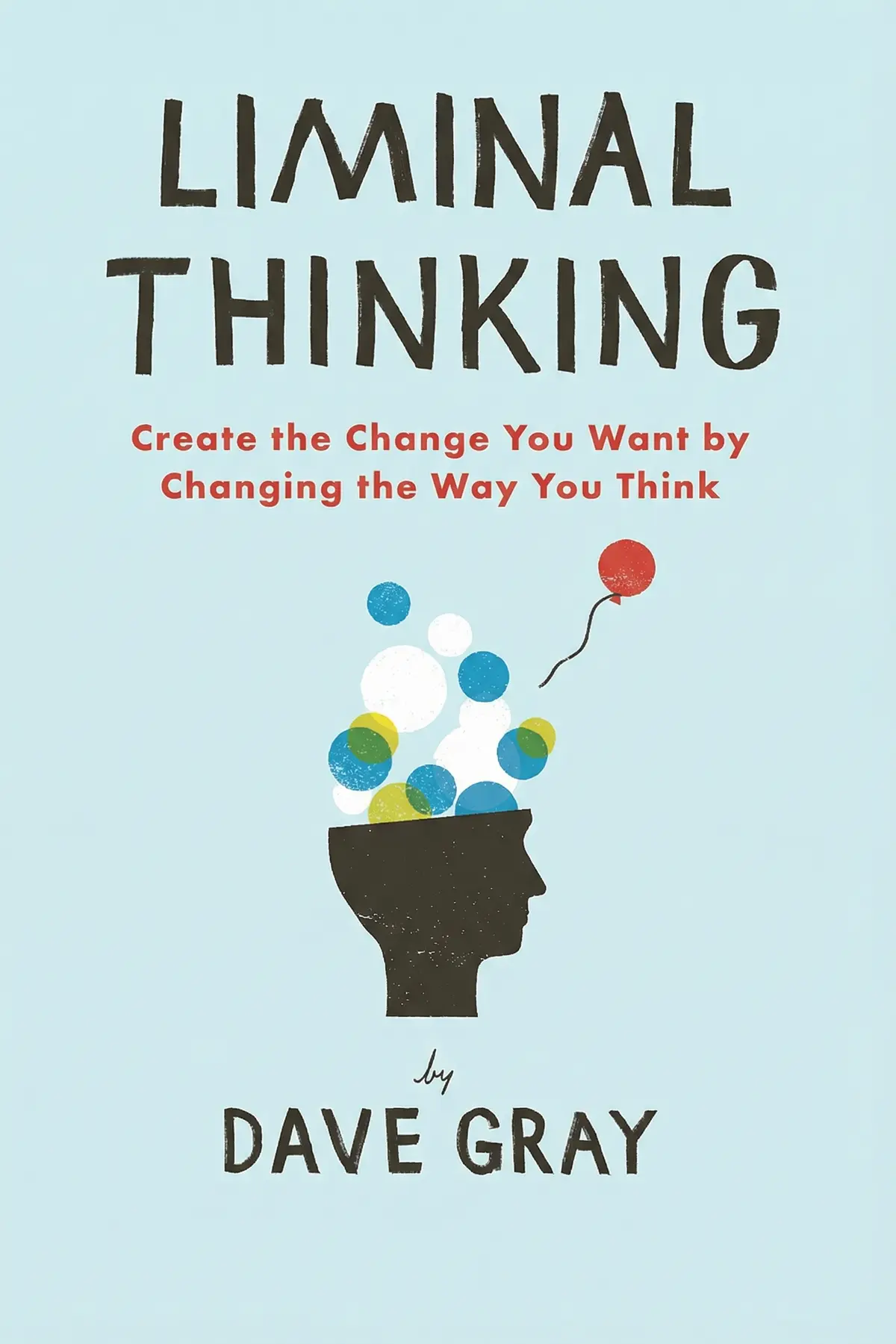
If a problem at work or at home has started to feel permanent, Dave Gray has an uncomfortable suggestion: the wall you keep hitting may be partly built from beliefs. In Liminal Thinking, Gray, founder of the visual thinking consultancy XPLANE, argues that a belief is a model of reality and never reality itself, and that every model leaves things out. He takes the word liminal from the Latin for threshold. It names the mental edges that give our outlook its shape and also hem it in.
The argument moves in two halves. First come six principles explaining how beliefs grow from a thin slice of experience, hide options and resist correction. Then come nine practices for loosening them, from admitting you are not objective to taking small, visible risks. What you gain is a way to find the hidden belief behind a stalled project, a tense team or a family standoff, and a set of moves for shifting it.
1 min 39 sec
Two people leave the same meeting with opposite stories about what happened, and both are sure they are right. An ancient tale and a trip to the grocery store explain why neither of them is lying.
1 min 38 sec
A snarling rescue dog and a job application that was supposed to be pointless reveal the same hidden mechanism. Well-meant advice can close doors you never even knew were open.
1 min 45 sec
A group predicted the end of the world, and the world carried on. What they did next shows why piling on evidence so rarely changes a mind, including your own.
1 min 38 sec
A senior executive was sure his team was hiding things from him. He was right, and the reason sat closer to home than he expected, which is where Gray says every fix should begin.
1 min 41 sec
A grocery chain’s online shopping plan kept stalling for reasons that never quite added up. The real objection was one nobody felt able to say aloud, and a simple model explains why.
1 min 41 sec
A colleague who works late every night must be trying to outshine everyone. Or must he? Fishermen in Mogadishu and a story about weak sales show what happens when you keep asking.
1 min 39 sec
Two parents ended a curfew war by doing something that sounds like giving up. A Dallas resident built a park nobody approved. Small, unexpected moves can shift what years of pressure could not.
1 min 17 sec
Gray traces all of this back to a single moment. At 29, in a bathrobe and coughing through a chest cold, he still could not stop smoking. Then he pictured himself as an old man, coughing the same way and struggling for breath, and decided on impulse to quit. He had failed many times before. This time it held. Having beaten something he thought fixed, he began to doubt other fixed things, and one decision led to the next: he ended a relationship, quit his job, moved and began a new career.
That is what the book adds up to. The edges of your options are often beliefs, built from a small slice of experience, guarded by self-sealing logic and tied to identity. They rarely give way to argument. They give way when you question your own view, make honest talk safe and change a move in a familiar pattern.
So begin where Gray begins. Ask two trusted people what they see in you that you miss. For the person who frustrates you most, write down several possible reasons before you talk. And in the standoff that keeps repeating, make one small move nobody expects.
A threshold only looks like a wall until someone steps across it.
Some problems feel fixed: the team that resists every change, the colleague who seems impossible, the family argument that repeats every week. Dave Gray argues that many of these walls are made of belief. A belief, in his account, is a model of reality, never reality itself, and every model leaves most of the world out. Gray borrows the word liminal from the Latin for threshold to describe the mental edges that shape and limit how we see. He sets out six principles explaining how beliefs grow from what we happen to notice, how they drive behavior, create blind spots, defend themselves against evidence and fuse with identity. Stories carry the argument, from a rescue dog guarding his bone to a prophecy that failed and only strengthened its believers. The second half turns practical. Nine practices, illustrated by cases from a grocery chain, a UNICEF project in Uganda, fishermen in Mogadishu and a Dallas neighborhood, show how to admit you are not objective, make it safe for people to voice real concerns, test explanations, disrupt stuck loops and take small risks that change how others see you.
Team leads facing quiet resistance to change who want to find the real objection.
Professionals stuck with a difficult colleague, client or boss and running out of ideas.
Anyone in a problem that feels permanent who suspects their own assumptions are part of it.
Dave Gray is the founder of XPLANE, a consultancy that uses visual thinking to help organizations reach clarity and alignment. With a background in design and leadership, he has worked with large global companies and with startups. His first book, Gamestorming, has sold more than 100,000 copies and appears in 16 languages, and he also wrote The Connected Company.
Listeners find this work both profound and accessible, valuing its functional methods and straightforward prose. The content is richly illustrated, featuring handwritten diagrams mentioned by one listener, and listeners appreciate the emotional depth, which one listener characterizes as an informed love letter. They commend the book's inventiveness, with one listener highlighting its creative solutions, while another values the way it renders intricate subjects understandable.
Dave Gray has crafted what feels like an informed love letter to the human mind. The book avoids the clinical dryness of most psychology texts, opting instead for a warm, accessible tone that encourages deep self-reflection. I was particularly struck by the idea that we must assume we are not objective in our observations. By acknowledging our own blind spots, we open the door to genuine change and better relationships. It’s not just a business book; it’s a manual for being a more conscious human being. The simple, handwritten diagrams throughout the chapters made the complex concepts feel much more approachable. I found myself slowing down to really process his points about how we construct our own realities. This is a must-read for anyone feeling stuck in their current patterns.
Show moreEver wonder why your dog barks at every stranger but wags his tail for you? Gray uses the brilliant example of the 'delight loop' to explain how we can rewire our conditioning through new experiences. I loved the story about using bones to change a dog's association with other animals from threat to reward. This book is packed with these kinds of creative solutions that are immediately applicable to real life. It moves beyond theory and gives you a sequence of insights to help you make wiser choices. The focus on 'liminal moments' as sources of creativity was a huge lightbulb moment for me. I’ve already started applying the 'cookies and tea' strategy to my more difficult team meetings. It’s a deceptively simple book that carries a lot of emotional weight.
Show moreThe concept of '400 billion bits' of information being processed by our brains every second really put things into perspective for me. It’s a staggering number that reinforces Dave Gray’s point about how narrow our conscious focus actually is. This book is beautifully illustrated with handwritten diagrams that make the reading experience feel personal and intimate. Personally, I found the advice on disrupting patterns and exploring alternative beliefs to be exactly what I needed for the New Year. The author manages to make complex topics like heuristic thinking feel approachable for a general audience. It's a quick read, but the ideas stay with you long after you close the cover. Gray reminds us that we construct our own boundaries, and therefore, we have the power to dismantle them. Truly a gem.
Show moreFinally got around to reading this after a friend recommended it for my creative block, and I’m so glad I did. The central premise—that we live in a world of our own construction—is both terrifying and incredibly liberating. I loved the distinction between facts and stories, and how stories are the only real way to bridge the gap between different belief systems. The book is short, punchy, and filled with the kind of 'aha' moments that usually take years of therapy to reach. It’s written with a clarity that is rare in the self-help genre, avoiding the usual 'woo-woo' language in favor of practical logic. Even the sections on business strategy felt deeply human and relevant to my personal life. If you feel like you’re stuck in a rut, this is the shovel you need to dig yourself out. Absolutely brilliant.
Show moreThe visual component of this book is what truly sets it apart from other productivity or mindset guides. Dave Gray uses these charming, handwritten diagrams to break down the Toyota Way and other complex systems into something digestible. I appreciated the practical approach to identifying our 'doom loops' and how they keep us stuck in failing routines. The writing style is simple and direct, which makes it an easy read over a weekend. While some sections felt a little light on the scientific details, the overall message about reframing beliefs is powerful. It served as a great reminder that the 'obvious' is often just a fiction we've built for ourselves. I’ll definitely be keeping this on my shelf for when I need a quick mental reset.
Show moreAs someone who devours psychology books, I found this to be a helpful companion to the works of Kahneman and Ariely. Gray focuses specifically on how our internal belief systems create invisible barriers to our own success. He argues convincingly that stories are more effective than facts when you're trying to promote a new belief, which is a vital lesson for any leader. The writing is incredibly concise, almost to a fault, but it ensures that the core message doesn't get lost in jargon. I did wish he had delved more into the science of NLP instead of just dancing around the terminology. However, the actionable insights provided are well worth the time. It’s an excellent tool for anyone looking to increase their self-awareness and break out of rigid thinking.
Show morePicking this up for the office was a gamble, but it turned out to be a very insightful tool for our management team. The section on how difficult conversations can be softened by something as simple as a warm cup of tea was fascinating. It highlights how much our physical environment and small gestures impact our psychological openness. Gray’s explanation of why we get into conflicts—confusing our beliefs with objective reality—is something every professional needs to hear. While the book is definitely on the shorter side, it doesn't feel like it's wasting your time with unnecessary academic fluff. I would have liked more deep dives into the case studies, like the Vietnam War example, but it serves its purpose as a quick catalyst for change. It really forces you to question what you take for granted.
Show moreIs this just common sense rebranded for the TED Talk generation? At times, the book gives off heavy PowerPoint vibes, with big ideas condensed into catchy slogans that don't always hold up under scrutiny. I listened to the audio version at 1.5x speed while commuting, and I think that was the right choice. There’s a lot of talk about suspending judgment and exploring alternative beliefs, which is fine, but it lacks the rigor of books like 'Thinking, Fast and Slow.' To be frank, the list-heavy nature of the chapters made it feel a bit disjointed in audio format. It's a decent enough primer if you're new to the concept of liminality, but seasoned readers of social science might find it a bit thin. Still, it’s well-written for what it is.
Show moreTo be fair, I expected a lot more depth from a title as intriguing as 'Liminal Thinking.' Most of the content feels like recycled NLP concepts that have been given a trendy, modern polish to appeal to the corporate crowd. You could summarize the entire 150-page book into a short blog post about the importance of being open-minded. There is an enormous amount of filler, and even the illustrations feel like they are there just to take up space. While the author is clearly passionate, the 'fresh' ideas aren't actually that fresh if you’ve read any basic cognitive psychology. I struggled to find anything truly actionable that wasn't already common sense. It’s a fast read, but that’s mostly because there isn’t much substance to chew on.
Show moreNot what I expected given the high praise I saw on social media. I found myself getting increasingly frustrated with the lack of new information, eventually giving up after about 60% of the way through. The book is essentially a very long way of saying 'take a risk' and 'be nice to people.' Gray has a nice writing style, but he spends way too much time on filler that doesn't add anything to the core argument. If you've read any other books on mindset or cognitive biases, you can probably skip this one entirely. It feels like a series of blog posts that were stretched out to fill a paperback. I wanted more substance and fewer slogans. It might work for some, but I just didn't connect with it at all.
Show moreGray argues that beliefs are models of reality, built from the small part of experience we happen to notice. Those models guide behavior but also create blind spots, defend themselves against evidence and become tied to identity. Many problems that seem unchangeable are held in place by such beliefs, so changing how you and others see a situation can open options nobody noticed before.
Gray says beliefs are models, they are built from experience, and they create a shared world through the behavior they drive. They also create blind spots, they defend themselves through self-sealing logic, and they are tied to identity. His examples include the blind men and the elephant, a rescue dog named Spitfire and Dorothy Martin’s failed flood prophecy.
SCARF names five emotional needs: status, certainty, autonomy, relatedness and fairness. Gray uses it to explain why people hide real concerns. When a grocery chain’s online shopping launch stalled, store managers feared for their in-store bonuses, a threat to fairness and autonomy. Once the company addressed the bonus structure, the project moved. Checking these five needs helps make it safe for people to speak openly.
Start by assuming you are not objective and ask trusted people about your blind spots. Before judging a difficult colleague, write down several possible explanations and test them in conversation. Look for unspoken threats to people’s status, certainty, autonomy, relatedness or fairness. In a recurring conflict, change one small part of your usual response, and try acting as if a change were already possible.
It suits managers and team leads dealing with resistance to change, professionals stuck in tense working relationships, and anyone facing a situation that seems impossible to shift. Gray’s practices are concrete, drawn from cases such as a UNICEF project in Uganda, fishermen in Mogadishu and a Dallas resident who built a temporary park to challenge outdated rules.
Richard Wiseman





William B. Irvine


Andrew D. Thompson


Deepak Chopra
AUDIO SUMMARY AVAILABLE
Get the key ideas from Liminal Thinking by Dave Gray, plus 5,000+ more nonfiction titles.









