

59 Seconds: Change Your Life in Under a Minute
Richard Wiseman
 English
Shows how to decide what to keep when you move, downsize or clear a loved one's home, by asking who you want to be, how you want to live and what you want to remember.
1 min 00 sec
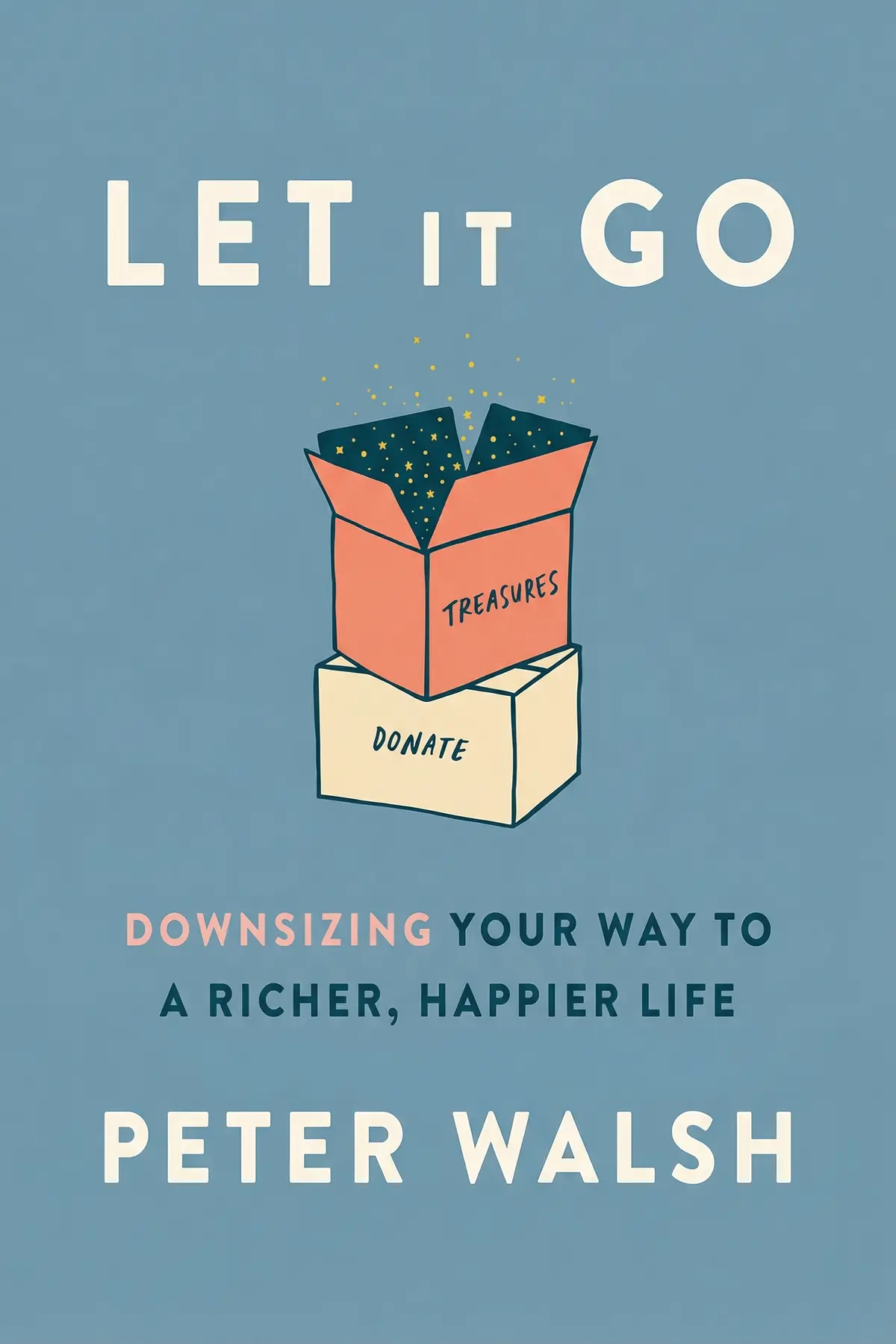
Moving, shrinking into a smaller place or clearing out a parent’s house can feel like a mountain of decisions with no path up. In Let It Go, Peter Walsh, who has hosted television shows on clutter, argues that the things you keep are never neutral: they either support the life you want or hold you in one you have outgrown. When his own mother died, he kept just one of her belongings, a green glass pie plate.
That single choice holds his whole method. Walsh says every object should face three questions: who you want to be, how you want to live and what you want to remember. Answered honestly, they turn a pile of boxes into a way of understanding yourself and the people you love.
Ahead are the hidden costs of clutter, the feelings that stall the work, tests for what deserves a place in each room, a kinder way to remember the dead and ground rules for sorting a family home without a family fight.
1 min 54 sec
A storage unit, a job offer in another city and an old t-shirt all point to the same hidden bill. Most people never add it up, and the total is larger than the shelf space it takes.
1 min 49 sec
Even people who are nowhere near hoarders freeze when they open an old box. A high school jacket and some forgotten welding tools reveal what is really making the decision so hard.
1 min 47 sec
A piano nobody plays and a faded scout neckerchief say very different things about their owner. Walsh offers a test that shows which of your belongings are helping you and which are holding you back.
1 min 51 sec
A house can be clean and still feel restless. The reason often has less to do with mess than with what happens when one room’s things start drifting into another.
1 min 52 sec
After a death, keeping everything can feel like the only loyal choice. One woman discovered what that choice did to her home, and Walsh found a different answer in a single dessert plate.
1 min 46 sec
One woman lost her grandmother twice, the second time because of her own brothers. Walsh shows how the same shared task can damage family relationships or turn two sisters born 13 years apart into best friends.
1 min 13 sec
Let It Go is a book about decisions that look small and turn out to be large. A t-shirt, a welding kit, a heavy antique chair, a shelf of beer cans: each one asks what you are holding on to and why. Walsh’s answer is that most of us own more than we need, and that clearing it with care lets us move on, makes our homes calmer and keeps the memory of the people we lost alive.
His filter has three parts: who you want to be, how you want to live and what you want to remember. A thing that serves none of them is taking room from the things that do, and from people.
You can start with one shelf or one room, asking what it is for and keeping only what fits. When an object hurts, look at the feeling behind it before deciding on the object. When something holds a memory but has no use, photograph it and write its story down. And if you are sorting with family, settle the rules together first, because a set of medals can decide whether siblings stay close.
Somewhere in every crowded house there is a green glass pie plate. Letting go of the rest is how you find it.
Moving house, shrinking into a smaller place or emptying a late parent's home means deciding the fate of a lifetime of belongings. These moments often arrive alongside big life changes, so the physical work comes with a heavy emotional load. Peter Walsh, who has hosted television shows on clutter, argues that the job gets easier once you see what your things are really doing to you. In his view, possessions are never neutral. They tie you to one place, cost money to store, bring up old regrets and keep you attached to identities you have outgrown. Walsh gives a clear filter for every object: does it serve the person you want to be, the way you want to live, and the memories you want to keep? The book also covers the hardest cases. A client rebuilt her childhood home out of her mother's and sister's belongings, siblings clashed over a father's war medals, and Walsh himself kept a single pie plate from his mother's house. Readers get a calmer way to sort, a kinder way to honor the dead and ground rules for downsizing with family without breaking it apart.
People facing a move, a smaller home or a house full of a late parent's belongings.
Anyone whose closets hold old hobbies, unread books and things they feel guilty throwing away.
Siblings and couples who must sort shared possessions and want to stay close while doing it.
Peter Walsh grew up in Australia and moved to Los Angeles in 1994 to start a company focused on job satisfaction and effectiveness in organizations. He holds a master's degree specializing in educational psychology. He has hosted television shows on clutter, including Extreme Clutter and Clean Sweep, appears regularly on the Rachael Ray Show and has written a column for O, The Oprah Magazine. Clearing out his childhood home after his parents died shaped his thinking on clutter. His bestsellers include It's All Too Much and Enough Already.

Listeners consider this downsizing manual useful and skillfully written, while one listener points out that it delivers distinct steps to follow. This work provides deep insights into sentimental bonds with belongings, and one listener notes it helps with the mental/emotional/psychological aspects of parting with possessions. Listeners value the author's professional knowledge, and one listener emphasizes the straightforward directions for accomplishing tasks. The title earns praise for its organizational tips, with one listener characterizing it as a genius method for tackling clutter.
The psychological shift this book triggered was exactly what I needed to tackle my guest room turned storage unit. Peter Walsh moves beyond just telling you to throw things away; he forces you to examine if your possessions actually align with the image you want to project to the world. I’d never considered that my clutter was a reflection of past versions of myself that I’m no longer living. Not gonna lie, I got a bit misty-eyed reading about 'malignant items'—those things we keep out of guilt even though they bring up bad memories. Letting go of a 'treasure' that was actually tied to a traumatic time was incredibly cathartic for me. This isn't just about cleaning; it’s about the mental and emotional freedom that comes from living with intention. It's easily the most compassionate organizing book I’ve read.
Show moreWow, I never realized how much my 'junk' was actually holding me back from the life I want to live right now. This book provides such a genius approach to clutter busting by focusing on the stories we tell ourselves about our objects. I loved the suggestion to write down the history of an item so that heirs understand its value—it turns a piece of wood into a family heirloom. The instructions are simple and the tone is incredibly encouraging without being condescending. I've already started my two-hour-a-day sessions, and the progress is visible. For the first time, I don't feel guilty about getting rid of expensive items I never use. Walsh is truly an expert in the psychological barriers we build around our stuff. This is an essential read for anyone feeling buried by their own home.
Show moreAfter hearing Peter Walsh on HGTV years ago, I knew his approach would be no-nonsense, and he definitely delivers on that front. This book saved my sanity during a cross-country move where I had to cut my belongings by half in just three weeks. The distinction between treasures and worthy items helped me make split-second decisions without the usual agonizing. To be fair, I think his best advice is about the legacy we leave; it really changed how I view my 'stuff.' The writing style is engaging and the real-life stories peppered throughout are actually relatable rather than just being filler. It feels like having a professional organizer sitting right there with you, coaching you through the hard choices. If you are struggling to start, just read the first two chapters and you'll be inspired to grab a trash bag immediately.
Show morePicked this up because my parents are finally moving out of my childhood home after forty years, and the sheer volume of stuff is paralyzing. Walsh provides a very practical framework for distinguishing between 'treasures' that actually mean something and 'worthy' items that just serve a function, like a toaster or extra towels. Truth is, the emotional weight of downsizing is often harder than the physical labor, and he handles that psychological aspect with real grace. I especially appreciated the two-hour daily limit suggestion because it makes the process feel manageable rather than like a death march. While the book can feel a bit repetitive in the middle, the 'treasure map' concept is a genius way to visualize what actually matters. It’s a solid guide for anyone facing a major life transition or just trying to clear out the basement.
Show moreManaging a parent's estate is an absolute nightmare, but the chapter on sibling dynamics in this book was a total lifesaver during a stressful month. Walsh suggests using dice or drawing straws to decide who picks first when divvying up items, which sounds simple but prevented so many arguments in my family. Gotta say, the advice to view items as having no monetary value during the family distribution phase was a game-changer for us. We were able to focus on the stories behind the objects instead of arguing over the price of an old entertainment center. The book is well-written and offers clear paths to take when you feel stuck. My only gripe is that it feels a bit like a commercial for his TV persona at times. Still, the practical wisdom regarding estate management is worth the price alone.
Show moreEver wonder why you're keeping a broken entertainment center just because it was a wedding gift twenty years ago? Walsh tackles that specific kind of guilt with no-nonsense advice that really hits home. I found the section on 'malignant items' especially powerful, as it gave me permission to toss things that only brought up bad memories. The book is very well-organized, moving from the emotional preparation to the physical execution. In my experience, most organizing books fail because they don't address the 'why' behind the hoarding, but Walsh nails it. I do wish the layout was a bit cleaner, as the anecdotes sometimes interrupt the flow of the actual tips. Overall, though, it’s a very practical guide that offers clear paths for anyone overwhelmed by a lifetime of accumulation. It's helpful and grounded.
Show moreAs someone who already follows Marie Kondo, I found Walsh’s perspective on 'worthy' items a bit more grounded for my everyday life. He doesn't expect every single spoon to spark joy, which is a relief when you're just trying to run a functional household. I liked the focus on the legacy we leave behind, specifically the idea that leaving a house full of junk is a burden rather than a gift to our heirs. Personally, I think the book is a bit too focused on the 60+ demographic downsizing their forever homes. I was hoping for more advice on merging households for marriage, which was only briefly mentioned in the intro. It’s a decent read with some good exercises, but it definitely targets a very specific stage of life. The writing is conversational, though it drags in the first few chapters.
Show moreLook, the advice here is solid, but the formatting of the physical book is kind of a mess and makes it harder to digest. I found myself flipping back and forth trying to find where a list ended because of the intrusive text boxes. That being said, the 'treasure map' exercise is actually quite helpful for identifying what you truly value. Frankly, I didn't learn much that felt revolutionary, as I've read Walsh's previous work, but the focus on 'Swedish Death Cleaning' vibes is timely. It’s a quick read if you skip the repetitive anecdotes in the beginning. It’s a fine resource if you’re currently in the middle of a purge, but it’s not something I’d keep on my shelf for years. Ironic, right? I'll probably donate this copy to the library now that I'm done with it.
Show moreDoes the world really need another decluttering book that starts with fifty pages of fluff just to hype up the author's own method? To be fair, there are a few decent nuggets of wisdom buried in here, like the advice on choosing one representative item from a collection. However, the layout is an absolute nightmare to navigate. You’ll be in the middle of a helpful bulleted list, and suddenly there's a two-page anecdote box that completely breaks the flow of the instructions. Also, the constant references to the song from Frozen felt incredibly dated and a bit lazy for a professional organizer. If you are specifically moving a parent into assisted living, you might find some value in the sibling dynamics chapter. For anyone else, this feels like a missed opportunity that needed a much more rigorous editor to trim the filler.
Show moreFrankly, I felt like I was being sold a method for the first third of the book rather than actually learning how to do it. The author spends so much time talking about how great the results will be that he forgets to get to the point. When he finally does reach the practical steps, it’s mostly common sense stuff you could find in a blog post for free. I was particularly annoyed by the 'Let It Go' puns and the quotes from movies like Shawshank Redemption. Come on, we want original insights! The book is marketed as a general resource, but it’s really only useful for seniors or people cleaning out a deceased relative's home. If you’re a thirty-something just trying to declutter a small apartment, this isn't the guide for you. It’s too much fluff and not enough substance.
Show moreWalsh argues that most of us own more than we need, and that our belongings shape how we feel, who we think we are and even whether we can move for a new opportunity. Downsizing goes best when every object is judged by three questions: who you want to be, how you want to live and what you want to remember. Done this way, clearing a home also clears emotional baggage.
Walsh suggests keeping things that make you proud, fit the person you want to become and that you actually use or like. Objects in a room should suit each other and fit the space comfortably. For the past, keep only highlights, like a worn scout neckerchief, and for the future, only equipment you will truly use and books you really plan to read.
Walsh warns against turning your home into a shrine, as his client Debra Clements did when she took in everything from her mother and sister. He suggests keeping only the few items that best capture the person, as he did with his mother’s green glass pie plate. Photograph the rest and write down their stories, and honor the person by living their values.
Walsh recommends talking often and honestly and agreeing on fair ground rules, such as getting everyone’s consent before selling items or hiring outside help. Compromise helps too: when his siblings argued over their father’s war medals, he had copies made for each of them. Handled well, the work can bring people closer, as it did for two Missouri sisters.
Richard Wiseman





William B. Irvine


Andrew D. Thompson


Deepak Chopra
AUDIO SUMMARY AVAILABLE
Get the key ideas from Let It Go by Peter Walsh, plus 5,000+ more nonfiction titles.









