

12 min 55 sec
Available in: English
Leading from the Middle: A Playbook for Managers to Influence Up, Down, and Across the Organization
By Scott Mautz
Gives middle managers a way to name the pressures of their squeezed role and answer them with seven skills, a coaching habit and a four-phase model for leading teams through change.
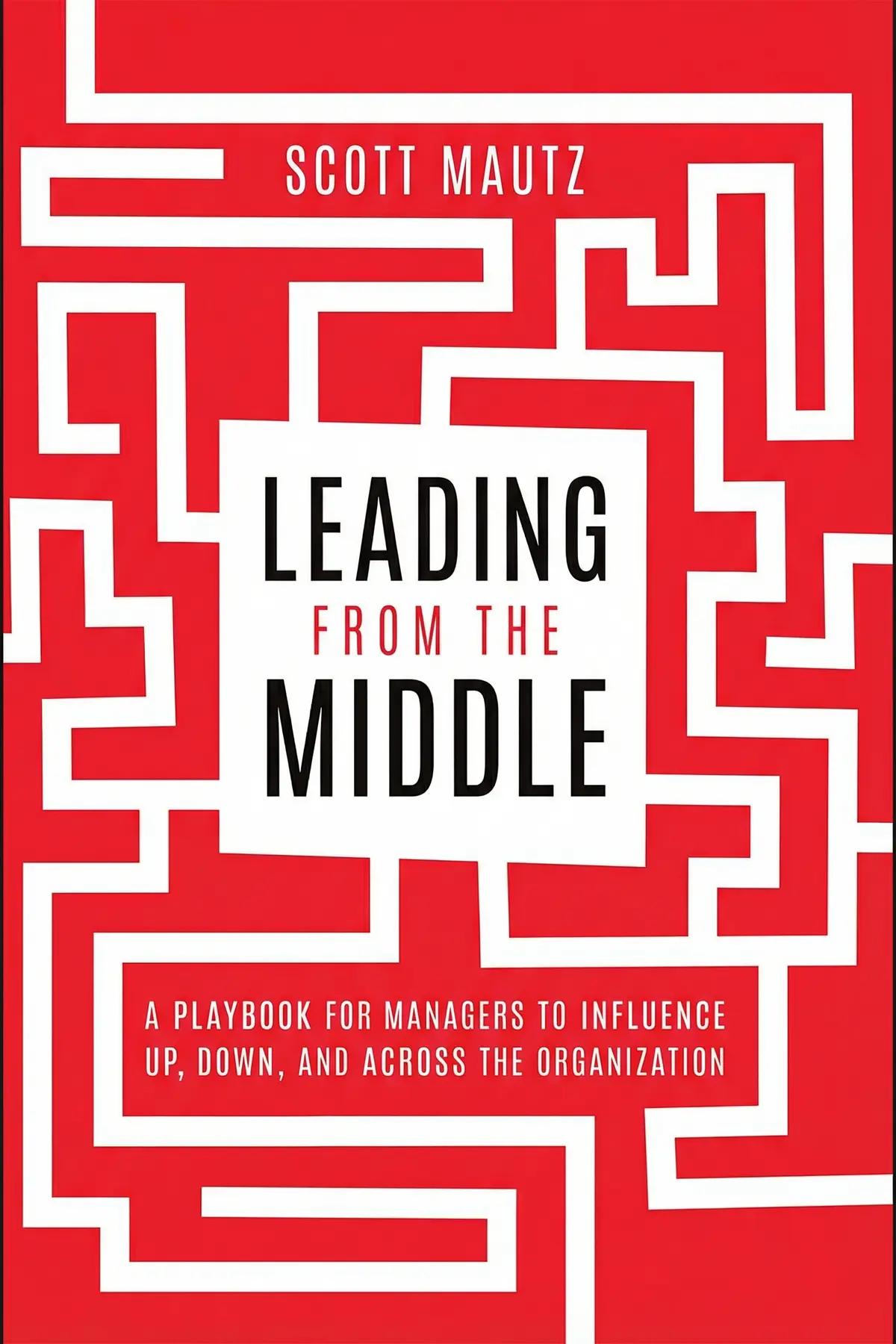
Table of Content
1. Introduction
1 min 02 sec
Middle managers carry pressure from three directions at once: the executives above them, the team below them and the peers beside them. In Leading from the Middle, former Procter & Gamble executive Scott Mautz argues that this squeezed spot is where big plans turn into daily work, which makes it one of the most influential seats in any company. He starts by naming the strain, sorting it into five pressures he gathers under the acronym SCOPE, and then offers a skill set called AMPLIFY to answer them.
The argument running through the book is simple. A manager in the middle earns influence through skill and personal trust, because rank alone gets compliance at best. From there Mautz turns to the people beside and below you, and to the hardest test of all, carrying a team through change with a four-phase model. What the book offers is a vocabulary for pressures most managers feel but rarely name, and a set of moves to try in your next one-on-one or reorganization.
2. Name the five pressures that squeeze middle managers
1 min 50 sec
Being pulled in every direction can feel like a personal failing. Mautz argues the pull has a clear shape, and that seeing which part of it drains you most changes where you should put your effort.
3. Bend with change and pull your team together
1 min 45 sec
Every new directive from the top can feel like a fresh disruption. A manager named Sam treats them differently, and the habits behind his calm say as much about the team around him as about himself.
4. Read office politics without playing dirty
1 min 43 sec
Ignoring rivalries and egos leaves a manager blindsided, but joining the games costs trust. Mautz describes a third option, along with a habit of spotting trouble inside your team before it shows up in the numbers.
5. Win agreement and set the tone others follow
1 min 40 sec
Many of the people a middle manager needs do not report to them at all. Mautz’s answer starts with listening and ends somewhere uncomfortable: with the manager’s own behavior, watched more closely than they think.
6. Coach your people to solve their own problems
1 min 55 sec
When a team member keeps missing deadlines, the fastest fix looks obvious. Mautz argues it often backfires, and a short scene between a tech manager and his struggling colleague shows what to do instead.
7. Carry your team through change in four phases
1 min 51 sec
Middle managers sit at the level where plans for change reach real people, which puts them in a position to instigate and drive it. Mautz’s model begins earlier than most managers do, and it ends with something many plans forget entirely.
8. Conclusion
1 min 09 sec
Mautz’s book recasts the middle of an organization. The squeeze is real, and SCOPE gives it five names, but the same position that pulls a manager in every direction also lets them decide what a strategy feels like on the ground. Whether a plan from the top becomes energy or resentment often depends on the person who explains it, adapts it and sits down with the team member who is stuck.
The tools all point the same way, toward influence a manager earns by noticing, listening and behaving consistently. That is why Sam reads the egos around him, why Mark asks Sarah questions instead of handing her answers, and why the change model opens with listening before any speech.
Two moves are worth trying soon. Name the SCOPE pressure that is draining you most, and pick the AMPLIFY skill that answers it. Then, in your next conversation with someone who is struggling, ask before you advise.
A title can make people comply. Commitment belongs to the manager in the middle who is trusted from above, from below and from across.
About this book
What is this book about?
Middle managers take pressure from every side. Executives hand down plans, teams bring up worries, and peers in other departments pull in their own directions. Scott Mautz argues that this position is where strategy becomes daily work, and that the people who hold it carry more influence than their title suggests. Mautz first names the strain with the acronym SCOPE: confusion over identity, conflict from many directions, the pressure to know everything, the physical toll and the emotional load. He then offers AMPLIFY, seven skills that run from adaptability and political savviness to compromise and setting the tone. He adds a coaching approach built on personal power, where managers help people solve their own problems, and a four-phase change model called EMC2 that moves a team from readiness to new habits. Readers get a shared vocabulary for pressures many managers feel but rarely name, illustrated through composite managers named Lisa, Sam and Mark. Each skill comes with moves to try in a one-on-one, a team meeting or the next reorganization.
Book Information
Who it's for
Middle managers
New and experienced middle managers caught between executive plans and a team's daily reality.
Leads hoping to coach
Team leads who keep fixing their people's problems and want to coach them instead.
Managers with change ahead
Managers about to roll out a reorganization or new process who need their team on board.
About the Author
Scott Mautz
Scott Mautz was a senior executive at Procter & Gamble, where he ran four of the company's largest businesses. He now speaks and trains internationally on leadership, team building, employee engagement, handling change and finding meaning at work. He teaches executive education at Indiana University's Kelley School of Business and is CEO of Profound Performance, a keynote, training and coaching company. Inc.com named him a Top 50 Leadership Innovator, and he wrote a column there. His other award-winning books include Find the Fire and Make It Matter.
Ratings & Reviews
Ratings at a glance

What people think
Listeners find the book packed with useful advice that is simple to digest and comprehend. They value its broad perspective on leadership, with one listener observing that it is highly relevant to their organization. The work earns praise for its insights, with one listener mentioning that it is based on rigorous data. Listeners describe the material as clear and easy to implement, while one review emphasizes that the concepts can be acted upon immediately.
Top reviews
Bua
Picked this up during a transition into a supervisor role, and it felt like a tailored playbook for my specific anxieties. Scott Mautz manages to capture the unique pressure of being the 'bridge' between the executive suite and the frontline staff. The advice is remarkably straightforward and easy to apply immediately, which is exactly what I needed while trying to establish my footing. I really do feel more confident having read it because the strategies for building trust and collaboration aren't just theoretical; they are backed by what feels like rigorous data. Truth be told, I was worried it would be another dry leadership tome, but the relatable examples kept me engaged. If you are a new manager looking for a way to have a greater impact within your organization right now, this is a must-read.
Show moreBunyarit
The chapter on building a culture of trust alone is worth the price of admission. Frankly, I didn't think I'd learn much new about management after a decade in the field, but Mautz surprised me with his rigorous data and unique perspective on influence. This book isn't just a collection of theories; it’s a practical guide that gives you a playbook for navigating the specific challenges of middle leadership. I loved the emphasis on being a bridge between frontline employees and the top-tier executives, which is a role that is often misunderstood. Each chapter is packed with actionable tidbits that I could use the very next morning in my staff meeting. It’s rare to find a business book that is this straightforward and immediately applicable to a complex organization.
Show moreLuckana
Mautz clearly spent a lot of time digging into the research before putting pen to paper, and that effort shows in the quality of the insights. Personally, I appreciated how the book moves from a big-picture approach down to the granular, tactical level that middle managers actually deal with daily. There is a ton of advice here, though some chapters felt a bit more focused than others. To be fair, the sheer volume of 'clever' acronyms can get a bit overwhelming after a while, making it hard to remember every single model he proposes. However, the usable tips on enhancing influence and driving results from the middle are far too good to ignore. It’s a solid resource for anyone who feels stuck in the middle of the organizational hierarchy and wants to move the needle.
Show morePenelope
As someone who has been stuck in the 'sandwich' of middle management for years, I found the realistic sentiment of this book very refreshing. Mautz does a great job of demonstrating the value these roles play, often being the unsung heroes of any organizational structure. The strategies for managing up and down simultaneously are particularly useful, providing a big-picture perspective that I hadn’t considered before. Not gonna lie, some parts are a bit heavy on the corporate jargon, but the actionable nature of the tips makes up for it. It’s a great way to get you thinking about how to empower your team while still meeting the demands of upper leadership. I’ll definitely be passing some of these principles along to my own direct reports this week.
Show moreRungtip
Finally got around to finishing this, and I’ve already started implementing the 'leading from the middle' framework with my direct reports. The book is full of practical tips that are easy to read and understand, which I appreciate given how little free time I have. Scott Mautz combines personal anecdotes with solid research to show exactly how middle managers can drive results without having total authority. To be fair, I did find myself skimming some of the more model-heavy sections, but the core message is powerful and highly applicable. It’s a great tool for anyone who wants to understand the big-picture impact of their role while staying grounded in daily operations. Definitely a solid addition to my professional library for the new year.
Show moreTan
Truth is, I was a bit skeptical about another leadership book, but this one provides a realistic sentiment regarding the unique pressures we face in the middle. Mautz does a fantastic job of highlighting how to cultivate collaboration across departments, which is often the hardest part of my job. I found the examples to be very relatable, and the writing style made even the more complex concepts accessible to someone who isn't a business major. My only minor gripe is that the book is a bit scattered, jumping from one clever acronym to the next without much transition. Still, the insights on managing the gap between leadership and employees are invaluable. It has definitely given me more career confidence and a better playbook for my daily interactions.
Show moreWatcharin
Look, the advice here is solid, but the delivery feels like it's drowning in a sea of acronyms and listicles that don't always have a clear through-line. I’ve read my fair share of business books, and while Scott Mautz obviously knows his stuff, this material might actually work better in a classroom setting where you can ask for specific examples. I found myself really trying to like this, yet I struggled to determine what was actually the most important takeaway. It’s not that the content is bad—it’s just a bit scattered and unfocused in places. I did appreciate the sections on cultivating a culture of trust, which resonated with my on-the-job experience. It’s a decent read if you have the patience to dig through the fluff to find the actionable gems.
Show moreRoongsak
After hearing a lot of buzz at a work book club, I finally sat down with this, but it didn't totally blow my mind. In my experience, most of what’s here is stuff you learn through trial and error on the job, though I suppose having it laid out in one place is helpful. Mautz provides some surprisingly usable tips, even if they are buried under a mountain of listicles that feel a bit repetitive. The writing style is engaging enough, but the book lacks a clear sense of what we should focus on first. Is it influence? Is it data? Is it collaboration? It’s all here, but it’s all given equal weight, which makes the implementation feel daunting. It’s a fine resource, but it didn’t quite offer the breakthrough I was hoping for.
Show moreVera
Ever wonder why business books feel the need to reinvent the wheel every five pages with a new catchy mnemonic? I found this book incredibly loaded down with acronyms to the point where it became a distraction from the actual message. Honestly, it was a chore to translate these business models into something I could use in a social work context, and I ended up feeling more frustrated than inspired. There’s a lot of information, but no real guidance on how to prioritize all these different frameworks in a real-world setting. Unless you are willing to do the hard work of organizing the scattered thoughts yourself, you might want to give this one a pass. It just lacked the connection and clarity I was looking for in a leadership guide.
Show moreNongnuch
Not what I expected given the high ratings. While there are definitely some useful tidbits buried in the text, the book is so loaded down with acronyms and models that it feels like Mautz is trying too hard to be clever. The truth is, I’m leaving the book feeling like I’m not quite sure if I actually retained any of it because the chapters are so scattered and unfocused. I really, really tried to like this, but it felt more like a textbook for a class that never ends than a practical guide for a busy professional. If you have hours to spare to dig out the nuggets of wisdom, go for it. Otherwise, there are much more concise ways to learn about leadership and influence without the acronym fatigue.
Show moreQuestions about this book
What is the main idea of Leading from the Middle?
Scott Mautz argues that middle managers turn big plans into daily work, so their role carries far more influence than it seems. He names the role’s pressures with the acronym SCOPE and answers them with AMPLIFY, a set of seven skills. He adds a coaching approach based on personal rather than positional power, and a four-phase model called EMC2 for guiding teams through change.
What does SCOPE stand for in Leading from the Middle?
SCOPE sums up five pressures middle managers face. Self-identity is the tension of speaking for leadership while also being the person the team confides in. Conflict comes from expectations arriving from above, below and the side. Omnipotence is the felt pressure to know everything. The last two are the physical demands of the role and its emotional strain, from absorbing the team’s worries and ideas.
What is the AMPLIFY skill set?
AMPLIFY is Mautz’s list of seven skills for managers in the middle. A is adaptability, M is meshing a team around a shared goal, P is political savviness, L is locking in on hidden problems such as bottlenecks and burnout, I is influencing, F is reaching compromise and Y is you setting the tone through consistent words, actions and values. He illustrates them through a composite manager named Sam.
How does Mautz suggest managers lead through change?
His EMC2 model has four phases. First, assess readiness by clarifying what is changing and why, gathering input and recruiting champions. Second, build enthusiasm with a vivid picture of the future. Third, move each person to commitment with empathy for their situation. Fourth, help people form new habits by making new behaviors easy and rewarding, and keep repeating why the change matters through several channels.
How can I apply Leading from the Middle this week?
Start by noting which of the five SCOPE pressures drained you most recently, then pick the AMPLIFY skill that answers it. Before your next one-on-one, prepare open questions and resist offering a solution first, as the manager Mark does with a struggling colleague. If change is coming, ask your team what they think is changing and why before you start persuading them.
Readers also enjoyed


A Year with Peter Drucker: 52 Weeks of Coaching for Leadership Effectiveness
Joseph A. Maciariello



Acting with Power: Why We Are More Powerful Than We Believe
Deborah Gruenfeld

All In: How Great Leaders Build Unstoppable Teams
Mike Michalowicz



7 Powers: The Foundations of Business Strategy
Hamilton Helmer
AUDIO SUMMARY AVAILABLE
Listen to Leading from the Middle in 15 minutes
Get the key ideas from Leading from the Middle by Scott Mautz, plus 5,000+ more nonfiction titles.
- 5,000+ titles
- Listen as much as you want
- 7-day free trial
- Cancel anytime









