

14 min 36 sec
Available in: English
Lead with a Story: A Guide to Crafting Business Narratives that Captivate, Convince and Inspire
By Paul Smith
Shows leaders how to use true stories to set service standards, prove company values, explain policies, bond teams and keep people going, and how to build a story people will remember.
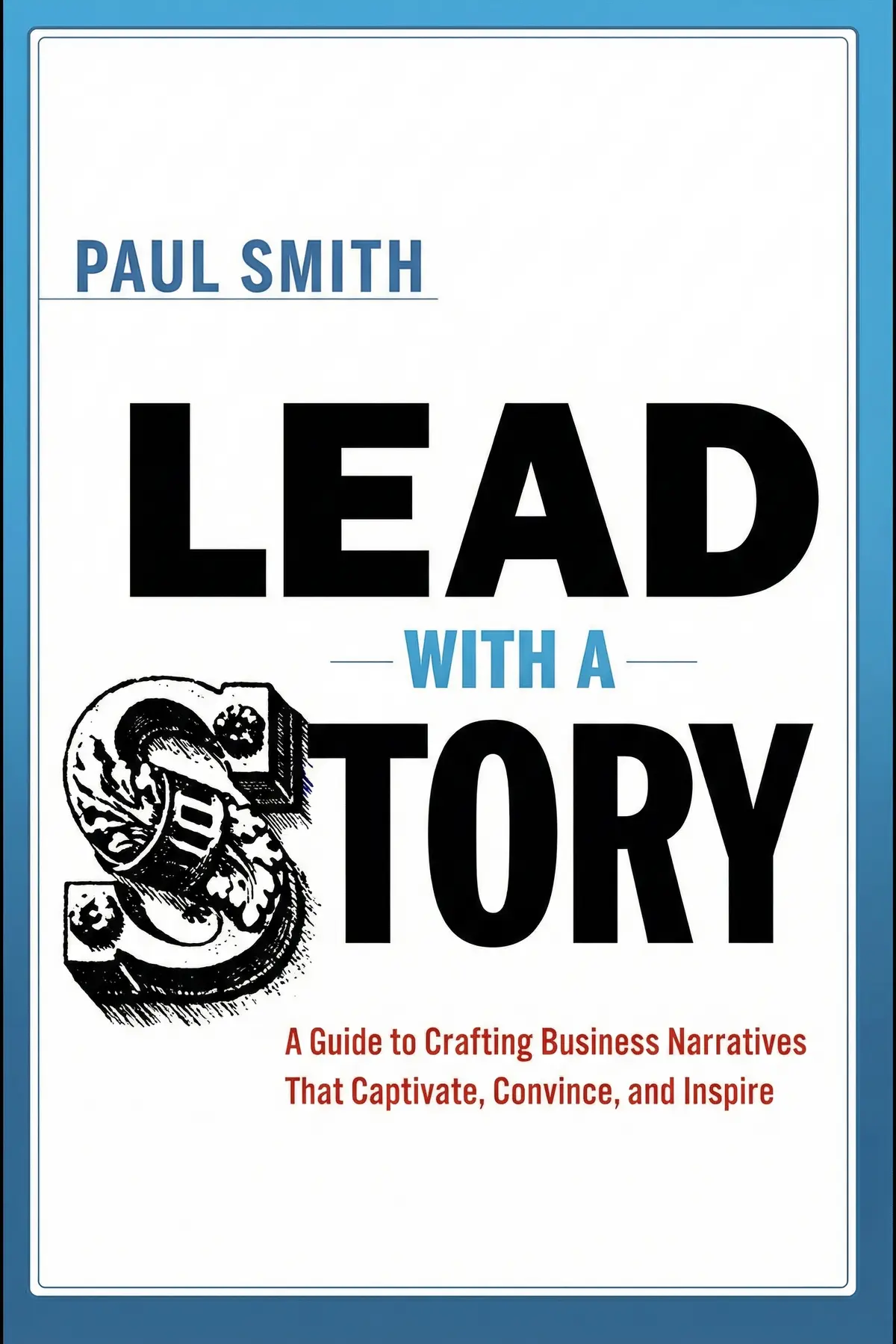
Table of Content
1. Introduction
1 min 02 sec
Most leaders try to move people with slides, slogans and rule books, and most of it is forgotten by the next meeting. In Lead with a Story, Paul Smith, who spent about twenty years at Procter & Gamble training managers to communicate, points to a better tool: the psychologist Jerome Bruner found that we are 20 times more likely to remember a fact when it arrives inside a story.
Smith treats storytelling as a working instrument of leadership. A well-chosen true story can set a service standard, prove what a company values, explain a policy, bond a team and keep tired people going. A well-built story follows a recipe anyone can learn, with a clear shape, the right emotion and a surprise in the right place.
What follows gives you both halves: where stories do a leader’s work better than anything else, and how to build the next one you tell so that it sticks.
2. Make your facts twenty times easier to remember
1 min 32 sec
Most numbers in a business review are gone by lunch, and the audience is not to blame. Smith traces the problem to the way people have learned for most of human history.
3. Turn one customer letter into a service standard
1 min 35 sec
A traveler arrived for two days of meetings and was told he could not legally rent a car. What the rental staff did next ended up changing how a whole company served its customers.
4. Show your values instead of announcing them
1 min 43 sec
Every company claims to care about its people, and almost nobody believes it. One evacuation during a revolution, and one free lunch that went wrong, show what actually makes values and rules believable.
5. Build trust on a team that barely talks
1 min 30 sec
A team leader who headed his group still could not seem to make real friends among them. One story, told in a single session, changed that and changed how hard they worked for him.
6. Keep people going when the work gets hard
1 min 31 sec
Near the end of a long project, motivational slogans fall flat. An Olympic runner on an injured knee and a snack brand that nearly failed show what a leader can say instead.
7. Give every story a context, action and result
1 min 36 sec
Most business stories fail before the lesson arrives, because listeners never knew what was at stake. Smith’s fix is a structure every schoolchild already knows, applied with a few sharp rules.
8. Choose the emotion that moves your audience
1 min 31 sec
A heartbreaking ad campaign in Texas failed to stop a single litterer. Its replacement cut littering dramatically, and the difference came down to whose feelings the story was aimed at.
9. Put the surprise where memory holds it
1 min 30 sec
A speaker drones for an hour and the audience keeps almost nothing. Smith shows two places in a story where surprise does its best work, and why the brain rewards one of them.
10. Conclusion
1 min 06 sec
Lead with a Story adds up to a plain claim about leadership: people act on what they can picture and remember, and a true story gives them both. National’s chief executive changed his company’s service by retelling one customer’s letter. P&G proved how it treats its people by booking seats on five different flights out of Egypt. A manager named Jamie earned his team’s effort by talking about his brother. Each time, a story did work that memos and slogans could not.
The habit Smith asks for starts with collecting. Give customers and colleagues a place to tell you what happened. When you need a story, give it a context, an action and a result. Aim it at a feeling your listeners already have, the way Texas traded a weeping stranger for its own sports heroes. Then save something unexpected for the final line, where adrenaline helps it stay.
The next time you reach for a statistic to make your point, find the person standing behind it and tell what happened to them.
About this book
What is this book about?
Most workplace communication is forgotten almost as soon as it is heard. Slogans about putting customers first sound empty, rule books go unread and statistics slip out of memory before the meeting ends. Paul Smith, who spent about twenty years at Procter & Gamble training managers to communicate, argues that leaders already hold a better tool: the story. Smith shows storytelling at work in five jobs a leader has to do. He covers spreading a service standard, proving what a company values, making policy clear, building trust inside a team and keeping people going when a project gets hard. His examples include a rental car company whose staff became one stranded customer's drivers, a family evacuated from Egypt during the unrest of 2011 and a marathon runner who finished on a dislocated knee. He then gives the craft behind a good story: a simple structure of context, action and result, a choice of emotion that matches what the audience cares about, and surprise placed where memory holds it best. Readers get both the reasons to tell stories at work and a method for telling them well.
Book Information
Who it's for
Leaders whose messages fade
Managers and team leads whose messages, values and policies get nodded at and then forgotten.
Senior leaders shaping culture
Founders and executives who want customer and employee stories to carry their company's culture.
Speakers wanting memorable stories
Trainers and presenters who want a simple structure for stories that audiences remember.
About the Author
Paul Smith
Paul Smith teaches leaders how to use storytelling in their work. He spent about twenty years at Procter & Gamble, where he led consumer and communications research and trained managers in leadership and communication, after earlier work as a consultant with Accenture. Besides Lead with a Story, he wrote Sell with a Story and Parenting with a Story, and Inc. Magazine named him one of its Top 100 Leadership Speakers of 2018. He holds an MBA from the Wharton School.
Ratings & Reviews
Ratings at a glance

What people think
Listeners find the work both accessible and captivating, noting that the superior prose offers valuable direction on utilizing narrative within leadership roles. Furthermore, the caliber of content is impressive; one listener highlights how it encourages a return to basic principles, while others value the inclusion of real-world scenarios and inspiring methods. Listeners also appreciate how the text improves their interpersonal interactions, and one listener points out its ability to build unity within their group.
Top reviews
Harper
Ever wonder why some leaders command the room while others just blend into the gray office wallpaper? This book answers that question by stripping away the dry corporate jargon and replacing it with narrative power. Smith makes a compelling case for using stories to create genuine team unity. It isn't just theory; the practical examples helped me rethink how I deliver quarterly updates to my own staff. Personally, I found the section on building commitment particularly strong. Even if you aren't a natural talker, the guidance here provides a solid roadmap for more effective interactions. It turned my dry data into something people actually remembered the next day.
Show moreVipawan
I was genuinely moved by how much heart Paul Smith puts into what could have been a very dry subject. Not gonna lie, a few of these stories actually made me tear up, which is a rarity for a business book! The anecdote about the pilot dealing with a mid-flight disaster was a standout moment that perfectly illustrated how to handle pressure and burnout. It’s incredible how a simple narrative can build such immediate rapport and trust with a skeptical audience. This isn't just about 'telling stories'—it’s about humanizing leadership. After finishing this, I felt a renewed sense of courage to be more vulnerable with my own team. Highly recommended for anyone who wants to lead with empathy.
Show moreWipada
The chapter on metaphors alone was worth the price of admission for me. In my experience, most leadership training forgets that humans are hardwired for narrative, not spreadsheets. Smith does a great job of showing how to appeal to emotion without coming across as manipulative or cheesy. The book is packed with practical 'how-to' advice that transcends the specific stories he tells. My only real complaint is that the chapter summaries are a bit cluttered with exercises, making them hard to use as a quick reference. Still, it’s an engaging read that offers a high-quality look at the fundamentals of communication. It definitely beats sitting through another boring PowerPoint training session!
Show moreWillow
Smith’s work is a masterclass in executive communication, even if it feels like a P&G commercial at times. The sheer volume of examples—over a hundred stories—ensures there is something for every possible management hurdle. I particularly appreciated the story matrix at the end, which serves as a quick-access tool for finding the right anecdote for the right moment. The writing style is engaging and moves at a clip. While some of the tales felt a bit 'canned' or familiar from the internet, their application to business principles is undeniably useful. It’s about more than just talking; it’s about inspiring movement within an organization.
Show morePatcharaporn
As a professional communicator, I initially picked this up thinking it focused on 'leads' for copywriting, but the focus on leadership storytelling was a welcome surprise. The book shifts the focus from purely logical persuasion to emotional connection. Smith explains metaphor and dialogue in a way that is easy to implement immediately. It’s geared more toward the spoken word, which is essential for anyone heading a department. The stories from Nokia and other older firms feel a bit dated now, yet the underlying lessons remain relevant. I’ve already used his 'Surprise Lesson' template to help my team navigate a recent project failure. It really helped us find the silver lining.
Show moreThida
Picked this up because my presentations were putting my coworkers to sleep. The truth is, people forget numbers but they remember how a story made them feel. Smith provides a massive repository of examples that you can basically borrow and adapt for your own needs. Some chapters felt a little overlapping, like the distinction between 'winning' and 'success,' but the overall utility is high. The writing is accessible and clearly written for the busy executive who needs to get a point across fast. I especially liked the exercises at the end of each chapter. They aren't just busywork; they actually make you think about your own career highlights. It’s a solid addition to any manager's bookshelf.
Show morePawinee
Finally got around to reading this, and it has completely changed how I approach my weekly staff meetings. The biggest takeaway for me was the idea of building a personal story repository so I’m never caught without a relevant example. Smith breaks down the 'ah-ha' moments that we all have but usually forget to document. The book is organized well enough that you can jump to specific challenges, like delegating authority or setting a vision. While the prose can be a bit dense in the middle, the payoff is worth the effort. It’s helped me create a much more cohesive environment for my remote team. We finally have a shared language.
Show moreKofi
To be fair, the premise that storytelling beats PowerPoint is hardly a revolutionary concept in today’s business world. While Smith provides a deep well of anecdotes, the book suffers from significant repetition that occasionally makes the reading experience feel tedious. The 'Five Es' structure—Envision, Environment, Energize, Educate, Empower—feels a bit forced and redundant in places. However, the templates for crafting your own narratives are a saving grace for any manager struggling with writer's block. I found myself skimming the middle sections to get to the actual techniques. It is a decent resource, but it could have been half the length and twice as impactful.
Show moreNang
Look, the advice here is solid, but the execution is a bit uneven across the board. The author leans very heavily on his P&G background, which makes the book feel a bit narrow in its cultural scope. I would have loved to see more global examples or diverse perspectives rather than just American corporate success stories. Also, citing Nokia as a prime example of success feels a bit strange given their trajectory shortly after the book was published. That said, the technical advice on how to use metaphors and repetition is gold. It’s a good follow-up if you’ve already read Steve Denning’s work on the subject. Useful, but definitely flawed.
Show moreSin
Frankly, this was a slog through stories I’ve already seen recycled a dozen times in various self-help blogs and LinkedIn posts. I hate books that could have been a single bulleted list, and this one definitely overstays its welcome at 300 pages. The author tells us to be concise and then proceeds to blabber on with repetitive prose that bury his actual points. Most of the stories are just glowing reviews of how great Procter & Gamble is, which feels more like corporate PR than a teaching tool. If you've read any other book on business storytelling, you can probably skip this one. My time is valuable, and I don't appreciate having it wasted on inane, recycled fluff.
Show moreQuestions about this book
What is the main idea of Lead with a Story by Paul Smith?
Smith argues that storytelling is a practical leadership tool. True stories carry knowledge and motivate behavior better than slogans, rule books or bare statistics, partly because, as psychologist Jerome Bruner found, facts in a story are 20 times more likely to be remembered. Leaders can use stories to set service standards, show values, explain policy, build trust and keep teams going, and Smith gives a method for building them.
What is the CAR structure in Lead with a Story?
CAR stands for context, action and result. Context sets where and when the story happens, who the hero is, what she wants and what stands in her way. Action is the struggle, told with a mix of wins and setbacks and not too much detail. Result shows who wins and gives the audience its lesson, either a path to follow or a warning.
How can leaders use stories to shape company culture?
Smith suggests replacing slogans with real events. Procter & Gamble shows its care for staff with the story of buying one employee’s family seats on five flights out of Egypt during the unrest of 2011. It explains policy by telling new hires about two employees fired for abusing the free trainee cafeteria. Smith also recommends collecting customer stories through a website story box, envelopes or review sites.
How do you make a business story memorable?
Smith points to two tools. First, choose the emotion your audience already feels: Texas cut littering by 72 percent once its ads tied litter to state pride instead of environmental sadness. Second, use surprise, both at the start and at the end. A surprising ending releases adrenaline during memory consolidation, which helps the story stick, as in his Abraham Lincoln story, which hides the name until the last line.
Who should read Lead with a Story?
It suits managers, team leads, founders and trainers who need people to remember and act on what they say. It helps most when slogans feel empty, policies go unread, a team lacks trust or a long project is losing energy. The book offers concrete stories, such as a rental car crew driving a stranded customer around, plus a simple structure for crafting your own.
Readers also enjoyed

A Bigger Prize: How We Can Do Better Than the Competition
Margaret Heffernan





A Year with Peter Drucker: 52 Weeks of Coaching for Leadership Effectiveness
Joseph A. Maciariello



AUDIO SUMMARY AVAILABLE
Listen to Lead with a Story in 15 minutes
Get the key ideas from Lead with a Story by Paul Smith, plus 5,000+ more nonfiction titles.
- 5,000+ titles
- Listen as much as you want
- 7-day free trial
- Cancel anytime









