

14 min 38 sec
Available in: English
Language Intelligence: Lessons on Persuasion from Jesus, Shakespeare, Lincoln, and Lady Gaga
Shows how short words, repetition, irony, foreshadowing and metaphor still drive persuasion in ads, politics and pop songs, so you can speak more memorably and notice when language is being used to steer you.
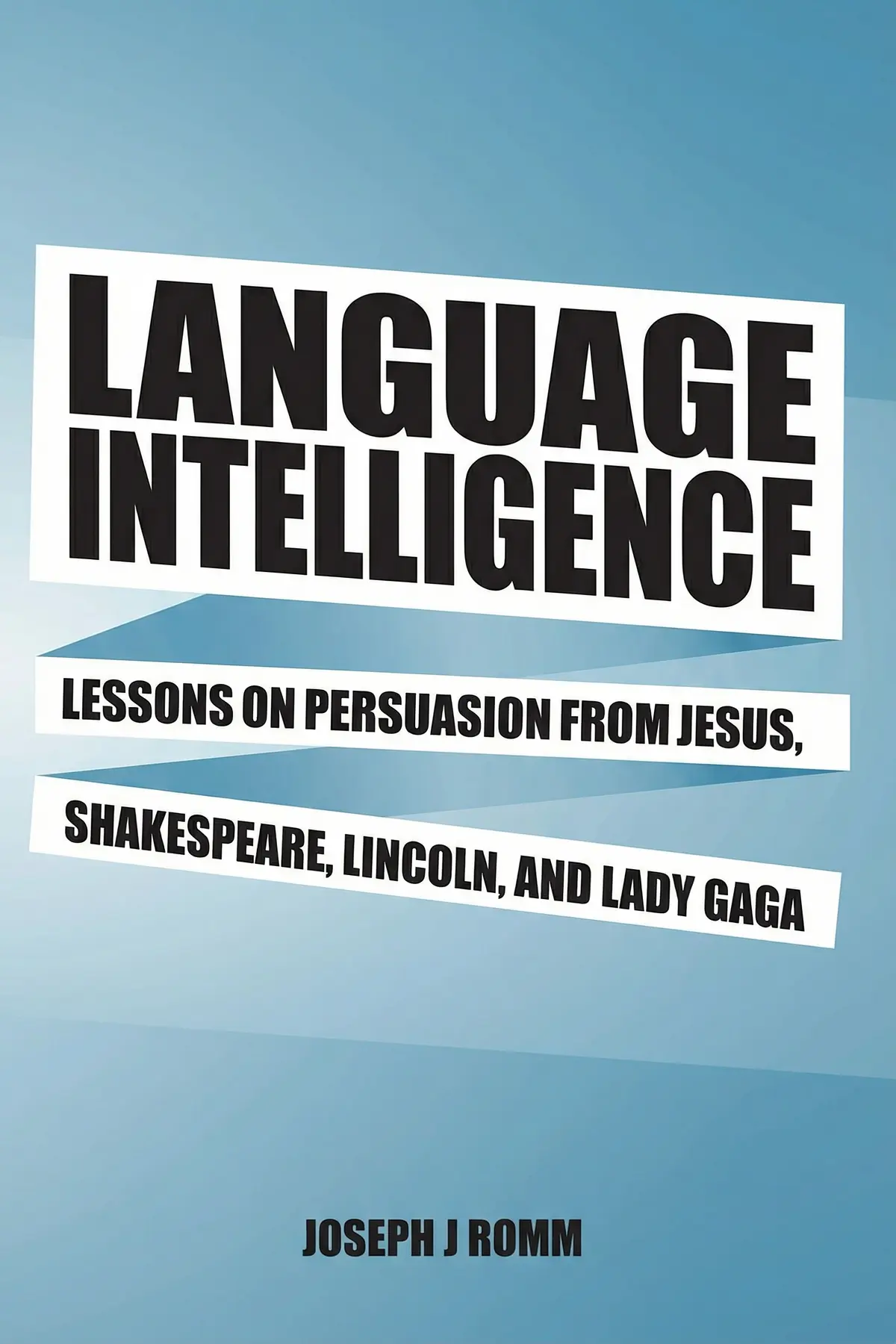
Table of Content
1. Introduction
1 min 01 sec
Most of us believe we judge an ad or a speech on its facts, while the words doing the real persuading slip past unnoticed. In Language Intelligence, physicist and author Joseph J. Romm argues that the old art of rhetoric never died. It went undercover, into tag lines, campaign slogans and pop choruses.
The proof starts with money. In 1992, two researchers, Edward McQuarrie and David Glen Mick, found that companies were spending billions on the study of language, with figures of speech at the heart of their advertising.
Romm’s case is that a small set of devices, short words, repetition, irony, foreshadowing and metaphor, has driven persuasion from the Bible and Shakespeare to George W. Bush and Lady Gaga. Learn to name them and two things happen at once. Your own words become easier to remember, and you start to hear when someone is working on your feelings while pretending to reason with you.
2. Spot the figures of speech hiding in every ad
1 min 28 sec
Scholars celebrating one of the finest works in English somehow ignored the very thing that made it great. Advertisers made no such mistake, and they spend fortunes on what everyone else forgot.
3. Say more with fewer, shorter words
1 min 31 sec
Critics laughed at one president’s plain vocabulary, yet a few unplanned words through a bullhorn became one of his defining moments. Romm explains why the simplest sentences are often the ones that last.
4. Repeat the one line you want remembered
1 min 36 sec
Your school teacher probably marked you down for repeating yourself. A pop star, a gospel writer and a future president all ignored that rule, and their words are still circulating today.
5. Spot honest irony and see through the smoke screen
1 min 36 sec
A joke about scientists and an ice age circulated for years, though it had no basis at all. Irony can bury a truth or reveal one, and the difference is easy to miss.
6. Plant your main point in the first minute
1 min 39 sec
A pistol on stage in the first act tells the audience something will happen, and that knowledge makes the play better. One civil rights leader used the same principle in the opening lines of a famous speech.
7. Metaphors that reach feelings without backfiring
1 min 40 sec
Calling someone your honey sounds sweet until you learn what that word reminds them of. Metaphors go straight to emotion, and a study of murder estimates shows how they also bend our judgment.
8. Keep one picture steady and your case holds
1 min 32 sec
A shepherd, a flock and a wolf have shaped how millions picture devotion. Political campaigns borrow the same technique, and one campaign showed what happens when two pictures fight each other.
9. Notice when "no pressure" is the pressure
1 min 34 sec
A salesperson tells you there is no need to decide today, and you walk out with a purchase. An old warning from Plato and a book about an elephant explain why.
10. Conclusion
1 min 01 sec
Romm’s larger claim is that rhetoric never left. It moved into places we stopped watching: the jingle, the campaign line, the friendly salesperson, the joke that ends a debate. The same few devices link the shepherd of John’s gospel to a pop chorus that repeats its title 30 times, and the people who use them well tend to win the room, whether or not they are right.
That knowledge works in both directions. When you need to be heard, choose short words, say your main line more than once, hint at your ending early and hold one image steady from start to finish. When you are the one being persuaded, slow down and take the message apart. Romm’s own advice is to treat the next political speech as a text to examine: which devices did the speaker use, and why? Once you see what they wanted you to believe, the real stakes become clearer.
Plato’s doctor lost the crowd to a better talker. Knowing the talker’s tools is how you avoid being that crowd.
About this book
What is this book about?
Persuasion seems to run on facts and data now, and the classical art of rhetoric has almost disappeared from schools and universities. Joseph J. Romm argues that this is a dangerous mistake. Rhetoric never went away. It moved into advertising slogans, campaign speeches and pop choruses, where it works on people who no longer know how to recognize it. Romm takes a handful of core devices and shows each one at work across very different worlds: the King James Bible, Shakespeare's plays, Martin Luther King Jr.'s March on Washington speech, George W. Bush at Ground Zero and Lady Gaga's Poker Face. Short words, repetition, irony, foreshadowing, metaphor and extended metaphor all make a message stick, and the same devices can hide a weak argument or push a reluctant buyer. Readers get two things from the book. They learn practical ways to make their own words clearer and more memorable, and they learn to take apart a speech, an ad or a sales pitch to see what the speaker really wants them to believe.
Book Information
Who it's for
Wanting their message remembered
Professionals who give presentations or pitches and want their key message to be remembered.
Voters and news followers
Voters and news readers who want to see past political slogans and spin.
Curious how ads persuade
Shoppers and students curious about how ads, songs and sales talk shape their choices.
About the Author
Joseph J Romm
Joseph J. Romm holds a Ph.D. in physics from the Massachusetts Institute of Technology. In the 1990s he worked at the US Department of Energy, serving for six months as Acting Assistant Secretary. In 2006, as a senior fellow at the Center for American Progress, he founded the blog Climate Progress, and in 2009 Time magazine named him one of its environmental heroes. He has written ten books on global warming, clean energy and communications.
Ratings & Reviews
Ratings at a glance

What people think
Listeners describe this work as educational and excellently composed, specifically valuing how it clarifies intricate ideas through straightforward narratives. Furthermore, they view it as a brilliant study of great rhetorical feats, and one listener points out that it is packed with examples from contemporary events. The content is also accessible, stimulating, and practical, with one listener remarking that the insights are instantly applicable.
Top reviews
Wararat
Ever wonder why some political slogans feel inevitable while others fail to launch? Joseph Romm delivers an incredible survey of rhetoric that connects the dots between Shakespearean drama and the modern-day pop lyrics of Lady Gaga. To be fair, I initially scoffed at the idea of comparing the Bible to a hit like "Poker Face," but his analysis of extended metaphors is genuinely eye-opening. The book is designed to make you a more persuasive communicator by using short words and strategic repetition. It’s a fast, punchy read. These insights provide immediate tools for anyone who writes or speaks for a living. I found the sections on how Republicans often out-message Democrats particularly insightful for our current political climate. If you want to understand the secret language of power, this is a must-have resource on your shelf.
Show moreTun
Joseph Romm has written what I consider a masterwork about masterpieces. This book doesn't just explain rhetoric; it demonstrates it through vibrant examples ranging from Winston Churchill to Bob Dylan. I've been looking for a guide that bridges the gap between ancient Greek techniques and the digital age’s 24-hour news cycle, and this is it. Romm succeeds by focusing on how "language intelligence" helps us create memorable brands and headlines that actually stick. Personally, I loved the breakdown of how metaphors mirror the human brain’s own physical structures. It’s a thought-provoking look at why facts often fail when they aren't wrapped in a compelling frame. You’ll walk away feeling much harder to manipulate by the ultra-subtle seducers in advertising and politics.
Show moreBella
Finally, someone has written a rhetoric book for the modern era that isn't boring! Romm takes these ancient tools and shows how they are still being used by everyone from Bill Clinton to the people writing your favorite pop songs. I found the advice on using short words and alliteration to be immediately helpful in my own professional emails and presentations. The truth is, most of us are being manipulated by these techniques every day without even realizing it. Reading this felt like finally getting the "source code" for how public opinion is shaped. It’s easily one of the most thought-provoking books I’ve read this year. I highly recommend it to anyone who wants to improve their communication skills and stand out in a crowded media landscape.
Show moreKai
Look, if you want to understand why some messages go viral and others die in obscurity, you need to read this immediately. Romm argues that facts alone cannot fight false frames, which is a bitter pill for many of us to swallow but absolutely necessary to understand. He uses examples from the Bible and Shakespeare to show that these "tricks" of the trade are as old as time itself. I especially liked the section on how salespeople use the "no pressure" tactic to actually increase their conversion rates. While the author’s own political biases are present, they serve as useful case studies for the rhetorical tools he is teaching. It’s a brilliant little book that has already changed the way I approach my own writing.
Show moreSupaporn
Picked this up after following Romm’s climate change blog for years, and his expertise in messaging really shines through here. He argues that we are in a rhetorical arms race where simple frames usually beat complex data points every single time. While I found his constant references to Lady Gaga a bit excessive, his core argument about "fighting fire with metaphorical fire" is incredibly persuasive. The book is structured like a modern primer on the art of speech, making it easy to digest in just a couple of sittings. My only real gripe is that he occasionally repeats the same examples to the point of exhaustion. Still, his insights into why scientists often lose public debates are worth the price of admission alone. It’s a solid 4-star read.
Show moreSomboon
After hearing a podcast interview with the author, I decided to dive into this short but potent guide. Romm explores how figures like Abraham Lincoln and Jesus used specific rhetorical devices to ensure their messages survived for centuries. It’s a fascinating, if sometimes cynical, look at how to pander effectively to an audience that might be distracted or superficial. I found the chapter on Socratic irony especially interesting, even if I disagreed with his take on George W. Bush’s communication style. The writing is clear and avoids the dry, academic tone you usually find in books about linguistics. It’s not quite as deep as Lakoff’s work, but it’s much more practical for the average blogger. A very useful tool for your professional kit.
Show moreNarut
The chapter on metaphor is undeniably strong, but I struggled with the book's relentlessly quantitative perspective on success. Romm seems to believe that YouTube hits and retweets are the ultimate metrics of "intelligence" in language. While he correctly identifies how repetition helps a message stick, he says very little about building a complex, evidence-based argument. It felt more like a manual for creating catchy soundbites than a deep dive into meaningful communication. To be fair, his analysis of the "I Have a Dream" speech was excellent, but then he’d pivot back to pop stars and lose me again. If you want to be wittier on Twitter, this book will definitely help you. If you’re looking for a serious aesthetic relationship with writing, you might want to look elsewhere.
Show moreJib
Honestly, I had a bit of a mixed reaction to this one. On one hand, Romm has a keen understanding of how rhetoric works and provides plenty of current affairs examples to prove his points. On the other hand, the book feels a bit like an undergraduate English essay that’s been expanded into a self-published volume. He makes bold claims—like asserting that President Obama isn't charismatic because he lacks metaphor—that simply don't hold up under scrutiny. I also found the constant repetition of the same five or six examples to be quite tedious after a while. It’s an okay primer for someone who has never studied literature, but it lacks the scientific rigor I was hoping for. It works as a basic introduction.
Show moreRungrat
Not what I expected from a book with "Intelligence" in the title, if I’m being frank. It’s a very light read that covers basic rhetorical devices like rhyme and irony through a series of celebrity anecdotes. While it’s certainly informative for a beginner, it lacks the depth of more substantive works like Lakoff's "Metaphors We Live By." Romm seems focused on quantity over quality, prioritizing web traffic and pithy headlines over nuanced discussion. I did appreciate the historical context regarding the Sophists, but the book spends way too much time on pop culture hits. It’s an easy read that might give you a few tips for your social media presence, but don't expect a profound shift in your understanding of linguistics. It is just okay.
Show moreSavannah
This felt more like a collection of blog posts than a cohesive book, and I was disappointed by the lack of original research. Romm relies heavily on a few specific figures—like Gaga and Dylan—to illustrate every single point, which gets old fast. The book is peppered with praise for the author’s own blog, which felt a bit self-serving and unprofessional for a published work. I also take issue with his idea that we should fight "metaphorical fire with fire" by oversimplifying complex issues. Instead of encouraging better discourse, this book feels like it’s teaching us how to pander to the lowest common denominator. To be fair, there are a few rare facts sprinkled in, but not enough to justify the length. It was a quick read, but not satisfying.
Show moreQuestions about this book
What is the main idea of Language Intelligence by Joseph Romm?
Romm argues that rhetoric, the classical art of persuasion, is still everywhere even though schools barely teach it. Advertisers, politicians and pop stars rely on a small set of devices, including short words, repetition, irony, foreshadowing and metaphor. Understanding those devices helps you communicate in a way people remember, and it makes you harder to manipulate, because you can see what a speaker is doing and why.
Why does Romm call Lady Gaga the queen of pop rhetoric?
Romm points to her mastery of repetition and simplicity. Even her stage name repeats itself. In her 2009 hit Poker Face, the title comes around 30 times, and she stretches the first word into a stutter several times to drive it home. For Romm, this shows the same principle found in the Gospel of John and in political speeches: people learn and remember through repetition.
Why does Romm say George W. Bush was a gifted speaker?
Romm argues that Bush’s plain vocabulary, which critics mocked, sounded sincere to voters. His strength was finding a few short words at the right moment. At Ground Zero, two days after the September 11 attacks, someone shouted that they could not hear him, and Bush replied at once that the world could hear them and the attackers would soon hear from America.
How can metaphors mislead people according to Language Intelligence?
Metaphors go straight to emotion and also shape how the brain sorts information. Romm cites a 2001 study by Kahneman and Frederick in which students judged Detroit twice as deadly as the whole state of Michigan, though the murder numbers were nearly equal, because Detroit served as shorthand for crime. Metaphors can also carry painful associations a speaker never intended.
How can I apply the lessons of Language Intelligence?
For your own speaking, use short words, repeat your key line, hint at your main point early and keep one consistent image throughout. When you are on the receiving end, analyze rather than absorb: ask which devices a politician or seller is using and why. Be especially alert to negative suggestions like no pressure to buy, which Kevin Hogan found can actually push people to buy.
Readers also enjoyed





AUDIO SUMMARY AVAILABLE
Listen to Language Intelligence in 15 minutes
Get the key ideas from Language Intelligence by Joseph J Romm, plus 5,000+ more nonfiction titles.
- 5,000+ titles
- Listen as much as you want
- 7-day free trial
- Cancel anytime









