

15 min 36 sec
Available in: English
Kaput: The End of the German Miracle
Explains how the export model that rebuilt Germany after the war turned into the cause of its decline, through state-steered banks, distrust of digital technology and risky dependence on Russian gas and Chinese supply chains.
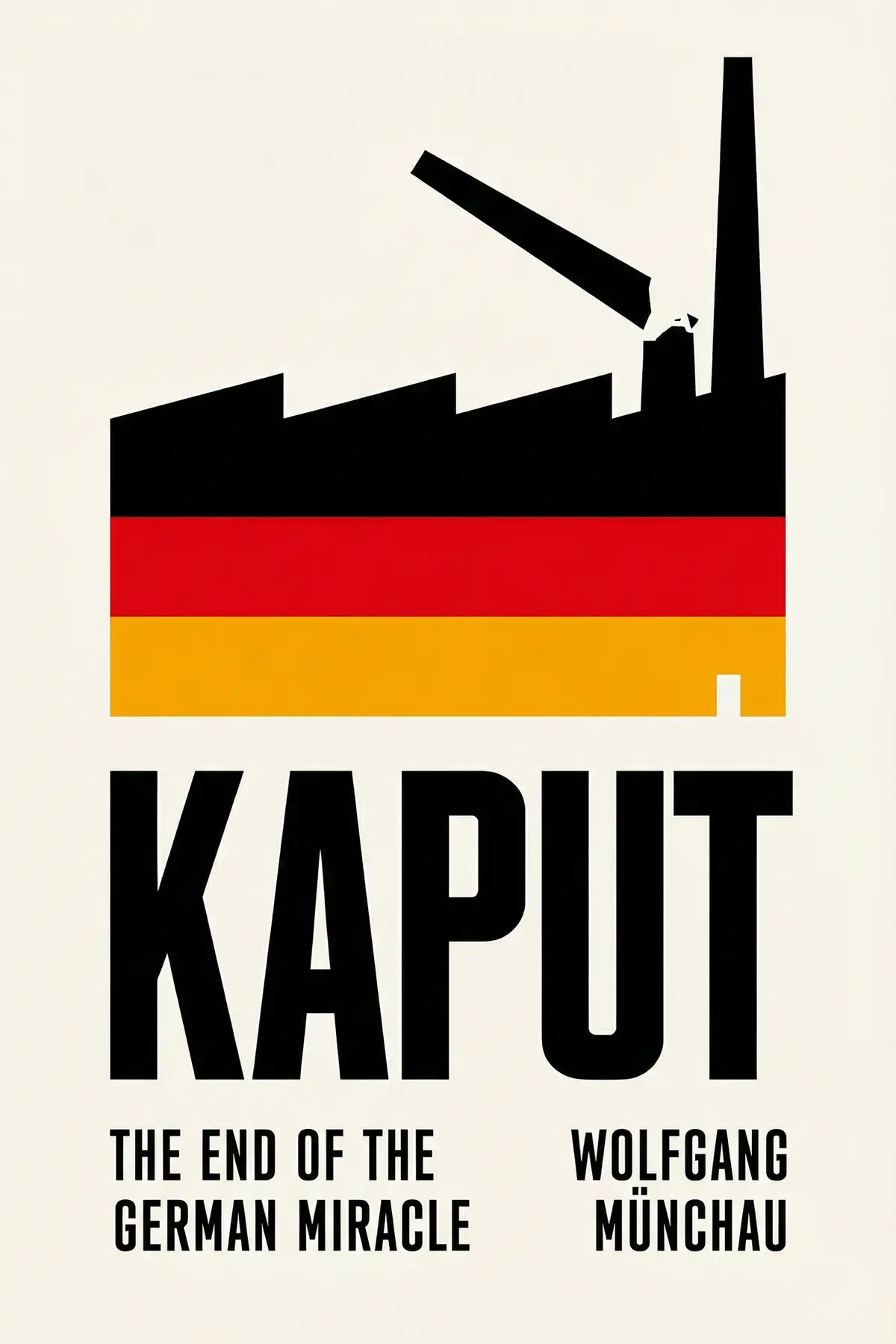
Table of Content
1. Introduction
1 min 01 sec
If headlines about Germany’s slump leave you unsure what actually went wrong, the short answer is that the country’s strengths turned against it. In Kaput, economic journalist Wolfgang Münchau traces the trouble to the postwar economic miracle itself: a model built on low wages, cheap state credit and ever larger export surpluses. He argues that the same habits, kept long after the world changed, are now pushing the world’s third-largest economy into decline.
Each idea follows one of those habits. There are banks that took orders from politicians, a ruling class wary of anything digital, cheap gas from Russia and an apparently endless market in China. Then come the visible costs, from closed bridges to a rising far right, and the reforms Münchau believes could still reverse course. What emerges is a clear account of how a rich country stalls, and a lesson that travels to any company or career built on yesterday’s winning formula.
2. See what an export obsession really costs
2 min 15 sec
A system that rebuilt a shattered country and was copied around the world had a weakness built into its design. A bank nicknamed the Red Godfather shows how the strength and the flaw were the same thing.
3. Learn from a country that kept betting on analog
2 min 24 sec
Germany gave the world both the printing press and the diesel engine, yet it spent fifty years refusing the digital age. A photographer, a printer and a horse reveal just how far behind it fell.
4. Cheap energy from a rival carries a hidden bill
2 min 25 sec
For fifty years, German leaders treated Russian gas as a bargain that served both business and peace. On September 26, 2022, the true price arrived overnight, and it was paid in closed plants.
5. Learn why China now holds the upper hand over Germany
2 min 26 sec
Germany once sold China its machines and its know-how and enjoyed the upper hand. Within a few decades the numbers had flipped, and one chemical giant’s chief admitted what a crisis over Taiwan would mean.
6. Read a nation's decline in its bridges and ballots
2 min 04 sec
A motorway closed for years, a bridge trucks could not cross for eight, and a far-right party nearing first place. A rescue plan worth hundreds of billions was also killed, and not by its opponents.
7. Two reforms that could fund Germany's repair
1 min 50 sec
Münchau believes the slide can still be stopped, but only through bold reforms, including changes to Germany’s strict fiscal rules. His proposals reach from the old regional banks all the way into the constitution.
8. Conclusion
1 min 11 sec
Kaput is a story about success that refused to update. Low wages, obedient banks, loyal old industries, cheap Russian gas and a vast Chinese market each made sense when it was chosen. Each became a trap because Germany kept it long after the world had moved on, and because every short-term win made the next change harder to accept.
The image worth keeping is the photographer’s horse, trotting 10 kilometers with a load of photos, coming home, eating its dinner, and still beating the internet. A country that gave the world the printing press ended up there one reasonable decision at a time.
The book also offers a way of looking at any organization, including your own. Watch where the profits go: if they only return to what already works, the future is going unfunded. Treat a cheap supplier or a huge customer as a dependency, and measure each year how the balance is shifting. And when a rule meant to keep you safe starts blocking repairs, Münchau’s case suggests the rule itself has become the risk.
Germany’s miracle was real. In Münchau’s telling, the formula that wrote its first chapter cannot write the next one.
About this book
What is this book about?
After the Second World War, Germany rebuilt a ruined economy into Europe's strongest, an achievement remembered as its economic miracle. Today its factories struggle, its roads and bridges are crumbling, its internet is slow and support for the far right is rising. Wolfgang Münchau sets out to explain how the world's third-largest economy got here. His answer is uncomfortable. The trouble did not arrive from outside. It grew out of the formula that made Germany rich: low wages and cheap state credit to win export markets, regional banks that obeyed politicians, an elite that kept choosing analog over digital, cheap gas from Russia and ever deeper ties to China. Each choice paid off in the short term, and each became a trap once the world changed. Readers get a clear, story-driven account of a rich country's stall, from the Red Godfather bank and a horse that beat an internet upload to the Nord Stream explosions and a BASF chief admitting his company could collapse over Taiwan. Münchau closes with the reforms he believes could still turn things around.
Book Information
Who it's for
European economy watchers
Professionals who follow European economics and want to understand why Germany stalled.
Leaders of proven businesses
Founders and managers whose business still runs on a formula that once won and may now be aging.
Energy geopolitics followers
Readers curious how energy deals and supply chains turned into geopolitical weak points.
About the Author
Wolfgang Münchau
Wolfgang Münchau is a German economic journalist and a co-founder of Eurointelligence, a platform that analyzes the economics of the Eurozone. His columns have run in The Times, the Financial Times and the New Statesman. In 2016 he received the Wirtschaftspublizistik award. He is also the author of The Meltdown Years.
Ratings & Reviews
Ratings at a glance
What people think
Listeners find this work to be a keen and approachable evaluation of Germany's recent economic history, focusing especially on its dependence on Russian fuel and the weakening of its manufacturing base. Additionally, they value the perceptive exploration of how red tape and the "neo-mercantilist" approach have obstructed progress in the digital sector. They further point out that the thorough study of the car industry is very enlightening, with one listener observing that the text offers a "solid account" of the nation's policy mistakes. Although some find the writer’s perspective too negative about what lies ahead, they nevertheless describe the title as a thoroughly researched guide to navigating a complicated economy in turmoil.
Top reviews
Soontorn
Wolfgang Münchau provides a chilling diagnostic of the German 'economic miracle' turned nightmare. He masterfully deconstructs the 'neo-mercantilist' obsession with exports that left the country vulnerable once cheap Russian gas vanished. The book isn't just about spreadsheets; it’s about a cultural refusal to embrace the digital age. While the US and China were building the future of AI and software, Germany was busy perfecting the internal combustion engine. Gotta say, some might find the tone a bit harsh, but the reality on the ground in Berlin confirms many of these points. It is a necessary, if uncomfortable, read for anyone interested in the future of the EU. The author connects the dots between industrial decline and the recent collapse of the Scholz government with remarkable foresight.
Show moreTee
Ever wonder why a country famous for engineering can't seem to figure out basic software or venture capital? Münchau’s breakdown of German bureaucracy is both hilarious and depressing. He uses the example of vertical farming to show how red tape kills innovation before it even starts. The section on Landesbanken was particularly enlightening; it’s shocking how local politicians use these banks to prop up zombie companies instead of investing in the future. It’s a world where vertical farming is strangled by red tape and local politicians treat public banks like personal piggy banks to bail out failing steel plants. It is maddening. This should be mandatory reading for every policymaker in Brussels and Berlin who thinks austerity is a magic bullet.
Show moreCaleb
Münchau’s 'Kaput' is the obituary for the industrial engine that powered Europe for half a century. It’s a biting, brilliant analysis of how arrogance and bureaucracy turned a global leader into the 'sick man of Europe.' He doesn't hold back when discussing how politicians like Schröder and Steinmeier tethered the country to Putin's whims. The lack of venture capital and the cultural fear of 'Neuland' (digital territory) are portrayed as the ultimate sins. It is rare to find an economic book that reads like a thriller, but the stakes here are high enough to justify the tension. Highly recommended for anyone tracking global shifts. The Schumpeterian battle is being lost in real-time.
Show moreWanida
Not what I expected from a book on economics, but I found myself genuinely gripped by the narrative of decline. The way the author explains the fall of the German car industry—from 'lord and master' of the road to struggling with software—is fascinating. It’s not just about money; it’s about a mindset that got stuck in the 1990s. Truth is, I picked this up thinking it would be dry, but the personal anecdotes and the 'iPad on wheels' comparisons make it very readable. It made me look at my 'Made in Germany' appliances in a whole new, slightly more worried light. Absolutely worth the time for the insights into the 'auto-politics' alone.
Show moreSomboon
Picked this up after seeing the headlines about the German government collapse, and the timing couldn't be better. The author explains the car industry crisis perfectly—calling a Tesla an 'iPad with wheels' really highlights how far behind Volkswagen has fallen. We used to think German engineering was invincible, but Münchau shows how they bet everything on the wrong horses. The chapters on Russian energy dependency were especially eye-opening and deeply frustrating. I wish there was a bit more hope offered, but maybe the situation just doesn't allow for it right now. Still, this is the most accessible economics book I've read this year. It turns a dry subject into a compelling narrative of strategic failure.
Show moreTaw
As someone who has lived in Berlin for a decade, I can't help but feel Münchau has hit the nail on the head regarding the 'digital desert' we live in. We are surrounded by amazing mechanical engineering, yet the internet barely works and cash is still king. The author connects these daily frustrations to the larger 'neo-mercantilist' strategy of the state. He argues that the focus on exports has left our infrastructure in ruins. In my experience, the book is quite pessimistic. However, when you see the state of the railways and schools, it's hard to disagree with his bleak outlook. It provides a sharp, penetrating analysis of how the 'Schumann' era of stability actually sowed the seeds of today's chaos.
Show moreMaksim
This isn't just a book about Germany; it’s a warning for any nation that gets too comfortable in its manufacturing niche. I found the analysis of the China-Germany relationship to be the strongest part of the text. For years, Germany thought they were selling tools to China, only to realize China was learning to build better versions of those tools themselves. Münchau’s point about the 'Schumpeterian battle' of creative destruction is vital. If you stop innovating, you don't just stand still—you fall behind. The writing is sharp and moves quickly through complex topics without becoming bogged down in jargon. It’s a bit repetitive in the middle chapters, but the core argument about the end of cheap energy is undeniable.
Show moreYaowaluk
The history here is top-notch, but the conclusions feel a bit like a stretch. I appreciated the deep dive into the 2005-2015 era, especially the stuff about labor market reforms and the 'black zero' austerity policy. It gives a lot of context to why things feel stagnant today. However, I’m not entirely sold on the idea that the entire German model is 'kaput' forever. Personally, the author’s point about the lack of digital innovation is hard to argue with when you try to use public services here. It’s a solid read if you want to understand the past, but I'd take the future predictions with a grain of salt. Good economic history, poor conclusion.
Show morePornpimon
Frankly, the author's fixation on 'neo-mercantilism' overlooks the structural benefits that the export model provided for years. While Münchau is right that the reliance on Russian gas was a strategic blunder, he acts as if the entire German culture is a fallacy. Look, the automotive industry is struggling, but writing off the entire precision engineering sector feels premature. The book also ignores how similar corporate lobbying problems exist in the US, which he holds up as a digital role model. It’s an interesting read for the historical data on the Landesbanken and the SPD's ties to Russia, but I found the overall thesis to be way too one-sided. It’s informative, but definitely written with an axe to grind.
Show moreKamol
Do we really need another doomsday prophecy about the European heartland? The author writes with a certain sanctimonious air that suggests he is the only person who understands basic macroeconomics. While he provides a decent historical account of the energy pivot, his insistence that the system is beyond repair feels like clickbait. Germany has faced existential crises before and managed to bounce back. Münchau admits the country has a history of resilience, yet he largely ignores that possibility for the future. It's a well-documented book regarding the 2000s, but the "everything is broken" conclusion is just exhausting. I found the constant bashing of the car industry particularly one-sided and lacking in nuance.
Show moreQuestions about this book
What is the main argument of Kaput by Wolfgang Münchau?
Münchau argues that Germany’s decline grew out of the model behind its postwar economic miracle. Low wages, state banks lending to favored industries and huge export surpluses worked in the twentieth century. Kept unchanged, they left Germany behind in digital technology and dependent on Russian gas and Chinese supply chains, with costs now visible in crumbling infrastructure and rising support for the far right.
What is neo-mercantilism in Kaput?
Münchau uses the term for an economic approach that treats world trade as a contest where one side’s gain is the other’s loss, so exports matter more than growth at home. In Germany it meant keeping wages low to make goods cheap abroad and using regional state banks, the Landesbanken, to fund industrial giants. The result was a trade surplus worth 8 percent of GDP.
How did Russian gas and China weaken Germany according to the book?
Since a 1970 gas deal, German leaders treated cheap Russian energy as good for business and peace, and reliance grew to 55 percent of gas supply. When the Nord Stream pipelines were destroyed in 2022, replacement gas cost three times as much. With China, Germany went from the stronger partner to a buyer relying on Chinese suppliers for more than 80 percent of imports in 36 critical sectors.
What reforms does Münchau propose for Germany?
He puts two first. One is a unified European financial system backed by bonds that governments issue together, which would stop German banks from endlessly funding failing industries. The other is reforming the constitutional debt brake, which caps the deficit at 0.35 percent of GDP and, he argues, has blocked infrastructure repairs and digitalization. Both would free money for digital industries, roads, railways and energy grids.
Who should read Kaput?
It suits readers who want a clear explanation of why Europe’s biggest economy is struggling, from slow internet to closed bridges and a rising far right. It also speaks to founders, managers and investors, because its central lesson applies to any organization: a formula that once brought success can become the trap that holds you back when the world changes and you keep reinvesting in the past.
Readers also enjoyed

A River in Darkness: One Man’s Escape from North Korea
Masaji Ishikawa

A Splendid Exchange: How Trade Shaped the World
William J. Bernstein

A Theory of Justice
John Rawls





A Warning
Miles Taylor
AUDIO SUMMARY AVAILABLE
Listen to Kaput in 15 minutes
Get the key ideas from Kaput by Wolfgang Münchau, plus 5,000+ more nonfiction titles.
- 5,000+ titles
- Listen as much as you want
- 7-day free trial
- Cancel anytime









