

13 min 38 sec
Available in: English
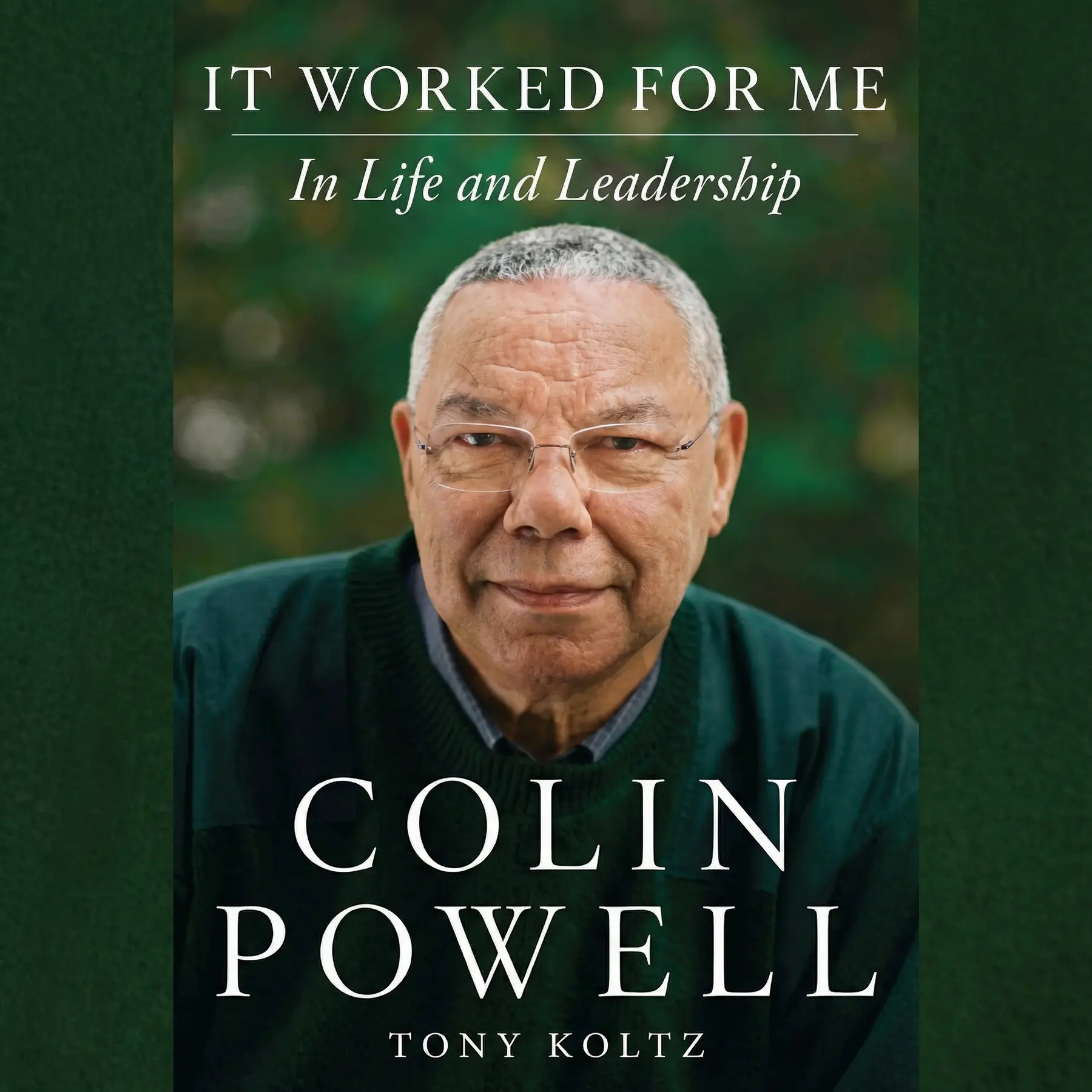
It Worked for Me: In Life and Leadership
Colin Powell's thirteen rules and working habits for leading people: stay calm and optimistic, own every decision, trust junior staff, welcome problems early, run better meetings and hand over a role cleanly.

Table of Content
1. Introduction
59 sec
Most people who end up leading others were promoted for being good at their own work. Then they find the job has changed under them. In It Worked for Me, written with Tony Koltz, Colin Powell answers with something anyone can practice: a set of habits. Stay optimistic, own your decisions, look after your people and be glad when they bring you problems. Powell spent 35 years as a soldier, rose to four-star general and later served as Secretary of State. The rules he led by first appeared in a 1989 magazine profile.
One idea holds his advice together. A leader gets results by being competent at the work and generous with the people doing it, and the two cannot be separated. What follows turns his thirteen rules and the practices behind them into steps you can try with your own team. They cover handling anger and mistakes, giving junior people real responsibility, running a morning check-in and leaving a role well.
2. Keep your team going when news is bad
1 min 34 sec
A leader’s mood spreads faster than any memo. Powell made confidence the center of his rules, yet he also set two firm limits on it, so that it never turns into empty cheerfulness.
3. Own every decision, including the wrong ones
1 min 31 sec
The hardest moment in leadership often comes after the decision, when it goes badly. Powell’s rules locate the trap in a place most people never look, and his remedy borrows its name from a shop.
4. Give your team a purpose they can repeat
1 min 20 sec
Hardworking teams can still pull in opposite directions. Powell puts one thing ahead of brains and common sense, and he pairs it with an instruction about where leaders should keep looking.
5. Trust junior people with the big moment
1 min 32 sec
Powell once gave a briefing for the president to two officers he had never met, and he skipped the rehearsal. What happened shows why trust is the cheapest investment a leader can make.
6. Equip people, then correct mistakes immediately
1 min 36 sec
Trusting people without supporting them is just a gamble. The Army has a habit for looking back after every operation, and its purpose is the opposite of what most performance reviews try to do.
7. Treat every problem brought to you as trust
1 min 23 sec
A stream of bad news landing on your desk can feel like a burden. Powell reads it as a good sign, and he names the moment when its absence should worry a leader far more.
8. Run meetings that respect everyone's time
1 min 29 sec
Meetings eat most of a leader’s day, yet Powell treats them as the bloodstream of an organization. He sorts them into three kinds, and one starts every morning without a single slide.
9. Train your successor, then leave for good
1 min 08 sec
Some leaders stay long after they are needed, holding on to titles and perks. Powell’s advice about leaving is blunt, and the work it requires begins years before the farewell.
10. Conclusion
1 min 06 sec
Powell’s rules can sound modest, even obvious, and that is part of their strength. None of them needs charisma. Each is a habit: calming down before you reply, letting two junior officers brief the president, asking for bad news early, starting the day with half an hour of plain talk. He describes leadership as two halves. One is being good at the job: a clear direction, honest reviews, well-run meetings and problems worked through to their side effects. The other is caring for people through kindness, trust and mutual respect, along with the tools and training they need to reach a shared goal. Without either half, the other stops working.
To start, pick the most important task coming up on your team. Give it to someone who knows the subject better than their rank suggests, give them what they need, and stay out of the way. And the next time someone brings you a problem, thank them before you say anything else. They have just told you they still believe you can help. For Powell, keeping that belief is the leader’s job.
About this book
What is this book about?
Many people are promoted for being good at their own work. Then they find that leading others asks for something different. Colin Powell spent 35 years as a soldier, rose to four-star general and later served as Secretary of State. In It Worked for Me, written with Tony Koltz, he sets out the habits that carried him through those jobs. At the center are his thirteen rules of leadership, first published in a 1989 magazine profile and later adopted well beyond the military. They ask leaders to stay optimistic, let anger pass, keep ego apart from position, take responsibility for decisions and share the credit. Around the rules, Powell describes the practical side of the job: setting a clear purpose, the Army's After-Action Review, the pottery barn rule of ownership, and building a team on kindness, trust and mutual respect. Readers get a working toolkit they can start using right away. It covers what to do when a problem lands on your desk, how to give junior people real responsibility, how to run a morning meeting, and how to train a successor and then step away for good.
Book Information
Who it's for
Newly promoted managers
New managers who were promoted for their own work and now have to lead others.
Team leads wanting routines
Team leads who want simple habits for handling mistakes, meetings and problems that arrive every day.
Thinking about succession
Experienced leaders thinking about how to grow a successor and when to step aside.
About the Author
Colin Powell
Colin Powell was born in New York City in 1937 to Jamaican immigrant parents and grew up in the South Bronx. Over 35 years as a soldier he rose to four-star general. He served as national security advisor, chaired the Joint Chiefs of Staff through the Gulf War and was Secretary of State from 2001 to 2005. He died in 2021. His co-author, Tony Koltz, is a former senior editor at Bantam Books who has co-written several books with General Anthony Zinni.
Ratings & Reviews
Ratings at a glance
What people think
Listeners find this book effortless to digest and packed with useful life lessons, calling it essential reading for everyone. It serves as a valuable reference for those in leadership roles, providing intriguing perspectives on management philosophy, and listeners appreciate the captivating anecdotes and polished writing. Furthermore, they consider the material both motivating and relevant, with one listener mentioning how it carries over into daily life.
Top reviews
Taweesak
Colin Powell’s wisdom is presented in a way that feels like a conversation with a mentor over coffee rather than a lecture from a world leader. I found his 'thirteen rules' to be surprisingly grounded, offering actionable advice that isn't just for those in uniform. While some of the military jargon can get a bit thick, the core messages about taking responsibility and trusting your team are universal. It is rare to find a book that manages to be both profoundly inspirational and intensely practical at the same time. The stories from his early days in the Bronx were particularly moving, showing that the man he became was built on a very human foundation. Every manager should keep a copy of this on their desk for those days when leadership feels impossible. It is a genuine must-read for anyone navigating a career in any field.
Show moreFah
Finally got around to this after seeing it on several 'must-read' lists, and it did not disappoint. Powell has a way of cutting through the nonsense to get to the heart of what makes an organization function properly. His anecdotes about the 'junk in the trunk' and how to handle problematic subordinates are both humorous and incredibly insightful. I've read plenty of leadership books that are full of abstract theories, but this one is refreshingly concrete and focused on results. It felt like a masterclass in diplomacy and human relations from someone who actually lived through the highest stakes imaginable. Not gonna lie, I found myself highlighting passages on nearly every single page to revisit later. This is exactly the kind of touchstone for leaders that we need in today's increasingly chaotic corporate landscape. Highly recommended.
Show moreManika
Ever wonder how a four-star general handles the day-to-day stress of the White House without losing his sanity? This book provides those answers through a series of engaging and often funny stories that highlight Powell's unique perspective on human nature. I particularly liked his advice on digital leadership and how to handle the influx of information in the modern age. It is inspirational to see how he maintained his core values while serving under multiple administrations with wildly different ideologies. The '13 Rules' are now taped to my monitor as a daily reminder of how to behave professionally. Frankly, it’s one of those rare books that actually makes you want to be a better person in your own career. I would recommend this to anyone from a new intern to a seasoned CEO. It is truly well-written content.
Show moreSayan
After hearing the General narrate the audiobook version, I found myself appreciating the nuances of his delivery even more than the text itself. He has a way of making high-level diplomacy feel like common sense, which is a rare talent in public service. The way he describes his relationship with his wife, Alma, adds a lovely personal touch that rounds out his public persona. It’s an engaging read that avoids the dry, academic tone often found in leadership manuals. You get the sense that he truly cares about the people who served under him at every level of his career. Personally, I found the chapter on his UN presentation to be honest, even if it was painful to revisit. This book is a must-read for anyone who values integrity and clear-headed decision-making in a complicated world.
Show moreRotjanee
As someone who has always been fascinated by modern history, this peek into the General's philosophy was quite rewarding. Powell doesn't shy away from the 'blot' on his record—the UN speech regarding Iraq—though he approaches it with the measured tone of a soldier rather than a politician. The chapter on February 5, 2003, offers a glimpse into the pressures he faced, even if it doesn’t provide the total closure some critics might want. Most of the book focuses on leadership basics that are easy to overlook in the rush of daily business. His emphasis on small details and looking after your people resonated with me deeply. It’s a well-written series of vignettes that remind us that character is the most important tool in any leader’s kit. This is a very solid addition to his legacy.
Show moreChanpen
The tone is very folksy and approachable, which makes the heavier leadership concepts significantly easier to digest during a commute. Powell shares stories ranging from his early childhood to his time in the White House, all with a humility that is quite refreshing. He focuses heavily on the idea that success is a collective effort rather than an individual achievement. This isn't a dense political biography, but rather a guide for people who want to improve their daily interactions with others. To be fair, some of the advice is a little bit basic—things like 'check your ego at the door'—but sometimes we need those reminders. The writing is crisp and the chapters are short enough to read in small bursts. It serves as an excellent companion to his earlier autobiography and offers practical life lessons for everyday situations.
Show moreWatcharee
Truth is, this feels less like a traditional autobiography and more like a collection of hard-won life lessons from a seasoned veteran. I appreciated how Powell talked about his mistakes just as much as his successes, which gave the book an authentic feel. His 'Pottery Barn Rule'—you break it, you own it—is something I’ve started implementing with my own team at work. There are definitely moments where the military structure he describes feels a bit dated compared to modern flat organizations. Still, the underlying principles of trust, loyalty, and clear communication are absolutely timeless and applicable across any field. It is a quick read that packs a punch, provided you aren't looking for a detailed political exposé. I found it quite satisfying and easy to apply to my everyday life.
Show moreCharlotte
I wasn't sure what to expect from a political figure, but this was surprisingly human and relatable in its approach. Powell manages to distill decades of high-level experience into simple, effective strategies that anyone can use to improve their professional life. I especially enjoyed the stories about his love for cars, as they showed a side of him that felt very down-to-earth. While I agree with other reviewers that the military focus can be a bit heavy-handed, the leadership philosophy is solid. It’s well-written and moves at a brisk pace, never lingering too long on any one anecdote. Not every lesson will work for every person, but there is enough variety here that everyone will find something useful. It’s a great touchstone for those looking to lead with more empathy and clarity.
Show moreNutnicha
The military hierarchies he discusses don't always translate perfectly to my specific professional environment in higher education. Truth is, many of his insights rely on a chain of command that simply doesn't exist in the civilian world where collaboration and consensus are the primary drivers. I enjoyed the anecdotes about his time in the State Department, but I often found myself questioning how to apply his 'Pottery Barn Rule' to a non-combat situation. The writing style is undeniably easy to read and the general's voice comes through clearly in every chapter. However, the lack of a chronological structure made it difficult to follow the overall arc of his career development. It is a decent collection of essays, but it felt a bit too superficial for my taste. I wanted more depth than just folksy aphorisms.
Show moreAey
This book left me wanting so much more regarding his time as Secretary of State and the decisions surrounding the Iraq War. Look, I understand it’s intended to be a book about leadership lessons, but you can’t simply brush over such a massive historical moment with folksy aphorisms. The stories felt fragmented and the lack of a clear timeline made the reading experience quite confusing at times. I struggled to see how his military-centric advice would work for anyone who isn't operating in a strictly top-down hierarchy. It felt like a collection of stump speeches rather than a deeply reflective memoir that grapples with the complexity of his legacy. While he seems like a decent man, the content here is just too light to justify the praise it has received. I was bored for large stretches of it.
Show moreQuestions about this book
What are Colin Powell's 13 rules of leadership?
They grew out of a Parade magazine cover story about him, written after he took charge of Forces Command in 1989. They ask leaders to stay optimistic, get over anger quickly, keep ego separate from position, keep a can-do attitude that is still grounded in research, choose carefully and own the results, work around unfavorable facts, make the final call themselves, check small things, share credit, stay calm in chaos, set a clear purpose, push past doubters, and back optimism with training.
What is the pottery barn rule in It Worked for Me?
Powell sums it up as: if you break it, you own it. When you make a major decision, you accept all of its results, good or bad. The rule also applies when you take over a role. From your first day, your predecessor’s problems and commitments are yours, so blaming the past only wastes time you could spend dealing with them.
How does Colin Powell say leaders should handle problems?
He treats problems as a sign of trust, because people bring them only to leaders they believe can help. Ask your staff to report problems early and get the full picture. Then let them try a solution first, with some guidance from you. Finally, help them test each option for new problems it might create, and do not let wishful thinking cloud that check.
Who should read It Worked for Me?
It suits new and experienced managers who want practical habits more than theory. It is especially useful for people leading a team for the first time, team leads who want to build trust and run better meetings, and senior people thinking about succession. The ideas come from Powell’s career as a general and as Secretary of State, but they fit any workplace.
How can I apply Colin Powell's leadership advice at work?
Start small. Hold a 30-minute morning check-in with no slides and nobody required to speak. Give an important task to a junior colleague who knows the subject, and give them the tools to do it well. After each project, run a short After-Action Review that looks for lessons, not grades. When you make a mistake, own it openly and fix it.
Readers also enjoyed


A Year with Peter Drucker: 52 Weeks of Coaching for Leadership Effectiveness
Joseph A. Maciariello



Acting with Power: Why We Are More Powerful Than We Believe
Deborah Gruenfeld

All In: How Great Leaders Build Unstoppable Teams
Mike Michalowicz



7 Powers: The Foundations of Business Strategy
Hamilton Helmer
AUDIO SUMMARY AVAILABLE
Listen to It Worked for Me in 15 minutes
Get the key ideas from It Worked for Me by Colin Powell, plus 5,000+ more nonfiction titles.
- 5,000+ titles
- Listen as much as you want
- 7-day free trial
- Cancel anytime









