

12 min 08 sec
Available in: English
Irresistible Change: A Blueprint for Earning Buy-In and Breakout Success
By Phil Gilbert
Shows leaders how to win real buy-in for organizational change by treating it as a product teams choose, proving it with one team, branding it well, rewiring culture's systems and shielding the change team.
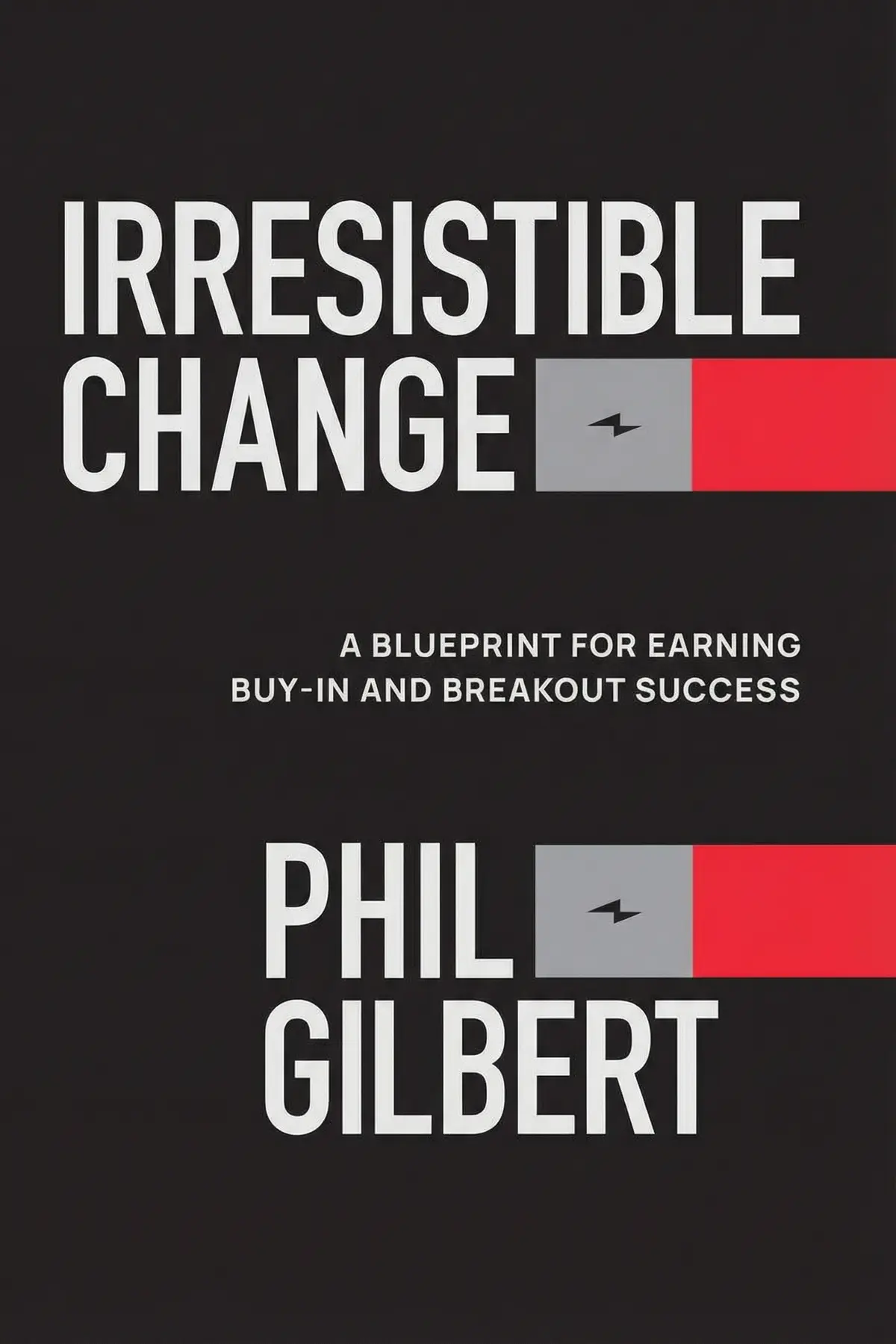
Table of Content
1. Introduction
1 min 05 sec
If you have watched a company-wide initiative fade within months, the idea itself was probably not the problem. In Irresistible Change, Phil Gilbert, a former start-up founder who was later asked to change how IBM’s teams worked, argues that people resist change when they distrust the process, the leaders or the likely result, and that orders from the top give them reasons to doubt all three.
His alternative is to treat change as a product your colleagues are free to buy or ignore. The whole argument rests on one claim: change spreads when it becomes more attractive and easier than staying stuck, and that has to be earned team by team.
Gilbert lays out how. Prove the approach with one fully backed team. Give it a name people want to be linked to. Rewrite the systems that pull everyone back to old habits, and shield the people doing the work. For anyone leading a team or a transformation, it is a way to win willing adopters instead of reluctant compliance.
2. Sell change like a product people choose
1 min 51 sec
Staff nod through the launch, learn the new vocabulary and then carry on exactly as before. Gilbert traces that pattern to one habit almost every leader has, and it sits in how the change is offered.
3. Prove it with one team before scaling
1 min 51 sec
Big kickoff events feel like progress, yet they tend to produce the opposite. A simple image about furniture explains what ambitious leaders get wrong, and where the first year of any transformation should really go.
4. Give your change a name teams want to join
2 min 01 sec
Branding sounds like decoration for an internal program. Gilbert argues the wrong label can doom a transformation on day one, and that the right one works best when you start turning people away.
5. Rewire the systems that pull people backward
2 min 00 sec
Even the best workshop in the world leaves most people working the old way half a year later. Gilbert explains what is pulling them back, and which unlikely specialists a change team needs to stop it.
6. Give your change team real air cover
2 min 01 sec
Finance, legal, HR and middle managers can stall a promising program without anyone acting in bad faith. Gilbert describes four defenses that determine whether a change team survives the forces working against it.
7. Conclusion
1 min 19 sec
Gilbert’s blueprint recasts the leader of change as something close to a product owner with very demanding customers. Every piece he describes, from the single chair to the leadership shell, exists to earn trust, because trust is what people hold back when change arrives as an order. Teams, in this view, are buyers, and they buy only when staying with a failing status quo starts to feel like the harder option.
That shifts where effort goes: away from announcements and training decks, toward one team’s real project, a name with no baggage, and the unglamorous work of rewriting promotion criteria and budget rules. It also makes refusal part of the job, whether that means turning away a team that would weaken the standard or declining to spread support thin.
If you are about to lead a change, start with one team you can back completely and judge it on business results. Before you scale, find the system that would drag those people back, perhaps a career ladder or an approval process, and enlist someone with the authority to change it. Then make sure a senior leader will stand beside the team when the antibodies arrive.
Forced change invites foot-dragging; chosen change travels from team to team on its own.
About this book
What is this book about?
Most organizational change fails, and Phil Gilbert thinks he knows why. Leaders announce initiatives, send staff to training and expect new behavior to follow. People respond with polite agreement and then drift back to old routines, because they never trusted the process, the leaders or the outcome in the first place. Gilbert, a former start-up founder who was later asked to change how IBM's teams worked, proposes treating change as a product that internal customers are free to accept or reject. That means proving the approach with one complete team before scaling, giving the program a neutral name that becomes a mark of quality, and guarding that quality by turning teams away. It also means admitting that training alone changes little. HR rules, promotion criteria, budgets and even office spaces have to be rewritten so the culture rewards the new way of working. Readers get a practical sequence for running a transformation, along with the protections a change team needs to survive: a sponsor who defends it, real resources, resilient people and a leadership shell that absorbs political pressure.
Book Information
Who it's for
Managers facing change fatigue
Managers and team leads asked to roll out a new way of working that staff are already tired of hearing about.
Scaling one team's method
Founders and operators scaling a method that worked in one team across a larger company.
Watching training fade
L&D and HR professionals who see training fade within months.
About the Author
Phil Gilbert
Phil Gilbert spent decades as a start-up entrepreneur before joining IBM, which acquired his third company in 2010. In 2012 he was asked to bring design thinking and agile methods into the way IBM's teams worked, an effort Harvard Business School wrote up as a case study and the documentary The Loop also tells. The New York Foundation for the Arts named him to its Hall of Fame in 2018, and Oklahoma made him a Creativity Ambassador in 2019. He works as an author, consultant, lecturer and board member in Austin, Texas.
Ratings & Reviews
Ratings at a glance
What people think
Listeners find the writing accessible and mentally stimulating, with one person observing that it is especially well-suited for middle and upper management. They value the strategies for execution, as one listener points to the systematic methodology and another mentions the advice on how to scale organizational shifts within a rigid environment.
Top reviews
Anthony
This book provides a masterclass in how to inject design thinking into an organization that has grown too rigid for its own good. Truth is, most 'change initiatives' are just corporate buzzwords, but Phil Gilbert shows the grit behind the actual transformation at IBM. I was particularly fascinated by the roles of 'Magic People' and 'Advocates'—these aren't just job descriptions; they are the lifeblood of any scaling effort. While the text is a bit heavy on IBM-specific history at times, the tactical frameworks for empowering teams are universal. If you are trying to move a mountain in a software-driven world, this is your lever. It’s a rollicking, thoughtful, and deeply instructive guide that proves culture can be redesigned if you treat it like a product.
Show moreOscar
Ever wonder how a massive, rigid tanker like IBM actually turns around? Irresistible Change is the roadmap. Phil Gilbert doesn’t just talk about the 'why' of change; he dives deep into the 'how' with a street-wise perspective that middle and upper managers will find incredibly refreshing. I loved the emphasis on treating change as a product that needs its own brand. It makes so much sense! The writing is straightforward and accessible, avoiding the usual fluff that plagues the business section of the bookstore. Gotta say, seeing how the design thinking concepts spread like a tsunami across various business units was both inspiring and highly practical. It’s a must-read for anyone facing the current AI transformation wave.
Show moreNim
Finally, a business book that treats change like a product rather than a chore. Phil Gilbert has a way of making complex cultural shifts feel attainable and, dare I say, irresistible. I’ve read my fair share of management theory, but this feels different because it’s rooted in a real-world, massive-scale success story. The concept of making teams the 'unit of change' instead of individuals changed my entire perspective on leadership. It’s contagious! The book is clearly written and provides an actionable game plan for anyone looking to foster a more collaborative team environment. It’s more than a success story; it’s a toolkit for the modern age of technology and service pivots.
Show moreChloe
Wow, I was genuinely surprised by how much heart is in these pages. Phil Gilbert’s devotion to his team and the process of design shines through every chapter. It’s not just about bottom lines; it’s about making employees feel seen and empowered. I particularly enjoyed the journey of his friend accepting a massive role without knowing exactly how to do it—it felt very human and relatable. The book is an incredible ride through a pivotal moment in tech history. It’s instructive without being preachy and analytical without being cold. For anyone who thinks corporate culture is impossible to change, this book is the evidence you need to keep fighting for better design standards.
Show moreSkylar
Look, if you're tired of hearing 'culture eats strategy' without a roadmap on how to fix it, buy this. Irresistible Change gives you the actual tactics. I’ve worked in several large companies where change initiatives died in the boardroom, and after reading this, I finally understand why. Phil Gilbert explains how to 'infect' change throughout a rigid structure by using champions and advocates. The writing is wise, street-wise, and avoids the usual terminology that makes your eyes glaze over. It’s a fantastic guide to the 'how' of implementing change at scale. Highly recommended for middle managers who are stuck between executive demands and team realities. This book will give you the tools to bridge that gap effectively.
Show moreVilaiporn
After hearing so much buzz about the 'IBM revival,' I wanted to see the blueprint. This book delivered. It’s a powerful account of how design thinking can transform even the most legacy-heavy organizations. What struck me most was the idea of 'Irresistible Change'—creating a shift so beneficial that people want to be part of it rather than being forced into it. The stellar results Phil achieved at IBM are admirable, but the coaching he offers the reader is the real prize. It’s a short, wise, and clearly written guide that feels especially relevant in today's era of rapid AI transformation. If you want your team to be more than just a cog in the machine, read this.
Show moreTang
Picked this up on a whim for my management team, and it’s already sparking discussions. The way Phil Gilbert frames change as a brand-building exercise is brilliant. Honestly, I didn't expect a book about IBM to be such a 'rollicking ride,' but the narrative style is very engaging. It’s an excellent resource for leaders who need to move away from disjointed approaches and toward unified, design-led solutions. The focus on 'Magic People' helped me identify the key players in my own organization who can help drive our next pivot. It’s a street-wise, practical, and deeply encouraging look at what is possible when you empower your people. Don't let the corporate title fool you; this is a human-first book.
Show moreTanawan
As someone who has spent two decades in software services, I found the historical context here fascinating, even if I disagreed with a few minor points on the 2005 PC business transition. The core of the book, however, is pure gold. Phil Gilbert captures the dynamism required to revive a legacy brand. The focus on 'empowered design thinking' isn’t just theory—it’s a structured change process that can be replicated in smaller companies too. My only gripe is that the middle chapters get a little dense with organizational charts, but the payoff in the final sections is worth it. It’s an engaging and thought-provoking look at how to make change stick when everyone else is resisting it.
Show moreYuki
Not all heroes wear capes; some just figure out how to scale design thinking across global business units. I appreciated the historical deep dive into the Watson-Noyes legacy, as it set the stage for why the 2012 revival was so critical. Personally, I found the frameworks for scaling change to be the most valuable part of the book. It’s not just 'fluff'—it's a tactical manual. I did notice a couple of repetitive points in the latter half of the book, but the sheer volume of actionable advice makes it easy to overlook. It’s a great, accessible read for anyone in the software or services industry. Phil Gilbert’s passion for design as a collaborative problem-solving tool is truly contagious.
Show moreBunyarit
To be fair, the level of detail Phil Gilbert goes into is both a blessing and a curse. On one hand, you get an incredibly thorough look at the IBM transformation from 2012 onwards, which is useful for scholars of design. On the other hand, the pacing occasionally drags when discussing the minutiae of corporate management functions. I found the 'Magic People' sections very insightful, but I wish there were more examples outside of the IBM bubble. It’s a good read for engineers and high-level leaders, but it might feel a bit overwhelming for a casual reader looking for quick tips. That said, the wisdom regarding design thinking as a problem-solving approach is undeniable, even if the delivery is sometimes a bit dense for my taste.
Show moreQuestions about this book
What is the main idea of Irresistible Change by Phil Gilbert?
Gilbert argues that organizational change fails because leaders mandate it, and people resist mandates they do not trust. He proposes treating change as a product that teams choose to adopt. Leaders prove it with one fully supported team, give it a premium brand, rewrite the systems that reward old habits and protect the change team, until adopting the new way feels easier than staying with a failing status quo.
What does build one chair mean in Irresistible Change?
It is Gilbert’s image for proving an approach before scaling it. Instead of designing a whole house, you build one chair and check that it holds weight. In practice, you pick one project team, give it expert guidance and all the resources it needs, and measure whether results improve. He suggests a one-year runway for this stage, refined with feedback, before expanding to more teams.
Why does training alone fail to change an organization?
Gilbert says culture beats competence. Organizations are systems in which HR rules, promotion criteria, meeting habits, budgets and physical spaces all reinforce how work was done before. Even people who have been trained well drift back when those systems keep rewarding old behavior. His fix is a change team that pairs content specialists in the new method with systems specialists who can rewrite policies and career ladders.
How can I apply Irresistible Change to my own initiative?
Start with one team you can support completely, on real work, and judge it on business results. Give the program a neutral name instead of a worn-out word like agile, and turn away teams that would lower its standard. Check whether promotion and budget processes reward the new behavior. And secure a senior sponsor who will actively defend the team, not just praise it in speeches.
Who should read Irresistible Change?
It suits leaders responsible for a transformation, team leads introducing new methods, and HR or learning professionals tired of training that fades. Founders and operators trying to spread a practice beyond one team will find its sequence useful: prove it small, brand it, embed it in systems, then protect the people doing the work from organizational pushback.
Readers also enjoyed


A Year with Peter Drucker: 52 Weeks of Coaching for Leadership Effectiveness
Joseph A. Maciariello





Acting with Power: Why We Are More Powerful Than We Believe
Deborah Gruenfeld

All In: How Great Leaders Build Unstoppable Teams
Mike Michalowicz

AUDIO SUMMARY AVAILABLE
Listen to Irresistible Change in 15 minutes
Get the key ideas from Irresistible Change by Phil Gilbert, plus 5,000+ more nonfiction titles.
- 5,000+ titles
- Listen as much as you want
- 7-day free trial
- Cancel anytime









