Managing Oneself
Peter Drucker
 English
 ไทย
Shows that anyone can learn entrepreneurship by searching systematically for openings created by change, from surprises to population shifts, and then choosing a strategy that fits, guided by what customers actually want.
1 min 03 sec
Most people assume entrepreneurs are born with a rare temperament, and that without it, building something new is not for them. In Innovation and Entrepreneurship, management thinker Peter Drucker argues the opposite: there is no entrepreneur personality, and anyone can learn the work. What separates the winners is innovation, and that does not have to mean inventing a gadget. It can mean finding a better way to do something that already exists.
Drucker treats innovation as a discipline with two halves. First you search, on purpose, for places where change is opening a door, both inside your industry and outside it. Then you choose a strategy that suits the opening, always shaped by what customers want. Department stores, cataract surgery, container ships, vitamins, transistor radios and razors all make the case. By the end you will know where opportunities tend to hide and have several proven ways to claim one.
1 min 34 sec
Two big department stores watched the same strange trend appear on their sales floors. One treated it as a problem to fix, the other as something else entirely, and their fortunes split accordingly.
1 min 36 sec
A common eye operation worked almost perfectly, except for one risky moment. Shipping lines kept building faster vessels while their costs climbed. Both stories reveal openings that insiders had stopped noticing.
1 min 39 sec
Some of the biggest shifts in demand can be seen coming years ahead by anyone willing to count. Others take generations to ripen, and mistaking one kind for the other is costly.
1 min 35 sec
Established firms are often written off as too slow to create anything new. Drucker thinks size is not the obstacle, and a bank and a drug maker show what actually makes the difference.
1 min 34 sec
An Indian company licensed a European product it was sure customers would love, and almost nobody bought it. What happened next shows why founders should hold their first market idea loosely.
1 min 22 sec
A small dye maker bet everything, including borrowed money, on a field almost nobody cared about. The payoff lasted decades, but Drucker warns that this strategy forgives no mistakes at all.
1 min 35 sec
IBM abandoned its own computer project, and giant American firms passed on a new invention that cost just $25,000. Both choices handed someone else a market, for reasons that still repeat today.
1 min 34 sec
A cheap enzyme no rival bothers to copy, a wedding list for china, a razor sold at a loss. These businesses won without a giant market, and two of them never changed their product.
1 min 13 sec
Drucker’s book adds up to a claim about where entrepreneurs come from. They are made by method. They look for change systematically, whether it shows up in a store’s sales figures, a risky step in surgery, a generation reaching its teens or a rival’s pride, and then they choose a strategy that fits the opening. Beneath every example sits the point he presses hardest: success follows the customer, not the product. Macy’s lost because it defended what it meant to sell. Bloomingdale’s, Melville and the Indian engine maker won because they followed what people actually bought.
That suggests a few habits worth starting this week. Keep a running note of results that surprised you, and treat each one as a question to investigate. When a process frustrates everyone, find the single step that breaks most often. Before backing any idea, decide which strategy you are using, whether racing in first, imitating with a better fit, holding a niche or delivering old value in a new way, and be honest about whether you know the market well enough to aim.
For Drucker, innovation is a habit of looking where the change is already happening.
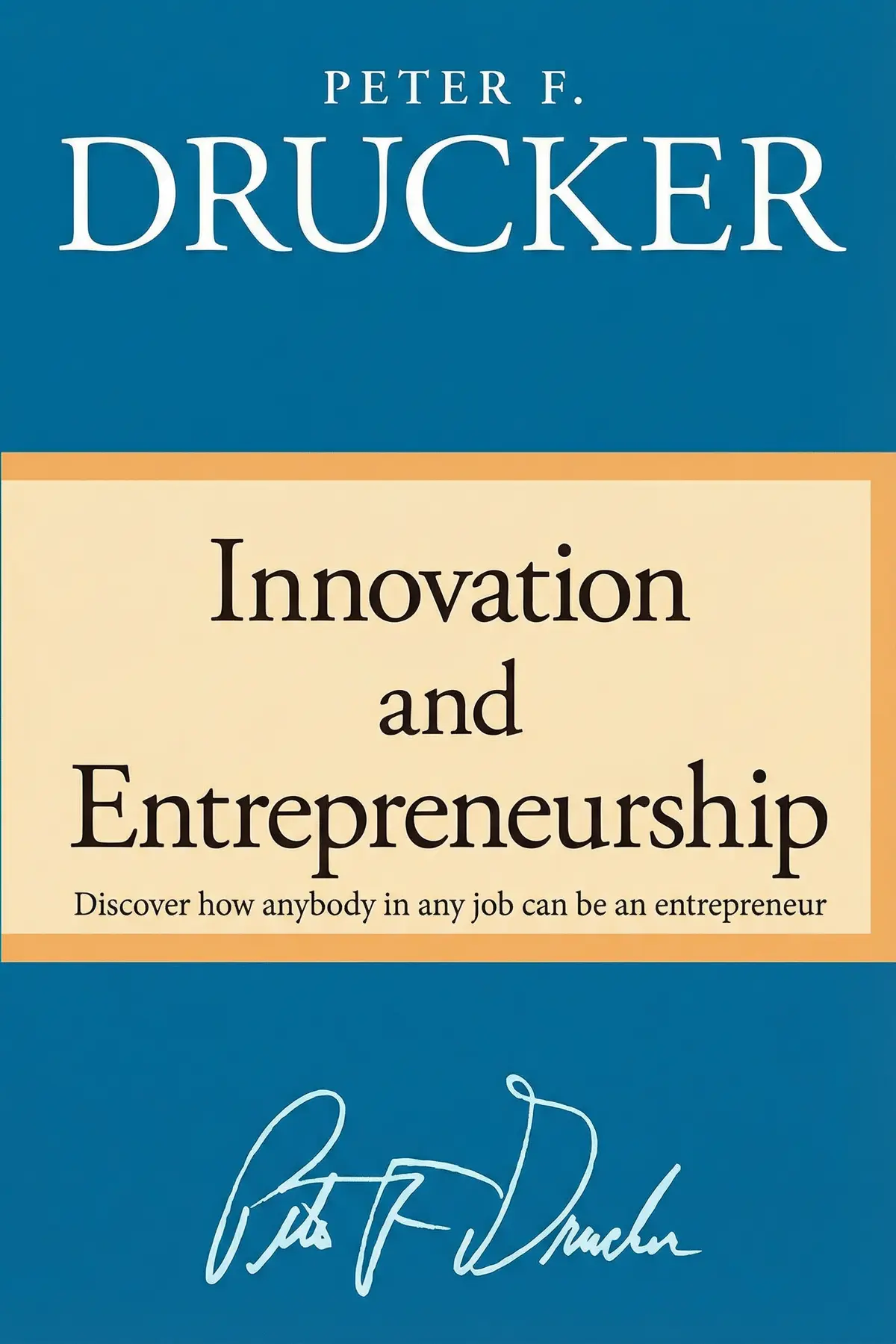
Many people believe entrepreneurs are born with a special temperament. Peter Drucker disagrees. In his view there is no entrepreneur personality, only a discipline that anyone can learn, and the heart of that discipline is innovation. Innovation does not have to mean a new invention. It can just as easily mean a better way of doing something that already exists. Drucker maps where openings come from: unexpected results, shifts in an industry's structure, weak links in a process, gaps between perception and reality, changes in population and slowly maturing knowledge. He then shows how established companies can organize to innovate, how a new venture should plan its market, money and management, and which strategies help an entrepreneur claim a market, from racing in first to imitating creatively, exploiting rivals' arrogance, holding a niche or creating new demand for an old product. The examples range from Macy's and Volvo to cataract surgery, container ships, Hoffmann-La Roche, IBM, Sony, Lenox china and Gillette razors. Readers get a working map of where opportunities hide and a reminder that success follows the customer.
Founders and would-be entrepreneurs who want a method for spotting real opportunities.
Managers inside established companies who need their teams to keep producing new ventures.
Professionals who doubt they have an entrepreneur's personality and want proof it can be learned.
Peter Drucker (1909 to 2005) was born near Vienna and worked in banking and journalism before earning a doctorate in international law. He settled in the United States in 1937, taught management at New York University from 1950 to 1971 and later held a professorship in social science and management at Claremont Graduate University. He coined the term knowledge worker in 1959 and received the Presidential Medal of Freedom in 2002.

Listeners view this title as an essential read for anyone launching new enterprises, commending its clear prose and approachable style. They value the book's lasting pertinence, with one listener observing that its teachings never age, and regard it as a definitive guide to the commercialization of original concepts. Listeners respect the depth of thought leadership provided, especially the way it encourages people to act on new possibilities. Views on the overall value are varied; some characterize it as an enduring masterpiece, whereas others feel that certain sections are now behind the times.
Ever wonder why some 'brilliant' ideas fail while simple ones take over the world? Drucker breaks this down with a clarity that few modern business gurus can match. He defines entrepreneurship not as a personality trait, but as a behavior that can be learned, which is such an empowering perspective. I particularly loved the section on 'creative imitation'—it’s a refreshing take on how to enter a market without having to be the first one through the door. While some of the corporate examples are dated, the underlying principles of looking for the 'unexpected success' or 'process needs' are timeless. This is a masterclass in seeing the world through an opportunistic lens. If you’re serious about commercializing new ideas, you cannot afford to skip this classic.
Show moreThe chapter on social innovation blew my mind. Most people equate innovation with high-tech software, but Drucker shows how things like the modern hospital or the university system were the real game-changers of their eras. He has this unique way of making you realize that the most successful innovations are often the ones that seem 'obvious' once they've been done. I loved his insistence that innovation must start small and focused—trying to be 'clever' or 'innovating for the future' is usually a recipe for disaster. This book encouraged me to stop looking for a 'miracle idea' and start looking for small incongruities in the market. It’s smart, deeply researched, and surprisingly practical. A must-read for anyone who thinks entrepreneurship is just about taking wild risks.
Show moreFinally got around to reading this, and I'm honestly annoyed I waited so long. Drucker basically predicted the 'shakeout' patterns we see in every new tech wave. His description of the 'window' of opportunity for knowledge-based industries explains exactly why so many venture-backed firms fail after the initial hype dies down. It’s not just about having the best technology; it’s about management, timing, and luck. I found his distinction between 'bright ideas' and 'systematic innovation' to be the most helpful part of the whole book. One is a lottery ticket, the other is a repeatable process. It’s a thick read, but it provides a mental model for business that is far superior to the 'move fast and break things' mantra.
Show moreDrucker manages to turn the chaotic world of entrepreneurship into a manageable, rational process. This book is a masterwork because it doesn't just tell you to be 'innovative'—it shows you exactly where to look for the opportunities that everyone else is ignoring. Whether it's changes in demographics or the 'unexpected failure' of a product, he provides a roadmap for the observant mind. To be fair, some sections on the 19th-century economy could have been trimmed, but they serve to prove that his principles are universal across time. I especially liked the 'Don'ts' section: don't try to be clever, don't diversify too early. It’s grounding advice for any dreamer. If you want to understand the DNA of progress, this is the book you start with.
Show moreThis book provides a remarkably structured approach to something most people think is just lightning in a bottle. Drucker argues that innovation is actually a systematic discipline, which was a huge eye-opener for me. The '7 sources of innovative opportunity' are still incredibly relevant today, even if the case studies about 1980s computer companies feel a bit like ancient history. Truth is, his analysis of demographics and market incongruities feels like it was written for the current tech landscape. I did find the middle section on 'entrepreneurial management' a bit dense, but the payoff is worth it if you’re looking to scale a business. It’s not just for startups; it’s for any organization that doesn't want to get left behind by the next big shift. Definitely a foundational text that requires some patience.
Show moreWow. I didn't expect a book written in 1985 to be this prophetic about our current economic shifts. Drucker’s take on 'knowledge-based innovation'—and why it’s the riskiest, most unpredictable path—really hit home for me. He explains that high-tech is often a gamble on receptivity, whereas social innovation often goes unnoticed despite its massive impact. Think about his example of the textbook making universal education possible; that’s the kind of insight that changes how you look at 'innovation' beyond just gadgets. The writing style is analytical and a bit stiff, but the logic is airtight. My only real gripe is that he can be a bit repetitive with his warnings about management. Still, it’s a required read for any founder who wants to understand the 'why' behind the 'what'.
Show moreAfter hearing so much about the 'Drucker way,' I finally dove into this one to help with my current role in corporate strategy. The most striking takeaway was the idea that an existing business must organize its entrepreneurial side separately from its daily operations. He’s right—the daily crisis will always swallow the new venture if they share the same space. I also appreciated his breakdown of 'entrepreneurial judo' and how to use a competitor’s arrogance against them. It’s a very tactical book once you get past the introductory theory. Look, it’s not a beach read, and the sentences can be long and winding, but the strategies for market dominance are pure gold. It’s a foundational piece of work that still holds its weight in a fast-paced world.
Show moreAs someone who has been in the startup world for a decade, I was surprised by how much I still had to learn from this 'old' book. Drucker’s focus on the customer is relentless. He argues that quality isn't what the supplier puts in, but what the customer gets out and is willing to pay for. It’s such a simple truth that is so often forgotten in the rush to build cool features. Personally, I found the section on 'fustest with the mostest' a bit too aggressive for my taste, but his analysis of the risks involved was spot on. The book is definitely wordy, and you have to ignore some of the outdated mentions of Japanese farmers and old computer labs, but the framework for identifying opportunity is flawless.
Show morePicked this up because it’s cited in almost every modern business book I’ve read lately. While the core philosophy is sound, I struggled with the sheer amount of antiquated references to 1950s light bulb manufacturing and 19th-century dynamos. It’s hard to stay engaged when you're wading through 200 pages of examples that feel completely disconnected from the digital age. Frankly, many of these concepts have been distilled into much more readable formats by modern authors. The seven sources of innovation are brilliant, don't get me wrong, but the delivery is quite dry and academic. It's a solid 3-star read for the historical context, but maybe just skim the first half if you're looking for immediate, actionable advice for a 2024 startup.
Show moreNot what I expected at all. I was looking for an inspiring guide to entrepreneurship, but what I got was a very dry, academic lecture on economic theory from the mid-80s. The writing is incredibly dense, and the author spends way too much time on historical examples that haven't been relevant for forty years. It felt like a chore to get through each chapter. Truth is, I think the 'classic' status of this book keeps it on reading lists more than its actual utility does. If you’re a history buff who wants to see where modern management theory started, go for it. But if you're actually trying to build a business today, there are much more concise and engaging resources available that don't require you to translate 1980s corporate-speak.
Show moreDrucker argues that there is no entrepreneur personality and that anyone can learn the discipline. Its core is innovation, which can mean a better way of doing things as well as an invention. Entrepreneurs search systematically for sources of change, such as unexpected results, weak links in processes, industry shifts, demographics and new knowledge, then choose a strategy that fits, always focused on customers rather than products.
Drucker divides them into inside and outside sources. Inside a business or industry, he points to the unexpected, changes in an industry’s structure, process needs or weak links, and incongruities between perception and reality. Outside, he points to demographic change and new knowledge. Examples include Bloomingdale’s appliance sales, Volvo’s global push, William Connor’s cataract enzyme, the container ship and Melville’s focus on teenage baby boomers.
He describes being first with full force, as Hoffmann-La Roche did with vitamins; hitting rivals where they are not looking, through creative imitation like IBM’s or entrepreneurial judo like Sony’s transistor radio; holding ecological niches such as a toll gate or specialty skill; and creating new demand for an existing product, as Lenox did with its bridal register and Gillette did with its pricing of razors and blades.
Yes, but only by design. Drucker says established firms need policies that welcome innovation and accept that every offering eventually ages, a structure that keeps new ventures separate with their own senior manager, and an appraisal system that checks results against expectations. He cites a bank that learned when new ventures should start paying off and a drug company that reviews every project yearly.
Start by tracking surprises in your results and treating them as signals. Map a process you own and find its weakest step. If you are launching something, stay open to markets you did not plan for and know your cash needs a year ahead. Before committing to an idea, pick a deliberate strategy and make sure you understand the market well enough to aim it.



Margaret Heffernan





Joseph A. Maciariello


AUDIO SUMMARY AVAILABLE
Get the key ideas from Innovation and Entrepreneurship by Peter Drucker, plus 5,000+ more nonfiction titles.