


14 min 20 sec
Available in: English
 ไทย
EnglishไทยI’m Ok, You’re Ok: The Pioneering and Bestselling Self-Help Guide
Shows why childhood feelings and inherited parental rules still steer your adult reactions. It also explains how to recognize your inner Child, Parent and Adult, so that your reasoning self can make the decisions.
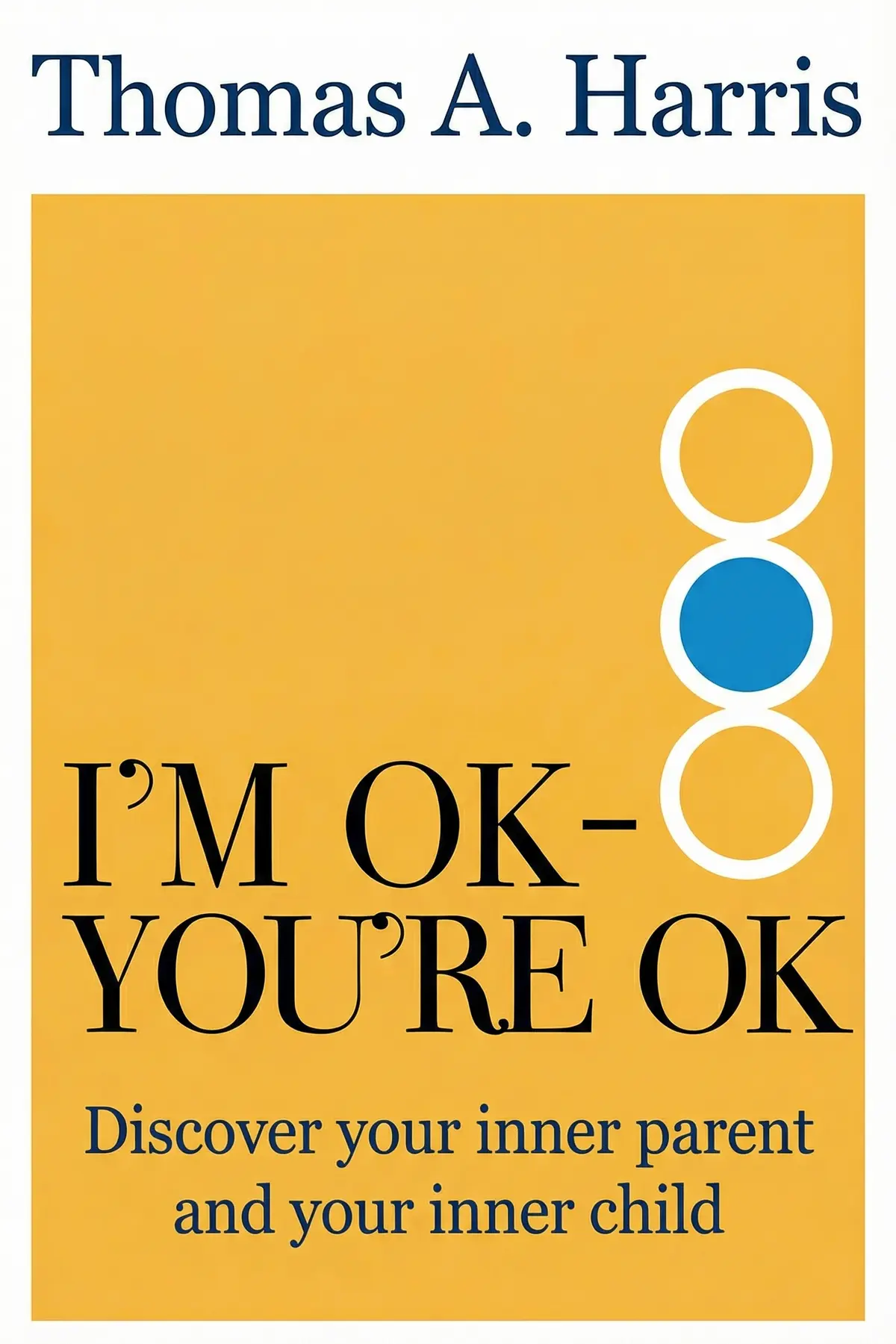
Table of Content
1. Introduction
1 min 02 sec
If a fight with your partner leaves you sounding like your father, or sinking into a panic you can’t explain, the cause may be decades old. In I’m Ok, You’re Ok, psychiatrist Thomas A. Harris argues that the brain stores past experiences along with their feelings, and that those recordings replay in the present whether we remember them or not. Building on the transactional analysis of psychologist Eric Berne, Harris describes three parts in every person: a Child shaped by early helplessness, a Parent built from the rules of authority figures, and an Adult that can think things through.
Harris’s message is hopeful. Everyone begins life with the quiet conviction that they are not okay and other people are. That position was learned, so it can be replaced, once you notice which voice is speaking and let the Adult decide. What you get is a way to catch an inherited reaction in the moment, read it on a face, and answer it with a choice of your own.
2. Trace a sudden mood back to its memory
1 min 36 sec
A brain surgeon with an electrode made patients feel old moments as if they were happening again. Ordinary life does something similar every day, and it explains why some feelings seem far too big for what triggered them.
3. Name the three voices behind your reactions
1 min 49 sec
A successful lawyer behaved like a whining little boy the moment he sat down for therapy. His psychologist decided this was no disorder at all, and the pattern he saw lives in every one of us.
4. Understand the birth trauma behind feeling not okay
1 min 44 sec
Almost nobody remembers their first two years, yet Harris believes that forgotten stretch decides how secure you feel today. A recurring dream about floating in space shows how deep those traces can run.
5. Read the face that gives each voice away
1 min 43 sec
A pat on the head can look kind, yet Harris treats it as one of the most telling gestures a person makes. Faces, hands and sighs reveal which part of someone is talking, including you.
6. Free your judgment from inherited rules and prejudice
1 min 57 sec
A man in the 1960s is handed a petition about housing and feels a wave of anxiety he can’t explain. His hesitation shows how rules from earlier generations can steer a decision that should be his own.
7. Spot the game when help keeps getting refused
1 min 40 sec
Someone asks for advice, then rejects every suggestion you offer until you give up. Harris argues that giving up was the point all along, and the hidden payoff explains a lot about scapegoats too.
8. Hand the final say to your Adult
1 min 38 sec
Years can pass on a career path that brings no satisfaction, held in place by a fear nobody names. Harris traces that fear to its source and shows how one harsh thought about yourself can be tested.
9. Conclusion
1 min 11 sec
The title of Harris’s book names a destination. Everyone sets out from the opposite corner, convinced from birth that they themselves fall short while everyone around them is fine. That belief made sense to a helpless infant fed and held by giants. It makes much less sense for an adult who still hears a parent’s stern tone in their own voice, or turns down every offer of help.
What Harris offers is a way to move. Old patterns can be dropped, and new, good experiences can build up beside the old recordings, until a different position takes hold: I’m okay, you’re okay. The second half matters too. An Adult in charge has less need to scapegoat others or to pat them on the head.
The practice is small. When a harsh thought about yourself shows up, ask which voice delivered it before you believe it. And make some room for the Child the Parent may have locked away, its laughter and its play, because the Adult Harris describes knows how to let that joy in.
The voices from childhood will keep talking. You get to decide which one answers.
About this book
What is this book about?
Most people have heard a parent's harsh words come out of their own mouth in the middle of an argument. Others have felt a panic far bigger than the moment called for. Psychiatrist Thomas A. Harris argues that these reactions are old recordings: the brain keeps past experiences together with the feelings attached to them, and everyday sounds, smells and conflicts can replay them. Building on psychologist Eric Berne's transactional analysis, Harris describes three parts in every person. The Child holds the feelings of our helpless early years. The Parent holds the rules and beliefs of authority figures. The Adult reasons, weighs the other two and finds sensible answers. Because birth and infancy leave us dependent, Harris says we all begin from the position that we are not okay and others are. The book shows how to spot each voice in speech and body language, how prejudice and fear contaminate clear thinking, and how the Child plays games for superiority and sympathy. Its promise is practical: once you notice which voice is talking, the Adult can take over and build a new position, I'm okay, you're okay.
Book Information
Who it's for
Arguing like a parent
People who hear a parent's words in their own mouth during arguments and want to stop.
Career chosen for approval
Professionals stuck on a career path chosen to please someone else.
Fears that feel old
Anyone whose harsh self-judgments or outsized anxieties feel older than the situation that triggered them.
About the Author
Thomas A. Harris
Thomas Anthony Harris (1910 to 1995) was a psychiatrist who worked for the United States Navy and later became a university professor. He founded an association for transactional analysis, the therapy method built on the ideas of psychologist Eric Berne that gives this book its framework. In 1985 he published a follow-up, Staying OK, written with his wife Amy Bjork Harris, a journalist and lecturer.
Ratings & Reviews
Ratings at a glance
What people think
Listeners find the material a superb resource for grasping psychology and human conduct, with one review noting the way it organizes daily relationship challenges using straightforward terminology. Additionally, the work is clear and accessible, with one listener pointing out its success in strengthening communication abilities. They also appreciate its suitability as a present and view it as a lasting reference.
Top reviews
Meen
Finally got around to this 70s classic after seeing it on so many 'must-read' lists. While some of the cultural references feel anchored in the Vietnam era, the core psychology remains remarkably relevant. Harris takes the dense concepts of Transactional Analysis and breaks them down into a Parent-Adult-Child model that anyone can grasp. It's an excellent source for understanding why we fall into repetitive, toxic patterns with the people we love. Truth is, I started seeing my own 'Child' reactions everywhere within the first fifty pages of reading. The writing is clear and simple, avoiding the heavy jargon that usually plagues this genre of self-help. Even if you aren't a psych major, this functions as a timeless reference for bettering your communication. It is a gift that keeps on giving to your mental health.
Show moreTeng
Picked this up on a whim after a friend recommended it for my recurring social anxiety. I wasn't expecting a book from the seventies to speak so directly to my modern-day struggles, but here we are. The realization that most of us are walking around in a 'not OK' state was incredibly liberating for me. Harris writes with a disarming engagement that makes you feel seen rather than just being studied. The way he explains how our 'Parent' tapes play in our heads is something I think about every day. It’s more than just a self-help book; it’s a manual for becoming a functional human being. Frankly, it’s a timeless reference that I plan on rereading whenever I feel myself slipping back into old habits. Truly a life-changing read.
Show moreChai
Ever wonder why you react the way you do when your boss or spouse hits a nerve? This book provides a fascinating framework for answering that specific question. By systematizing everyday issues of human relationships into simple language, Harris makes the internal workings of our minds feel manageable. I found the breakdown of the 'Not OK' positions particularly eye-opening for my own personal growth. Although some sections on religion and morality felt like a distraction, the core message about reaching the 'I'm OK, You're OK' state is life-changing. It really helps in enhancing communication skills during heated arguments with family members. Not gonna lie, I’ve already bought two extra copies to give as gifts to my siblings who struggle with social anxiety.
Show moreSofia
The chapter on the P-A-C system completely changed how I view my internal dialogue and my interactions with others. It's rare to find a book that takes complex psychiatric theories and turns them into something so practical for the average person. Harris does a great job of systematizing everyday issues, making it much easier to spot when someone is 'hooking' your Child. Some of the references to 1960s American counterculture are a bit jarring, but they don't detract from the psychological value. For anyone wanting to improve their interpersonal communication, this is a total goldmine. It is simple, effective, and offers deeply insightful looks into the human mind. Every household should have a copy on the shelf.
Show moreGabriel
Look, if you can get past the 1969 publication date, there is some serious gold in here for anyone struggling with relationships. I’ve read a lot of modern self-help, and most of it is just a watered-down version of what Harris wrote. The book is remarkably easy to read and understand, which is a testament to his skill in translating complex ideas. It’s helped me tremendously in enhancing my communication skills at work and at home. Sometimes the tone gets a little bit 'preachy' regarding older values, but the core psychological framework is absolutely solid. A classic for a reason, despite the outdated bits. You will likely find yourself checking your own ego states mid-conversation.
Show moreTee
I've been interested in Eric Berne for a while, and while Harris isn't quite as focused as 'Games People Play', he is digestible. This book acts as an excellent bridge for those who find academic texts too intimidating or dry. I love how it categorizes human behavior into four distinct modes, providing a roadmap for reaching emotional maturity. Personally, I found the discussion on the 'Adult' state to be the most helpful part of the entire book. It’s a great tool for anyone looking to break out of the cycle of ennui or boredom. While the writing style is a bit loose and meandering, the insights into the human mind are undeniable. It remains a staple of transactional analysis for a reason.
Show moreOrathai
Frankly, it's rare to find a psychology book that doesn't feel like a dense textbook, yet manages to offer such profound insights. Harris has a knack for systematizing everyday issues of human relationships using the P-A-C model. I found the advice on how to stay in the 'Adult' mode during conflict particularly useful for my marriage. The book feels like a timeless reference that you can dip back into whenever you need a quick perspective shift. My only gripe is that it can feel a bit repetitive in the middle chapters of the book. Overall, it is a very solid and helpful read for anyone curious about human behavior. I highly recommend it for the curious reader.
Show moreThida
As someone who appreciates psychology, I found the core concepts of Transactional Analysis fascinating but the delivery a bit dated. Harris is clearly passionate, yet his tendency to make blanket statements about 'moral decay' and international politics felt entirely unnecessary. However, the basic structure of the Parent, Adult, and Child personas is a brilliant way to visualize our ego states. It’s an easy read, which I appreciated, even if it feels like it belongs on a 1969 clearance rack. In my experience, the four modes of interaction are the most valuable takeaway from this classic text. It’s a decent introductory text, just take the 'global' theories with a grain of salt. The core logic remains sound even after fifty years.
Show moreNongnuch
To be fair, Harris writes in a very accessible way, but he tends to wander off into strange territory regarding international politics. I enjoyed the explanation of the four life positions and how they dictate our general happiness. But then the author starts talking about 'Parent' nations and 'Child' nations in the context of war, and it just feels silly. It’s a bit of a mixed bag for me as a reader. The psychological parts are a 5-star resource for understanding human behavior, but the social commentary is a 1-star distraction. I’d say it’s worth reading for the P-A-C theory alone, but feel free to skim the philosophical tangents. It is a product of its era for better or worse.
Show moreTang
This book suffers from being a product of its time and an author who doesn't know where his expertise ends. While the 'I’m OK – You’re OK' mantra sounds nice on a coffee mug, the actual text is a disorganized mess. Harris tries to apply P-A-C theory to everything from the Vietnam War to hippie culture, making himself look like a jackass. Stick to Eric Berne if you want actual science instead of errant speculation. To be fair, the four life positions are interesting, but they’re buried under far too much 1960s fluff. The state of marriage and international politics shouldn't be explained via simple nursery-room analogies. I finished this one so you won't have to waste your own precious time.
Show moreQuestions about this book
What is the main idea of I’m Ok, You’re Ok?
Thomas A. Harris argues that everyone begins life feeling that they are not okay while other people are, because birth is traumatic and babies depend heavily on their caregivers. Those early feelings, plus the rules of parents and other authority figures, are stored and replayed in adult life. By recognizing these old patterns and letting the rational Adult take over, people can reach a new position: I’m okay, you’re okay.
What are the Parent, Adult and Child in transactional analysis?
Psychologist Eric Berne, whose ideas Harris builds on, described three parts of every personality. The Child holds the experiences and feelings of our helpless early years. The Parent contains the beliefs and behaviors taken in from mothers, fathers and other figures of authority, while the Adult is the rational self, which weighs the other two and finds sensible solutions. Harris shows all three surfacing in one patient, a mother suffering from insomnia, as her tone of voice changed.
How can you tell which voice is speaking?
Harris points to body signals. The Parent often furrows its brow, purses its lips, points, sighs, crosses its arms and clicks its tongue, and a pat on the head marks it at its most condescending. The Child pouts, whines, rolls its eyes, bites its nails and bursts into tears or laughter. The Adult is recognized mostly by the absence of those extremes, with a relaxed, lively face and body.
How can I apply I’m Ok, You’re Ok in daily life?
Start with your negative thoughts. When you catch yourself thinking something like I am really lazy, ask whether it is a judgment handed down by a parent or authority figure, or the Child trying to keep you somewhere safe and familiar. Then let the Adult make a more realistic assessment. Harris applies the same test to bigger choices, such as a career picked to win a parent’s approval.
Who should read I’m Ok, You’re Ok?
It suits readers who notice themselves repeating their parents’ attitudes, who feel insecure without knowing why, or who keep rejecting help they asked for. People reconsidering a career chosen to please someone else will find Harris’s account of the Parent and Child especially useful. Those curious about transactional analysis get an accessible introduction to Eric Berne’s three-part model of personality.
Featured in
Readers also enjoyed


Acting with Power: Why We Are More Powerful Than We Believe
Deborah Gruenfeld




Age of Propaganda: The Everyday Use and Abuse of Persuasion
Anthony Pratkanis



A Guide to the Good Life: The Ancient Art of Stoic Joy
William B. Irvine
AUDIO SUMMARY AVAILABLE
Listen to I’m Ok, You’re Ok in 15 minutes
Get the key ideas from I’m Ok, You’re Ok by Thomas A. Harris, plus 5,000+ more nonfiction titles.
- 5,000+ titles
- Listen as much as you want
- 7-day free trial
- Cancel anytime









