

13 min 57 sec
Available in: English
If I Understood You, Would I Have This Look On My Face?: My Adventures in the Art and Science of Relating and Communicating
By Alan Alda
Actor Alan Alda shows how to make sure people actually understand you. His tools come from improv: naive questions, shared games, close reading of faces, plain stories and a careful balance of empathy and reason.
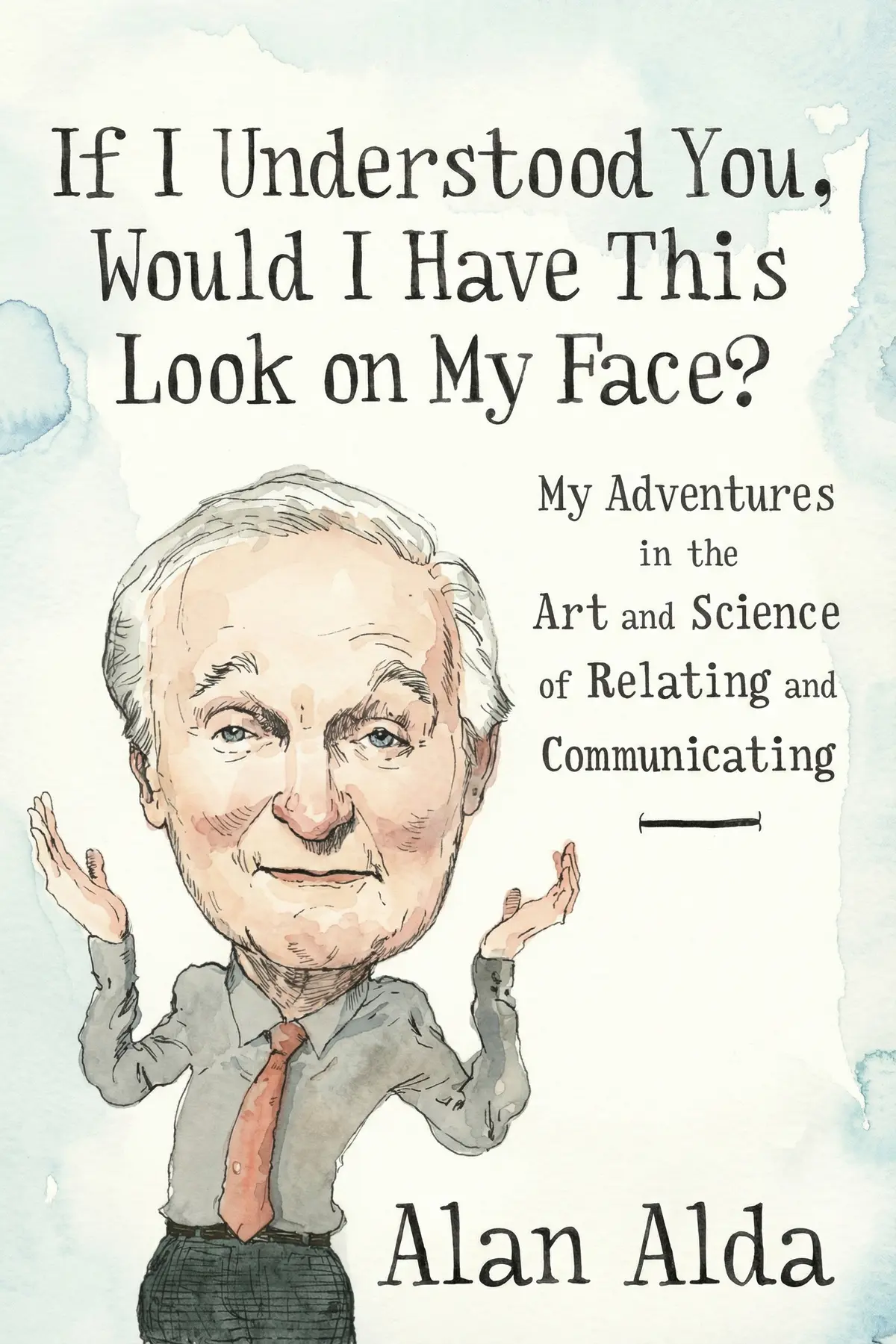
Table of Content
1. Introduction
1 min 06 sec
Most of us walk out of conversations sure we were understood, and often we were not. Award-winning actor Alan Alda learned the price of that gap in a dentist’s chair. In If I Understood You, Would I Have This Look On My Face?, he recalls a dentist muttering one word, tethering, just before an operation. Alda had no idea what it meant, yet he stayed silent rather than question the man holding the scalpel. The surgery was a rather experimental one, and afterward he could no longer smile the way he used to, a cruel outcome for someone who earns a living with his face.
Alda’s case is that good communication can be trained, and that the best training comes from the improv stage. Admit what you don’t know, put people at ease, feel what they feel while reasoning about what they know, and watch the signals words leave out. Each habit narrows the distance between what you say and what lands. The book hands you games, questions and one small eye-contact practice to try in your very next meeting.
2. Ask the naive question out loud
1 min 34 sec
Asking a basic question can feel like admitting you are out of your depth. Alda found that the opposite habit cost him his smile, while a broad, naive question drew an entertaining answer from an expert.
3. Warm up a group with a shared game
1 min 28 sec
A room full of nervous students had to give presentations to one another. What helped them most was not coaching on slides or posture, but a few minutes of playing something that did not exist.
4. Feel with people, then think about their view
1 min 44 sec
Our brains copy what we watch others do, which makes empathy almost automatic. Yet a simple scene with a cookie shows how easily we still forget that other people do not know what we know.
5. Read the faces and bodies around you
1 min 51 sec
Two scientists stood face to face and copied each other’s movements until neither was leading. The exercise looks odd, but it trains a skill most of us use badly every day without noticing.
6. Know when empathy helps and when it scares
1 min 50 sec
A therapist discovered her calm readings hid a patient’s serious anxiety, while a doctor’s open sympathy terrified someone with sore feet. Both cases point to the same skill, used in opposite directions.
7. Turn dry facts into a story people repeat
1 min 42 sec
A scientist made the thinnest glass ever, and the news spread because of some muck in a machine. Meanwhile, a perfectly accurate security warning can be ignored entirely. The difference lies in delivery.
8. Build on what the other person gives you
1 min 25 sec
A thief pulled a gun on a man, and the man facing him answered with an offer of help. The rule behind that response comes from comedy, and it works in far calmer rooms too.
9. Conclusion
1 min 17 sec
Alda’s dentist answered his question with a single word, mumbled impatiently. Alda did not ask what that word meant, and he let the procedure go ahead. Most failures to communicate look like that: nobody is careless on purpose, yet both people leave believing in an understanding that never existed. The book’s answer is to treat every exchange as a scene two people play together, where your job is to watch your partner as closely as an improviser does.
That becomes habits you can start this week. Ask the plain question when you don’t understand, especially when the person with the power is in a hurry. Before explaining anything, picture what your listener actually knows rather than what you know. Choose how much feeling to show, remembering that Riess had to learn to see hidden anxiety while the foot doctor’s open distress only caused fear. And when you speak to a group, try Alda’s small practice: pick one person and look straight at them as you finish a sentence. Eye contact, he notes, is known to lift empathy, and it can even give you a natural boost of oxytocin.
The look on someone’s face is information. Read it, and ask about it before anyone picks up the scalpel.
About this book
What is this book about?
Most people leave a conversation believing they were understood. Often they were not, and the cost can be high. Alan Alda learned this in a dentist's chair, when he let a single unexplained word pass and came out of an experimental procedure unable to smile properly. Drawing on his years as an improviser, actor and interviewer of scientists, Alda argues that communicating well is a skill anyone can train. His tools are simple and often playful. He asks broad, naive questions to draw experts out. He warms up nervous groups with a game of invisible instruments. He pairs the empathy our brains produce by mirroring others with a deliberate effort to picture what they actually know. He uses mirror exercises and charades to sharpen the reading of faces and bodies. The book also covers when to show empathy and when to hold it back, why a story about a lucky lab mistake spreads further than a technical briefing, and how the improv rule of Yes, and calmed a man facing a gun. Readers get exercises and habits they can try in their next meeting, presentation or difficult talk.
Book Information
Who it's for
Experts explaining to outsiders
Professionals and scientists who explain complex work to people outside their field.
Managers and trainers
Managers and trainers who run meetings, workshops or presentations with nervous or guarded people.
Unsure they were understood
Anyone who often leaves a conversation unsure whether they were really understood.
About the Author
Alan Alda
Alan Alda was born Alphonso Joseph D'Abruzzo in New York City in 1936, the son of actor Robert Alda. He played Hawkeye Pierce in a long-running television series from 1972 to 1983, writing and directing several episodes, and won a Primetime Emmy for The West Wing. After hosting the PBS series Scientific American Frontiers, he turned to helping scientists communicate more clearly, and he has hosted the podcast Clear+Vivid with Alan Alda.
Ratings & Reviews
Ratings at a glance

What people think
Listeners find this book to be an exceptional resource with helpful perspectives on improving communication, particularly via improvisational methods. They value the scientific research included, with one listener highlighting the great equilibrium between personal anecdotes and the functional use of improv activities. Listeners appreciate the narrative voice, wit, and deep storytelling, which ensure the work is both amusing and informative.
Top reviews
Rin
Ever wonder why people give you a blank stare when you’re explaining something you’re passionate about? Alan Alda has clearly spent years obsessing over this question, and the results are profound. This book isn't just for scientists; it’s for anyone who wants to build better relationships through the 'Theory of Mind.' I loved the description of the mirror exercise where you have to move in perfect sync with a partner. It sounds simple, but it requires a level of focus on the other person that most of us lack in daily conversation. The writing is conversational and witty, making it a very quick read. I’ve already started trying to 'read the mind in the eyes' during my morning meetings, and the difference is startling.
Show moreSamuel
Finally got around to reading this and I’m genuinely surprised by how much I learned about the art of relating. Alan Alda is something of an institution, and his transition into science advocacy is inspiring. This book is a levelheaded blend of entertainment and educational discourse. I loved the concept that you aren't really listening unless you are 'willing to be changed' by the person you are talking to. That is a high bar for communication! The stories are sublime, especially when he talks about his own failures to communicate with his wife or colleagues. It’s a vulnerable, smart, and necessary book for our currently toxic public discourse. I’ll be buying copies for my children’s teachers as a gift.
Show moreCaleb
Wow, who knew Hawkeye Pierce was such a science nerd? This book is absolutely fantastic. It balances anecdotal evidence with a genuine curiosity about how our brains process social cues. The way Alda explains 'Theory of Mind'—essentially the rational ability to understand what someone else is thinking—is clear and accessible. I’ve already started using his tip about silently naming the emotions I see on people’s faces during conversations. It really does make you feel like you’re reading minds. The writing is full of nuggets of wisdom and profound experience. Every single person on the planet should read this, especially in an era where we mostly just yell at each other through screens. This is a five-star read for sure.
Show moreSing
Alda’s narration in the audiobook version is what truly sells this entire experience. He brings a warmth and a distinctive rhythmic cadence that makes even the drier sections about neurobiology feel like an intimate fireside chat. I was particularly fascinated by his transition from a legendary actor on M*A*S*H to a dedicated science communicator. The way he describes using theatrical improv exercises to help scientists drop their jargon is brilliant. Frankly, it makes so much sense that we need to mirror others to truly understand them. My only gripe is that the middle section felt a bit repetitive, hammering home the 'empathy' point a few more times than necessary. However, the humor and the rich personal anecdotes kept me engaged until the very last chapter.
Show moreArt
After hearing about the Alan Alda Center for Communicating Science, I had high hopes for this, and it mostly delivered. The core idea—that communication happens in the recipient, not the speaker—is a total game-changer. Alda explores the bridge between emotional empathy and the rational 'Theory of Mind' with real grace. I particularly enjoyed the sections on how doctors can better communicate terminal diagnoses without being cold or overly technical. It’s a serious tome focused on a critical skill, yet it never feels heavy or academic. The truth is, we all have a bit of the 'curse of knowledge,' and Alda provides a fun, theatrical roadmap for how to break out of it. Highly recommended for professionals.
Show morePhimwan
The chapter on jargon and the 'Flame Challenge' was worth the price of the book alone. It is incredible how much we hide behind big words when we don't actually understand the person we are talking to. Alda writes with such a comfortable, inviting style that you can almost hear his voice on the page. I found his focus on 'listening with your eyes' to be a very helpful reminder to stop just waiting for my turn to speak. While some of the lab experiments he financed didn't yield the 'eureka' moments he hoped for, his honesty about those failures makes the book more authentic. It isn't a magic wand for social skills, but it’s a great starting point for being more present.
Show moreMonthon
As someone who works in a technical field, I found Alda’s insights into the 'curse of knowledge' to be incredibly relatable. We often think we are being clear when we are actually just drowning our audience in data. Alda uses his acting background to show that the emotional connection is the 'glue' that makes the facts stick. The book is short, conversational, and packed with interesting stories about the Alan Alda Center's work. To be fair, some of the science feels a bit 'pop-science,' but the practical applications of his improv-based techniques are solid. It really changed how I approach my presentations at work. If you want to be understood, you have to look at the face of the person you're talking to!
Show moreLucia
Picked this up because I’ve always been a fan of Alda’s curiosity, but I found the content to be a bit of a mixed bag. The personal stories from his time on 'Scientific American Frontiers' are definitely the highlight. They provide a wonderful context for why he cares so much about this topic. However, the advice itself is somewhat limited if you aren't able to join an improv troupe. He keeps coming back to 'active listening' and 'having empathy,' which are great concepts but hard to implement without the specific games he mentions. In my experience, the book could have been a long essay and achieved the same result. It's a charming read, but not quite the practical handbook I was expecting.
Show moreAhmed
Look, I appreciate the enthusiasm Alda brings to the table, but there's a lot of repetition here for a 200-page book. He spends a lot of time talking about how great improv is for empathy, which I don't doubt, but it's not a very accessible solution for the average person. I was hoping for more exercises I could do on my own rather than just reading about what scientists do in his workshops. Not gonna lie, I grew a bit weary of the anecdotal nature of the science towards the end. It’s a 'light' version of science writing that feels more like a memoir about a hobby. It’s perfectly readable and Alda is a joy, but it lacked the 'bite' I wanted from a serious look at communication.
Show moreNannapat
Disappointing for a book that purports to be about the science of communication. While I enjoy Alda's work, the absence of rigorous references is incredibly lazy for a nonfiction book making such bold claims. For instance, he asserts that empathy training for doctors significantly improves patient outcomes, yet the meta-analysis he alludes to is based on tiny sample sizes. Science is a method for understanding the universe, not just a collection of 'gee-whiz' factoids to be sprinkled into an acting memoir. To be fair, he's a master communicator, but this kind of mess illustrates why you must understand the scientific process before you can teach it. If you're looking for actual data, look elsewhere; if you want stories about improv, this is fine.
Show moreQuestions about this book
What is the main idea of If I Understood You, Would I Have This Look On My Face?
Alan Alda argues that communication often fails because we assume we have been understood. Using tools from improv, acting and interviewing, he shows how to close that gap: ask naive questions, put people at ease with shared activities, combine empathy with deliberate thought about what others know, read nonverbal signals, and deliver messages as clear stories without jargon.
What improv exercises does Alan Alda recommend?
Alda describes a group warm-up at the University of Southern California where students joined in one by one playing imaginary instruments to the first player’s rhythm. At Stony Brook University, he had scientists mirror each other’s movements, first with a leader, then with no leader, then while speaking. He also suggests charades and guessing two people’s relationship from body language and tone.
Does Alan Alda say empathy is always good in communication?
No. He argues that different people need different amounts. Psychiatrist Helen Riess learned to spot a patient’s hidden anxiety from small gestures, and the patient later lost 50 pounds. But when the doctor examining a friend of Alda’s slumped and put his head in his hands, that display of sympathy merely scared the patient.
How can I apply Alan Alda's communication advice at work?
Ask a basic question whenever someone uses a term you don’t know. Before explaining something, picture what your listener has actually seen and heard. Lead updates with the story behind a result, like David Muller’s accidental discovery of ultra-thin glass, and cut jargon. When speaking to a group, hold eye contact with one person as you finish each sentence.
What is the Yes, and technique in Alda's book?
Yes, and is an improv rule: accept what your partner offers, then add to it and see where it goes. Alda tells how his colleague Larry, faced with a young man holding a gun, stayed calm, acknowledged the young man’s situation and offered help. The thief put the gun down, and Larry found him a job the next day.
Featured in
Readers also enjoyed






AUDIO SUMMARY AVAILABLE
Listen to If I Understood You, Would I Have This Look On My Face? in 15 minutes
Get the key ideas from If I Understood You, Would I Have This Look On My Face? by Alan Alda, plus 5,000+ more nonfiction titles.
- 5,000+ titles
- Listen as much as you want
- 7-day free trial
- Cancel anytime









