

14 min 58 sec
Available in: English
Human History on Drugs: An Utterly Scandalous but Entirely Truthful Look at History Under the Influence
By Sam Kelly
A history of the drugs behind famous decisions and works, from the Oracle of Delphi's vapors to Freud's cocaine and Nixon's drinking, showing how altered minds steered prophecy, war, science, art and technology.
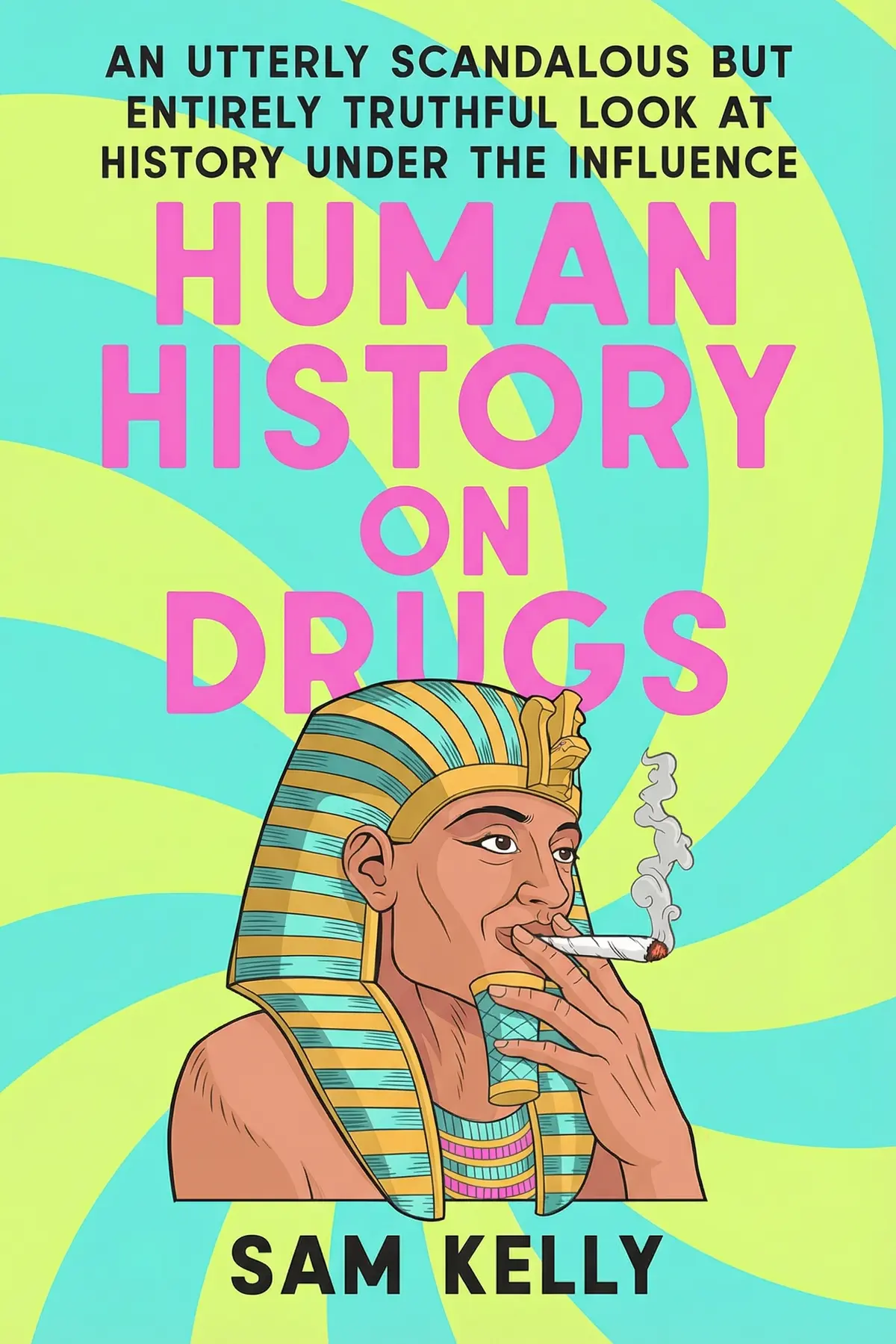
Table of Content
1. Introduction
1 min 04 sec
Most of us learned history as a parade of clear-headed rulers and thinkers making sober choices. In Human History on Drugs, Stanford-trained historian Sam Kelly argues that a large share of those choices were made under the influence. His opening witness is Queen Victoria, the very symbol of strict morals. Her physician prescribed cannabis tinctures for her period pains and a daily tonic of opium in wine, and she also used cocaine, mixing it into her wine or chewing gum. She later knighted the doctor.
For Kelly, Victoria is no oddity. From Egyptian tombs to Silicon Valley offices, altered minds have steered prophecies, wars, theories, poems and products, toward greatness and toward disaster. The stories that follow, from a Greek priestess breathing gas to a president giving nuclear orders after dark, give you a sharper way to read any official account: ask what condition the people at the controls were in, and who was standing by to catch their mistakes.
2. Read ancient prophecy and philosophy with fresh eyes
2 min 32 sec
A pharaoh’s tomb, a Greek temple and a Roman emperor’s morning routine all hide the same detail. It changes how we should read the gods’ answers and the calmest philosophy ever written.
3. See both faces of drugs in modern science
2 min 29 sec
Two famous episodes with mind-altering drugs involved Freud’s daily cocaine use and a psychology study at Harvard. One helped found a new science of the mind, the other left a young genius broken, and an astronomer shows what made the difference.
4. Build guardrails that outlast the person in charge
2 min 37 sec
A dictator on twenty injections a day, a president on a celebrity doctor’s syringe and another drinking through a war. What kept the worst from happening came from an unexpected direction.
5. Look at famous art through its makers' eyes
2 min 28 sec
Pipe fragments from an English garden, a poem lost to a knock at the door and a doctor’s prescription for a troubled painter. Three masterpieces look different once you know what their creators were taking.
6. Weigh Silicon Valley's psychedelic habit against history
2 min 32 sec
The discovery of the century, the first Apple computer and many Silicon Valley engineers share a reported ingredient. Before taking the latest productivity advice, it helps to know which stories are confirmed and which are only whispered.
7. Conclusion
1 min 16 sec
Kelly’s history works like a new pair of glasses. Put them on and familiar scenes change shape. A prophecy that sent Greek ships to Salamis came from gas seeping through a temple floor. A philosophy of self-mastery came from an emperor on twice-daily opium. The yellow of a famous night sky came from a medicine made from foxglove. Whether people chose the substance, needed it as treatment or had it forced on them in secret, Kelly’s verdict is that altered states have not simply ridden along with history. They have helped steer it, toward breakthroughs and toward catastrophe alike.
What to keep from that is practical. When you read about a great decision or a great work, ask what condition its maker was in, because the official record usually leaves it out. When an idea arrives in an unusual state of mind, treat it as Sagan did, as something to test once the effect wears off. And wherever one person’s judgment can cause harm that cannot be reversed, build the check before you need it, the way Kissinger and Schlesinger told commanders to confirm any order given after dark.
Sometimes the person who saved the day was not the one in charge but the sober one quietly standing beside them.
About this book
What is this book about?
School history tends to show leaders, scientists and artists as clear-headed people making sober choices. Historian Sam Kelly argues that this picture leaves out something important: many of them were drunk, high or medicated when they did the things we remember them for. Kelly moves from ancient Egypt and Greece to Silicon Valley. He looks at cannabis in a pharaoh's mummy, a Greek oracle breathing gas from fault lines, and a Stoic emperor taking opium twice a day. Then come Freud's cocaine years, the CIA's secret LSD experiments, Hitler's daily injections and Nixon's late-night nuclear orders, along with Shakespeare's pipes, Coleridge's opium dream and the yellow tint of Van Gogh's medicine. Each story ties a substance to a decision or a work that changed what came after. Readers get a new way to read any official account of a great moment. Ask what state the person at the controls was in, and who stood ready to catch their mistakes. The book also offers useful background for today's debates about psychedelics and microdosing at work.
Book Information
Who it's for
History buffs
History lovers who want the hidden, human side of famous rulers, scientists and artists.
Curious about microdosing
Professionals curious about microdosing who want the long view before they try it.
Managers and team leads
Managers and team leads interested in how organizations guard against a leader's impaired judgment.
About the Author
Sam Kelly
Sam Kelly is a historian who holds a history degree from Stanford University. He is known for bringing overlooked stories from the past back into view, above all in his TikTok videos, where his following has grown to nearly 100,000. Human History on Drugs applies that interest in neglected details to the substances behind famous rulers, scientists and artists.
Ratings & Reviews
Ratings at a glance

What people think
Listeners find the material both accessible and funny, with one listener noting that it animates history through intriguing background details. They also value the simple, approachable format.
Top reviews
Sirinat
Ever wonder how many of our world's most pivotal moments were fueled by something other than pure ambition? Sam Kelly delivers an incredibly punchy, entertaining look at the pharmaceutical habits of historical heavyweights. I loved how the chapters were bite-sized, making it the perfect "snackable" nonfiction for someone with a busy schedule. Some of the revelations about JFK and even Queen Victoria being a massive drug dealer were genuinely mind-blowing to read. While it doesn't dive into the heavy sociology of drug prohibition, it excels at being a fun, witty conversation starter. To be fair, it’s more of a "did you know" collection than a dense academic text, but that’s exactly why it works so well. The writing is snappy and modern, almost like a really high-quality long-form video essay. I finished it in two sittings because the pacing is just that good. If you want history that feels alive and a little bit scandalous, this is definitely the book for you.
Show moreMichael
Picked this up on a whim after seeing it mentioned online, and I honestly couldn't put it down. It is such a wild ride through the pharmaceutical history of the famous and infamous. I had no idea about the extent of JFK’s drug use or the chaotic stories surrounding people like Dock Ellis. Kelly’s writing is incredibly witty and he has this way of making history feel incredibly modern and relatable. The chapters are short, which makes it perfect for reading on my commute. Some might say it’s "shallow," but I think it’s just accessible. Not every history book needs to be a 600-page slog with footnotes on every sentence. This is entertaining, scandalous, and just plain fun. I particularly enjoyed the laudanum references—it’s wild to think about how different the world was just a century ago. Highly recommend if you want a non-fiction book that actually keeps your attention from start to finish.
Show moreWacharapol
Finally finished this during my weekend travels and it was exactly the kind of "brain candy" I needed. The book is essentially a highlight reel of history’s most famous drug users, and Kelly’s narrative voice is just fantastic. It’s funny, irreverent, and doesn't take itself too seriously, which is a breath of fresh air for the genre. I loved the variety of figures covered, from the Oracle of Delphi to Steve Jobs. It really puts into perspective how the "war on drugs" is such a recent and weirdly inconsistent phenomenon when you look at how doctors used to hand out addictive substances like Tic Tacs. The chapter on the CIA’s involvement with LSD was particularly chilling. Sure, it’s not a deep academic study, but it’s incredibly readable and brings history to life in a way that feels relevant. It’s quirky, offbeat, and definitely worth a read for anyone who likes their history with a side of scandal.
Show moreWipawan
I’ll admit I was skeptical at first, but this book is just excellent. Sam Kelly has managed to pull together a wealth of fascinating stories and present them in a way that feels balanced and fact-driven, even with the humorous tone. What I really loved was how tight and engaging the prose is; there’s no unnecessary fluff, just a smooth ride through the chemical history of civilization. The connections drawn between figures like Queen Victoria and the broader drug trade were particularly clever. It’s a perfect companion for a long trip or a lazy weekend when you want to learn something without feeling like you’re back in a classroom. The layout is great, the pacing is perfect, and the "snack-sized" chapters make it very hard to put down. Five stars for making history feel this vibrant and, frankly, this weird.
Show moreOmar
As a history enthusiast, I was pleasantly surprised by how readable and engaging this collection was. Sam Kelly takes a quirky, offbeat approach to figures we think we know, like Richard Nixon or Friedrich Nietzsche, and shows them through a chemical lens. It’s fascinating to see how common highly addictive substances were back in the day—doctors were basically handing out laudanum like it was candy. My favorite parts were the sections on writers like Aldous Huxley; it gave me a whole new perspective on their literary output. The tone is definitely casual and a bit witty, which helps the medicine go down when the subject matter gets dark. I do think the book leans heavily toward American history, and I would have loved to see more global figures included. However, for a quick dive into the hidden habits of the famous, it’s a total win. It’s the kind of book that makes you want to immediately text your friends with trivia.
Show moreSofia
Not what I expected, but in a good way. I thought this would be a dry textbook, but it’s actually a hilarious celebrity tell-all spanning centuries. Kelly does a great job of humanizing these monolithic historical figures by showing their flaws and dependencies. The chapter on Philip K. Dick seeing pink lasers was a highlight, though it was also quite sad to see how many brilliant minds were destroyed by their addictions. To be fair, the book does feel a bit like a collection of Cracked articles, which might not be everyone's cup of tea. It’s very snarky and the author’s personal opinions are front and center. Still, the research into MK-Ultra and the CIA’s unethical experiments was genuinely eye-opening, even if some of the connections felt a little speculative. It’s a smooth, well-paced read that manages to be both informative and slightly unhinged. 4 stars for keeping me entertained throughout.
Show morePrasarn
Look, if you're looking for a deep dive into the socio-economics of narcotics, move along. But if you want a book that tells you crazy stories about famous people being high during major historical events, this is it. It’s written in a very modern style—think "TikTok history"—with short, punchy chapters that get straight to the point. I found the section on Audie Murphy and the general "golden age" of doctors prescribing anything and everything to be fascinating. There’s a bit of snark that can be distracting, and some of the psychological diagnoses the author throws around feel a bit "nilly willy." However, the entertainment value is off the charts. It’s a quick, easy read that manages to be informative without being boring. I wish it were a bit longer and focused a little more on everyday people rather than just the "great men" of history, but overall it’s a very solid 4-star read.
Show moreKob
This book reads like a series of Reddit threads or a TikTok script, which is both its greatest strength and its most annoying flaw. On one hand, it’s very easy to get through and the short chapters mean you’re never bored. On the other hand, the depth is severely lacking for anyone who actually enjoys rigorous history. Kelly uses a lot of clinical terminology and pop psychology to explain complex behaviors, which feels a bit "unserious" at times. For example, the connections drawn between the CIA's LSD experiments and the Unabomber felt more like sensationalism than proven fact. Truth is, I enjoyed the fun facts about Philip K. Dick and Hitler, but I wanted more analysis on the broader societal impacts. It’s a great "waiting room" book where you can dip in and out, but don't expect it to change your worldview or offer deep insights into the human condition. It’s light, fluffy, and a bit too snarky for its own good.
Show moreNan
Sam Kelly has a very specific voice that will either charm you or drive you crazy. Personally, I found it a bit too reminiscent of a sophomore English essay at times. He injects so much of his own commentary into the history that it starts to feel less like a biography and more like a lecture on how you should feel about these people. The stories themselves are undeniably interesting—who doesn't want to hear about Hitler’s drug cocktail or Queen Victoria’s role in the drug trade? But the lack of deep analysis regarding the cultural or societal forces behind these trends left me wanting more. It’s a very bird's-eye view that prioritizes shock value over historical context. It’s a fine book for a beach read or a flight, but it’s not exactly a definitive text on the subject. If you like fast-paced, "unserious" nonfiction, you'll probably enjoy it more than I did.
Show moreWan
The chapter on Ted Kaczynski was the breaking point for me in an otherwise "okay" reading experience. Kelly pushes the narrative that the CIA basically created the Unabomber through LSD testing, but then admits there isn't actually hard evidence for it in this specific case. It felt very conspiracy-adjacent and lowered the credibility of the rest of the book for me. Frankly, the writing style is a bit grating—it tries way too hard to be edgy and "online," using buzzwords that don't quite fit the historical context. Most chapters are just a few paragraphs of drug trivia followed by generic biographical info you could find on Wikipedia. I expected a more meaningful analysis of drug culture, but instead, I got a collection of shallow anecdotes. If you want a serious look at how substances shaped civilization, this isn't it. It’s clearly aimed at a generation that wants fast facts without the burden of nuanced proof or academic rigor. Disappointing overall.
Show moreQuestions about this book
What is Human History on Drugs by Sam Kelly about?
Historian Sam Kelly argues that many defining moments in history happened under the influence of drugs. He traces cannabis in Ramses II’s mummy, ethylene gas at the Oracle of Delphi, Marcus Aurelius’s opium, Freud’s cocaine, Hitler’s injections, Nixon’s drinking, Coleridge’s opium dream and Steve Jobs’s LSD. His conclusion is that altered states have shaped history, toward both breakthrough and disaster.
Did Queen Victoria really take drugs, according to the book?
According to Kelly, Victoria’s personal physician prescribed cannabis tinctures to ease menstrual cramps, plus a daily tonic of opium dissolved in wine. Every day she also took cocaine, either in her wine or in her chewing gum. Kelly uses her as the opening example because she symbolized strict Victorian morals, and he notes that she even knighted the doctor who supplied her.
What does the book say about leaders and nuclear weapons?
Kelly describes John F. Kennedy taking daily injections of amphetamines and steroids from Max Jacobson during the Cuban Missile Crisis. He also writes that Richard Nixon gave nuclear orders while drunk, including during the 1973 Yom Kippur War. Henry Kissinger and James Schlesinger responded by telling commanders to ignore such commands after dark and to confirm them with one of the two men first.
Does the book say drugs make people more creative?
Kelly shows both outcomes. Carl Sagan credited marijuana with some of his best insights, which he then tested scientifically, and Steve Jobs called LSD one of his most important experiences. But Freud’s cocaine prescriptions caused psychosis and deaths, and Coleridge’s opium use became a forty-year addiction. Kelly presents altered states as a force that has shaped history, steering it toward both transcendence and catastrophe.
How can I apply the ideas in Human History on Drugs?
The book suggests a few habits of mind. When reading about any great decision or work, ask what state its maker was in. Treat ideas that come in an unusual state of mind as Sagan did, as hypotheses to test later. And where one person’s judgment can cause irreversible harm, add a check, like the confirmation rule Nixon’s staff created for nuclear orders.
Readers also enjoyed
Alexander Hamilton
Ron Chernow

Alexander the Great
Philip Freeman


A History of Iran: Empire of the Mind
Michael Axworthy
A History of the World in 6 Glasses
Tom Standage

A Long Way Gone: Memoirs of a Boy Soldier
Ishmael Beah


AUDIO SUMMARY AVAILABLE
Listen to Human History on Drugs in 15 minutes
Get the key ideas from Human History on Drugs by Sam Kelly, plus 5,000+ more nonfiction titles.
- 5,000+ titles
- Listen as much as you want
- 7-day free trial
- Cancel anytime









